
Car modification is more than just a hobby; it’s a passion for many car enthusiasts, bringing aesthetics and performance enhancements to life. However, it’s crucial to understand the legal landscape surrounding car modifications, particularly in China, where regulations are not only stringent but also essential for maintaining safety and compliance. This guide explores the regulations for exterior and interior modifications, ensuring hobbyist car modifiers, professional tuners, classic restorers, and global enthusiasts can navigate the legalities effectively. Each chapter outlines the essential aspects of what modifications are permitted, emphasizing safety and functionality while recognizing what remains illegal. By outlining these details, we equip you with the knowledge to personalize your vehicle without incurring penalties.
Color, Wraps, and the Blueprint of Legality: Navigating Exterior Car Modifications Under Modern Regulation
Exterior car modifications sit at the crossroads of personal expression and public safety. The chapter you’re about to read traverses a landscape where appearance and accountability are not opposed forces but partners in a well-regulated design discipline. As of 2025 in China, the regulatory framework treats many exterior changes not as free rein for vanity, but as actions that must be documented, inspected, and registered. The underlying logic is simple and practical: when you alter what a car looks like or how it occupies space on the road, you alter its official identity in the eyes of authorities, insurers, and manufacturers. The only sustainable way to pursue transformation is through a clear chain of documentation that travels from the workshop to the vehicle management office and beyond into the insurance file and the safety inspection record. In this sense, legality is less about stifling creativity and more about preserving a coherent road identity, so every vehicle on the road remains trackable, accountable, and safe for all users.
The most important rule in this ecosystem is registration, a formal acknowledgement that a modification has occurred and that the vehicle’s official records need updating. The rule is strict in its practicality: after any exterior change that affects appearance or structure—whether a color change, a wrap, or the installation of a new bumper—ownership must apply for a change registration within 10 days. This step is not a mere administrative ritual; it sits at the hinge between a vehicle’s legal identity and its ongoing safety checks. The process typically mirrors the regular safety inspection but adds the critical element of updated appearance and structural details. Submitting the modification for inspection, presenting the vehicle’s safety technical inspection certificate, completing an application form, and paying a fee to receive a new driving license photo with updated details—these elements bind the modification to the vehicle’s ongoing legal profile. The practical implication is straightforward: if you skip registration, you risk fines, impoundment, or denial of certain insurance claims after an collision or incident. The system’s coherence depends on that registration step to keep the vehicle’s record current across ownership changes, maintenance cycles, and risk assessments.
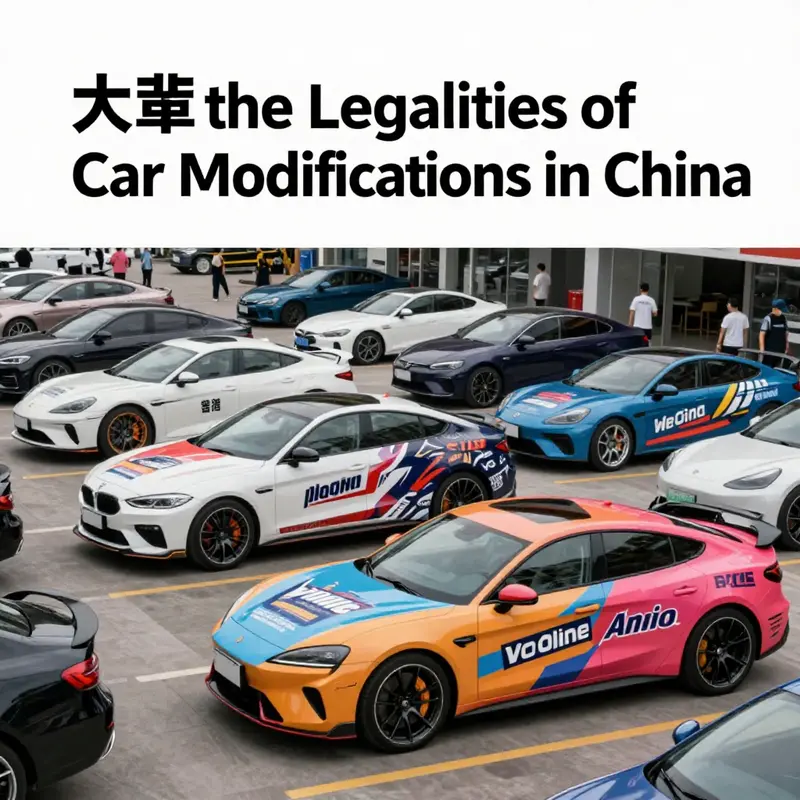
Color is the most emotionally charged dimension of exterior customization, and it also carries the clearest regulatory signal. A color change is permissible, but it is constrained by two critical boundaries. First, the new color or colors must cover no more than 30 percent of the total body surface area. If the plan involves more extensive color coverage, it triggers the need for formal filing and registration, often accompanied by a more thorough safety and identity review. The second boundary is the prohibition on colors that evoke the look of emergency services. The characteristic blues and certain reds associated with police or firefighting services are restricted precisely because they could mislead other road users in high-stress situations. This is not simply a question of taste; it is a public safety safeguard designed to avoid misidentification in traffic, at toll booths, or during emergency responses when rapid recognition matters. The color rule thus protects both the vehicle’s identity and the safety ecosystem that depends on predictable signaling from every car on the road. As a result, a thoughtful color project begins with a clear accounting of the surface area involved and ends with a documentation trail that records the exact hue, its coverage, and its registration status.
Wraps and two-tone paint, often deployed to realize dramatic design fantasies such as a floating roof or a wrapped silhouette, illustrate a similar path from aesthetics to accountability. Wraps and two-tone schemes are allowed, but completion must be followed by formal registration at the Vehicle Management Office. The registration step ensures that the wrap’s material, installation method, and its coverage are acknowledged in the official vehicle record. Without this step, the vehicle can appear on the books as the manufacture’s original specification while the physical car has already taken on a completely different visage. This mismatch can complicate insurance coverage, maintenance planning, and safety inspections. The requirement for post-application registration underscores the principle that the roadworthiness framework must always reflect the car’s updated identity, so that inspectors and insurers have a consistent reference point when assessing risk and responsibility. It also emphasizes the need for precise workmanship. A wrap that begins to peel or a poorly sealed edge can become a safety concern far sooner than a simple color repaint, thus the registration process sits alongside professional installation in signaling to authorities that the modification has been executed to a standard compatible with ongoing safety checks.
Decals and stickers, often used to express identity, branding, or attitude, also operate under a measured system. If decals cover up to 30 percent of the vehicle’s total surface area, they are allowed. But if the coverage surpasses that threshold, an official application for approval becomes necessary. The 30 percent limit is a practical boundary that preserves the vehicle’s visibility and recognizability, ensuring that decals don’t obscure critical signals or distort the vehicle’s silhouette in a way that could mislead pedestrians or other drivers. This boundary does not simply regulate aesthetics; it maintains a functional clarity on the road, where a car must remain easily identifiable at speed, in rain, or at night. The policy recognizes the power of decal expression and channels it through a formal process when it crosses an architectural boundary on the vehicle’s surface.
Wheels present perhaps the most visible area of modification and yet also the area with tight safety constraints. A wheel design change is permissible only if the dimensions—size, bolt pattern, and offset—remain identical to the original factory specifications. Altering tire size or other tire specifications is strictly prohibited. The rationale here is straightforward: wheel geometry directly influences braking response, steering accuracy, suspension geometry, and the vehicle’s clearance. Any deviation from the factory geometry can ripple through the dynamics of the car, potentially affecting safety in everyday driving and in emergency maneuvers. The rule seeks to preserve the fundamental geometry that the car was engineered to maintain, ensuring predictable handling across varying loads, speeds, and road conditions. Aesthetic enhancements, even when visually striking, must not compromise these foundational parameters:
In practice, these exterior rules reverberate with a broader safety culture that governs lighting, visibility, and structural integrity. Lighting is one of the most sensitive dimensions because it carries a dual function: signaling the vehicle’s intent to other road users and ensuring the driver’s own perception remains clear. In many jurisdictions, LED underglow or auxiliary lighting can be restricted by color and intensity. Blue and red lighting, in particular, are commonly banned or restricted precisely to prevent misidentification as emergency vehicles. The effect of an improperly configured lighting system can extend beyond cosmetic concerns and into real-world safety risks, including glare, distraction, and miscommunication at night or in bad weather. Any additional lighting must be designed, installed, and operated within the boundaries established by local authorities, with attention to color, brightness, and placement to avoid interference with standard headlights, taillights, and turn signals.
Windows and visibility introduce another critical constraint. Tinting is regulated to ensure adequate driver visibility for the occupants and to maintain the ability of other road users to see the driver’s signals. Front side windows and windshields face especially stringent minimum light transmission requirements. When considering tinting, drivers should think not only about privacy or style but about the ability to observe pedestrians, cyclists, and other vehicles in complex urban environments. The regulatory frame thus requires a measured approach to any tinting work: it should be performed by qualified technicians with documentation that verifies compliance with the relevant light transmission standards. The overarching aim is to prevent a car’s interior from becoming a shield that hides the driver’s intent or obscures critical signals in traffic, which could lead to unsafe driving conditions or enforcement actions.
Beyond the purely cosmetic, the law also guards against modifications that could fundamentally alter the vehicle’s safety profile. Exaggerated body kits or spoilers that significantly change the vehicle’s silhouette and aerodynamics may be scrutinized to ensure they do not obstruct visibility, interfere with pedestrian protection, or create aerodynamic instabilities that could elevate risk. In many cases, modifications that alter the structure or fundamental dimensions of the body are prohibited unless they are designed and certified to maintain safety margins. This is not an argument against indulging in sportier or more aggressive styling; rather, it is a reminder that safety and predictability on the road take precedence over stylistic daring. Any such modification should involve professional design assessment and should be implemented with careful documentation and, if required, formal approval from the relevant authorities.
Underpinning all exterior changes is the critical requirement for registration and documentation. This step is not a bureaucratic formality but a governance mechanism. It ensures that the modified vehicle remains within the safety, maintenance, and insurance ecosystems that rely on an accurate and up-to-date vehicle identity. The practical reality is that modifications must be scheduled and sequenced with inspections, documentation, and license updates in mind. The ten-day window is a concrete threshold that helps avoid the drift that occurs when changes accumulate without formal acknowledgment. Keeping a tidy, transparent trail of changes reduces the risk that modifications will be misrepresented during a claim, a sale, or a roadside check. It also helps the vehicle management offices keep pace with the evolving realities of modern car design, where the line between customization and conformity is increasingly nuanced but always trackable through proper records.
Regional variations exist, and the general pattern is mirrored in adjacent regulatory environments. For example, in Hong Kong, the Road Traffic Ordinance and related regulations reflect a similar emphasis on safety, signal integrity, and visibility. In practice, this means that while the core principles may be universal—preserve safety margins, maintain clarity of signals, and document changes—the exact thresholds, testing standards, and procedural steps may differ by jurisdiction. The Hong Kong framework demonstrates that even in high-density urban settings with mature safety regimes, the governance of exterior modifications remains anchored in a combination of performance verification and documentation, with inspections designed to ensure that modifications do not compromise pedestrian protection, visibility, or the vehicle’s role on the road. This cross-jurisdictional perspective reinforces a practical takeaway: before embarking on modifications, consult the local authority and, if applicable, coordinate with your insurer to avoid surprises in coverage or claims processing.
For readers seeking a broader framework beyond a single jurisdiction, a consolidated resource tracing what counts as legal modifications across different contexts can be illuminating. It helps drivers understand where personal expression can flourish within a safety-first system and how to navigate the often delicate balance between design ambition and regulatory compliance. The central message remains consistent: if you want to push the envelope in exterior design, you must integrate documentation, inspection, and formal approval into your plan from the outset. Creativity and compliance are not mutually exclusive; they are coauthors of a stable, safe, and insured ownership experience. A practical starting point is to review a guide focused on legal car modifications and to reflect on how the thresholds—such as coverage area, color restrictions, and the need for post-modification registration—shape what is possible and what requires extra steps and clearance. See more in this guide: Legal car modifications.
In closing, the real measure of success for exterior customization is not the audacity of a change but the integrity of the process that follows it. A well-executed modification respects the car’s engineered safety envelope, maintains the clarity of signals on the road, preserves the driver’s visibility and control, and, crucially, remains auditable through registration and documentation. This approach secures not only compliance but the durability of personal expression across the lifetime of the vehicle. The world of car customization is dynamic, and the rules will continue to evolve as technologies advance and as road-safety science refines our understanding of how aesthetic changes can influence behavior and risk. Staying informed, working with qualified professionals, and maintaining meticulous records will ensure that your ride stays both stylish and compliant, ride after ride, mile after mile.
External resources for reference and ongoing learning are essential. For readers who want to explore official guidance and up-to-date standards, official agencies provide updated regulations and guidelines that can help navigate the nuances of modifications in specific regions. The interplay between appearance and safety is persistent, and the more you understand it, the more confidently you can pursue tasteful, lawful expressions of personal style. In this spirit of informed design, the next chapters explore interior modifications and performance-oriented changes that remain within the safeguards established by the road authorities and the insurance ecosystem, ensuring your ride remains not only stylish but consistently compliant as well. External resource: Hong Kong Transport Department – Vehicle Modifications
Inside the Cabin, Under the Law: The Interior Modifications Framework for Chinese Vehicles

Interior work often feels like a gentler form of customization. Seats, fabrics, sound, and ambience can reflect personal taste without touching the chassis. Yet in China, interior modifications sit under a precise legal ceiling. The backbone is Article 16 of the Road Traffic Safety Law, which forbids any entity or individual from assembling motor vehicles or arbitrarily altering the registered structure, construction, or characteristics. That rule is not about stifling personal expression; it is about ensuring the vehicle’s safety profile, the accuracy of its registration, and the integrity of its safety systems during inspection and in the event of a crash.
When people think about what can be changed inside a car, separating safety-critical elements from non-structural comforts helps. The law places the strictest guardrails around safety and structural integrity. Any interior modification that could undermine crash protection, disrupt the functioning of airbags, or alter the vehicle’s fundamental safety design risks illegal status. This is not a blanket ban on all interior changes; it is a careful balance between personalizing space and preserving a vehicle’s essential safety characteristics. The aim is to allow some creativity in the cabin while ensuring the car remains a predictable and safe tool for both the driver and passengers.
Seat configuration sits at the heart of that balance. The number of seats listed on the vehicle’s registration certificate, together with the vehicle type and its passenger capacity, must remain unchanged. Permanently removing seats or retrofitting non-original seating that would alter the vehicle’s classification is illegal. There are nuanced possibilities, however. Temporary, non-invasive adaptations like foldable seating or bed-conversion configurations can be acceptable in some cases, provided they do not permanently alter the vehicle’s safety architecture and are designed to be reversible and compliant with official procedures. In practice, what matters is not the cosmetic appearance of an altered cabin but whether the change would require new safety testing, affect occupant protection ratings, or change the vehicle’s regulatory identity.
Non-structural, cosmetic, or comfort-oriented interior improvements glide along a safer path. Replacing upholstery with different materials—such as leather or high-quality synthetics—falls within permissible territory if it does not affect the vehicle’s safety systems or modify its critical components. The same logic applies to decorative dashboards, panel inserts, and small hangings, as long as they do not obstruct visibility, airbags, or emergency controls. Soundproofing, carpeting, or insulation installed for comfort is usually allowed when the materials are non-combustible and do not interfere with sensors or cables that course through the cabin. The guiding principle is clear: changes should be reversible, maintainable, and practically invisible to the safety checks that govern roadworthiness.
Electrical and operational systems sit at the edge of what is permissible in the interior domain. The interior realm includes wiring, sensors, and power management, and modifications here demand heightened caution. If a modification could overload circuits, shift the layout of critical cabling, or disrupt safety devices, it is unlikely to be considered legal. Alterations to the vehicle’s electrical architecture must not compromise the reliability of essential systems, including those that support airbags, instrumentation, and engine management, and they should be designed and implemented by qualified professionals who understand the vehicle’s overall safety framework. Likewise, changes that affect fuel lines, ignition timing, or other core mechanical or safety-critical pathways are outside the permissible envelope for interior work.
Airbags and safety systems deserve special emphasis. The airbag network is a central pillar of modern protection, and any interior modification that compromises deployment timing, sensor placement, wiring integrity, or the visibility of airbag modules risks falling outside legal bounds. If a modification obstructs sensor access or interferes with how the system communicates with other safety components, authorities will treat it as unsafe. The bottom line is simple: safety-critical components must remain intact and fully functional after interior work, with no additional risks introduced by the modification. In practice, the safest interior projects respect the original design language of the car and keep access to safety devices clear and unobstructed.
Beyond safety, there is a procedural dimension that governs interior changes when they extend beyond simple cosmetic upgrades. The broader rule is compliance through proper channels. If you undertake any interior alterations that impact the vehicle’s appearance or its structural integrity, you should submit an application for change registration with your local Vehicle Management Office within ten days of completing the modification. The process is designed to revalidate the vehicle’s identity and safety status in light of the new configuration. The typical steps are straightforward but meticulous: bring the car in for a safety-oriented inspection, present the vehicle’s safety technical inspection certificate, fill out the registration change form, and pay a fee to receive an updated driving license and registration details. The goal is to ensure that the vehicle’s record reflects its current form and capabilities, enabling authorities to confirm that the modification does not undermine safety standards.
The practical consequence of bypassing this process is significant. Authorities can impose fines, impound the vehicle, or deny insurance claims if the vehicle’s post-modification state does not match its official records or if the alteration is not disclosed. The consequences are not merely bureaucratic; they touch everyday realities like insurance coverage, road-worthiness, and the vehicle’s eligibility for legitimate use on public roads. The emphasis is on accountability: the interior is personal, but the vehicle’s official identity must stay aligned with its safety standards and regulatory status. In this light, interior modifications become a test of foresight and diligence, rather than a spur-of-the-moment act of customization.
For readers planning interior changes, a disciplined, safety-first approach pays dividends. Start by clarifying the scope of the modification. If the goal is enhanced comfort—upholstery, seating materials, or non-invasive cabin refinements—focus on changes that preserve the original layout, the seat count, and the integrity of safety features. Use materials that meet fire resistance and electrical safety standards, and keep the original components accessible for inspection. When upgrades involve the electrical system, consult a qualified technician who understands the vehicle’s architecture and the regulatory constraints. Document everything: receipts for materials, certifications for non-combustible insulation, and records of where and how the work was performed. This level of documentation can streamline the inspection process and reduce the risk of late-stage disputes about the modification’s legality. If an interior change touches the vehicle’s aesthetics in a way that could be interpreted as altering its identity, it becomes even more prudent to verify that the work aligns with the registration profile and the safety expectations of the national standards.
It is also prudent to consider the long arc of the vehicle’s lifecycle. Interior changes that are reversible are often favored precisely because they minimize risk during inspection, resale, and insurance considerations. If you anticipate selling the car, keep the modifications reversible and retain original parts where possible. This preserves options and reduces the friction of reversion should the new owner prefer standard configurations. In many cases, working with certified or credentialed professionals who understand the local rules and the inspection standards can remove ambiguity and ensure the work remains compliant. The objective is not to chase a look at any cost; it is to achieve a balanced outcome where comfort, aesthetics, and personal expression coexist with safety, legality, and the ability to pass inspection without friction.
For readers who want to situate interior decisions within the broader legal landscape, a broader discussion exists about the overall permissibility of modifications. See the discussion on legal car modifications for context and related considerations. Legal Car Modifications.
Finally, it is important to anchor interior modification practices to the national baseline evidenced in regulatory texts. The foundational reference is China’s Road Traffic Safety Law, including revisions through 2021. The law places the integrity of the vehicle’s registered structure and its safety apparatus above vanity or convenience, framing interior changes as legitimate so long as they do not undermine safety, do not alter registration, and comply with inspection standards. The most current, official articulation of these constraints resides on the government portal. For those seeking primary legal sources, the official Road Traffic Safety Law text and related rules are accessible at the national government site: https://www.gov.cn/zhengce/zhengceku/2021-04/29/content_5608476.htm.
Safety Boundaries in Motion: Functional Modifications, Standards, and Legal Risk
When car owners imagine personalizing their vehicles, the impulse often centers on aesthetics, performance, or comfort. Yet every modification that touches a vehicle’s safety-critical systems or its fundamental attributes—even if wrapped in fashion or convenience—enters a realm where science, regulation, and liability converge. The modern road car is not merely a metal shell with wheels; it is a complex, interdependent system whose safety depends on a precise balance of hardware, software, and human oversight. Functional modifications—those that alter how a system behaves rather than just how it looks—carry a responsibility that extends far beyond a receipt and a warranty. They implicate standards, risk management, and the legal environment in which manufacturers, service professionals, and drivers operate. This chapter anchors that reality in the framework of functional safety and governance, with a view toward the contemporary regulatory landscape in which many jurisdictions, including China’s evolving regime, insist on rigorous discipline around change management, documentation, and post-modification accountability.
At the heart of safe modification is a disciplined approach to functional safety. A change to a software update, a new sensor integration, or a different braking controller is not a one-off swap; it is a potential alteration to the vehicle’s safety integrity level. ISO 26262 frames this in a lifecycle that begins with Hazard Analysis and Risk Assessment (HARA) and extends through verification, validation, and up to production and operation. In practical terms, this means every modification must be scrutinized for how it could introduce new hazards or alter the likelihood and severity of existing ones. For example, a modification that adds a more complex traction control algorithm, a different steering assist profile, or a new autonomous advisory capability demands a clear Safety Goal, a set of Functional Safety Requirements, and a validation plan that demonstrates the intended benefits without undermining safety margins. The standard emphasizes a traceable, auditable flow from the rationale for the change to the evidence that the change is safe in all intended operating conditions. It is not enough to claim a modification improves performance or convenience; the modification must be demonstrably safe within the system’s overall architecture.
The safety reality is especially nuanced when a modification touches the human-machine interface, the vehicle’s perception and control loops, or the boundary conditions that determine how software interacts with hardware. The risk landscape shifts depending on whether the change affects a subsystem that directly governs critical functions such as braking, steering, acceleration control, or vehicle dynamics. In those cases, the risk analysis is probabilistic and layered, requiring mitigation strategies that are proportionate to an ASIL (Automotive Safety Integrity Level) assignment. An ASIL A modification, while still subject to rigorous testing, may permit a lighter validation effort than an ASIL D change, but both require documentation, traceability, and independent verification where appropriate. This is not a rigid compliance ritual; it is a disciplined discipline meant to prevent safety degradations, enable quick detection of unforeseen interactions, and support accountability when things go wrong.
The consequences of neglecting these principles extend beyond regulatory penalties. When a modification disrupts the vehicle’s safety envelope, manufacturers and service providers can face recalls, civil liability, and reputational damage that erode trust in an industry that increasingly blends software responsibility with hardware safety. In a global context, the push toward standardized safety practices under ISO 26262 is not merely about international conformity; it is about building a common language for risk, verification, and accountability that transcends borders. As advanced driver assistance and autonomous features become more prevalent, regulators are more attuned to the idea that changes to perception, decision-making, and actuation pathways can introduce emergent hazards that were not anticipated in the original design. This is why a formal process of risk assessment and validation is regarded not as an optional extra but as an integral part of responsible modification.
A practical implication of this safety-centric view is the insistence on rigorous documentation. A modification is, in effect, a claim about safety; therefore, it requires a documented trail that justifies the change, records risk analyses, captures verification results, and records formal approvals. Rationale adjacent to the modification should address why the change is necessary, what hazards were considered, and what safety measures are in place to mitigate residual risk. Verification results—whether from bench tests, simulation, hardware-in-the-loop testing, or real-world trials—should demonstrate that the modification behaves as intended under a spectrum of operating scenarios. Approval records, including sign-offs from qualified professionals, provide the shield against later disputes about responsibility. The documentation burden is not a bureaucratic drag; it is a living record of the modification’s safety posture that can be consulted in audits, recalls, or claims processes.
This safety-first ethos aligns with broader regulatory thinking that sees the car as a dynamic system whose capabilities evolve over time. When a modification interacts with evolving software stacks, sensor calibration, or cloud-enabled features, the need for ongoing validation grows. Post-deployment monitoring becomes as important as pre-implementation testing. A modification might pass initial checks, yet reveal adverse interactions after long-term exposure to wear, temperature variability, or changing software ecosystems. A robust safety regime therefore combines upfront hazard analysis with ongoing verification and periodic re-validation linked to operating conditions and software version changes. In practice, this means a change control process that requires version tracking, rollback capabilities, and a clear pathway to suspend or revert a modification if emergent risks are detected.
For players in the Chinese regulatory ecosystem, the imperative to formalize changes is reinforced by the country’s emphasis on registration and inspection as part of the modification lifecycle. The rule that changes affecting appearance or structure require an update with the Vehicle Management Office within a defined window underscores the convergence of safety and administrative control. This approach ensures that the public authority has visibility into what has changed, why, and how the vehicle’s safety posture has been maintained or improved as a result. The registration step is not merely a bureaucratic formality; it is a checkpoint that aligns the modification with the vehicle’s documented safety profile, validates that safety-related parameters remain within acceptable limits, and updates official records to reflect new configurations. Such alignment reduces the risk of unsafe configurations slipping through the cracks and creates a clear framework for enforcement, insurance, and roadworthiness assessments.
From a policy perspective, the fusion of ISO 26262 with national regulations offers a pathway for harmonization. While local procedures and interpretations differ, the core idea—that any modification that could affect safety must be analyzed, tested, and verified within a formal framework—resonates across jurisdictions. This is particularly relevant as vehicle technology becomes more software-defined and as artificial intelligence components find their way into safety-critical domains. In this context, regulatory bodies are not simply policing the mechanics of a modification; they are stewarding a culture of accountability around how changes are designed, tested, and governed over the vehicle’s life.
The cross-border relevance of such standards is not abstract. It translates into practical considerations for owners and for businesses that perform modifications. For instance, the involvement of certified professionals, the use of validated testing frameworks, and the maintenance of auditable records all help manage risk while supporting claims of due diligence in the event of a dispute or accident. The literature increasingly highlights that adopting ISO 26262 as a reference point not only enhances technical safety but also mitigates legal and financial exposure by clarifying roles, responsibilities, and the limits of safety claims. In a landscape where autonomous systems and AI-enabled features are growing, there is a parallel push to consider regulatory frameworks like the EU AI Act, which imposes transparency, accountability, and robustness requirements for high-risk AI components. This broader regulatory convergence signals that the safest path for modification is one that anticipates governance needs as part of the engineering process, rather than as an afterthought.
For practitioners and enthusiasts alike, the practical takeaway is straightforward: treat modifications as engineering projects with safety as the primary objective. Begin with a clear hazard analysis, identify the ASIL implications of the change, and design mitigations that preserve or enhance safety. Build a verification plan that is commensurate with the risk, and maintain a rigorous documentation trail that can withstand scrutiny from internal auditors, insurers, or regulatory authorities. In the real world, this discipline translates into better strategies for risk management, more resilient designs, and a lower likelihood of unintended consequences that could undermine both safety and legality. It also offers a framework for communicating with customers or end-users about what a modification does, how it is validated, and what safety assurances accompany it. When such communication is transparent and grounded in recognized standards, it reinforces trust and supports a more sustainable culture of responsible customization.
The link between safety compliance and insurance outcomes is a practical bridge worth underscoring. Modifications that follow a formal safety process and that produce verifiable safety evidence tend to correlate with clearer risk profiles, which can influence coverage terms, premiums, and claim outcomes. Conversely, modifications that bypass validation and documentation expose drivers to uncertainties in coverage and roadside assistance. This is not a conjecture but a pattern observed in many jurisdictions, where the insurance ecosystem evaluates how a change affects risk exposure. For readers seeking a concise view of how modifications may impact insurance considerations, resources like car modifications and insurance impact offer practical explanations of the trade-offs involved. While the specifics vary by insurer and market, the underlying principle remains consistent: safety-first modifications tend to support more favorable risk assessments, whereas unverified changes can complicate coverage and recourse during claims.
As the automotive landscape continues to evolve toward higher levels of software control and connectivity, the alignment between functional safety and regulatory oversight will become even more critical. The path forward will likely involve tighter integration of safety cases into change management, more explicit obligations for verification and traceability, and greater emphasis on lifecycle monitoring that spans from initial installation to routine maintenance. At the same time, drivers and service professionals must recognize that the right to customize is balanced by the obligation to preserve safety, protect others on the road, and honor the rule of law. The chapter’s central message is not that modification is forbidden; it is that modification is a responsibility—one that gains credibility and practicality when it is conducted within a rigorous safety framework backed by transparent documentation and ongoing verification. In that sense, safety compliance is not a constraint on creativity but a credential for responsible innovation on the road.
External resource: https://www.iso.org/standard/85947.html
Legal Boundaries in Car Customization: Understanding What Modifications Are Allowed and the Consequences
The impulse to shape a vehicle into a personal statement runs through many owners, yet the road between taste and rule is drawn with care. In a regulatory landscape that shifts with policy updates and safety priorities, understanding what counts as a legal modification is not a luxury but a necessity. This chapter stitches together the practical realities of compliance with the deeper question of why laws exist in the realm of car customization. It is a narrative about boundaries, care, and accountability, not a catalog of forbidden ideas. By tracing the spectrum of permissible changes, and then outlining what happens when those boundaries are crossed, readers gain a clearer map for pursuing style and function without paying in fines, insurance troubles, or legal jeopardy. The core message is simple: legality hinges on alignment with documented standards, proper registration, and a demonstrated commitment to safety and roadworthiness.
Registration matters anchor the regulatory framework. When a modification changes the appearance or the essential structure of a vehicle, the owner must file a change registration with the local Vehicle Management Office within a defined window. In many jurisdictions, including the one contemplated here, that window is a short, disciplined span—often ten days from the completion of the modification. Registration is not a bureaucratic afterthought; it is a safeguard that triggers a formal inspection, validates safety credentials, and updates the official vehicle record. The process typically involves presenting the vehicle for inspection, producing the safety technical inspection certificate, filling out an application form, and paying a fee that results in a new driving license or a renewed record with updated photos and details. The logic is straightforward: without this update, a car can drift into a murky legal space where enforcement, insurance, and liability are ambiguous. The consequences of falling outside this process can be tangible and expensive—fines, impoundment, or denial of insurance claims if an accident occurs.
From this procedural anchor, the texture of permissible changes emerges. Exterior modifications, for instance, are not inherently forbidden; they simply must be circumscribed by boundaries that preserve safety, visibility, and identification. A shift in body color is allowed, but the new hue cannot dominate more than a practical portion of the surface area. The criteria are precise: color changes must be registered, and certain tones that mimic official vehicles are prohibited for obvious safety and identity reasons. The modern practice of vinyl wraps and two tone schemes, including the fashionable floating roof effect, is explicitly permitted under the same registration condition. Decals and stickers follow a similar logic. Coverage is allowed up to a threshold—often a specific percentage of the total surface area. Exceeding that threshold requires an official application and approval. These rules are not punitive; they are a structured approach to maintaining visibility, authenticity, and road safety while accommodating personalization.
Wheel alterations illustrate how even functional modifications are tethered to original specifications. A wheel design may be changed, yet the dimensions—size, bolt pattern, and offset—must remain identical to the factory configuration. In practice, this means that while you can dress the car’s exterior with new rims, you cannot alter the fundamental geometry that affects steering geometry, braking, and tire contact with the road. The tire itself, a critical interface with the surface, remains bound by the original size and specification. This constraint is not merely technical trivia; it reflects a broader commitment to predictable handling and mechanical harmony. The same principle underpins interior choices. Reupholstering seats in leather or Alcantara for comfort and luxury is permissible if it does not compromise the safety systems or the seating geometry. A car’s steering wheel may be upgraded in style, but the airbag and its deployment system must stay intact and functional. In tandem with these protections, small, non-intrusive interior accessories—decorative dashboards or hangings—usually slip under the regulatory radar, provided they do not interfere with airbags, sensors, or driver vision.
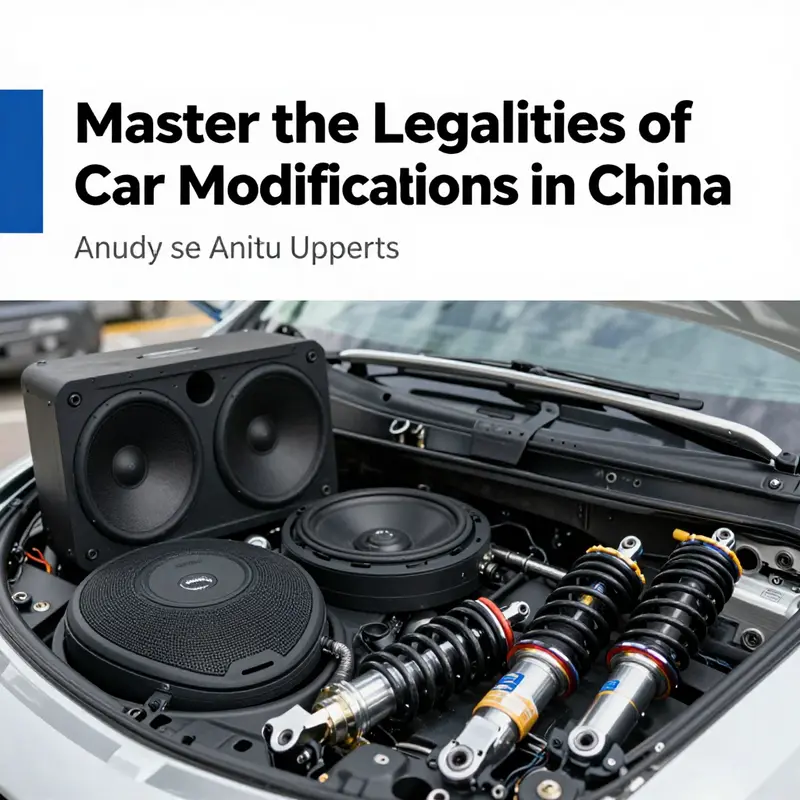
Turning to the functional and safety-related domain, the law tends to reward thoughtful, safety-forward improvements. A sound system upgrade, for example, is typically legal, especially when the installation is performed by a certified professional who can ensure that power routing, grounding, and interference with other systems are properly managed. Roof racks and cargo carriers reflect a similar philosophy: support for practical needs without compromising aerodynamics or collision protection. Suspension and handling improvements are allowed when executed with care and within safe limits, provided they do not modify the vehicle’s core structure or ride height in ways that could destabilize dynamics or invalidate safety certifications. Anti-collision devices, including forward- and rear-facing protection bars, are encouraged as enhancements to occupant safety, not as aesthetic flourishes. The exhaust system represents a nuanced exception. A variable valve exhaust designed to alter sound is permissible if it does not undermine emission controls or elevate noise and pollutant levels beyond legal thresholds. What is not permitted in this space is the installation of high-performance exhausts that escalate noise or emissions; such choices undermine public health objectives and the regulatory framework’s core intent.
Beyond the mechanics of what is allowed in principle, responsible car owners must engage with the consequences of altering a vehicle’s identity and behavior. Certain changes, even when technically feasible, can ripple into insurance, resale value, and legal standing. Insurance companies, for instance, scrutinize modifications for their impact on risk profiles. Modifications that substantially raise the likelihood of theft, damage, or injury can trigger premiums that reflect the added risk. Conversely, modifications that demonstrably improve safety or reliability may be treated more favorably. The literature on car modifications stresses the need to disclose changes accurately to insurers and to maintain documentation that substantiates the nature, extent, and installation of any modification. Failure to disclose or to document changes can lead to disputes over coverage, claims denials, or even policy cancellation. This interplay between regulation, risk management, and consumer choice underscores the practical importance of bridging personal preference with formal compliance.
A careful reader will notice a broader comparative thread running through these considerations. In the United States, for example, the Environmental Protection Agency enforces a distinct set of rules around emissions control. Modifications that bypass, disable, or degrade emission control devices—such as catalytic converters, EGR systems, or OBD monitors—trigger federal violations under the Clean Air Act. The consequences can be severe: substantial fines, mandatory repairs, criminal charges in extreme cases, and inspection failures that prevent renewed registration or road legality. The juxtaposition of this global perspective with the Chinese framework highlights a common thread: the pursuit of personalization must not erode safety, environmental protections, or the vehicle’s ability to be properly identified and traced through official records. In both contexts, regulatory regimes respond not only to consumer tastes but to systemic concerns about air quality, accident risk, and the integrity of the vehicle fleet.
To translate these principles into practical decisions, consider a hypothetical sequence that a careful owner might follow. First, plan any modification with an eye toward how it will appear on the official record. Before execution, verify whether the intended change requires registration or a formal approval process. If registration is required, prepare the documentation, schedule the inspection, and budget for the associated fees. After modification, submit the change to the Vehicle Management Office within the mandated window. Ensure that the vehicle’s safety and technical inspections are up-to-date, and retain receipts and certificates that demonstrate compliance. If a modification touches the vehicle’s exterior, interior, or functional systems in ways that could affect safety—such as suspension changes or steering modifications—consider consulting a qualified technician who understands the regulatory constraints and the vehicle’s original design tolerances. The aim is to preserve roadworthiness while embracing the expressive potential of customization.
The human dimension of legality should not be overlooked. The law is not a random tally of prohibitions; it is a framework that seeks to balance individuality with collective safety. Car owners who respect the process, document their work, and choose modifications aligned with official standards often find that their investments yield more predictable outcomes. The car remains a reliable companion, and the experience of driving remains harmonious with the city’s traffic environment. When owners view compliance as a collaborative process—working with the authorities, with certified installers, and with insurers—the result is a smoother path to personalization that is sustainable over the vehicle’s life cycle. In this sense, legality is not a limitation but a facilitator of responsible creativity.
For readers seeking a broader comparative lens or additional context on related topics, a related discussion on legal car modifications in other jurisdictions can provide helpful perspective. See the resource titled legal-car-modifications for supplementary ideas and considerations that may inform decisions in different regulatory climates. This cross-jurisdictional awareness can empower owners to think beyond quick fixes and temporary compliance toward durable, well-documented customization strategies. The aim is not to mimic another system but to learn how different regulatory cultures approach the same human impulse: making a car feel more like you while keeping it safe, identifiable, and officially compliant.
In closing, the pathway to legitimate modification rests on three pillars. First, an adherence to documented boundaries that separate what can be changed from what must stay intact. Second, a disciplined registration process that keeps the official record accurate and up-to-date. Third, a commitment to safety, reliability, and environmental responsibility that justifies any changes to the vehicle’s original design. When these pillars are in place, car owners can enjoy a broad spectrum of personalization—vinyl wraps, color changes, interior upgrades, and even refined performance elements—without sacrificing compliance or public safety. The consequence of this approach is clear: ownership becomes both expressive and accountable, a duality that preserves trust on the road and confidence in the legal system that governs it. For those who bend the rules or skip registration, the potential penalties are real and tangible. And as regulations continue to evolve, staying informed is not a one-time task but an ongoing practice of responsible citizenship behind the wheel.
Final thoughts
Understanding the legal parameters surrounding car modifications is imperative for anyone looking to personalize their vehicle in China. From recognizing what exterior and interior changes are permissible to ensuring that functional modifications comply with safety regulations, car enthusiasts can navigate these waters confidently. Illegal changes carry significant consequences, which can affect not only the vehicle owner but also the wider community they navigate. With this knowledge, you are better equipped to pursue your passion while adhering to local regulations, ensuring both creativity and compliance.