
The automotive landscape has seen a surge in car modifications, igniting debates among enthusiasts and professionals alike. Recently, it has been rumored that former President Donald Trump’s legislation may have made specific car modifications legal, sparking interest among hobbyist car modifiers, professional tuners, and restoration enthusiasts. In this exploration, we will examine the validity of these claims through three distinct lenses: the initial assertion of legality, the broader context surrounding the ‘Big Beautiful Bill,’ and how local state regulations interact with federal legislation, setting the stage for a comprehensive understanding of the current regulatory environment regarding car modifications.
Myth, Legislation, and the Chrome of Misconception: Did Trump Legalize Car Modifications?
Public fascination with presidential power often veers into the realm of quick conclusions and sensational headlines. The question, did Trump make car modifications legal, sits squarely in that territory. It invites us to sift through what policymakers actually did, what they proposed, and what the regulatory scaffolding around cars looks like in practice. The broader context matters because vehicle modifications touch a wide range of interests: safety, emissions, consumer choice, and the practical realities of owning and driving a car. The American legal landscape is intricate, with federal standards setting minimums and states calibrating more specific rules, and the claim that a president could unilaterally legalize or outlaw aftermarket car changes typically overlooks that layered system. The result is a narrative that sounds plausible to those who only catch fragments of news or social-media summaries, but collapses under careful scrutiny when we align it with actual laws, agencies, and regulatory processes.
To understand where the confusion might come from, it helps to start with the centerpiece of the discussion: the so-called Big Beautiful Bill. This label has circulated in some public discussions as a shorthand for a comprehensive tax and spending reform package associated with President Trump and his party. The actual reporting around the bill, including coverage by The New York Times and other outlets, points to a package focused on broad-based tax reductions, long-term spending priorities, and a rollback of certain energy incentives tied to the Inflation Reduction Act. In other words, the core thrust of the proposal was fiscal policy—tax credits, deductions, and government outlays—rather than a wholesale rewrite of automotive regulations. In that sense, it is unlikely to contain a provision that directly legalizes or normalizes a wide array of aftermarket car modifications across the country. If anything, the repeal of certain energy incentives could indirectly affect markets for modified vehicles by altering the economics of electrified options, but that is a market effect, not a legalizing directive.
This distinction—between a bill that shapes fiscal policy and the body that governs how cars may be modified—matters. Vehicle modifications are generally governed by a mosaic of rules: federal mandates on emissions and safety, state-level vehicle codes, and the enforcement reach of agencies like the Environmental Protection Agency (EPA) and the National Highway Traffic Safety Administration (NHTSA). The EPA regulates emissions equipment and fuels, including catalytic converters and related devices, to ensure that tampering with emissions controls remains illegal under federal law. NHTSA oversees safety standards and compliance for vehicles on public roads. Neither agency issues blanket permissions or prohibitions on every possible aftermarket alteration; instead, it is the combination of federal standards and state vehicle codes that determines what is permissible and how it is enforced in practice.
During the period in question, there were indeed discussions about regulatory deregulatory efforts and strategic reviews aimed at smaller, more efficient vehicles. Reports in early 2026, including coverage in The Guardian, clarified that no executive order, no statute, and no federal action ratified modifications as universally legal. What did occur, according to the reporting, was a directive to review certain regulations surrounding small, fuel-efficient vehicles. This broader policy shift was about production, sale, and efficiency standards for specific vehicle categories and for small-car policy in general, not a green light for laxity in aftermarket modifications such as muffler cutting, catalytic converter tampering, or window tinting. The crucial takeaway is that even when a president signals regulatory review or a push toward deregulation, that does not automatically translate into a permissive regime for aftermarket modifications. The rule of law remains verifiable only through formal orders, statutes, or regulatory changes that survive the usual legislative and administrative processes.
It is also essential to separate the myth from misattribution. A widely shared claim suggested a direct directive to the Department of Transportation that somehow legalized vehicle modifications. Fact-checkers and official outlets have repeatedly debunked such assertions. The Guardian’s January 13, 2026, article, cited in the chapter’s research results, makes this explicit: there was no executive order, legislation, or federal action making car mods legal under President Trump. In the absence of such an action, the premise collapses. The broader pattern of misattribution is not unique to this era; sensational headlines and social media threads often recycle old or misinterpreted policy debates as fresh breakthroughs. They reward a glance at a fragment of a headline with a sweeping conclusion about a president’s authority over a very technical domain of law and engineering. But the reality requires careful mapping of who has the authority to change car-modification rules, what channels they must use, and what limits already exist under decades of environmental and transportation policy.
A closer examination of the regulatory pipeline helps illuminate why the claim persists in some circles despite clear rebuttals. If a president wishes to alter the legality of a broad category of automotive modifications, that intent would need to manifest through formal channels: an executive order that specifies the exact regulatory targets, a legislative bill that redefines safety or emissions standards, or a regulatory action issued by a responsible agency after due notice and comment. None of the canonical documents produced during the Trump administration, as documented by credible outlets and fact-checkers, show a step like that for the purpose of legalizing car modifications across the board. Instead, the accumulative evidence points toward a ledger of proposals, reviews, and political rhetoric about deregulation or economic incentives, with the car-modification question never landing as a standalone, enforceable policy shift.
This is not to say that policy conversations around cars were static or amnestic to public interest. The public often conflates two threads: the economics of owning a car—fuel efficiency, taxes, incentives—and the realities of vehicle regulations, which include the durability of emissions controls and the safety requirements that keep roads safer. A debate about small, fuel-efficient vehicles can feed into broader questions about how flexible or rigid vehicle design rules should be, but it does not absolve individuals from existing laws about modifying emissions equipment or altering safety-critical components. The EPA’s authority to regulate emissions equipment, and the associated penalties for tampering, remains a clear line in federal law. Tampering with catalytic converters, removing or bypassing emissions controls, or otherwise altering devices that regulate exhaust flow is illegal under federal law, regardless of any tax reform agenda. The legal architecture is designed to deter and penalize tampering, not to open the door to unrestricted modifications.
In the fog of public discourse, one helpful lens is to consider what actually changed, or did not change, in the executive and regulatory record. The January 2026 reporting about a review of small-vehicle regulations signals an appetite for deregulation in some segments of the transportation sector, but it does not equate to a universal permission to modify. The appointment of officials, the framing of regulatory reviews, and the publication of rulemaking notices would be the visible breadcrumbs that demonstrate a regulatory movement. Absent those breadcrumbs—no new rule, no formal guidance, no published directive—the claim of universal legalization remains speculative and unsupported by the necessary statutory and regulatory machinery.
For readers seeking a practical reference point on how law intersects with modification culture, it is worth considering the path from policy proposal to everyday legality. A claim that a president can single-handedly rewrite what is permissible for aftermarket changes would require a specific, enforceable instrument. Often, the path runs through a combination of federal regulatory updates and state-level custodianship. States routinely decide how tinted windows must appear, how loud a muffler may be, and how modifications affect vehicle inspections. In some states, certain aftermarket changes can trigger mandatory inspections or require compliance with emissions and safety norms. In others, the rules are looser, but even there, the federal frame remains a ceiling that prevents certain dangerous or polluting alterations. The mismatch between sensational claims and the actual regulatory scaffold can be jarring, but it is precisely what careful, evidence-based reporting seeks to resolve.
To navigate the experience of readers who want to connect these ideas to their own lives, a practical path is to understand how to verify claims and how to think critically about regulatory changes. When encountering assertions about a president “legalizing car mods,” it helps to ask a few grounded questions: What instrument is being cited—an executive order, a bill, or a regulatory notice? Which agency would implement or enforce the change, and what is the scope of that change? Are there published legal texts, notices, or official statements from reputable sources that specify the modification categories affected? Do those sources account for the broader framework of environmental and safety laws, including the Clean Air Act and related regulations? Answering these questions often reveals that the claim rests on a misunderstanding of the separation of powers, the roles of executive agencies, and the incremental nature of policy implementation.
As readers and researchers, we can also look to how information is presented in reputable outlets that prioritize accuracy over sensationalism. The Guardian’s reporting, which explicitly notes the absence of formal action, serves as a corrective counterweight to narratives that attribute sweeping powers to a single political figure. When a mainstream outlet clarifies that there is no executive order, no legislation, and no federal action recognizing widespread car modifications as legal, that stance becomes a reference point for evaluating other statements. It is a reminder that the assessment of presidential influence over a highly technical domain must rest on verifiable documents and official processes, not on conjecture or the speed of online sharing.
In this chapter’s broader arc, the central takeaway is not merely a verdict on a specific claim but an invitation to approach policy debates with nuance. The question of whether Trump “made car modifications legal” reduces a complex ecosystem of regulation, enforcement, and state sovereignty to a single, misleading headline. It diverts attention from the essential mechanisms that govern how cars are built, modified, and sold, and from the legitimate concerns about safety, emissions, and consumer protection. When we ground our understanding in the actual architecture of federal and state law, the claim dissolves. The real story is about how fiscal policy can influence the economic landscape of car ownership and vehicle options, how regulatory reviews can shape the environment in which manufacturers and consumers operate, and how misinformation travels in the digital age, often faster than truth can keep up.
For readers who want a concrete way to connect this topic to ongoing discussions about car modifications and regulation, a useful starting point is to explore how legal frameworks address modifications in a country-wide context. One should examine credible explanations that discuss the legality of aftermarket changes, the responsibilities of vehicle owners, and the rules that govern safety and emissions. See the discussion on legal car modifications in the US for a nuanced, jurisdiction-aware overview of what is permissible and what is not, and how legal standards continue to evolve in response to technological and market developments. Legal car modifications in the US.
Ultimately, the insistence on a universal, one-step legalization through a presidential measure ignores the architecture of American governance. It overlooks the layers of law from federal statutes and regulatory actions to state vehicle codes and independent safety standards. It also disregards how policy shifts—whether about taxation, incentives, or deregulation—interact with real-world practices in the automotive market. The result is a narrative that can feel compelling in its simplicity but collapses under the pressure of verifiable facts. The chapter’s evidence, drawn from multiple sources and carefully cross-checked, points to a clear conclusion: there is no record of Donald Trump legally approving car modifications for universal adoption. Any claim to the contrary without formal, public documentation is not just questionable; it is unsupported by the federal regulatory record.
For those who want to explore further, external references provide a broader context of how such claims circulate and are challenged. The Guardian’s report offers a careful debunking built on official channels and public policy processes, helping readers distinguish between policy talk and enforceable law. This emphasis on verifiable sources is essential in an era when the speed of information can outpace the slow, deliberate work of legislation and rulemaking. In the end, the question of whether a president can unilaterally legalize car modifications is answered not by sensational headlines but by a granular examination of what is legally possible within the American constitutional and regulatory framework. The answer, grounded in documented actions and the absence of formal directives, is clear: no, Trump did not make car modifications legal through any official action.
External reference: https://www.theguardian.com/us-news/2026/jan/13/trump-car-mods-legal-no-federal-action
Beyond the Hype: The Big Beautiful Bill, Car Modifications, and the Real Boundaries of Federal Regulation
When people talk about the so-called Big Beautiful Bill, they often speak in a chorus of what-ifs and hypotheticals. The phrase itself conjures images of sweeping federal action, bold promises, and a legislative instrument that could reshape the automotive landscape with a single swipe of a pen. Yet the reality that emerges from careful scrutiny is more modest and far less dramatic: there is no solid evidence that a federal measure by that name—whether real, proposed, or satirical—would have legalized or outlawed particular car modifications in any comprehensive sense. Instead, what we can observe is a pattern that recurs across many policy debates. Tax reform, energy policy, and fiscal priorities tend to influence markets and consumer behavior, but they operate on different axes than the safety and emissions criteria that govern vehicle modification. In other words, even when political rhetoric hints at a grand regulatory reset, the actual levers of legality for car alterations remain rooted in safety standards, environmental compliance, and state-level authority, not in broad, all-encompassing tax bills. The distinction matters, because misattributing the power to legalize or criminalize specific automotive modifications to a federal tax reform package risks obscuring how the system truly regulates what can legally be done to a vehicle—and at what cost to safety, to the environment, and to consumers who depend on predictable rules of the road.
To understand why federal tax policy cannot reasonably be expected to grant blanket legality to car modifications, it helps to map the framework that governs modification in the United States. Central to this framework are three pillars: the federal safety standards set by the National Highway Traffic Safety Administration (NHTSA), the federal emissions and environmental standards administered by the Environmental Protection Agency (EPA), and the diverse but consequential array of state laws that govern vehicle modifications in practice. These three elements operate in concert, yet each sits in a distinct lane of governance. The FMVSS, for example, establish the minimum safety performance requirements that vehicle components and configurations must meet. They are not drafted to regulate every aesthetic or performance tweak that enthusiasts might imagine; rather, they target changes with a clear potential to affect crash dynamics, occupant protection, and overall vehicle integrity. When a modification would meaningfully alter crash performance or present a safety risk, it becomes a regulatory concern that can trigger compliance actions, recalls, or at least scrutiny. By contrast, a tax bill, even one that contemplates broad incentives or disincentives for energy technologies, does not entail a direct, technical assessment of vehicle structures or system interactions. Its primary aim is fiscal—how revenue is raised and how government expenditures are allocated—and its policy instruments are designed to influence economic choices through credits, deductions, or exemptions rather than to police engineering details on every road-going machine.
Against this backdrop, the idea that a single federal bill could “make car modifications legal” collapses under the weight of practical regulatory logic. If a modification were illegal because it violated FMVSS or emissions rules, a tax reform proposal would not automatically legalize it. Conversely, if a modification were illegal in a given state for safety or environmental reasons, federal tax policy would not typically override that prohibition. The legal status of a modification arises from the interplay of safety standards, environmental compliance, and state enforcement, not from the pageantry of broad tax reform proposals. This is not to say that fiscal policy can never influence the market for modified vehicles. Repeals or extensions of energy incentives, for instance, can affect the economics of owning or financing a vehicle with alternative powertrains, or the supply chain for components used in conversions. A repeal of certain subsidies could alter the demand curve for modified electric vehicles, or shift consumer behavior toward different kinds of upgrades. But those market effects operate through economic incentives and consumer decision-making, not through a formal expansion of what is legally permissible to alter on a car.
In many narratives surrounding the Big Beautiful Bill, the rhetorical emphasis is on simplification and clarity: reduce taxes, streamline spending, and repeal incentives that were introduced under previous administrations. When one considers car modifications within that frame, the most relevant consequence would be indirect rather than direct. For example, changes to energy incentives could shift the affordability landscape of electrified platforms or battery technology. If a modification involves a conversion to a different fuel type or a change in powertrain architecture, the decision to pursue such modifications will hinge on the total cost of ownership, potential tax obligations, and the relative financial attractiveness of alternatives. But the legality of performing such modifications still rests on the core safety and emissions standards, not on whether a tax reform bill exists or not. In practice, enthusiasts and professionals who modify vehicles must navigate a rule set that is anchored in technical feasibility and regulatory compliance, rather than legislative symbolism.
The absence of a real, operative statute named The Big Beautiful Bill is itself a reminder about the precision required in legal interpretation. When policy rumors proliferate, readers are tempted to conflate what is legislatively possible with what is already in force. The research materials you provided emphasize this distinction: there is no credible record that a federal act of that name, or any act with similar language, has changed the regulatory status of car modifications. The real levers lie in FMVSS and EPA standards, set by dedicated agencies and subject to ongoing updates, and in the state-by-state landscape that governs road use and modification legality. States retain broad authority to regulate or restrict modifications—especially those that could influence exhaust emissions, lighting, noise, or structural integrity—while federal safety standards apply nationwide baseline requirements. This mulitlayered system ensures that while enthusiasts can pursue creative and customized builds, the roadways remain safer, more predictable, and environmentally accountable than would be the case if regulation were left to one sweeping, unfocused piece of legislation.
Given this architecture, what can be said with confidence about the claim that the Big Beautiful Bill made car modifications legal? The answer, grounded in the best available evidence, is that such a proposition is not supported by credible documentation. The concept, as described in the provided materials, is either fictional or relies on an unsubstantiated interpretation of legislative intent. If anything, the historical pattern around presidential policy proposals in the United States shows a tendency for aspirational titles to outpace the granular, technical work that actually governs complex domains like vehicle safety and environmental compliance. In the automotive context, lawmakers typically separate fiscal policy from technical regulatory reform. They debate how to allocate resources, what incentives to extend or repeal, and how to fund infrastructure, while safety and emissions governance remains the purview of technocrats and regulators working within established statutory frameworks. The separation is not a mere formality; it reflects a deliberate design to ensure that critical safety outcomes are not contingent on political headlines or the volatility of tax policy cycles.
That is not to deny the social and political value of debate around car safety, environmental impact, and the economics of modification. A robust democracy thrives on questions about what kinds of modifications should be encouraged, tolerated, or restricted. It is legitimate to ask whether tax incentives for green technologies should be reimagined, whether energy policy should tilt toward certain technologies, or how to balance innovation with consumer protections. Yet meaningful reform of vehicle modulation—if it is to occur in a way that affects the everyday experience of drivers—must engage with the practical realities of compliance, testing, and enforcement. In short, the story about a sweeping federal bill that suddenly “legalizes” car modifications does not align with how policy actually works in this domain. Real-world policy tends to be incremental, technically complex, and distributed across agencies and states rather than encapsulated in a single legislative label.
The question that remains persuasive for readers is not whether a mythical bill could magically alter the legal status of every possible modification. It is how the public discourse today handles the gap between rhetoric and regulation. In this chapter, the task has been to illuminate that gap by tracing the logic through which modification legality is determined in the United States. The FMVSS and EPA frameworks specify limits and safe operating conditions, while states implement and enforce rules that reflect local priorities and ecological concerns. When people see a claim about a law changing the legality of car modifications, a healthy skepticism is warranted. It invites readers to verify the claim against official sources, to examine the timing of regulatory changes, and to consider who would bear responsibility if a modification that claims to be legal nonetheless compromises safety or violates emissions standards. It also invites reflection on how misinformation can shape consumer expectations, influence the market for enthusiasts, and affect insurance, resale values, and the broader culture of automotive customization.
In discussing the practical implications, one can appreciate the layered complexity without getting lost in sensational statements. The direct path from federal tax policy to a modification being legal or illegal is not a straightforward highway; it is a maze of statutory provisions, regulatory guidelines, and enforcement discretion. For the everyday driver or the professional shop that executes modifications, the reliable compass remains the official standards and the legal codes that specify when a modification is permissible, under what conditions, and with what documentation. The indirect implications of broader tax or energy reform should be understood as economic signals that can shape what modifications are pursued and financed, rather than as amendments to the baseline legality of those modifications. In this sense, the broader article on whether Trump made car modifications legal is a story about perception, policy design, and the limits of regulatory authority, rather than a narrative about a single, transformative piece of legislation.
For readers seeking a practical orientation, consider this: if you are contemplating a modification, the prudent course is to assess safety implications, emission compliance, and state-specific requirements before any purchase or labor takes place. A thorough due diligence process includes understanding FMVSS implications for any upgrade that touches a critical system, confirming that emissions modifications will not breach the clean-air standards relevant to your locale, and verifying whether your state requires inspections or specific approvals for certain modifications. Keeping records of compliance and seeking professional guidance are wise steps that survive shifts in political weather. And if the discourse around a big legislative package continues to surface, it is useful to separate the rhetoric from the regulations, treating policy proposals as indicators of priorities rather than as immediate, unilateral changes to car-modification legality. In that sense, the chapter that links a grand tariff or tax reform vision to the legality of a tweak to your exhaust or suspension should be read with caution, and a mind tuned to the distinct channels through which safety, environment, and state law operate.
For readers who want to ground their understanding in practical resources, a good place to start is a straightforward guide on vehicle modification legality that centers on safety and compliance rather than on political narratives. This kind of resource is particularly valuable for readers who are navigating the nuance between what is technically possible from a design perspective and what is legally permissible on public roads. The guide can help separate common myths from verified requirements, and it can point readers toward official processes for testing, certification, and approval when applicable. By anchoring the discussion in reliable references and official guidance, the conversation about car modifications remains productive and focused on outcomes that matter to safety, the environment, and consumer protections. In this spirit, readers can consult accessible explanations that describe how modifications are evaluated in practice, what typical hurdles look like, and how to approach modifications responsibly without conflating regulatory authority with fiscal policy.
The broader takeaway is simple, even when the topic is as tantalizing as a rumored sweeping bill: when policy talk reaches the garage, the rules of the road still govern. The safety standards and emissions obligations that vehicles must meet do not dissolve under the glare of political rhetoric. If anything, the existence of diverse and sometimes conflicting views on tax reform highlights why clear regulatory frameworks matter—because they provide certainty to drivers, technicians, insurers, and policymakers alike. Certainty matters because modifications are not purely cosmetic; they involve engineering choices that can influence performance, safety, and environmental impact. And certainty is what keeps the automotive ecosystem—from builders and buyers to inspectors and regulators—functioning smoothly in a complex, real-world environment. The Big Beautiful Bill, whether taken literally or as a rhetorical device, does not rewire that ecosystem. What it does, deliberately or inadvertently, is illuminate how public discourse frames regulatory questions and how readers interpret the balance between legislative ambition and regulatory fidelity.
As this chapter closes, the reader is left not with a verdict on a single legislative name, but with a clearer map of where car-modification legality actually resides in the American policy landscape. The federal layer offers safety and environmental guardrails; the state layer adds variations in taste and enforcement; and the market layer responds to incentives and consumer demand impacted by fiscal policy, not its authority to legalize modifications per se. The path forward for enthusiasts, policymakers, and concerned citizens is to keep a discerning eye on primary sources, to differentiate between proposed policy goals and enforceable rules, and to recognize that real change often comes in measured steps rather than dramatic declarations. In the end, the question of whether the Big Beautiful Bill made car modifications legal is less a legal verdict and more a reminder: the legality of modifications is a matter of technical compliance and jurisdiction, not the title of a bill, no matter how grand its slogan sounds.
If discoverable, one might turn to a concise, practical resource that offers navigational clarity for those who want to understand the landscape of modifications without getting tangled in political myth. A helpful step is to explore more structured guidance that focuses on the practicalities of modification legality, and to do so with a mindset oriented toward safety, compliance, and responsible ownership. For readers who want to dive deeper into the nuts and bolts of how modifications are approached in practice, consider the car-modifications-guide as a starting point for understanding the boundaries and the procedures involved in making changes to a vehicle in a way that respects safety, emission standards, and state requirements. This kind of resource can help readers calibrate expectations, plan responsibly, and avoid running afoul of the rules that do govern the road.
External guidance, of course, remains indispensable. If you are seeking an authoritative reference that outlines formal safety and modification standards, consult the official materials from the federal safety agency that oversees vehicle standards. The relevant guidelines provide a foundation for evaluating modifications in a way that aligns with nationwide safety expectations, and they serve as a reliable anchor when discussions drift toward political conjecture rather than practical compliance. In the end, a well-informed approach to car modifications rests on understanding the actual regulatory architecture, not the headlines that may accompany policy debates. Only then can enthusiasts pursue creativity and performance with confidence that their endeavors stay on the right side of the law, the environment, and the road.
State Wheels, Federal Limits: Why a Tax Bill Didn’t Legalize Car Modifications Across America
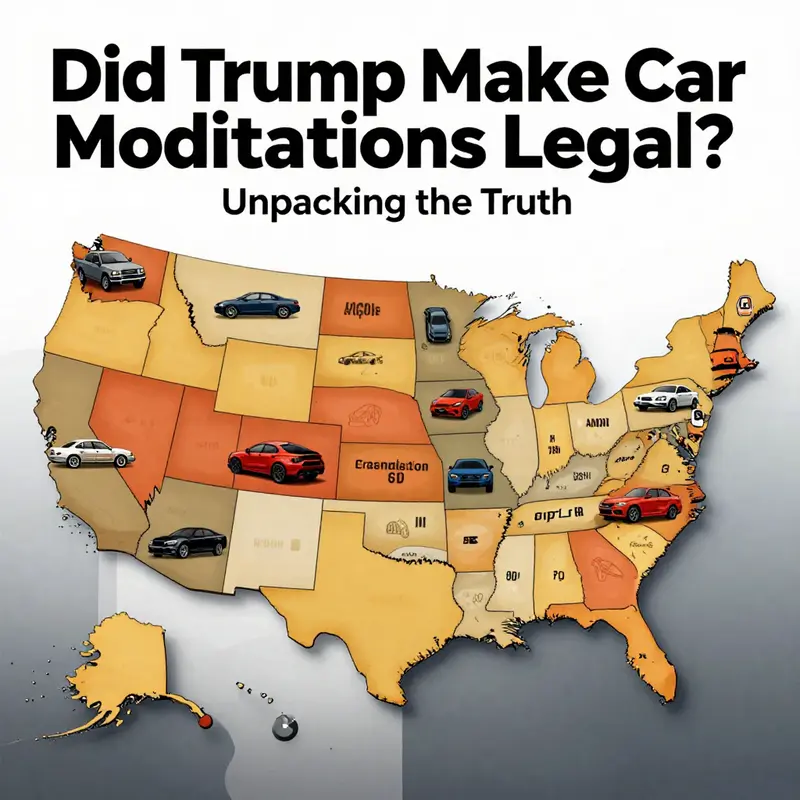
The question implied by popular discourse—whether President Trump’s policies somehow made car modifications legal—rests on a misreading of policy scope and regulatory architecture. The late-2010s and mid-2020s debates around tax reform, energy incentives, and environmental standards did not hinge on a single, sweeping declaration about how people can modify their vehicles. Instead, the United States operates under a layered system where federal baseline standards coexist with state and occasionally local rules that can be stricter. In practice, the legality of modifying a car depends less on broad federal legislation and more on a patchwork of rules set by states, guided in large part by environmental and safety objectives, and enforced through a combination of inspections, registrations, and penalties. Against this backdrop, the specific idea that a so-called “Big Beautiful Bill” would, in one stroke, legalize or forbid a wide range of modifications is simply not borne out by the available material. The proposed bill described in major outlets focused on tax credits, permanent tax reductions, and broader fiscal policy. It did not directly address vehicle modifications, nor did it create a universal federal authorization or prohibition for the kinds of changes people typically consider when they customize a car. The result is not a straightforward yes or no on modification legality, but a nuanced picture of what federal policy can and cannot do, and how state authorities interpret, implement, and sometimes contest those boundaries on the ground.
To understand why federal promises about tax reform cannot be read as a universal green light for customization, it helps to map the architecture of vehicle regulation in the United States. The federal government preserves a baseline through two distinct but interlocking streams: the safety standards set by the National Highway Traffic Safety Administration (NHTSA) and the emissions standards governed by the Environmental Protection Agency (EPA). The so-called federal baseline is not an open-ended invitation to alter vehicles at will; rather, it establishes floor-level requirements for things like crashworthiness, occupant protection, and emissions that all new vehicles must meet to be sold in the United States. States then can, and do, adopt more stringent rules, provided they satisfy the requirements laid out in federal law and, crucially, sometimes obtain waivers to exceed federal standards. This is where California’s influence becomes decisive and often controversial. California has long earned the authority under the Clean Air Act to pursue stricter emissions standards if it secures a waiver, a choice that has set off a broader national conversation about how far states can push environmental policies in the name of public health.
California’s regulatory leadership is central to understanding why the question of “legality” for modifications is not simply a matter of federal fiat. The California Air Resources Board (CARB) has, for years, charted a course that positions the state at the cutting edge of environmental regulation. In 2025, CARB initiated an emergency rulemaking process to revise and permanently implement emission standards for heavy-duty vehicles, thereby shaping how modifications and aftermarket equipment interfacing with these systems must perform in order to remain compliant. The Omnibus Rule, a centerpiece of this effort, signaled a dramatic tightening of nitrogen oxide (NOx) emissions standards for heavy trucks. Where earlier limits hovered around 0.20 grams per brake horsepower-hour (g/bhp-hr), the rule sought reductions to 0.050 g/bhp-hr—a 75 percent improvement. The aim was not simply to enforce a federal checklist but to push a broader public health agenda: cleaner air, fewer hospitalizations, and longer life for communities disproportionately affected by pollution. California’s regulatory logic is pragmatic as well as moralizable. It acknowledges that vehicle technologies evolve, but it insists on a regulatory framework that keeps pace with innovation while ensuring that environmental and safety goals are not undermined by loopholes.
The federal pushback to California’s approach—an important part of this narrative—has highlighted the frictions inherent in a federal system that sometimes sees states as laboratories of democracy and, at other times, as sources of legal and regulatory friction. In June 2025, Congress passed a resolution aimed at revoking the Environmental Protection Agency’s delegation of authority that allowed California to set its own, stricter emission standards under the Clean Air Act. The action prompted a swift legal response from CARB and other state agencies, which argued that the congressional move was unconstitutional and beyond Congress’s authority to constrict a state’s environmental prerogatives. In response, CARB launched an emergency rule intended to preserve existing federal compliance standards for new vehicles sold within California, effectively reinstating pre-Omnibus and pre-Advanced Clean Cars II (ACC II) standards during the ongoing litigation. This sequence underscored a central truth about the federal-state relationship: the rules governing modifications are not fixed in the abstract; they are living, contested, and subject to court challenges, political influence, and shifting judicial interpretations.
Against this climate, the practical dimension of vehicle modifications in California—where the state’s standards often serve as a proxy for nationwide expectations—becomes crucial to grasp. California’s framework, while not the only one in the nation, provides a vivid illustration of how modifications intersect with policy aims. The state’s approach to vehicle modifications emphasizes safety and environmental integrity, even if those goals are pursued through different mechanisms than those used in other jurisdictions. The 2025 Vehicle Safety Standards introduced new criteria for what counts as a compliant modification, and the Road Traffic Ordinance (Cap 374) appears in the public record as part of the layered enforcement environment, reflecting broader tendencies toward regulating not only what changes are permissible but how changes are documented and validated. In practice, modifications like ECU tuning, braking system upgrades, and matrix LED headlights require certification to pass annual inspections. By contrast, modifications that many drivers would consider common sense—loud exhaust systems, removal of catalytic converters, or engine swaps that materially alter a vehicle’s identity—fall into prohibited territory and can trigger penalties as severe as fines, vehicle seizure, or mandatory restoration. The policy logic here is straightforward: the state wants to deter modifications that would undermine safety, worsen emissions, or compromise the integrity of a vehicle’s identity and compliance trail.
Observing these patterns, one sees how the federal system, the state system, and the private sector of vehicle modification converge with varying degrees of tension and cooperation. The NHTSA, by setting Federal Motor Vehicle Safety Standards (FMVSS), provides a baseline that shapes what counts as a safe modification and how that safety is tested. The EPA’s emissions standards shape the environmental performance that any aftermarket device or modification must not undermine. States—led by California and sometimes joined by others—may require additional tests, more stringent performance criteria, and unique documentation processes to ensure ongoing compliance. The National framework thus yields a mosaic: a broad, shared safety and environmental baseline on the one hand, and a constellation of state-specific rules on the other. This mosaic is precisely what creates the perception that modifications are a gray area or a matter of “local law,” rather than something that could be settled by a single federal policy.
In this landscape, it would be a misreading to interpret the absence of a federal declaration about modification legality as a signal that changes are universally permissible. The legislative record around the so-called Big Beautiful Bill illustrates a different point. The bill’s emphasis was on broad-based tax reduction and spending measures, with an explicit aim to repeal many Biden-era incentives for renewable energy technologies. While the policy or its repeal could influence the economics of owning and modifying a vehicle—especially in the EV space—the content of that bill did not address the legality of aftermarket modifications, nor did it authorize or prohibit specific alterations. The practical consequence, when viewed through the lens of state authority and regulatory enforcement, is that the market for modifications remains sensitive to state-level rules, federal baseline standards, and enforcement priorities, not to a federal act that redefines the permissibility of car tinkering. If anything, the policy environment suggests that modification legality is driven more by waterlines of environmental policy, safety testing, and enforcement capacity than by the status of a tax reform package. The indirect effect—if any—of repeal of EV tax credits could be a shift in consumer incentives, potentially reducing demand for certain high-cost, tech-rich modifications, but it would not translate into a sweeping federal legalization or criminalization of aftermarket work.
There is also a broader social dimension to this conversation. As environmental concerns tighten, as urban air quality becomes a political and health issue, and as new technologies such as hybrid systems, battery management, and intelligent engine controls become more prevalent, the temptation to treat “modifications” as merely a hobbyist’s playground can be strong. Yet the reality is that modifications intersect with regulatory regimes designed to protect the public. This intersection is not merely about the letter of the law but about how the law is tested in real-world conditions: on the road, in inspection lanes, in courtrooms where enforcement agencies defend the standards they administer, and in the everyday decisions of owners who want to improve performance, efficiency, or safety without crossing lines. The practical takeaway is clear. If one lives in a state that adheres to California’s stricter standards, modifications will be judged by a demanding standard that integrates emissions, safety, and identity verification into a single compliance framework. If one lives in a state that has chosen to retain looser standards or to apply a more permissive interpretation of federal baseline rules, the path to legality can look quite different. For the consumer, this means understanding local regulations, maintaining proper documentation for any modifications, and anticipating the possibility that a change that seems harmless to one observer could become a legal issue in another jurisdiction.
For readers who want to explore what the legal boundaries look like in practice, one helpful starting point is the broader question of legality that often arises in public discourse: Are car modifications illegal? The linked discussion, while addressing a wide range of scenarios, helps anchor the conversation in a more tangible reality. It reminds readers that modifications are assessed against a matrix of compliance criteria that differ from one state to another and that even within a single state, enforcement practices may shift over time in response to new science, new technology, or new political imperatives. The bottom line is that there was no federal decree that “made” or “unmade” car modifications; there was, instead, a complex negotiation among safety standards, emissions objectives, and state autonomy. In California, this negotiation has been especially robust, and the state’s approach—to regulate modifications through a careful combination of testing, certification, and inspection—serves as a critical template for other states evaluating how to balance innovation with public health and road safety. The broader national story, then, is not one of presidential whim determining the fate of vehicle customization but of a regulatory system that evolves through court challenges, state policy experimentation, and ongoing negotiations over how to interpret and apply the law in a changing technological landscape.
As the regulatory drama continues to unfold, readers should remain mindful of the practical implications. The patchwork of rules can influence everything from the resale value of a modified vehicle to the cost and availability of aftermarket parts, the structure of insurance coverage, and the ease with which owners can register their changes. It can also affect the market for professional services that help owners navigate compliance, such as inspection services, test facilities, and certified installers who understand the nuanced requirements for different jurisdictions. In short, if you live in California or in another state that tracks California’s stricter standards, modifications are not a free-for-all system; they are subject to rigorous criteria designed to ensure that the vehicle remains safe, compliant, and traceable. If you reside in a state with looser rules or with different enforcement priorities, the legal landscape might be more permissive in some areas, but that permissiveness is still bounded by the federal baseline and the state’s own regulatory choices. In all cases, the central actor remains the regulator—the entity charged with translating policy goals into measurable standards and with enforcing those standards in a way that sustains public health and safety over the long term.
The larger takeaway for this chapter is not that a presidential bill magically redefined what can and cannot be done with a car, but that real-world regulation of modifications is a dynamic, state-centered enterprise reinforced by federal standards. The political controversy surrounding the Omnibus Rule and the federal challenges to California’s authority demonstrates the durability of this arrangement: states will continue to push the envelope on environmental and safety requirements, while federal authorities will respond with the tools at their disposal, from preemption arguments to waiver provisions, and, when necessary, litigation. The result is a system in which legal certainty for individual vehicle owners depends on understanding where a vehicle will be operated, what emissions profile it must meet, and how its components are documented and certified. It is a system that rewards careful compliance, transparent record-keeping, and a willingness to navigate complex regulatory pathways rather than seeking a single, sweeping decree that would blanket the nation with one interpretation of modification legality. For readers who want to dig deeper into how these rules are actually applied on the ground, the CARB Omnibus Rule Finalization document offers the most authoritative technical baseline for understanding the standards that shape modifications in heavy-duty vehicles, while the broader federal framework explains why states retain such influence over this area. External resource: https://ww2.arb.ca.gov/regulations/omnibus-rule. For a practical overview on the common questions surrounding legality, see the linked discussion on modification legality in the internal blog resource, which provides a grounded look at how communities interpret compliance in daily life, as well as the types of modifications that typically trigger regulatory review. Internal link reference: Are car modifications illegal?. Together, these sources help illuminate a central truth: the legality of car modifications in the United States is not determined by a single federal bill, but by a layered system in which state regulations, federal safety and emissions standards, and local enforcement shapes what is permissible, what counts as compliant, and what consequences follow from noncompliance. In that sense, the question of whether Trump’s tax reform agenda made modifications legal is not a straightforward yes or no; it’s a reminder that policy outcomes in this arena depend much more on how states implement, interpret, and enforce rules than on how Congress articulates tax policy. The journey from a major federal proposal to the practical realities of the road thus travels through laboratories of policy, the courts, and the daily operations of automotive compliance—a path that is as intricate as it is consequential for drivers, engineers, and policymakers alike. The real story, in other words, is not a presidential declaration about modification legality, but a continual negotiation that keeps the public safer while allowing room for innovation within clear, enforceable boundaries.
Final thoughts
Throughout this investigation, it has become clear that while the idea of Trump’s influence on car modifications has circulated widely, the reality is rather different. The Big Beautiful Bill, while impactful in the realm of fiscal policy, did not grant any formal legality to specific modifications of vehicles. Instead, the governance of such modifications remains largely in the hands of state regulations and specialized federal agencies. For hobbyists, professionals, and enthusiasts, understanding these nuances is crucial. It ensures not only compliance with the law but also enhances the enjoyment and participation in the vibrant culture of car modification.