
For car enthusiasts and modifiers in Texas, the thrill of personalizing vehicles is matched only by the responsibility of staying within the law. Unsanctioned modifications can not only mar the aesthetic and performance aspirations of your ride but can also land you in legal troubles. This guide delves deep into the common car modification pitfalls that are strictly prohibited under Texas law, including window tinting, VIN alterations, license plate regulations, noise restrictions, and lighting modifications. By understanding these laws, you can enjoy your passion for car customization while ensuring compliance, thereby keeping your vehicle roadworthy and you free of fines.
Shadows on the Windshield: Navigating Texas Tint Laws and the Boundaries of Legality
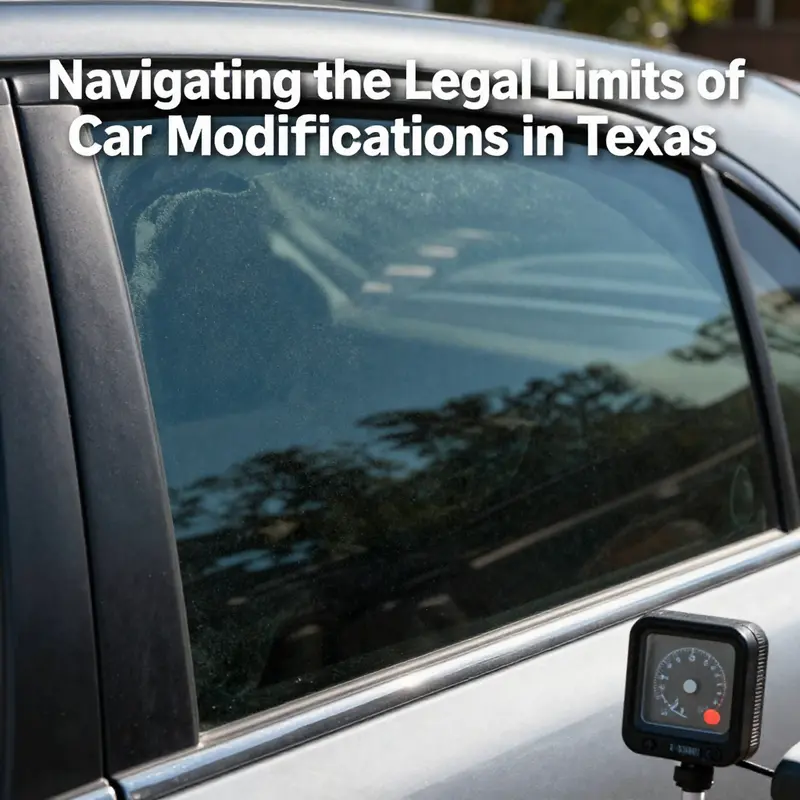
The Texas sun refuses to apologize. It beats down on dashboards, grills, and windshields with a heat that can felt as much as seen. In many places, drivers want a cooler ride, a touch of privacy, and a shield from glare. Window tint can deliver all those benefits, but in Texas, a careful line separates what’s stylish from what’s illegal. This chapter follows that line, not as a dry regulation lecture but as a practical map for anyone who wants heat relief and privacy without risking a citation or a trip to the side of the road with a flashing ticket. The governing idea is simple: tint is allowed, but darkness and placement have rules. The windshield, the front side windows, and the rear windows each fall under a different set of expectations that police officers, inspectors, and courthouses take seriously. The key is to understand what counts as a legal shade and how to stay within the margin while still achieving the benefits tint promises. The front portion of the windshield is the first major checkpoint. Texas law allows non-reflective tint on the top part of the windshield, but it must stay above the manufacturer’s sunshade line. In practical terms, that usually means keeping tint to the top roughly four inches from the top of the glass. Any tint applied below that point is illegal. This is not a vague suggestion but a specific boundary that is tested during inspections and reflected in citations. It is easy to think a darker tint will look cooler or offer more heat relief, but the front windshield is not a place to experiment beyond this boundary. The purpose behind this rule is straightforward: maintain adequate visibility for the driver, especially in bright or low-light conditions where glare can distort judgment or obscure a pedestrian, cyclist, or other driver. The same caution applies to how the front side windows are treated. The policy here is clearly stated: these windows must allow at least 25 percent visible light transmission, or 25% VLT. In other words, a tint no darker than 25% VLT is the legal minimum for the front driver and passenger windows. It is tempting to push deeper into the spectrum of dark shades to enjoy a sleeker look or more interior cooling, but anything darker than 25% VLT for the front side windows becomes a ticketable offense. The contrast with the rear windows could not be starker. The law places no minimum VLT requirement on the rear side windows or the rear window. A vehicle can have a rear window as dark as desired, even nearing limo-tint levels like 5% VLT, as long as the driver’s view through the rearview mirror is not obstructed. This is the one area where drivers often push the envelope, especially those facing extreme heat and glare in the Texas climate. Yet even here, the requirement is practical, not ornamental: the tint cannot obscure the driver’s view through the mirror. This nuance is crucial. It means the legal tint does not simply vanish when the sun dips low or when the car is packed with passengers. The enforcement officers observe not just the darkness but the impact on visibility from the driver’s seat. For many people, the practical question is not only “Is this tint legal?” but also “Will this tint actually help me see clearly while driving, at dawn, dusk, or at night?” To address that, some drivers use a mid-range solution: tint between roughly 35% and 40% VLT on the front side windows. This choice often balances noticeable heat and glare reduction with a level of visibility that remains compliant. It keeps the interior more comfortable without stepping into the area where law enforcement would consider the tint too dark for daytime or nighttime driving. The medical exemption is an important feature that recognizes individual health needs while preserving roadway safety. Texas allows a medical exemption for tinted windows when a physician certifies a condition that makes standard tint problematic. In practice, that means a physician’s certification must accompany the vehicle whenever the tint is used at a level beyond the standard limits. The exemption is not an automatic pass; it requires documentation and must be carried in the car. The certificate signals to officers that there is a legitimate medical reason for the darker tint. Carrying this documentation is essential, because if a driver is stopped for tint that violates the standard limits, the medical exemption becomes a critical part of the discussion in court or at the scene. The practical consequence of non-compliance can be more than a simple warning. A police officer can issue a citation, and the vehicle may be required to be re-tinted to a compliant level. In some cases, courts may impose fines or require corrective action to bring the vehicle back into legality. The result is not just a financial penalty; it is a disruption to daily life and, in some instances, a temporary burden of arranging the tint service again, scheduling re-inspection, or adjusting the vehicle’s appearance long enough to satisfy the law. For those who live in areas with strong sunlight and long, hot seasons, the temptation to push tint beyond the legal limit can be strong. The legal landscape in Texas emphasizes safety and visibility, not merely aesthetics. It is essential to approach tinting as a carefully calculated modification rather than a statement of style. If your goal is to improve heat reduction and reduce glare while staying compliant, there are straightforward decisions you can make. Opt for tint options that align with the front side window requirement and the top-windshield rule. Choose non-reflective films for the front windows to avoid any glare that might be misread by an officer as non-compliant reflective tint. Before installation, discuss the exact VLT targets with the installer, and request a written specification that can be presented if needed. This is not just about legality; it is about ensuring you can drive with confidence, knowing that your appearance does not come at the cost of a stop or a citation. The enforcement reality is that Texas law is not ambiguous in its limits. Officers use the standard measurements to determine if a tint is legal. The 25% front-side window rule is a common standard across the state, but it is the placement rules that often cause confusion: the top-of-windshield line and the need for non-reflective film on certain areas. The rear windows’ lack of a minimum VLT is a significant distinction, yet it comes with the caveat that the driver’s rearview mirror must remain unobstructed. For anyone documenting their vehicle’s modifications, it is worth keeping a copy of the relevant regulations and having it on hand during inspections or if questions arise during a traffic stop. This is not about evading the law; it is about understanding it well enough to comply and to avoid the friction that comes with misinterpretation. The broader context of car modifications in Texas includes many other kinds of changes that can trigger legal scrutiny. While tint is a frequent concern, illegal modifications can also involve VIN tampering, improperly displayed or hidden plates, or modifications that hinder safety features. The tint conversation, however, illustrates the state’s approach: clear limits, practical exemptions, and a path to lawful enjoyment of comfort and privacy without compromising safety. If you want to dive deeper into the bigger picture of what counts as legal car modifications in Texas, you can explore related discussions and guidance that frame these rules within the broader landscape of state regulations. For a concise overview that helps connect tint rules to other legal considerations, see the article on legal-car-modifications. legal-car-modifications. For official detail, consult the Texas Department of Public Safety and related statutes, which outline the exact text and interpretations that govern tint and other modifications. This context is essential because the line between compliant and non-compliant changes can shift with new regulations or local ordinances. As a practical takeaway, if you are considering tinting your windows, start with the front side windows at no darker than 25% VLT and keep the windshield tint in the top four inches, non-reflective. If you need darker tint for medical reasons, pursue the medical exemption with proper documentation and keep that paperwork accessible. And if you are unsure, consult a licensed installer who understands the state’s requirements and can provide certified documentation of the exact VLT and placement. The goal is a comfortable, cooler ride that remains clearly within the law, reducing heat without increasing the risk of a costly stop. For those seeking the most authoritative reference in one place, the Texas DPS site is the best starting point, along with the statute text that governs window tinting. Official details can be found at https://www.dps.texas.gov/.
VIN Under Fire: The Severe Consequences of Tampering in Texas and the Road to Legitimate Modifications
A vehicle identification number is more than a serial tag on a dashboard or door jam. In Texas, as in states across the country, the VIN is the formal proof of ownership, the key to a vehicle’s history, and a line in the ledger that ties everything together from title to insurance to enforcement. When that number is altered, obscured, or counterfeit, the entire system can unravel. The legal framework in Texas treats VIN manipulation not as a mere nuisance or a cosmetic trick, but as a serious offense with consequences that scale with intent, harm, and the potential to facilitate theft or fraud. This is not an argument about taste or style; it is about accountability, safety, and the integrity of the roadways. The core of Texas law rests on the simple premise that a VIN is a unique identifier assigned by the manufacturer and recorded by state authorities. When someone tampers with it, they disrupt the chain of title, complicate the ability to determine a car’s true history, and create a pathway for criminal activity. The gravity of that disruption is reflected in the penalties and the procedures that follow a finding of VIN tampering. In practical terms, this means the moment a vehicle’s VIN is altered or obscured with the intent to defraud, or to conceal information about ownership or origin, the clock starts ticking toward serious criminal exposure. The statute does not mince words; it assigns a spectrum of felonies that can turn a single act into years of prison time and substantial fines. The categories hinge on factors such as the offender’s state of mind and the relationship between the VIN alteration and any broader illegal conduct. The law is crafted to deter both opportunistic acts and more calculated schemes that rely on a manipulated VIN to pass a stolen vehicle off as legitimate, to obfuscate a vehicle’s theft history, or to evade enforcement beyond the border of ordinary civil disputes. The result is a carefully calibrated set of penalties designed to reflect severity while still preserving space for legitimate corrections when a VIN is damaged through no fault of the vehicle owner. At its core, the Texas Penal Code § 32.01 makes three things clear: it is illegal to alter, destroy, remove, or obscure a VIN; it is illegal to knowingly possess, sell, transfer, or use a vehicle with an altered, destroyed, removed, or obscured VIN; and it is illegal to use a false or forged VIN. Each clause is designed to address a different point in the lifecycle of a modified or misrepresented vehicle: the act itself, the possession or transfer of a vehicle with the tainted identifier, and the attempt to mislead others about the vehicle’s identity. The law recognizes that sometimes a VIN might need legitimate attention due to damage, manufacturing error, or a clerical oversight. In those cases, there is a lawful process to correct or replace the VIN, typically through official channels and with proper documentation. It is the unauthorized tinkering—whether grinding, stamping, or substituting digits—that falls outside the pale and triggers criminal exposure. The penalties reflect a graduated response that aligns with the degree of harm and the offender’s intent. A third-degree felony provides a baseline of two to ten years in prison and fines up to ten thousand dollars. The framework grows more serious if prior convictions exist or if the altered VIN was used to conceal theft, fraud, or to evade detection. In those circumstances, the offense elevates to a second-degree felony, carrying two to twenty years of imprisonment and the same potential $10,000 fine. If the tampering is part of a broader, more calculated criminal plan—such as fabricating a vehicle’s identity to commit other felonies, including trafficking stolen vehicles or evading law enforcement—the charge can escalate to a first-degree felony, with a penalty range stretching from five to ninety-nine years, or even life imprisonment, and fines up to $10,000. These state penalties are complemented by federal implications. Federal law, notably 18 U.S.C. § 511, makes it a federal crime to alter, remove, or tamper with a motor vehicle identification number with fraudulent intent. The possibility of federal prosecution introduces the prospect of longer prison terms and higher fines, and it aligns with broader criminal enforcement strategies that cross state lines and involve interagency cooperation. The weight of this law is also felt at the administrative level. The Texas Department of Public Safety (DPS) maintains that a vehicle with an altered VIN cannot be registered or titled legitimately. This is not a mere administrative hurdle; it is a tangible consequence that affects ownership rights, insurance coverage, and the ability to operate the vehicle on public roads. In practical terms, a car with an altered VIN may be seized or forfeited if the matter escalates, and the owner could face additional sanctions. It is no exaggeration to say that VIN tampering threatens every layer of the vehicle’s legal existence—from title and registration to insurance and resale value. For someone who enjoys car customization, the line between compliant modifications and illegal tampering can blur in a hurry if the intent is unclear or the process bypasses official channels. Cosmetic changes, performance upgrades, or aesthetic enhancements that do not touch the VIN are generally permissible, and many enthusiasts pursue these within the boundaries of state law. The moment the modification targets the VIN itself, or when a new identity for the vehicle is created outside the proper legal framework, the risk shifts from hobbyist exploration to criminal liability. It is not a risk worth taking, because the consequences extend beyond penalties. They reach into the realm of personal freedom, professional licensing, and the ability to drive or own a vehicle in a legally recognized way. To avoid this fate, it is crucial to approach vehicle identity with reverence and procedure. If a VIN plate is damaged or if there is a legitimate reason to request a VIN correction or replacement, the route is not to improvise but to contact the appropriate authorities, submit the necessary documentation, and follow through with the official channels for title work and registration. The legitimacy of the process matters as much as the outcome. In the course of discussing a topic as grave as VIN tampering, it is helpful to place a broader emphasis on how distinct categories of modifications are evaluated. A string of changes that affect a vehicle’s appearance or mechanical performance—without touching the VIN—may still touch on other legal concerns, such as emissions compliance, safety equipment, and correct labeling. These related issues often appear in the same conversations about legality and risk, prompting owners to ask tough questions about what is permissible and what is not. For readers who want a quick snapshot of the broader landscape, a concise guide to the “illegal car modifications” conversation can provide helpful context. See illegal-car-modifications for a related discussion that helps distinguish between appearance-oriented upgrades and actions that cross into illegal territory. The principle remains constant: legality hinges on intent, process, and the potential for harm, not merely on the outward look of the vehicle. The chapter on VIN tampering sits at the intersection of ownership integrity and public safety. It reminds readers that the highway is not a testing ground for improvisation and that the law expects a transparent, traceable record of a vehicle’s identity. A driver who chooses to modify a car must do more than dream up new aesthetics or improved performance; they must also respect the rules that govern how a vehicle is identified, recorded, and tracked through every phase of its life. When a VIN is involved, the stakes are especially high, because a single misstep can ripple through the entire system—from the moment a car is sold or stolen, to the moment it is repaired, insured, and ultimately retired. In the end, the safety and integrity of Texas roads depend not just on responsible driving, but on responsible stewardship of the identifiers that confirm who owns what and where it came from. The legal framework is precise, and the penalties are significant because the consequences of VIN tampering extend far beyond the individual. They affect victims of theft, the reliability of crime investigations, and the efficiency of the state’s regulatory system. For anyone contemplating modifications, the message is clear: pursue changes that improve your vehicle while preserving, and never compromising, its true identity. To stay compliant, seek advice from the Texas DPS or a licensed professional who understands the nuances of title transfers, VIN corrections, and the appropriate documentation required for any official VIN change. This approach protects you, your vehicle, and the roadways you share with others. External references to the statutory language provide an authoritative foundation for the specifics of the penalties described above. For the formal text of the statute, see the Texas Penal Code § 32.01. https://statutes.capitol.texas.gov/Docs/PE/htm/PE.32.htm
License Plate Regulations and Visibility Requirements in Texas Car Modifications: Keeping Identity and Compliance in Sight
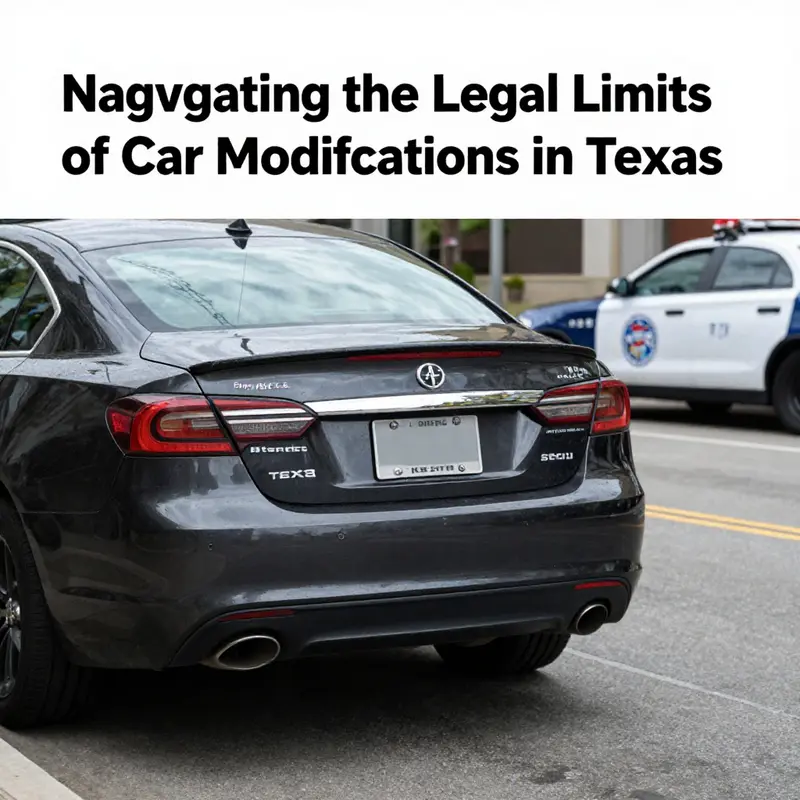
In the world of car modifications, a driver’s first line of accountability is often the most overlooked: the license plate. It is more than a decorative plate or a badge of ownership; it is a fixed, official identifier that allows law enforcement and regulatory systems to track a vehicle’s history, ownership, and compliance with safety standards. In Texas, this reality is underscored by a set of rules that bind the aesthetics and performance upgrades to the quiet, persistent gaze of enforcement and administration. What begins as a quest for personalization or enhanced performance can easily drift into illegality if the plate is obscured, relocated, or rendered illegible. The chapter you are reading is not a list of forbidden toys but a map of boundaries where modification meets public safety and orderly regulation. It is a reminder that responsible upgrading requires not only a dream for the ideal stance or the quiet roar of a tuned exhaust but also a practical respect for the system that keeps every vehicle identifiable on every highway mile.\n\nThe most recent shift in Texas vehicle regulation, effective July 1, 2025, centres on the mechanics of plate issuance itself. The Texas Department of Motor Vehicles (TXDMV) is phasing out paper temporary tags and replacing them with permanent metal plates issued to buyers at the time of purchase. This change is designed to streamline registration, reduce fraud, and improve the efficiency of the system that watches over every registered vehicle. It is a reminder that even administrative changes ripple into the street-level realities of driving, including what counts as a legal modification. When the plate in your car is part of the modification discussion, the new metal plate regime can interact with other alterations in nuanced ways. For instance, if a modification triples the distance between the plate and the camera’s line of sight, or shifts it behind protrusions that catch mud or glare, you are treading into questions of visibility that the law will scrutinize.\n\nAt the heart of Texas’s license plate rules is a straightforward premise: plates must be clearly visible and properly displayed on the rear of the vehicle, unobstructed by dirt, mud, snow, or any material that could impede legibility. This standard is not merely about aesthetics; it is a practical requirement designed to ensure rapid recognition by patrol officers, automated cameras, toll systems, and other readers of the plate. Obscuring the plate with aftermarket bumpers, oversized body kits, or custom exhaust setups may not always trigger a ticket by itself, but when such modifications impede readability from a distance—typically evaluated at around fifty feet during traffic stops—it becomes a subject of enforcement. The rule translates into concrete consequences: a citation wields the authority of the road, and a driver who cannot satisfy the serviceability of the plate can quickly find themselves entangled in administrative penalties, fines, or mandated reconfiguration to restore compliance. In other words, the quest for a standout look must respect the system that anchors a vehicle’s identity in traffic and in the records that ride along with it.\n\nThe new metal plate regime also intersects with how vehicles are presented to the road in other ways that touch the plate’s visibility. Texas law is explicit that alterations altering the placement or clarity of the license plate—such as installation of large aftermarket bumpers, aggressive body kits, or modifications to the exhaust that change the vehicle’s profile—may draw added scrutiny. The concern is not the modification per se but its effect on the plate’s legibility and the vehicle’s instant recognizability. A plate curling under a flared fender, or a plate mounted high on a grille that blocks head-on shots from cameras, creates a measurable risk: it makes the plate harder to read at a distance, undermining the very purpose of the plate’s existence. In practice, this means that while you can customize your ride, any change that hides or distorts the plate can become grounds for a citation. The balance between personal expression and civic duty here is delicate, and it demands proactive checking, not reactive justification after a stop.\n\nThe emphasis on plate visibility has broader implications for the lifecycle of mods. Any modification that alters a vehicle’s configuration—beyond mere aesthetics or performance—carries responsibility to ensure that the plate remains readable. If you engage in a build that involves substantial changes to the bumper geometry, underlying chassis, or overall silhouette, it is prudent to re-evaluate how the plate is mounted and protected. A well-executed modification plan should include a plate mounting strategy that remains compatible with the rear-facing plate’s required clearance and readability. In practice, this means choosing mounting hardware and placement that keep the plate flat, unobstructed, and at a height or angle that avoids glare or camera misreads, all while not compromising the reliability of the plate illumination or the plate’s own light.\n\nThere is a broader compliance horizon that drivers should navigate alongside plate visibility. Texas requires that the plate be legible not just under ideal conditions but in the varied realities of normal driving: dirt, rain, road spray, mud, and occasional snow must not render the characters illegible. The practical consequence is that any protective trim, cover, or clearance design must be evaluated for its performance in adverse weather and street-dirt conditions. Even mounting styles intended to minimize vibrations can inadvertently tilt or obscure the plate enough to provoke a stop. This is a reminder that the law views legibility as a multi-faceted standard rather than a single momentary snapshot. It calls for ongoing attention to how a vehicle looks on the road across different weather events, lighting conditions, and travel speeds.\n\nFor readers who are contemplating modifications that touch the plate or its rear presentation, there is a path that keeps you integrated with the regulatory framework. Engage with official sources to confirm what remains permissible and what crosses the line. The TXDMV website is the primary portal for current regulations and compliance standards. Where there is ambiguity, consult the Texas Department of Motor Vehicles and, when necessary, seek professional guidance from a certified mechanic with experience in state vehicle regulations. If you encounter a scenario where you believe a modification has been misinterpreted by enforcement or where you think a citation was issued in error due to an unclear plate presentation, there are established channels to report and review such concerns. For readers seeking practical guidance on reporting illegal car modifications or seeking clarification on questionable practices, you can follow this resource: How to report illegal car modifications.\n\nThe road to lawful customization is not a rejection of personal style but a call to plan for legal compatibility from the outset. That means verifying that any rear-plate installation, including during and after the transition to metal plates, preserves legibility from the mandated distance and remains free of obstructions. It also means recognizing that other facets of a build—such as lighting, exhaust, and body modifications—can indirectly affect how a plate is perceived by readers and law enforcement. A thorough approach to modification combines technical planning with a clear-eyed view of the regulatory landscape. It asks for proactive checks, not post hoc explanations, and it treats the plate as a critical hinge between self-expression and the social contract that governs safe and predictable driving on Texas roads.\n\nUltimately, the interplay between plate regulations and vehicle customization highlights a central truth for enthusiasts: legal compliance is not a constraint on creativity but a framework for responsible innovation. By prioritizing plate visibility, aligning with the 2025 metal plate transition, and ensuring that no rear-mounted element obscures or alters legibility, drivers can pursue performance and styling goals without compromising safety or legality. As you plan upgrades, keep the plate front and center in your design thinking. The result is a vehicle that reflects personal taste while remaining reliably identifiable to other road users, to law enforcement, and to the systems that track safety and compliance on Texas highways. If questions arise about how a specific modification interacts with plate visibility, a careful consultation with a qualified technician and a review of the official TXDMV guidelines can prevent misunderstandings and potential penalties before they occur. For continued clarity on current regulations and compliance standards, refer to the official source: https://www.dmv.texas.gov/.
Ringing for Compliance: Exhaust Noise Rules and Legal Modifications in Texas
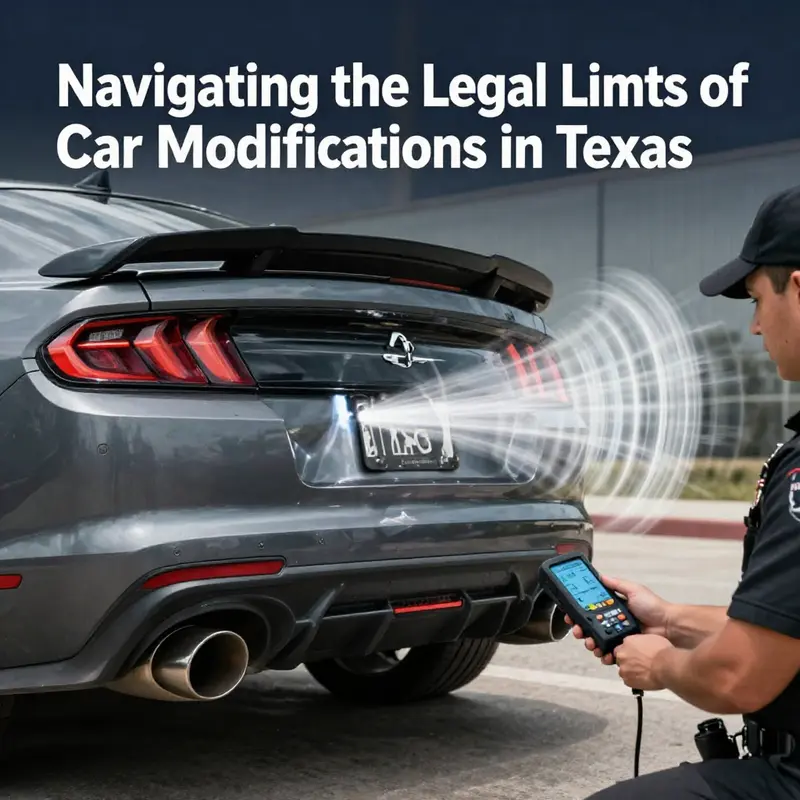
Noise is not merely a nuisance; in Texas, it can become a legal fault line that separates allowed customization from illegal modification. The state’s approach to exhaust systems sits at the intersection of public peace, safety, and individual automotive experimentation. Drivers who want a more aggressive or distinctive sound must navigate a framework that values performance and expression, yet demands restraint when that expression crosses into what authorities deem unreasonably loud. This balance is not a single, uniform standard but a tapestry of laws and local ordinances that vary by jurisdiction while resting on a shared statutory backbone. Understanding this landscape means looking at both the letter of the law and how it is interpreted on the street, in the shop, and during a midnight traffic stop.
At the core of the exhaust discussion in Texas is the prohibition on operating a vehicle with an exhaust that emits excessive or unusual noise. Texas Transportation Code Section 545.421 makes it illegal to drive a motor vehicle whose exhaust produces a sound that is “unreasonably loud” or “excessive,” especially if it can be heard from a distance of 25 feet or more. The phrase “unreasonably loud” is not defined by a single decibel measurement that applies statewide. Instead, enforcement relies on a combination of the vehicle’s characteristics, the context of the driving scenario, and the officer’s assessment of whether the noise causes a nuisance or constitutes a hazard. This subjective standard means that the same exhaust setup could be treated differently depending on time of day, location, and the cadence of the engine. The absence of a universal decibel ceiling can be confusing for enthusiasts who assume a fixed metric should govern all modifications, but it is precisely this flexibility that allows local officials to tailor enforcement to their communities.
Companion to the noise prohibition is another explicit restriction: muffler integrity. Section 545.422 targets modifications that would bypass or diminish the effectiveness of the factory muffler in ways that raise noise levels beyond what the state considers acceptable. Muffler cutouts, straight pipes, or any device that removes or alters the original muffler in a manner that amplifies noise are prohibited. The practical upshot is clear: if a modification makes the exhaust system louder than the design intent of the vehicle’s original equipment, it risks drawing a citation. The law thereby encourages aftermarket choices that preserve a baseline level of sound while still allowing for performance or tonal preferences, provided those choices stay within the bounds of regulation and do not translate to recklessness or public disturbance.
The line between legal modification and illegality, however, is not drawn in a vacuum. Texas acknowledges a broader reality: local jurisdictions frequently impose stricter controls to reflect urban noise climates, road usage, and neighborhood expectations. In large cities such as Houston, Dallas, and Austin, authorities actively enforce noise restrictions that can be more stringent than state defaults. A car that might be on the edge in a rural setting could easily be cited in a dense urban corridor if its exhaust announces itself with persistent volume. In practice, this means that a modification that passes muster in a quiet suburb could fail under city code during late-night hours, on busy boulevards, or near residential districts where sound limits are aggressively policed. The variability underscores a central point for Texas drivers: local rules matter, and even compliant-looking setups should be vetted against municipal codes before hitting the road.
Enforcement hinges on perception as much as on decibel measurement. Law enforcement officers assess factors such as the exhaust’s tonal character, the onset of resonance, and the duration of loud phases during idling or acceleration. The law does not provide a fixed decibel threshold across all contexts, which leaves room for interpretation. For enthusiasts who tune their exhaust for a particular roar or rasp, this ambiguity invites a practical, rather than purely legal, risk assessment. A modification that seems balanced and purposeful to a mechanic or a fellow car enthusiast can still become a citation if it disrupts nearby peace or safety. Conversely, a carefully designed, certified aftermarket exhaust that adheres to both federal and state noise standards may be treated as permissible, provided it does not exceed reasonable bounds in the eyes of enforcement officers.
To navigate this landscape, many drivers pursue a pragmatic approach. First, verify that any aftermarket exhaust appears to be installed with an intent to comply rather than to dominate sound. A reputable shop will consider the relevant Texas laws, the vehicle’s use, and the local noise climate when recommending a system. The emphasis is on maintaining a level of sound that respects neighbors and traffic conditions while preserving the intended performance benefits. Second, stay mindful of the setting. A daytime highway drive might tolerate a different acoustic footprint than nighttime cruising through a residential block. Third, recognize that modifications are not a one-and-done decision. If you relocate, change the vehicle’s use, or alter emissions equipment, re-check your compliance posture, because new circumstances can shift how a modification is viewed under the law.
The broader discussion of exhaust compliance cannot ignore the connection to other forms of modification that law enforcement and regulators monitor. A vehicle’s legality does not hinge solely on the exhaust. The overarching theme is whether a modification preserves safety, does not misrepresent the vehicle, and does not create an unreasonable disturbance. For example, while the muffler system may be the focal point of an acceptable modification, it sits within a larger framework that includes visibility, VIN integrity, and recognition that the vehicle remains safe and lawful in operation. In some cases, a modification that is technically compliant in one dimension could be disallowed if it interacts problematically with other components or misrepresents the vehicle’s identity or purpose. Thus, the broader caution is to approach modifications with a holistic mindset: each change should be vetted for how it harmonizes with safety, law, and the vehicle’s operating context.
For drivers seeking clarity, practical guidance blends official sources with professional consultation. The Texas Department of Public Safety (DPS) and local law enforcement agencies offer the authoritative interpretations that guide day-to-day enforcement. Additionally, consulting a certified mechanic who understands state and local regulations can prevent missteps that might otherwise lead to citations or vehicle compliance issues. It is also worth remembering that while the statute provides a frame, the enforcement experience can vary by jurisdiction. As a result, car owners who plan exhaust modifications should keep a disciplined record of the components installed, the installation process, and the certifications that accompany the exhaust system. Documentation can support a case for compliance should a traffic stop or an inspection test questions arise.
The interplay between state law and local practice matters because many owners want to strike a balance between personal expression and legal responsibility. In this sense, the exhaust conversation reflects a broader culture within Texas car communities: the desire for individuality, paired with respect for community standards and road safety. A thoughtful, standards-based approach to exhaust modifications can satisfy both impulses. When in doubt, consult the DPS or a trusted mechanic who specializes in state-regulated modifications to verify that your chosen path will not only deliver the sound you crave but also stand up to the scrutiny of Texas roads and regulations.
For readers seeking a broader view of lawful car modifications that extend beyond the noise issue, the community guidance often emphasizes a consistent, legally grounded approach. A broader discussion can be found at the resource focused on legal car modifications, which offers perspectives on how to distinguish compliant changes from those that risk penalties or penalties associated with unregistered or improperly documented configurations. See Legal car modifications for additional context about lawful approaches to altering a vehicle’s setup while staying within regulatory boundaries. This is not a substitute for local rules or DPS guidance, but it provides useful framing for enthusiasts who want to navigate the landscape with confidence rather than risk.
Ultimately, Texas’s approach to exhaust noise and related modifications is a practical example of how sound regulation operates in a diverse, dynamic driving environment. It recognizes the value of customization while insisting that the road remains safe, predictable, and respectful to neighbors. The absence of universal decibel standards does not create a free-for-all; it creates a framework where sound must be managed within the broader constraints of public order and vehicle safety. As you plan any exhaust-related upgrade, remember that legality is not a static barcode but a living policy that requires diligence, local awareness, and professional guidance to ensure that the roar you chase remains a controlled, lawful expression rather than a citation in disguise. For the precise statutory language that shapes these rules, consult Texas Transportation Code § 545.421 and related provisions, which define the boundaries of acceptable exhaust noise and the modifications that regulators will scrutinize. https://statutes.capitol.texas.gov/GetStatute.aspx?LegData=545.421
null
null
Final thoughts
As a passionate modder in Texas, understanding legal limitations is as crucial as the appreciation for automotive design. Each chapter of this guide illustrates significant aspects of modification regulations—tinted windows, VIN alterations, license plate visibility, exhaust noise, and lighting rules. By adhering to these constraints, you not only protect your investment in your vehicle but also foster a safer driving environment for all. Be an informed enthusiast, and choose modifications that enhance your car legally while still reflecting your unique style.