
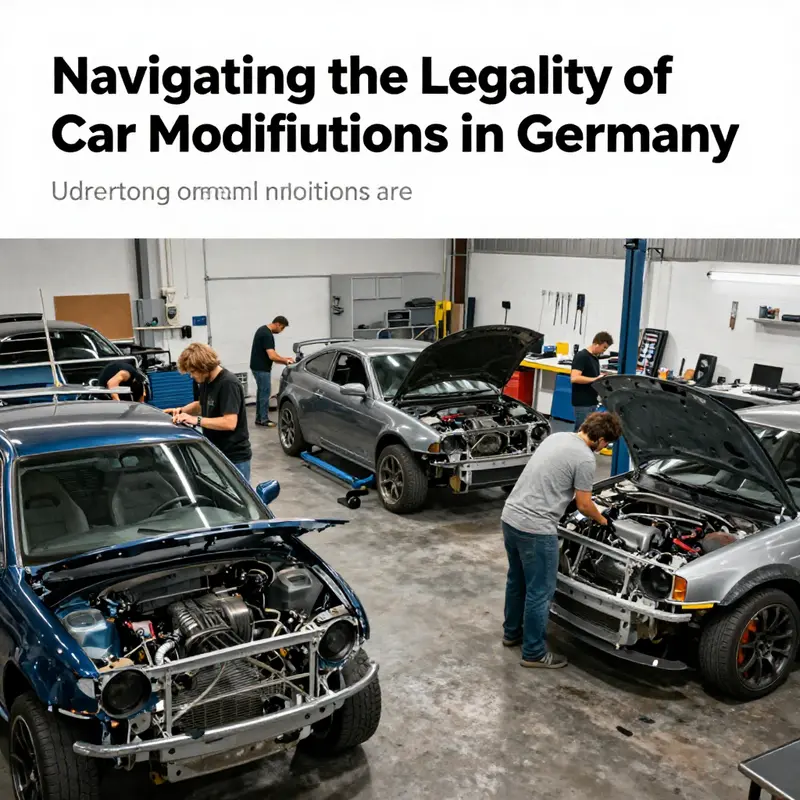
Modifying a car is often a labor of love for enthusiasts, but in Germany, this comes with specific legal considerations. Safety, environmental compliance, and roadworthiness are paramount in car modifications. From aesthetic enhancements to performance upgrades, knowing the legal landscape can save hobbyists and professionals from penalties and ensure their vehicles remain roadworthy. This article explores what modifications are legal, what changes might breach regulations, the process for approval and registration, and the distinction between aesthetic and performance modifications, providing a comprehensive guide for anyone looking to modify their vehicle in Germany.
null

null
Illegal Modifications in Germany: Understanding What Is Prohibited to Safeguard Safety, Emissions, and Roadworthiness
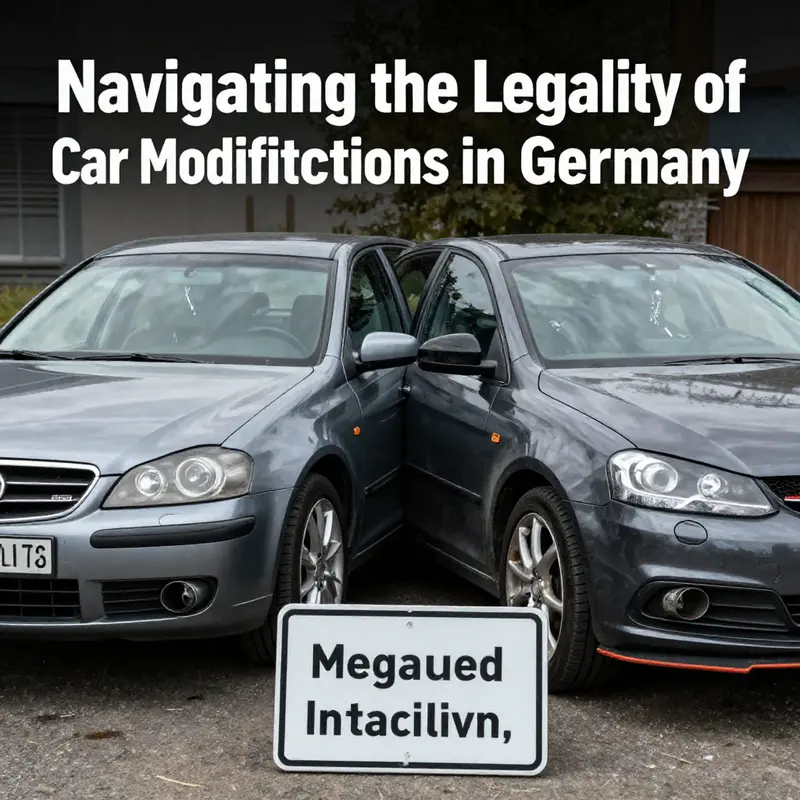
Germany’s rules on car modifications balance individual customization with road safety. Modifications are assessed for their impact on safety systems, crash performance, emissions, and conformity to the vehicle’s type approval. Anything that alters fundamental safety features, the crash structure, or environmental performance often requires formal certification and registration before it may be driven on public roads. The framework emphasizes that changes should not undermine the guarantees of the original type approval.
Key areas of scrutiny include engine tuning or power upgrades beyond the manufacturer’s approved specifications, exhaust systems that increase noise or disable emission controls, and changes that bypass or weaken safety systems. Any such modification typically must be certified and declared in the type approval documents before use.
Lighting, windows, tires, and suspension changes are also regulated. Non-homologated lights, excessive tint, or tires that do not match approved sizes can fail inspection, while suspension changes may affect handling and crash performance and thus require certification.
Safety equipment must not be removed or disabled. Removing airbags or seatbelts is illegal, and even modifications that affect restraint systems require careful evaluation and formal approval. Hauptuntersuchung (the mandatory periodic vehicle inspection) and professional inspections by TÜV or DEKRA verify ongoing compliance.
Practical guidance: keep documentation of any modifications, obtain official certification before installing parts that affect safety or emissions, and consult the licensing authority if in doubt. Noncompliant vehicles risk fines, penalties, failed inspections, and possible impoundment, as well as insurance issues and loss of coverage in the event of a claim.
Bottom line: certification and compliance are central in Germany’s modification regime. Cosmetic changes that do not affect type approval may be permissible if they pass inspection, but anything that alters safety, emissions, or the vehicle’s fundamental design should be planned with the appropriate testing authority.
null
null
Beyond Looks and Power: Navigating What Modifications Are Legal in Germany
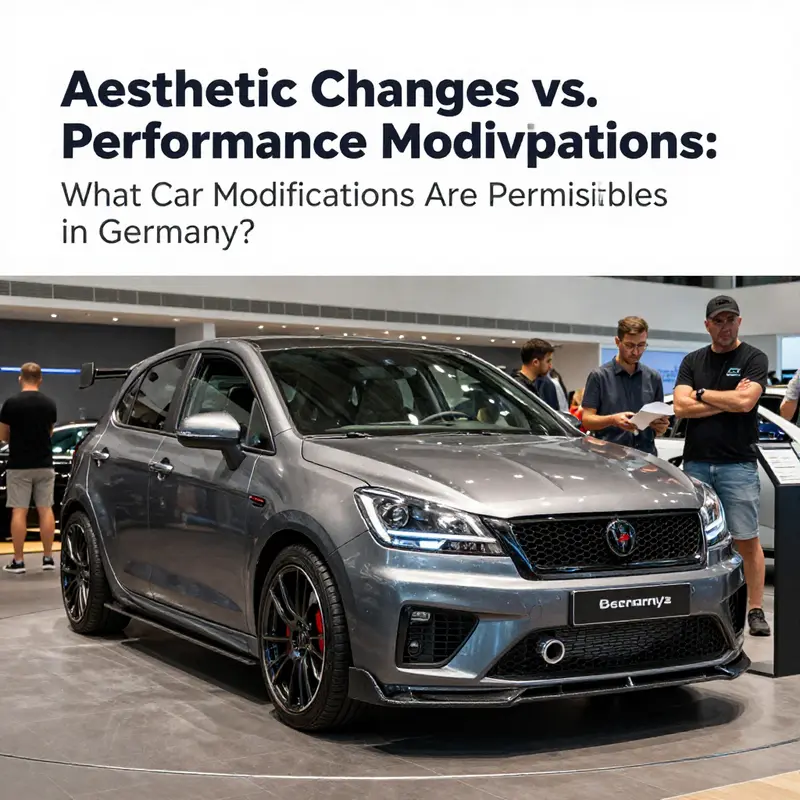
Germany sits at the crossroads of personal expression and public safety, where the desire to tailor a car meets a precise framework designed to keep roads safe and emissions in check. The chapter that follows doesn’t merely catalog what you can do to your vehicle; it traces how rules, institutions, and everyday driving realities shape the practical limits of modification. The result is a landscape where aesthetics, performance, and safety must align with official approvals, tests, and registrations. In this environment, what looks like a simple tweak can unfold into a chain of compliance steps, each with its own costs, timelines, and potential consequences if overlooked. Understanding this flow matters not only for legality but for preserving the vehicle’s value, reliability, and the peace of mind that comes with compliant ownership.
Aesthetic changes, on the surface, invite creativity without necessarily inviting trouble. The German system recognizes that cosmetic updates—paint choices, wheels, body kits—are part of vehicle culture and individuality. Yet they operate within hard boundaries designed to preserve the vehicle’s original type approval, or typegenehmigung. In practical terms that means changes must not alter a car’s fundamental geometry or safety characteristics. Minor cosmetic alterations, such as a fresh paint job, are typically permissible as long as the paint does not affect the vehicle’s original type approval. Custom wheels, likewise, are allowed within specified size and offset limits that do not destabilize handling or undermine braking performance. And aftermarket body kits are acceptable only if they do not change the silhouette or overall dimensions of the car. The aim is to let owners refresh appearance and personalize style while ensuring the vehicle remains within the safety envelope that was tested and certified at the factory level.
Yet even within the realm of aesthetics there are sharp lines. One deceptively simple modification—the tinting of windows—gets immediately thornier. The German authorities regulate tinting to preserve driver visibility and ensure that law enforcement can assess occupants and situations adequately. The rule of thumb is that tinting must not reduce visibility below specified minimum light transmittance. In practice that means front windshields usually must maintain around 70% light transmission, while side windows typically require at least 50% transmission. Those numbers are not merely guidelines; they reflect enforceable standards tied to road safety, and failing to meet them can invite fines, required removals, or more rigorous technical inspections. And lighting remains a gatekeeper of compliance. Any modification to lighting must be harmonized with homologation and technical specifications. Upgrades or replacements that do not meet the defined standards—for example, non-homologated or excessively bright exterior lighting—are likely to trigger inspections and potential penalties.
Aesthetic modifications also intersect with the broader regulatory framework that governs the vehicle’s homologation status. This is where the concept of type approval becomes central. If a modification would undermine the car’s original regulatory classification, it can no longer be treated as a simple bolt-on update. In such cases, revalidation through a formal approval process becomes necessary. This process often involves certified testing at recognized institutions like TÜV (Technischer Überwachungsverein) or DEKRA, and it can entail substantial costs and time. The emphasis on maintaining type approval ensures that even as owners pursue personal expression, the vehicle remains within a safety and environmental envelope that the system has already verified across all relevant crash tests and performance criteria. It is this careful balance—between opportunity for customization and rigorous verification—that defines what is permissible on German roads.
When shifting focus from aesthetics to performance, the terrain becomes considerably more rugged. Performance modifications—engine tuning, turbochargers, superchargers, exhaust system changes—are governed by even stricter rules because they directly affect emissions, fuel efficiency, and dynamic safety. Any alteration that could alter power output or emissions requires official approval, and often a pause in the normal registration cycle to undergo Hauptuntersuchung, the mandatory technical inspection that accompanies changes affecting safety and environmental performance. In practice, an alteration to increase horsepower beyond the manufacturer’s specification is not a casual upgrade. Owners must secure certification and, in many cases, revalidate the entire configuration to ensure continued compliance with EU emissions standards. The consequences of proceeding without such certification can be severe: fines, penalties, or the vehicle being deemed unfit for road use. The standards are not mere bureaucratic hurdles; they are designed to prevent situations where increased performance translates into elevated risk for the driver, passengers, and other road users.
Even more sensitive are the modifications to exhaust systems. They sit at the intersection of noise regulation and emissions control. An unapproved exhaust can produce excess noise, breach sound limits, and push emissions beyond legal thresholds. In Germany, the exhaust system isn’t just about performance; it is a compliance component wired to environmental protections and vehicle testing regimes. The moral here is that a performance upgrade is not an invitation to bypass verification—the opposite, in fact. Only with proper documentation, tested performance, and a proper homologation can such upgrades be considered legal.
The interior and safety domain provides another layer of lawful enhancement. Installing advanced safety features or upgrading seat belts can be legal or even encouraged, depending on how the change integrates with the vehicle’s safety architecture and certification. Features that strengthen occupant protection or enhance driver assistance systems may be permissible if they do not undermine the integrity of the original safety design. The regulatory calculus becomes subtler in this space because advanced systems must be compatible with the vehicle’s existing electronics and safety protocols. Even as technology advances and households seek more protective or intelligent driving aids, the German system requires evidence that these additions meet the same rigorous standards as the rest of the vehicle and have undergone appropriate inspections.
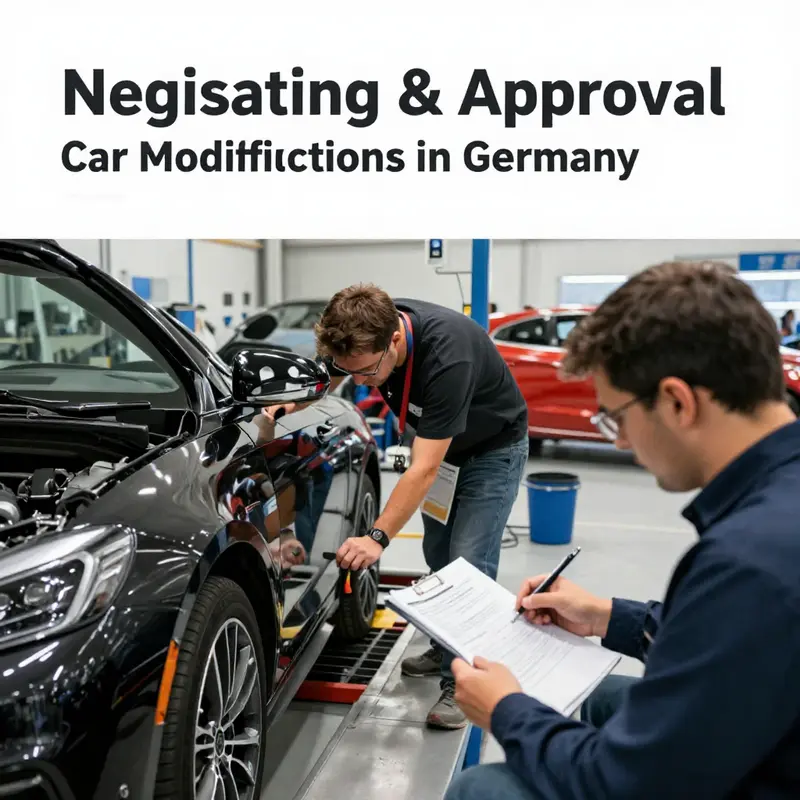
All of these pathways converge in the practical steps of registration and approval. Any modification that touches safety, emissions, or structure must be registered with the Kraftfahrt-Bundesamt (KBA), the Federal Motor Transport Authority. The process typically runs through a Hauptuntersuchung at an authorized testing station, such as TÜV or DEKRA, where a technician verifies that the modification complies with the relevant standards and has not compromised the vehicle’s crashworthiness or environmental performance. This is not merely a formality; it is an evaluative moment where the vehicle’s modifications are cross-checked against the original type approval and current regulations. The costs associated with certification and inspection can be significant, and delays are possible if the modification requires additional testing or documentation. The centrality of the KBA in Germany’s system means that credible, up-to-date information should be sought from official channels. Guidance and the most current stipulations can be found on the official KBA website, which serves as the authoritative reference point for type approval, modification allowances, and the steps to certification.
For readers seeking a concise overview that translates these formal rules into practical guidance, consider this resource on legal car modifications. It offers a more accessible entry point to understand what is typically allowed and what commonly triggers required approvals: legal car modifications.
In practice, the dance between personal customization and compliance hinges on planning, documentation, and a clear-eyed respect for the boundaries that keep roads safe and the vehicle market stable. A well-planned modification path starts with identifying whether the intended change could affect the car’s type approval. If so, expect a certification step, potentially involving TÜV or DEKRA testing, and a re-registration procedure that aligns the vehicle with the new configuration. If the modification is cosmetic or does not affect safety or emissions, the path is usually smoother, but it still requires awareness of the relevant limits—dimensional changes, lighting standards, and the necessity of having any non-factory parts properly installed and certified. Knowing which category your plan falls into saves time and prevents the frustration of discovering later that a change was not legally permissible or required post-installation paperwork.
The broader picture also includes practical realities beyond the garage. Germany’s enforcement culture emphasizes compliance, but it does not aim to stifle personal expression. The solution lies in approaching modifications as a regulated project rather than a casual upgrade. Owners who invest in reliable, certified parts and collaborate with recognized testing bodies typically achieve a smoother path to admissibility. This collaborative approach can also help protect resale value, as documented modifications with approved pathways are generally more straightforward to certify in another jurisdiction or in future private sales. The knowledge base that supports this approach grows as regulations evolve, driven by concerns about safety, emissions, and the evolving landscape of vehicle technology.
In this light, it is worth acknowledging that the regulatory environment also interacts with everyday travel realities. A telling example is the need to plan ahead rather than improvise when operating a modified vehicle in Germany. The road network and enforcement practices reward preparation: documents, inspection appointments, and proof of compliant parts should be ready, not improvisations in the field. The example of on-the-go decisions—such as attempting to address a sudden mechanical question without proper spare parts or regulatory clearance—illustrates how risk rises when modifications lack formal validations. The underlying lesson is straightforward: understanding and respecting the regulatory framework reduces risk, saves money, and preserves the vehicle’s utility over time.
As readers consider their next steps, the key is to map intent to process. Cosmetic improvements that don’t disturb the type approval can often be realized with modest timelines and cost. More ambitious performance or safety enhancements require careful alignment with testing regimes, and in some cases, funding for professional validation. The German system rewards transparency and documentation, and it makes sense to build a compliance plan early in the modification journey. This approach helps ensure that after the work is done, the vehicle can stay on the road without unwelcome surprises during inspections or resale.
For those who want a direct reference to the formal framework, the official guidelines maintained by the German Federal Motor Transport Authority (KBA) remain the best resource. They outline how type approvals apply to various modifications, how to proceed with registrations, and what tests and certificates are required to maintain roadworthiness. While the process can seem intricate, it is ultimately designed to safeguard traffic safety and environmental performance, ensuring that a vehicle remains compliant as technologies evolve. By following these channels, owners can pursue their preferred aesthetic or performance enhancements with confidence that their car will continue to perform safely and legally on Germany’s roads.
External resource: https://www.kba.de/EN/Vehicles/TypeApproval/TypeApproval.html
Final thoughts
Understanding the complexities of car modification regulations in Germany is crucial for enthusiasts and professionals alike. The line between legal and illegal modifications can often be fine, and neglecting these laws can lead to unwanted complications. By knowing what changes can be legally made and how to navigate the registration process, modifiers can enjoy their passion while staying compliant with the law. As car culture continues to grow, staying informed empowers enthusiasts to make savvy decisions that enhance their driving experience without compromising safety or legality.