
California enforces strict vehicle modification rules to protect air quality and community noise levels. This guide outlines common illegal modifications and provides a path to lawful upgrades for enthusiasts, hobbyists, and professionals alike.
California Emissions and Tuning: Understanding CARB’s EO Process

California’s approach to vehicle tuning is guided by emissions control requirements. The California Air Resources Board (CARB) oversees the emissions performance of mobile sources and enforces rules to ensure road vehicles meet the standards they were certified to when new. This means that modifications affecting emissions must be certified or listed on CARB’s EO (Executive Order) program as compliant for on-road use. Without an EO, a part or tune is generally not permitted on public roads.
Key areas include catalytic converters, oxygen sensors, exhaust systems, and engine management software. Modifications that bypass or disable emission controls or alter the air-fuel balance without EO approval are typically unlawful. The EO process provides documentation showing that a change has been reviewed and certified to meet emissions standards, helping inspectors and owners avoid penalties and vehicle immobilization.
For performance enthusiasts, the path to compliant upgrades is through certified parts and professional installation, with careful record-keeping: EO numbers, certification documents, and receipts should be kept in the vehicle. This ensures that upgrades can be verified during inspections and audits.
Non-compliance can lead to failed smog tests, registration issues, fines, and even criminal charges in extreme cases. CARB’s framework aims to balance innovation and performance with public health and air quality.
Crossing the Emission Line: The Legal Fallout of Turbocharging and Other Modifications in California
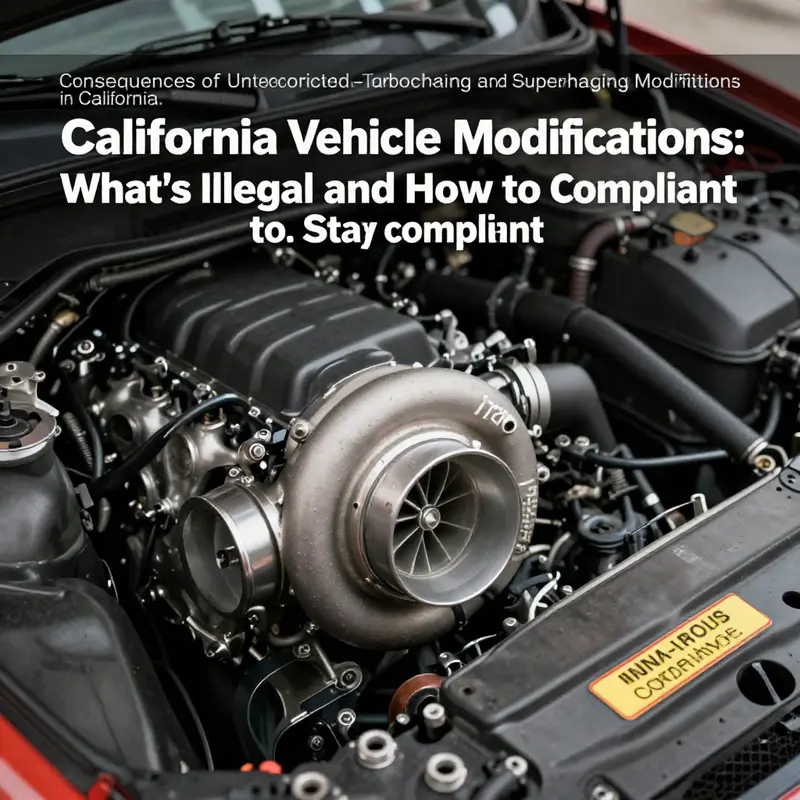
California’s roadways carry more than cars and drivers; they carry a regulatory mindset built on reducing smog and protecting air quality. The state’s framework isn’t simply about a preferred aesthetic for performance cars. It’s about standardized systems designed to cap pollutants at the levels a vehicle was certified to meet when it rolled off the factory floor. At the center of this framework sits the California Air Resources Board (CARB), a agency whose authority over emissions and vehicle modifications extends well beyond a casual ban on “hot-rodding.” When a car owner modifies an engine, exhaust, or control systems in ways that bypass, disable, or overwhelm the factory’s emissions controls, those changes are not just questionable in taste; they are potentially illegal actions that trigger a series of civil, administrative, and sometimes criminal consequences. The intent of this chapter is not to dampen the curiosity of enthusiasts but to illuminate what constitutes crossing a regulatory line and what that crossing can cost in practical terms across inspections, registration, insurance, and daily use on public roads. The state’s emphasis on preventing extra pollution means it treats certain acts as tampering with an emission control system. In this sense, the line between performance and compliance is not a gray area for California; it is a bright, enforceable boundary that guards the air we breathe and the integrity of emissions testing nationwide. The conversation begins with turbocharging and supercharging, a category often pitched as a straightforward upgrade in horsepower but that, in California, can become a legal minefield if the modification has not earned CARB’s explicit certification under its Executive Order (EO) program. A turbocharger or supercharger can dramatically alter an engine’s air-fuel mix, boost pressure, and timing, which in turn changes the vehicle’s emissions profile. If that alteration is not evaluated and certified for use on public roads, it is treated not as a simple mod but as tampering with a vehicle’s emissions control system. CARB’s doctrine is clear: any modification that causes a vehicle to emit more pollutants than it did when certified is unlawful. This isn’t a theoretical risk; it is a practical constraint that affects how enthusiasts plan upgrades and how shops approach tuning work. When a modification lacks an EO number, California law recognizes the change as non-compliant. Car enthusiasts may yearn for the thrill of more boost, sharper throttle response, and faster quarter-mile times, but the reality is that the state imposes a high bar for what counts as a legitimate, road-legal upgrade. The EO process exists to verify that a given part or modification will not cause emissions to spike beyond what the vehicle was certified to emit. Without that verification, the modification sits outside the legal framework, exposing the vehicle to a range of compliance issues at every stage of ownership, including inspections and registration. Those who pursue unapproved forced induction should be prepared for more than a warranty dilemma: they risk failing California’s mandatory smog inspections, which can prevent vehicle registration renewal and, in some cases, trigger DMV penalties. The smog test in California is not a courtesy check; it is a state-mandated examination designed to verify that a vehicle’s emissions system still functions within the parameters set during the certification process. A vehicle that has had its turbocharging or supercharging modified in ways not approved by CARB may fail the test because the emissions data it presents do not align with certified standards. When a failure occurs, the owner faces the practical consequence of an out-of-compliance vehicle that cannot be registered until the issue is remedied—often a costly undertaking that requires removal or reversion of the modification or retrofitting with compliant components. Even beyond inspections, the legal framework views unauthorized turbocharging as tampering in the eyes of law enforcement and the DMV. Repeated violations compound the risk, drawing escalating penalties that can include fines, suspension of vehicle registration, or court action. It is not merely a bureaucratic nuisance; it constitutes a legal jeopardy that can disrupt daily transportation, affect financing, and complicate resale. Insurance is another critical axis of risk. Many insurers assess the risk profile of a modified vehicle and may exclude coverage for modifications that the insurer considers unapproved or noncompliant with emissions regulations. In a collision or loss scenario, an insurer might contest claims or reduce payouts if the damage involves components altered outside the EO framework. This is not a hypothetical complication. Insurance contracts often hinge on maintaining compliance with regulatory standards, and coverage denial or premium increases can follow if a vehicle is found to be operated with illegal modifications. The consequences extend beyond the mechanical and the legal into the financial and practical spheres of ownership. The issue is not limited to turbocharging alone. California’s modification landscape includes restrictions on the removal or disabling of factory-installed emissions-control devices. Catalytic converters, exhaust manifolds, and oxygen sensors, among others, are designed to limit pollutants as the engine burns fuel. Removing or bypassing these devices does not merely increase emissions; it also disrupts the vehicle’s ability to meet the certification standards that underpin road-legal status in the state. Even the act of installing aftermarket parts that bypass or defeat emissions systems is treated as illegal tampering if it results in higher pollutants than the vehicle was certified to emit. These actions carry the same weight as unauthorized turbocharging in terms of inspection outcomes, registration, and potential penalties. The regulatory framework recognizes that some modifications, though technically possible, undermine the integrity of the emissions-control system and thereby threaten air quality. Another dimension of legality concerns the exhaust system itself. California regulates not only what an exhaust can do in terms of performance, but also how loud it can be and whether the exhaust meets emissions standards. Aftermarket exhausts that exceed noise limits or do not carry the required emissions certifications may be deemed unlawful. A commonly cited benchmark in California is the noise level, which, at idle, can trigger concerns about compliance when it surpasses the state’s decibel thresholds. While 85 decibels at idle is a frequently cited figure in California’s regulatory discussions, the precise limits may be codified in specific statutes or regulations, and enforcement can be case-by-case. In practice, a loud exhaust may fail not only on nuisance grounds but also on emissions grounds if it alters backpressure or exhaust flow in ways that affect the catalytic converter’s performance. Such outcomes create a dual risk: a vehicle that sounds powerful but that also risks failing emissions testing and incurring penalties for noncompliance. Finally, the terrain of legality extends to devices that alter engine timing or fuel delivery beyond what the factory controls allow. Aftermarket “chip” programmers and tuning devices claim to optimize performance by recalibrating fuel maps, timing, and boost limits. California’s authorities treat many of these devices as illegal unless they have obtained CARB certification and an EO authorization. The risk is that these tools, when used without certification, can increase pollutants and disrupt catalytic converter function, pushing the vehicle beyond the limits of its certification. In short, California’s stance on modifications is oriented around preserving the integrity of the emissions system and ensuring that any alteration has been thoroughly vetted under the EO program. That is not an obstacle to performance by design; it is a framework that seeks to preserve air quality while still allowing certified, safe, and verifiable upgrades. For readers seeking a concise entry point into the broader discussion, a helpful overview exists that discusses the scope of illegal modifications in California. This resource offers a grounded sense of what falls outside the regulatory boundary without getting lost in the technical minutiae of every potential upgrade. illegal car modifications in California. Beyond the paragraphs above lies a broader, more consequential truth: in California, the dream of extra horsepower must always be weighed against the state’s duty to protect air quality, and the legal path to greater performance runs through the CARB EO certification process. When a modification earns an EO number, it becomes a recognized, road-legal option that has been validated for emissions and safety. When it does not, it remains suspect, exposing the vehicle to regulatory actions and the practical costs of noncompliance. Enthusiasts who respect the rules can still pursue meaningful performance gains by focusing on certified parts and carefully planned upgrades that preserve the integrity of emissions systems. They can work with shops that understand the EO process, ensure that any boost or power-adder is certified, and maintain meticulous documentation that demonstrates compliance during inspections and potential future sales. The discipline of compliance becomes part of the engineering challenge rather than an impediment to innovation. A well-documented approach also helps avert negative outcomes in the insurance and resale markets, where the perception of risk can influence coverage terms and value. The road to performance in a state like California is thus a balance, not a surrender. It is the product of understanding the regulatory framework, choosing parts that CARB has tested and approved, and maintaining the vehicle in a way that preserves both performance and compliance. For readers who want a practical starting point, the official regulatory resources provide the authoritative map. The California Air Resources Board’s regulations and guidance on EO-certified parts and emissions-compliant modifications are the most reliable reference points for anyone planning upgrades. External resources are essential to grounding any modification project in verified compliance. See the official CARB regulations for detailed guidance on how emissions controls are managed and how EO-certified components are evaluated as part of the broader framework that governs vehicle modifications in California. As a concrete next step, check the state’s emissions-regulation pages and speak with a qualified technician who understands both performance goals and the critical requirement to remain within legal boundaries. For further context on how the emissions framework is implemented and what constitutes tampering versus a permitted upgrade, see the detailed regulatory landscape outlined by CARB. External resource: https://www.arb.ca.gov/regulations/evap/evap.htm
When Exhaust Becomes Evidence: Navigating California’s Prohibited Aftermarket Exhausts and Emissions Rules
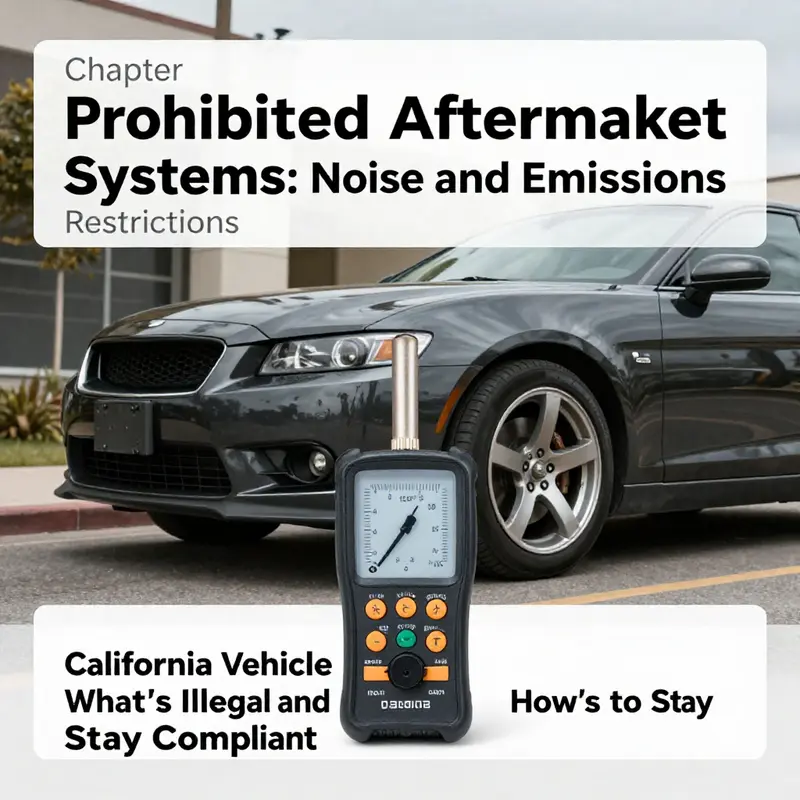
California’s reputation for drive-seasoned rigidity extends beyond its landscape of steep hills and sprawling coastlines. It lives in the air you breathe and the road you ride. For anyone curious about what car modifications are no longer legal in the state, the answer is less a simple yes-or-no and more a careful balancing act between performance desires and environmental stewardship. Among the most contentious frontiers is the aftermarket exhaust, a modification many hope will sharpen throttle response or transform a car’s soundtrack, yet one that CARB treats as a potential threat to air quality and community quiet. The practical reality is that the legality of exhaust work hinges on two intertwined standards: emissions compliance and noise control. In California, an exhaust system isn’t just a bolt-on accessory. It is a regulated component that carries the authority of the California Air Resources Board, which requires that installed parts be tested, certified, and traceable to an Executive Order, or EO, number. Without that EO designation, the part cannot be legally used on public roads. This is not an abstract safeguard. It is a concrete gatekeeper intended to prevent even well-intentioned upgrades from turning into polluting liabilities or public nuisances. The logic is straightforward on paper: if a modification makes a vehicle emit more pollutants or break the integrity of its certified emissions system, it becomes unlawful. In practice, this translates into a practical, sometimes frustrating, hurdle for enthusiasts and small shops alike. The EO program is the linchpin of California’s regulatory approach. When an exhaust kit or cat-back system carries a valid EO, it signals that CARB has evaluated the component and deemed it compatible with California’s emissions standards. If a system lacks that EO, or if the installation bypasses the emissions controls, the modification is non-compliant. It is not merely about performance gains; it is about accountability to the air that thousands of Californians breathe daily. The interplay between emissions and noise further complicates the equation. Even a CARB-approved exhaust can become a legal minefield if it amplifies sound beyond the statutory threshold. California Vehicle Code § 27000 and related provisions set boundaries for what is considered excessive or unusual noise. The lines here are not drawn in a single decibel figure that applies to all contexts. Instead, the state’s approach considers the vehicle’s design, the environment, and the practical impact of the noise. A system that is perceived as a constant, disruptive howl—think straight pipes or ultralight mufflers—might push a vehicle into non-compliance even if its emissions remain within permitted limits. The commonly cited benchmark around idle noise levels—often framed as a general reference point of around 85 decibels for certain contexts—serves as a practical yardstick, but it is not a universal ceiling. Law enforcement has broad discretion to interpret noise in relation to public comfort, safety, and the potential disturbance to nearby residents. The result is a compliance landscape where a technically certified system could still draw a citation if the resultant sound is deemed excessive in a given setting. It is this dual emphasis on emissions integrity and acoustic behavior that makes California’s exhaust regulations both comprehensive and, at times, confounding for the everyday builder. In a state where air quality standards are a public health measure and where neighborhood peace is a civic value, the same exhaust tweak that might pass muster in another state can trigger a ticket here. The recommended approach for consumers is not to chase the loudest or the fanciest kit, but to pursue systems that are CARB-certified with a valid EO, while also meaningfully assessing the noise footprint. This means verifying the EO number, reviewing test data for both emissions and noise, and insisting on professional installation to avoid inadvertent changes to the exhaust routing or catalysts that could nullify the certification. The goal is to strike a balance: preserve the vehicle’s performance characteristics within the legal envelope while sustaining the community’s well-being and the state’s air quality commitments. The regulatory framework also recognizes that the aftermarket ecosystem is diverse. Engineers, small businesses, and hobbyists all participate in California’s car culture, and the enforcement narrative reflects that reality. Some shops specialize in CARB-compliant configurations, while others, perhaps drawn by the allure of faster cars and more aggressive sounds, may push parts that lack EO numbers or offer modifications that could defeat emissions controls. The governing principle remains unwavering: a modification is lawful only if it has been joined to the state’s certification framework and does not undermine the vehicle’s emissions or create undue noise. For consumers, this means a disciplined procurement process. Begin with a careful product vetting routine: confirm the EO number on the packaging or the manufacturer’s documentation, request CARB test results or independent third-party verification, and inspect the installation plan to ensure no modifications undermine the vehicle’s catalytic system or oxygen sensors. A reputable shop can provide a transparent chain of custody for the exhaust components and a pre-installation assessment to anticipate potential regulatory concerns. This is also where the broader topic of “what car modifications are no longer legal in California” converges with everyday ownership realities. The state’s modification landscape is not a single, monolithic rule set; it is a mosaic shaped by emissions science, local ordinances, and public tolerance for noise. For example, a system that remains within the emissions envelope but is paired with an unusually aggressive muffler may trigger a noise citation in a residential area, while the same system installed on a different street or at a different hour could ride out with fewer concerns. The enforcement variable is real, and it means that owners and installers must understand not only the regulations in the abstract but how they play out in neighborhoods, at smog testing facilities, and during routine traffic stops. Toward that end, the landscape is not simply a checklist but a set of practices that safeguard both compliance and safety. The right approach emphasizes documentation and accountability. Keep receipts for all parts and professional labor, maintain a clear record of EO numbers, and ensure a compliant installation that preserves the functionality of the vehicle’s emission control devices. This is critical because the removal or bypassing of factory-installed emissions control devices—such as catalytic converters, exhaust manifolds, or oxygen sensors—remains categorically unlawful in the state. Even the most well-intentioned performance upgrades can become liabilities if they lead to higher pollutant output or if the modifications obscure the vehicle’s ability to meet the certification baseline. The underlying objective is not to quash creativity but to preserve cleaner air and public peace. If you find yourself wrestling with the tension between a dream build and a regulatory boundary, a prudent path is to engage early with a CARB-compliant shop and to consult CARB’s resources directly. The official agency site provides the EO database, product certification lists, and clarifications on what counts as a legitimate modification under state law. While the process can feel slow or exacting, the payoff is clear: a road-legal setup that avoids tickets, keeps your vehicle within test standards, and respects the communities that share the same streets you do. For readers who want a more narrative sense of how these rules shape the modern car scene, consider the broader implications. California’s exhaust and noise rules embody a philosophy that combines environmental responsibility with civic responsibility. They recognize that performance culture does not exist in a silo; it interacts with traffic safety, urban acoustics, and air quality. The result is a regulatory environment that rewards innovation when it proves itself through certification, while penalizing changes that threaten the air we breathe or the quiet of our neighborhoods. If you’re curious about how an individual modification fits into this framework, you may explore resources such as community discussions, professional guides, and the careful analyses offered by those who bridge the gap between automotive engineering and regulatory compliance. And if you want to connect this discussion to related considerations—such as how emissions-focused modifications intersect with insurance implications, resale value, or compliance during inspections—there are paths to follow that maintain coherence with the broader article. For readers who want further background beyond this chapter, a reliable place to start is the CARB site, which houses the official EO database and regulatory guidance. You can learn more about certified products, compliance expectations, and the state’s ongoing efforts to reduce vehicle emissions. For a deeper dive into the legal landscape of California exhaust modifications, you may also find value in related discussions on legitimate versus illegal modifications and the practical steps owners take to stay compliant while pursuing performance goals. The important takeaway is that California’s prohibition on certain aftermarket exhausts rests on a clear framework: protect air quality, limit excessive noise, and insist on verifiable certification. This triad makes the laws accessible to those who want to modify responsibly, while serving as a shield against a cascade of unintended consequences that could arise from unverified or unlawful components. The balance between liberty and accountability is delicate, but with careful planning, it is possible to enjoy automotive creativity without compromising the state’s stringent standards or the comfort of neighbors. As you move through the chapter that follows, keep in mind that the exhaust domain is only one facet of a broader regulatory tapestry. Other modifications—ranging from turbocharging without CARB approval to devices that alter engine timing or fuel delivery—present their own legal puzzles. In all cases, the thread that runs through California’s policy is a commitment to verifiable safety, clean air, and community well-being. For those seeking a practical reference point, bear in mind the recurring principle: verify certification, respect noise limits, and prioritize compliance over the merely spectacular. That approach will keep your vehicle on California roads, your conscience clear, and your curiosity alive. If you want to explore the topic further, you can read about how the legal landscape intersects with resale value, insurance considerations, and the realities of modifying financed or leased vehicles. And if you’re looking for a concise starter guide on navigating the intricacies of state rules, there are resources that summarize the key compliance steps without erasing the fun of customization. For readers who want to dig deeper into the specifics of California’s illegal modifications and how to avoid them, see the broader discussion on illegal and legal car modifications and how California’s rules are applied in practice. The bottom line is that the modification you choose should be something you can stand behind—certified, legal, and respectful of the environment and your neighbors. To learn more about the nuances of certified exhaust products and the regulations that govern them, visit the official CARB website: https://www.arb.ca.gov. For a broader look at how these restrictions intersect with everyday ownership, you may also find helpful discussions that explore the implications for resale value, insurance, and other practicalities of modifying vehicles. Additionally, those who want to connect with a broader community viewpoint can consult resources that discuss the challenges and opportunities of modifying cars within California’s regulatory framework. And should you want to read more about the social and legal dimensions of car culture in California, there are knowledgeable analyses that explore how enthusiasts adapt to the EO system while remaining compliant. In short, the road to a legally enhanced exhaust is a curated path—one that starts with certified products, proceeds through careful installation and verification, and ends with the steady peace of mind that your modifications contribute to a cleaner air future and a quieter street footprint. If you’d like a starting point for practical steps, consider the guidance found in discussions around illegal car modifications, and always verify the current status of EO numbers and local ordinances before purchasing or installing a new exhaust setup. To close this part of the conversation, remember that California’s exhaust rules are designed to be navigable rather than insurmountable. With due diligence, you can pursue performance and sound within the bounds of the law. And as the state continues to refine its policies in light of evolving emissions science, staying informed and connected to CARB’s updates remains the best way to ensure your project remains both exciting and compliant. For a concise primer on related topics, you may also consult the linked resource that offers a practical overview of illegal car modifications in California. This awareness helps preserve the thrill of modification while preserving the air and the peace that Californians expect on their streets.
Tuning Under California’s Watchful Eye: The Legal Boundaries of Performance Chips and Programmers
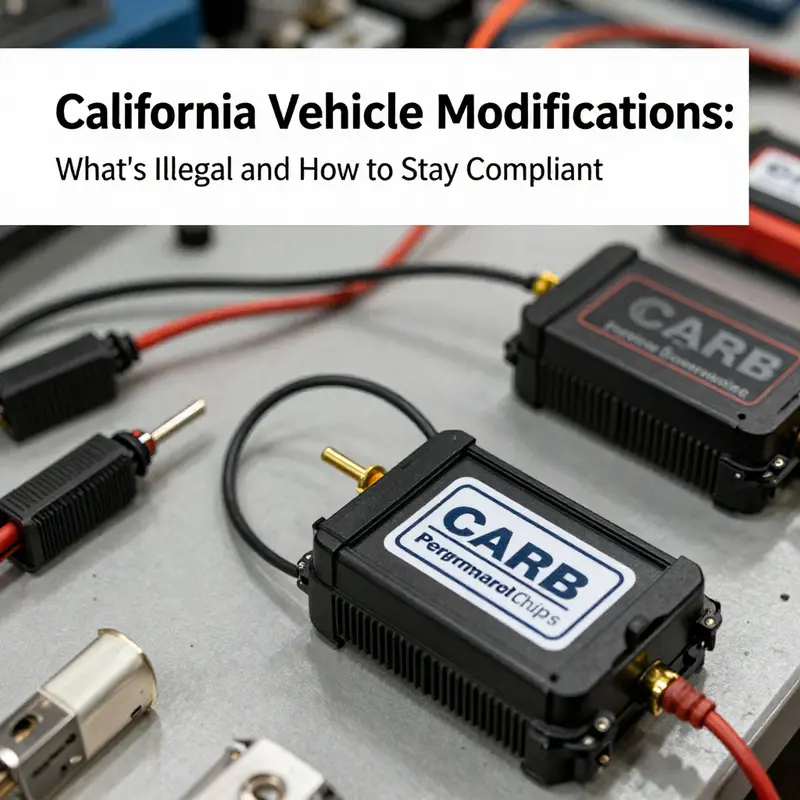
California’s car culture often cherishes the idea of tailoring a vehicle to personal taste and driving style. Yet in the realm of emissions and air quality, the state imposes clear lines that separate what drivers can legally modify from what must remain as factory design. The centerpiece of this regulatory posture is the California Air Resources Board (CARB), an agency whose mission includes safeguarding air quality and ensuring that vehicles on public roads comply with emissions standards. When it comes to performance chips and engine-programming devices, California treats changes to the engine management system not as a simple tweak but as a modification that can alter the vehicle’s foundational emissions profile. In practical terms, this means that many devices and configurations that boost power or alter timing and fuel delivery are not automatically permissible simply because they are popular or effective in other states or contexts. The path to legality hinges on certification, not just performance claims. CARB’s framework requires that any modification which affects emissions be vetted through an official process and awarded an Executive Order, or EO, number. Without that EO, a device’s fitment on a California-registered vehicle on public roads is a legal risk and a compliance violation. The consequence of circumventing this rule reaches beyond a momentary roadside check. It can jeopardize a smog certificate, trigger fines, and expose a vehicle to potential impoundment or denial of registration until the issue is resolved. For enthusiasts, this is a quiet reminder that the road to improved performance in California runs on documented compliance rather than instinct or speed alone. The EO program is not an abstract credential. It is a structured determination that a specific device, when installed and used in a defined manner, will not cause emissions to exceed the levels the vehicle was certified to meet during the regulatory approval process. Car enthusiasts who push the envelope often underestimate how a seemingly modest adjustment can cascade into a broader emissions problem. Emission systems are interconnected. Altering timing, fuel maps, or spark control can influence catalytic converter temperatures, oxygen sensor responses, and exhaust gas composition. In some instances, a device intended to increase power may reduce available control over pollutant formation in ways that the original certification did not anticipate. California’s regulators are aware of these possibilities and require proof that the modification will perform within the confines of the vehicle’s certified envelope. The practical implication is that a broad swath of widely available chips and programmers, particularly those marketed to increase horsepower, are only lawful if they have earned an EO number from CARB. Without that certification, installation on a street-legal California vehicle becomes non-compliant, even if the device worked flawlessly in another state or environment. This rule does not merely hinge on the hardware being added; it also covers how the device is used. Some chip settings come with adjustable maps or modes that can be toggled mid-ride. If a driver uses a non-certified map that raises emissions while in a testing regime or on public roads, the modification breaches California law. The careful observer will note that this is not about discouraging innovation but about aligning performance enhancements with environmental protections. CARB’s framework creates a clear, navigable path for responsible tuning. A device with a valid EO is legally permissible, provided it is installed in accordance with the conditions specified by CARB and the EO. That usually means the installer must follow the manufacturer’s instructions, ensure the device is compatible with the vehicle’s emission control system, and confirm that no other emissions-control components are being defeated or bypassed in the process. It also means that the device should not void the vehicle’s smog certification or lead to detectable increases in regulated pollutants during standardized testing. Vehicle owners who are serious about performance enhancements in California should accept that compliance requires due diligence. The search for compliance begins with a simple, yet fundamental step: verify that the product has CARB authorization. CARB maintains a searchable database of certified products, and the onus is on the consumer to confirm before purchase or installation. This diligence protects the vehicle owner from potential noncompliance penalties and safeguards the broader public interest in clean air. The process is not opaque; it is transparent and accessible to anyone who takes the time to look. When a product carries an EO number, it signals that CARB has reviewed the modification and determined that, under specified conditions, it meets emission standards for on-road use in California. The EO often comes with limitations, including the model years for which it is approved, the specific vehicle configurations, and the required installation or calibration steps. These conditions are not mere bureaucratic hurdles; they are environmental guardrails designed to prevent unexpected pollutant spikes. Even with an EO, improper installation can still create problems. A modification might be certified in a particular vehicle category, but if it is used outside that category—or if the installer deviates from the specified procedure—the system can drift out of compliance. For this reason, professional installation that adheres to the EO’s terms is crucial. The consumer should seek installers who understand the nuances of CARB’s requirements and can document adherence to the EO program. This documentation becomes important evidence should there ever be a need to demonstrate post-installation compliance to regulatory authorities or during a vehicle inspection. The regulatory landscape in California thus frames a paradox familiar to many car lovers: the same curiosity and drive that lead to performance improvements can also become a regulatory liability if pursued without proper certification. It is not enough to believe a modification is harmless or that it would not affect emissions in the way it does on a test bench or a dyno run. CARB’s emphasis on real-world emissions testing and certification under its EO program means that only devices that have demonstrated compliance are routinely considered lawful for street use. The conscientious path forward for any California resident who wants to explore performance improvements through chips or programmers is to treat certification as a prerequisite, not an afterthought. This means conducting due diligence well before a purchase, rather than scrambling to retrofit compliance after a modification has been installed. It also means adopting a mindset that values long-term, legally compliant tuning over short-term gains that could jeopardize a vehicle’s registration or driver’s license. For readers who desire a broader perspective on how California handles car modifications, there is a broader discussion available at this resource: illegal car modifications in California. This reference provides context about where the boundaries lie, how enforcement can unfold, and why certain practices—though common elsewhere—are not transferable to California’s streets without explicit certification and compliance. The essential takeaway is that California’s restrictions on performance chips and programmers are less about restricting creativity and more about preserving air quality standards that affect every resident. The state does not ban performance tuning outright; instead, it channels innovation through a strict permit system. If a device has earned CARB’s EO and is installed by a qualified technician who follows the prescribed procedure, drivers can enjoy increased performance with the confidence that their vehicle remains within the law. If not, the risk is substantial: fines, the potential loss of a smog certificate, and the possibility that the vehicle will not pass state inspections. The balance CARB seeks to strike is nuanced. It recognizes a legitimate consumer demand for enhanced performance while safeguarding air quality, ensuring that automotive enthusiasts do not inadvertently undermine public health goals. In practice, this balance translates into a pragmatic, step-by-step approach to modification: verify certification, install according to the EO guidelines, document the process, and maintain compliance through regular checks. For many drivers, following this path may seem more arduous than simply loading an unapproved map or swapping in a non-certified controller. Yet it is precisely this discipline that maintains the integrity of California’s air program and the legitimacy of the street-legal performance ecosystem. As with other aspects of vehicle customization in California, the journey from concept to street legality is a negotiation between aspiration and accountability. The state’s regulatory framework does not suppress the idea of tuning; it clarifies how tuning can be undertaken responsibly. By embracing CARB’s EO process, and by relying on certified products and properly trained installers, California’s drivers can pursue higher performance without compromising the air quality that residents expect and regulators strive to protect. For those who want to explore further, the official ARB platform provides a transparent route to verify certification and to understand the scope of each EO. In the end, the question is not whether performance can be achieved, but whether it can be earned within the parameters that California has established for clean air, safe roads, and verifiable compliance. External resource: https://www.arb.ca.gov
Final thoughts
Understanding California’s strict vehicle modification laws helps enthusiasts modify legally and responsibly. From emissions controls to noise standards and hardware restrictions, staying informed prevents fines and impoundment. Always prioritize compliance to protect the environment while enjoying your project.