
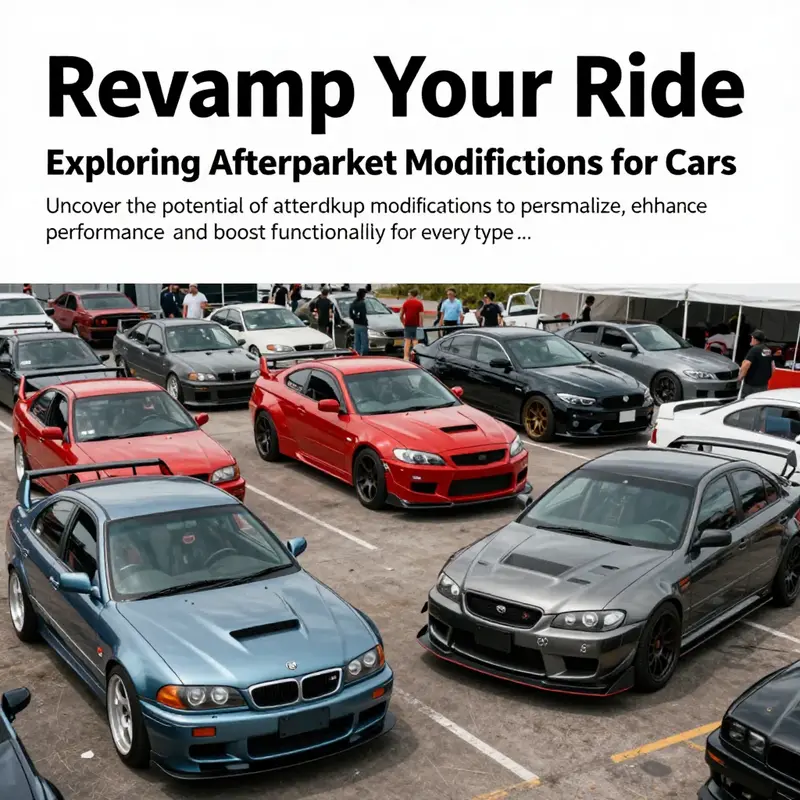
Aftermarket modifications have evolved from mere enhancements to essential components of the automotive culture. For hobbyist car modifiers, professional tuners, and restoration enthusiasts alike, these modifications not only reflect personal style but also boost performance and utility. In this article, we delve into the multifaceted world of aftermarket modifications, exploring aesthetic changes that breathe new life into vehicles, performance upgrades that elevate driving experiences, and functional additions that enhance convenience and safety. Each chapter provides insights that cater to global car modification fans and auto parts suppliers, enabling you to make informed decisions on your customization journey.
Visually Driven: The Personal Art of Aesthetic Car Modifications in the Aftermarket Landscape

A car is more than a collection of mechanics and metal; it is a moving canvas, a platform for personal storytelling that evolves with taste, trends, and the rhythm of daily life. When we talk about aftermarket modifications, the conversation often turns to performance metrics, torque figures, and lap times. Yet a substantial and enduring thread in the fabric of car culture runs through the aesthetic realm, where owners exercise choice not to chase speed but to curate a look, a mood, and a sense of individuality that can travel with them on every street and highway. Aesthetic modifications on cars are, at their core, about projection. They translate a private sense of style into public perception, turning the vehicle into a statement that can be subtle or bold, timeless or provocative. This visual language is a powerful, accessible entry point into the broader world of aftermarket customization. It lets people experiment with identity without necessarily sacrificing reliability, and it often does so at a price point that is manageable for many enthusiasts. The chapter that follows treats aesthetic changes not as fluff, but as a meaningful category within the aftermarket ecosystem—a category that touches design philosophy, consumer psychology, maintenance habits, and the evolving marketplace that connects designers, tuners, and drivers in new ways every year.
To appreciate why appearance-centered modifications have enduring appeal, it helps to map their most common forms. Body kits, for instance, are more than decorative add-ons; they alter the silhouette and stance of a car, guiding the eye toward a sharper contour or a more aggressive profile. Front lips, side skirts, and rear diffusers can create a cohesive, sculpted line that emphasizes horizontal breadth or a low, planted presence. The impact of such changes extends beyond aesthetics. A well-integrated lip or diffuser can subtly affect aerodynamics, balance, and even the perceived weight distribution of the vehicle, influencing how a viewer reads the car’s intentions at a glance. Wrapping a car in a color or finish—whether a matte layer that dulls the reflection of chrome, a gloss that amplifies the vehicle’s contours, or a color-shifting paint that morphs with light—provides a dramatic, non-permanent way to reimagine a car’s identity. Wraps and paints are not interchangeable in their effects, but both offer pathways to personalization that are reversible and relatively affordable compared with more invasive changes. The choice between a wrap and a repaint often hinges on durability, reversibility, and how deeply the modification should alter the original finish. A wrap can protect the factory paint while delivering an eye-catching transformation, whereas a high-quality paint refresh can achieve a more integrated, long-lasting look, with the potential to add resale value if the color is desirable or timeless.
Inside the cabin, aesthetic choices extend beyond the exterior and touch the tactile experience of daily driving. Trim kits—carbon fiber, real wood, or other premium materials—overlay existing panels to create a new texture and glow. They often come with customizable lighting that lets ambient hues reflect an interior theme, from calm and focused to vibrant and playful. Such upgrades are less about altering the car’s geometry and more about refining the sensory language of the space, boosting perceived quality, and signaling attention to detail. These interior modifications function like a soundtrack to the vehicle’s visuals, harmonizing materials, color schemes, and lighting to produce a cohesive atmosphere that aligns with the owner’s mood and routine. Alloy wheels, too, are a staple of the visual language. While they can influence handling and brake cooling, their primary contribution is presence—the way a set of rims catches light, fills wheel arches, and communicates a stance. A careful choice in wheel design and finish can elevate the entire frame, giving the car a curated personality that communicates confidence, sportiness, or elegance before the engine is even started.
Yet the charm of aesthetic modifications is inseparable from the question of value and practicality. For many owners, the allure is the ability to resist the fatigue of a static, factory-finished look. Personalization provides a sense of ownership that can be reaffirmed each time the key is turned. It is also a social currency within car communities, where peers recognize a shared favor for certain styles or themes. This social dimension, however, must be navigated with awareness. Trends shift, and what reads as sophisticated today may feel dated tomorrow. The risk is not only fashion misalignment, but also the practical reality that a modification can affect resale perceptions. The balance is in selecting high-quality materials and finishes that age gracefully, maintaining harmony with the car’s lines and the owner’s long-term plans. A well-executed aesthetic upgrade can preserve or even enhance perceived value by elevating the vehicle’s condition, while a poorly matched or shoddily installed modification can detract, becoming a point of attention that potential buyers notice first.
The practicalities of implementing aesthetic modifications deserve careful attention. Proper execution matters as much as the concept. Aesthetic work that preserves safety and reliability requires skilled installers who understand the delicate balance between form and function. For example, body kits should align with the car’s existing contours and mounting points, avoiding interference with lower ground clearance, crash structures, or sensor housings. The line between a stylish enhancement and a problematic alteration is thin; a kit that looks great in the showroom can cause rubbing, rattles, or aerodynamic drag once in motion if not engineered with precision. Wrapping or repainting demands attention to surface preparation, color consistency, and long-term durability under UV exposure and environmental stressors. A wrap that looks flawless in the shop may peel or fade if corners and edges aren’t properly sealed or if the substrate isn’t correctly prepared. In interiors, the fit of trim panels, the alignment of lighting elements, and the softness or rigidity of new surfaces all contribute to the sensory experience. A dashboard that looks perfect at a glance but creaks under heat or vibration undermines the owner’s sense of luxury. These are not mere cosmetic concerns; they reflect how the car is used daily and how well the modification stands up to use over time.
An important dimension of aesthetics is how modifications align with warranty, safety, and regulatory considerations. For many manufacturers, cosmetic changes that do not affect the safety systems or the structural integrity of the vehicle are not expected to void the warranty. The subtle distinction lies in installation quality and the degree to which the modifications interact with critical systems. A poorly installed sensor wrap or a misaligned wheel could, in rare cases, influence diagnostic readings or steering geometry. The practical implication is that serious cosmetic work should be undertaken by technicians who understand not only appearance but also the car’s governance systems. The goal is to preserve the car’s core reliability while enabling a personalized look. It’s a careful negotiation: owners seek expression and individuality, while technicians and insurers assess risk, durability, and compatibility with the vehicle’s original design. In this space, education and communication matter. A shopper who asks informed questions about installation methods, material choices, and service warranties is less likely to encounter surprises when the car returns from a shop.
The social and economic dynamics surrounding aesthetic modifications are also evolving, especially as the aftermarket landscape grows with digital integration. Industry observers have noted a rising interest in personalization that goes beyond single items to curated packages that curate the car’s entire look—from exterior lines to interior ambience and technology accents. In several major markets, the aftermarket sector for customization is expanding rapidly, with projections that emphasize personal expression and innovation. The appeal is not merely vanity; it is a reflection of how people want to interact with machines that are, at their core, tools for daily life and personal storytelling. The growth is accelerating in part because modern materials and techniques make sophisticated appearances more affordable and durable than ever. Carbon fiber accents, high-quality vinyls, and adaptive lighting systems can deliver a sense of premium refinement at a price that feels attainable. The result is a democratization of style, where a wider range of drivers can explore look-and-feel upgrades without requiring extreme mechanical changes.
The market context is important for any discussion of aesthetics, because the ways people access and evaluate these modifications shape what is possible, and what is valued. In regions with large, active car cultures, appearance-focused customization has long thrived. The Chinese aftermarket scene, for instance, is described in industry analyses as having substantial growth potential, driven by consumer demand for personalization, design innovation, and digital platforms that connect service providers with customers and investors. These platforms can accelerate project matching, streamline procurement of materials, and enable a broader ecosystem where small shops, freelance designers, and established tuners collaborate. It is a reminder that aesthetic modifications are not merely the work of a single artisan in a garage; they are part of a connected network that blends creativity with supply chains, engineering standards, and consumer choice. In this sense, aesthetics are also a kind of low-risk gateway into the broader world of aftermarket customization, offering a soft entry point that can eventually lead to more sophisticated or even performance-oriented enhancements if the owner’s interest deepens.
The social, economic, and technical dimensions of aesthetic car modifications intersect with the question of value in a nuanced way. On one hand, an elegant, well-executed exterior upgrade can move a car into a more desirable category for enthusiasts who value design language and craftsmanship. On the other hand, a modification that clashes with widely held tastes or that looks overly flashy could alienate potential buyers who favor restraint or a specific brand aesthetic. The reality is that taste, quality, and context govern outcomes. A tasteful matte wrap with a subtle color shift that complements the car’s lines can heighten perceived quality and uniqueness while preserving broad appeal. A dramatic, high-contrast body kit might signal a distinct identity within a local car community but may limit buyer interest outside that circle. The balancing act is never just technical; it is deeply cultural and personal. Owners must consider how long they intend to keep the car, what environments it will inhabit, and how the look aligns with their own evolving tastes. The market responds to such choices by shaping available options, pricing, and even service options that can sustain or refresh a given aesthetic over time.
As the conversation around aftermarket modifications continues to mature, a convergence with digital technology becomes more evident. The same tools that enable streaming music and augmented reality experiences also influence how people plan, visualize, and realize aesthetic changes. Virtual reality and AI-assisted design tools allow potential buyers to experiment with color schemes, finish textures, and interior materials before committing to a single path. This reduces risk, expands creative possibilities, and supports a more informed decision-making process. The ability to simulate different outcomes, check for alignment with existing components, and forecast maintenance needs makes aesthetic modifications less of a leap of faith and more of a thoughtful, iterative process. In the coming years, it is likely that digital platforms will play an even larger role in aesthetics, offering libraries of styles, design templates, and interactive tutorials that guide owners from concept to completion while ensuring compatibility with the car’s architecture.
The ethical and sustainability dimension of aesthetic modifications also deserves attention. If a wrap or paint job is designed to protect the underlying metal, it may extend the vehicle’s life by providing an additional layer of corrosion resistance or UV protection. Designers and installers who emphasize durability, recyclability of materials, and safer disposal of waste materials contribute to a more responsible culture of modification. In an era when consumer choices are scrutinized through the lens of environmental impact and resource use, appearance upgrades can be framed not as frivolous excess but as forms of stewardship—protecting the vehicle’s integrity while expressing a personal narrative. Of course, not all aesthetic options share the same sustainability profile. The production, adhesion properties, and end-of-life considerations of wraps, paints, and trim materials vary, and informed buyers will weigh these factors alongside price and aesthetics. The market’s trajectory will likely reward those who bring together beauty, durability, and responsible material choices in a coherent, well-documented package.
In considering why aesthetic modifications endure, it helps to remember that human beings are pattern seekers and visual processors. A car’s curb appeal is a first impression, but it also conveys a story about the owner: their interests, their sense of space, and their approach to daily life. A well-considered modification communicates confidence, attention to detail, and a willingness to invest in one’s environment. This is not simply vanity; it is an art practice that operates within a consumer technology space, where design language and engineering meet cost considerations and lifestyle choices. The result is a living field in which creativity and practicality co-exist, allowing drivers to reshuffle their cars’ personalities as easily as they might update a wardrobe. The deeper value lies not only in how others perceive the car, but in how the owner experiences the car—how it feels to get into a cabin that looks and sounds the way one imagines one should, or to pull into a lot where the exterior reflects an inner sense of order and taste.
For readers who want to explore practical paths within this aesthetic world, the journey can be as important as the destination. The conversation begins with a clear assessment of priorities: what aspects of the car’s appearance matter most, how much you’re willing to invest, and how the modification will function in daily life. It continues with an exploration of the options that best fit those priorities—from the exterior language of body kits and wraps to the interior poetry of trim and lighting, and finally to wheels that set the tone for the entire stance. The most satisfying outcomes often arise when a project is approached as a cohesive portfolio rather than a collection of disparate parts. When the pieces harmonize—color, texture, line, and lighting—the result is a vehicle that feels less like a machine and more like an extension of the driver’s own design sensibility.
Aesthetics, in this sense, become a practiced, ongoing conversation with the car. They invite experimentation, but they also demand prudence: a clear sense of how changes will be perceived over time, how they will wear with daily use, and how they will interact with the vehicle’s original architecture. The best outcomes emerge when owners work with skilled professionals who respect design integrity, who can translate a vision into a practical build, and who can explain the tradeoffs involved in different material choices. In this collaborative space, the car becomes a canvas whose meaning shifts with the owner’s context—daily commute, weekend cruises, car-show showcases, or photoshoots for social media. The aesthetic is not merely about attracting glances; it is about enabling a consistent, dependable experience of style that remains legible and resonant as time passes.
The broader implication of the aesthetic aftermarket, beyond individual cars, is a cultural economy that values style as a form of personal resource. The market’s growth, the emergence of design-driven shops, and the increasing sophistication of materials all point to a future where appearance upgrades are both more accessible and more strategically integrated with other forms of modification. The digital layer—the platforms, communities, and design tools—promises to connect enthusiasts with projects, suppliers, and peers who share a vision. It is a reminder that aesthetics are not an isolated act but a social practice embedded in fabrication, commerce, and culture. As drivers become more fluent in the language of design, the lines between customization, personalization, and expression blur in productive ways, enabling a richer, more diverse aftermarket landscape.
If the curiosity lingers about how these changes come to life in the real world, there is a simple, practical starting point. Look at the modularity of options as a design system: exterior styling kits, color treatments, interior surfaces, and wheel configurations can be treated as components of a single, coherent statement. This approach encourages a disciplined, iterative process that reduces risk and yields a result that feels intentional rather than accidental. For readers who want to explore installation methodologies, the following resource offers a guided overview of practical steps and considerations for installing cosmetic enhancements while maintaining vehicle integrity. How-to guidance can complement the initial ideas with actionable steps, ensuring that the pursuit of aesthetics remains aligned with safety, reliability, and respect for the vehicle’s original design intentions. See: How to Install Modifications on a Car.
Finally, the broader chapter of aesthetic car modification sits within a spectrum of aftermarket possibilities that continues to expand as technology, design language, and consumer appetite evolve. The aesthetic path is neither a denial of performance nor a retreat from functionality. Rather, it is a reclamation of shape and meaning—an ongoing negotiation between what the car is, what the owner wants it to be, and how those intentions are communicated to the world around them. The chapter thus treats aesthetics not as ornamentation but as a meaningful, ongoing dialogue between maker and machine, a dialogue that keeps the car’s story alive in a way that is visually legible, emotionally resonant, and deeply personal. This is the language of personalization in the aftermarket world—a language that invites experimentation, rewards quality, and continually reshapes the relationship between driver and vehicle.
External reading for deeper technical context on aesthetic car modification is available at Autocar’s guide to aesthetic car modification, which outlines the broader technical considerations behind appearance-focused work and offers further perspective on implementation standards and best practices. https://www.autocar.co.uk/car-review/what-is-aesthetic-car-modification
Tuning the Drive: The Real-World Impact of Performance-Oriented Aftermarket Modifications

Performance enhancements in the aftermarket space are not a monolith, but a spectrum. They blend a driver’s desire for quicker responses, sharper handling, and a more satisfying auditory presence with the practical realities of daily use. When people talk about modifying a car for performance, they are usually thinking about a deliberate recalibration of how the vehicle behaves across the full range of driving conditions. It is not merely about squeezing more horsepower from an engine; it is about shaping the car into a responsive partner that can meet the rider’s expectations in a way the stock setup may not fully satisfy. The allure is easy to understand. A factory-tuned vehicle may deliver consistent output and reliability, but it rarely matches the immediacy of throttle response, the linearity of power delivery, or the precision of handling that an enthusiast seeks on a winding road or a challenging track day. In an era where configurability is a defining trait of modern automobiles, performance modifications have become a language through which drivers can express their personal driving style, their tolerance for risk, and their willingness to invest in their own vehicle as a kinetic instrument rather than a static form.
To understand the practical outcomes of performance-oriented aftermarket work, it helps to move beyond the idea of a single number on a dyno and imagine the car in the real world. Engine tuning and performance chips, for example, are often the first topic that comes to mind when people think of power gains. These modifications reprogram the engine control unit to optimize fuel delivery, ignition timing, and air-fuel ratios so the engine can produce more power and torque at usable RPM ranges. The effect is rarely a simple one-to-one improvement. A well-conceived tune respects the engine’s temperature management, fuel quality, and the calibration of other systems that govern drivability. The goal is a more responsive throttle, a smoother power curve, and a broader usable band in which the engine feels eager rather than pinched. But there is a caveat that cannot be ignored: the same adjustments that unlock extra power can also alter how the engine behaves under load, and they may interact with factory safety nets such as knock sensors and adaptive timing. In practice, a tune that delivers gains on a dyno can translate into more efficient, predictable performance on public roads only when it is paired with complementary components and a robust cooling strategy.
Exhaust systems sit next to engine tuning as a frequent companion in the performance-modification narrative. A high-flow exhaust can reduce backpressure and improve the engine’s ability to expel exhaust gases, which, in turn, can free up some horsepower and torque. The sound signature often becomes a secondary, yet meaningful, aspect of the experience. Yet this kind of upgrade is not entirely cosmetic. The design must consider heat distribution, backpressure characteristics, and the potential for exhaust routing to affect other systems or the chassis. A louder exhaust may improve the sensory feedback of acceleration, but it can also raise noise levels for occupants and neighbors, invite stricter emissions scrutiny in certain jurisdictions, and complicate resale or warranty considerations. The balancing act—gains in power, changes in torque delivery, and the overall character of the exhaust tone—depends heavily on harmonious integration with the rest of the powertrain.
Air intake upgrades represent another common avenue for performance gains. Upgraded cold-air intake systems are marketed on the premise that they deliver cooler, denser air, which can improve combustion efficiency and, by extension, power and throttle response. The physics is straightforward: cooler air is denser, containing more oxygen per unit volume, which can enable a more energetic burn when combined with precise fueling. However, modern engines already employ sophisticated air management and can be quite sensitive to intake design. A mismatched intake can introduce turbulence, alter boost or vacuum levels, or interfere with mass airflow sensing in ways that erode drivability rather than improve it. As with other performance modifications, the best outcomes come from aligning the intake with the engine’s overall breathing strategy, the tuning profile, and the cooling layout.
Suspension upgrades are the chassis counterpart to engine work. Performance-oriented components such as adjustable dampers, stiffer springs, and sways or lower ride heights can dramatically reshape how a car sits on the road and how it responds to steering input. The difference is most immediately felt in cornering and highway maneuvers: reduced body roll, sharper turn-in, and a more confident sense of grip when the tires meet the pavement. But there is a tradeoff. A firmer suspension tends to transfer more road texture to the cabin, and ride comfort can suffer on uneven streets. The choice of springs, dampers, and anti-roll bars must consider the vehicle’s weight, chassis stiffness, tire characteristics, and the driver’s preferred compromise between comfort and control. The best setups often involve careful alignment and sometimes adjustable components that let the driver tailor the stiffness according to the day’s road conditions or the track’s demands.
Braking systems are another critical frontier for performance work. Upgraded brake kits aim to deliver stronger stopping power, more consistent fade resistance under heavy use, and better pedal feel. Larger rotors, higher-friction pads, and multi-piston calipers contribute to shorter stopping distances and improved thermal management during repeated stops. Yet greater capability requires greater discipline: brake balance with the rear axle, rotor heat management, and the compatibility of upgraded brakes with wheels and tires must be considered. Without careful setup, a car can suffer from harsh initial bite, increased pedal travel, or unpredictable modulation, especially when paired with stiff suspension or aggressive tire choices. The intention behind brakes is straightforward—more confidence when you need to slow down hard—but the actual experience depends on precise calibration, driver feedback, and a thorough understanding of heat dissipation under sustained use.
Wheels and tires complete the performance loop by shaping grip, response, and steering feel. Lighter, stiffer wheels reduce unsprung weight and improve acceleration and turn-in, while high-performance tires can drastically alter traction and cornering limits. The dynamic result is a car that feels more agile and communicative to the driver, with quicker responses to steering and throttle inputs. However, larger or wider wheels can have unintended consequences: increased unsprung mass if not matched with appropriate tires, more stress on suspension components, and potential rub on suspension travel or bodywork if geometry is not adjusted. The overall package—wheel weight, diameter, offset, and tire compound—must be selected with the intended use in mind, whether that is spirited street driving, track sessions, or a more aggressive daily setup. A well-integrated wheel-tire package helps the car maintain predictable behavior across braking, acceleration, and cornering, whereas a mismatched pair can erode confidence and precision.
All of these elements—engine, exhaust, intake, suspension, braking, and wheels—are most effective when considered together rather than as isolated tweaks. The magic of a true performance build is in the synergy: a tune that matches the exhaust’s flow, a suspension that keeps the chassis planted under the new torque, a brake system that can sustain repeated high-energy stops, and a tire choice that translates the raw numbers into real grip. In practice, this means moving beyond the bare label horsepower and toward the car’s overall driving dynamics. It means thinking about heat management, driveline durability, and the risk calculus that accompanies any modification. Enthusiasts often begin with one focal point—usually somewhere in the engine or the suspension—and then fill in the rest of the package as experience and budget allow.
The broader context for these technical decisions is important, especially given the market dynamics that shape what is possible and affordable. In several major markets, including a rapidly evolving automotive scene in parts of Asia, the aftermarket has grown into a formidable sector driven by consumer appetite for personalization and a willingness to invest in driving experience. The push toward digital tools that connect service providers, suppliers, and investors is turning performance modifications into more than a hands-on, workshop-driven activity. Platforms that facilitate project matching and resource integration can shorten the path from idea to road-ready upgrade, helping drivers assemble a coherent build rather than assembling disparate parts without a clear plan. This shift toward connected, data-informed modification projects can improve outcomes by aligning parts, tuning strategies, and installation expertise. It also raises questions about standardization, repeatability, and the long-term reliability of components chosen for a particular build.
With performance work, the considerations extend beyond raw capability. The very act of modifying a car has implications for the vehicle warranty, the integrity of safety systems, and the legal framework governing modified vehicles. Many aftermarket alterations can affect warranty coverage, especially when critical systems such as the engine, transmission, or electronics are altered. If a modification changes the way a car interacts with its control networks, it can also influence how safety and driver-assistance features operate. This is not simply a matter of theory; it plays out in real-world ownership, where a driver may be surprised to learn that a certain upgrade undermines warranty protection or complicates service visits.
Insurance is another practical concern. Modifications can alter risk profiles, which may change premium levels or even coverage terms. The effect varies by jurisdiction, insurer, and the exact nature of the modification. For drivers contemplating performance upgrades, an early conversation with an insurer or broker can reveal how a planned build might influence policy terms. It can also illuminate the need for documenting upgrades, installing appropriate disclosures, or acquiring specialized coverage for certain components. The broader takeaway is that performance enhancements are not purely technical decisions; they are strategic decisions that ripple through ownership costs, risk, and the car’s long-term value. For more on how modifications affect insurance, see the linked discussion on insurance considerations in car modifications.
Beyond the mechanical and financial dimensions, there is also a safety and legal dimension. Many regions have strict regulations about modifications that affect noise, emissions, lighting, suspension height, and tire sizes. Even changes that seem purely mechanical can have downstream effects on vehicle certification and compliance with local traffic laws. The safest path is to approach performance work with a clear compliance plan, a careful assessment of the intended use of the vehicle, and a conservative mindset about how much change is appropriate for a given car. A thoughtful build prioritizes predictable behavior, consistent drivability, and a clear understanding of how each modification interacts with the others.
The decision-making process around performance upgrades benefits from a holistic view that respects the car’s original design intent while acknowledging the driver’s evolving needs. Start with goals that reflect how the car will be used, not just how it must perform on a test stand. If the aim is sharper response for weekend canyon drives, the choices may differ from a plan focused on track-day performance or aggressive street-use with daily reliability. It is also prudent to consider the car’s baseline: some platforms respond dramatically to modest changes, while others require substantial reengineering to achieve meaningful improvements. The role of the installer cannot be overstated. A skilled technician who can map performance goals to practical, repeatable results through a combination of parts, calibration, and verification is essential. The cost of professional installation should be viewed not as an added expense but as a guarantee that the upgrade will perform as intended and remain reliable under real-world conditions.
In this evolving environment, the driver who purchases a car ready for modification benefits from a plan. A plan that acknowledges the car’s chassis limits, the reliability of components under heat and high-load conditions, and the long-term implications for resale. A well-conceived performance build does not merely chase peak numbers on a dyno; it translates technical gains into a smoother, more confident, and more engaging driving experience on the road. The driver who understands the interplay of power, handling, braking, and ride quality will be better positioned to select modifications that complement each other, rather than create conflicting demands on the vehicle’s systems. And in the end, the most satisfying performance upgrade is the one that broadens the car’s capabilities without eroding its everyday friendliness.
For those curious about the broader market landscape and the shifting dynamics of how performance modifications are conceived and delivered, it is worth noting that the aftermarket sector in several large markets continues to grow. Personalization remains a powerful driver, and digital platforms are accelerating the ability to find compatible parts, professional installation, and post-modification support. Yet the growth is not simply a matter of more parts on a shelf. It is a testament to evolving consumer expectations: people want to tune the driving experience in a way that preserves safety, aligns with local rules, and respects the car’s underlying engineering. In this light, performance modifications become a collaborative process—between driver, shop, and the broader ecosystem of part makers, tuners, and calibrators.
When a driver weighs a performance upgrade, the decision-making framework should be comprehensive. It should start with a clear use case and a realistic budget, then expand to a plan that includes maintenance, monitoring, and potential future steps. A modular approach—beginning with one or two well-chosen improvements and expanding as confidence and results accumulate—often yields better long-term satisfaction than a single, large, untested modification. This method helps balance the thrill of greater speed and sharper handling with the realities of daily driving, fuel economy considerations, and the realities of warranty and insurance. The driver who plans carefully is more likely to enjoy consistent improvements over time and to keep the car performing at a level that feels connected, predictable, and genuinely engaging.
In sum, performance-oriented aftermarket modifications offer a pathway to transform the way a car responds, handles, and communicates with its driver. They are not just about adding power but about shaping a driving experience that is more precise, predictable, and pleasurable. The best outcomes come from an integrated package that respects the vehicle’s chassis, aligns with the driving goals, and stays mindful of safety, legality, and long-term ownership. As markets continue to evolve and digital platforms expand the toolkit for builders and drivers alike, performance upgrades will likely become more accessible and more carefully engineered. The result, when done thoughtfully, is a car that communicates with its driver in a more honest, more immediate, and more satisfying language.
External resource: https://www.nhtsa.gov/sites/nhtsa.gov/files/2024-01-19-adas-aftermarket-modifications-research-report.pdf
Smart, Safe, and Simple: How Functional Upgrades Turn a Car into a Tailored Companion
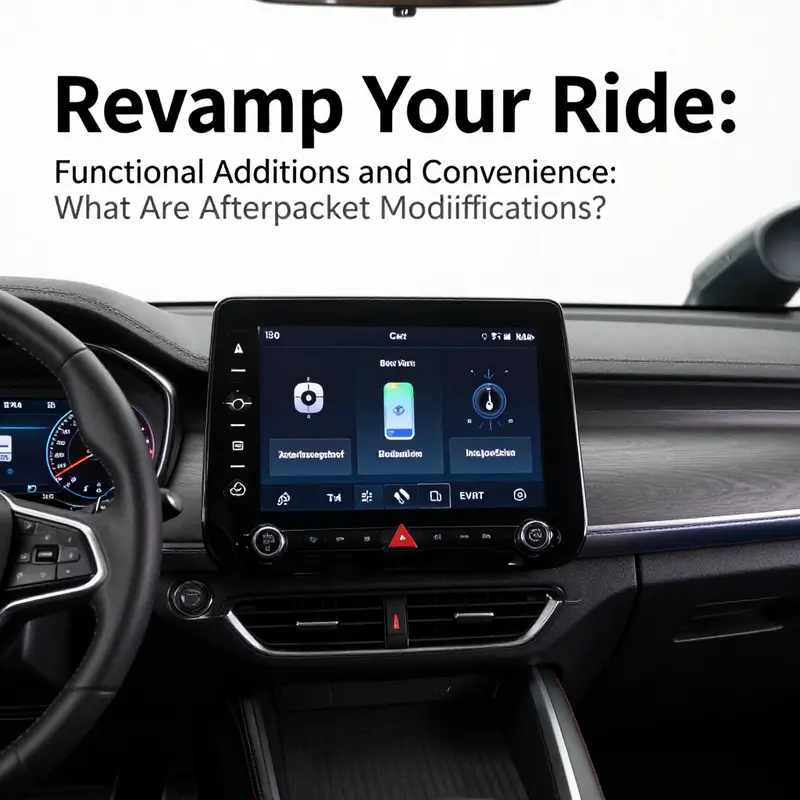
When people think about aftermarket modifications, their minds often jump first to dramatic visuals—paint finishes, body kits, or wheels that grab attention. Yet beneath the surface of style lies a vast realm of functional enhancements that quietly reshape how a car behaves, feels, and serves in daily life. Functional additions and convenience upgrades are not merely about making a car look different; they are about extending its capabilities in ways that align with the owner’s routines, priorities, and comfort. In this chapter, we explore how these practical modifications function as a kind of engineering of everyday life, turning a factory-built machine into a customized partner that better anticipates needs, reduces friction, and enhances safety without sacrificing usability. The modern aftermarket scene recognizes that a vehicle is a platform for living—a mobile workspace, a personal climate-controlled haven, a shelter of security, and a gateway to information and connectivity. When approached thoughtfully, functional upgrades respond to real anxieties and aspirations: the fear of getting stranded, the desire to stay organized, the wish to stay connected, and the need to protect passengers and cargo through varying conditions. The result is a spectrum of enhancements that, while varied in purpose, share a common aim: to make the car more predictable, more capable, and more comfortable in the moments that matter most. As consumer expectations evolve, the line between a stock car and a highly personalized vehicle becomes increasingly porous. The growth of the aftermarket sector in many regions reflects a broader shift in car ownership—from a static acquisition to a customizable lifecycle. People are no longer satisfied with a one-size-fits-all chassis; they want a car that mirrors their daily rhythms, adapts to their family’s demands, and responds to the way they travel for work, hobbies, and errands. Aesthetic choices still matter, but the most consequential transformations often happen in the realm of function and convenience. This approach to modification emphasizes practical gains—how a vehicle can help avoid hassle, save time, and reduce risk—while preserving or even enhancing overall reliability and resale value through careful, informed decisions. The chapter below threads these ideas into a cohesive narrative about why functional upgrades matter, what they typically comprise, and how they fit into the larger ecosystem of modern vehicle ownership.
At the heart of functional upgrades is a triad: safety, comfort, and connectivity. The safety dimension begins with enhancements that keep drivers aware of their surroundings and better prepared to respond. Rearview cameras and parking sensors, for example, translate the often awkward task of maneuvering a larger vehicle into a more confident act. They reduce blind spots, improve precision in tight quarters, and provide feedback that helps a driver adjust in real time. Blind-spot monitoring, too, adds a layer of awareness that can prevent side collisions when changing lanes in busy traffic. Automatic emergency braking (AEB) systems, when adopted as aftermarket upgrades, push the concept of preventive safety from a purely defensive stance to a more proactive one. The idea is not to replace careful driving but to augment it with technologies that can detect dangers beyond the driver’s immediate perception and to intervene when a collision risk becomes imminent. While these systems share a common goal with factory implementations, aftermarket versions often require thoughtful integration to ensure compatibility with the vehicle’s existing electrical architecture and sensor networks. This is where qualified installation matters: misalignment, power drain, or sensor interference can undermine the intended benefit and even create new hazards. The safety narrative of functional upgrades thus hinges on the quality of the installation as much as on the sophistication of the components themselves.
Comfort and interior convenience represent the second axis of practical modification. Heated or ventilated seats, enhanced climate control, and ambient lighting are often pursued not as luxury add-ons but as essential contributors to sustained comfort, especially on long trips or in extreme weather. The value of such upgrades extends beyond personal preference. They can improve concentration, reduce fatigue, and help maintain a stable body temperature, which in turn supports safer driving. Advanced climate systems that balance cabin temperature efficiently can prevent driver distractibility caused by discomfort. In many cases, these upgrades also bring fractional gains in energy efficiency because modernized systems manage heat and airflow more intelligently than older stock configurations. The comfort gains are complemented by convenience features that keep drivers focused on the road rather than on fiddling with controls. Universal remote key fobs, smart key systems, and seamless smartphone integration enable easier access to the car’s functions, often without the need to fumble for keys or memorize multiple steps for every action. The aim is less about replacing the core user experience and more about smoothing the friction so that the vehicle adapts to people’s routines instead of requiring people to adjust to the car.
The third pillar—advanced technology and connectivity—reflects shifting expectations about how a car should live alongside its occupants’ digital lives. Upgraded infotainment systems deliver larger displays, clearer interfaces, and faster response times. They enable more intuitive navigation, robust voice control, and smoother integration with smartphones and online services. Built-in connectivity, such as onboard Wi-Fi hotspots, turns the car into a mobile hub for work, entertainment, or family coordination. The practical advantages here are not merely about streaming media on a road trip; they include real-world benefits like staying in touch with teammates during a commute, accessing important documents on the go, or coordinating schedules with others in the household. A thoughtful implementation considers data security, user privacy, and bandwidth usage, ensuring that the added technology enhances the experience without compromising safety or reliability.
Storage, cargo management, and modular organization form the fourth functional family. Roof racks, cargo organizers, and trunk liners expand the vehicle’s capacity to carry equipment, groceries, or sports gear with confidence that items stay in place during transit. The convenience-oriented solutions—modular floor mats, under-seat organizers, and dashboard trays—address the small frictions of daily life: where to put charging cables, where to stash sunglasses, where to place a toolkit so it’s accessible but secure. The beauty of these upgrades lies in their adaptability. A vehicle that is easy to reconfigure for a family road trip, a weekend outdoor safari, or a day of shopping becomes a more versatile tool for navigating a busy life. This adaptability is especially valuable for owners who move between roles—parent, commuter, hobbyist, or professional—and depend on a single vehicle to perform multiple tasks with minimal reorganization.
A fifth, often overlooked but equally important category comprises convenience-oriented accessories that address the practical realities of driving. Portable jump starters, tire inflators, and compact tool sets provide a form of on-the-spot resilience that can reduce downtime during unexpected situations. Self-cleaning car covers, automatic windshield wipers, and built-in cup holders contribute to everyday ease, turning routine maintenance or simple tasks into low-effort activities. These accessories do not pretend to replace a professional service when it’s truly needed; instead, they provide reliable support that empowers drivers to handle minor incidents themselves, preserving time and reducing stress.
The logic behind these upgrades rests on a straightforward premise: a car should be a tailored response to the owner’s life as it unfolds. In urban environments, a car often serves as a secure, climate-controlled zone that protects occupants from weather, noise, and fatigue. In suburban settings, it becomes a reliable carrier for family activities, groceries, and errands, demanding more organized storage and predictable comfort. On longer journeys, the vehicle must offer dependable connectivity for navigation and communication, as well as safety features that reduce cognitive load. Each aftermarket upgrade contributes to those outcomes by addressing a particular pain point or opportunity for improvement. The cumulative effect is a vehicle that behaves more like a personal assistant than a generic machine: it anticipates needs, minimizes distractions, and supports occupants in ways that feel almost instinctive.
This pragmatic lens helps explain why the aftermarket ecosystem has garnered enduring appeal. Unlike purely cosmetic changes, functional and convenience upgrades align with measurable outcomes—less time spent searching for items, quicker and safer parking, more efficient climate control, and a smoother integration with digital life. The market signals a willingness among drivers to invest in small, low-risk improvements that collectively raise the quality of the driving experience. It is also worth noting that the attractiveness of functional upgrades is conditioned by broader consumer expectations around personalization and technology. In an era when digital devices pervade every aspect of life, people expect their cars to mirror the same level of sophistication, ease of use, and reliability that define their other daily tools. The aftermarket responds to that expectation by offering modular, scalable improvements that can be added, removed, or upgraded as needs evolve.
For readers already contemplating a plan to upgrade their vehicle, a practical path emerges from these principles. Start with a clear view of daily routines: where do friction points most often appear? Is it parking, loading and unloading cargo, or staying connected on the road? Prioritize upgrades that address those pain points with the safest, most reliable components available. Consider how each enhancement integrates with the car’s existing electrical system and comfort controls. Seek qualified installation to ensure sensors, wiring, and software operate harmoniously with the vehicle’s original design. This is not merely about installing more gadgets but about enabling a coherent system of features that work together without compromising safety or reliability. The goal is to achieve a balanced portfolio of upgrades that complements the car’s core strengths rather than undermining them. In practice, this means selecting components that are compatible with the vehicle’s architecture, that meet applicable standards, and that come with proper documentation and support.
A note on the business and social context helps situate these decisions within a larger landscape. The demand for practical upgrades is part of a broader pattern toward personalization and efficiency in daily life. In some markets, such as large and rapidly evolving automotive ecosystems, the aftermarket sector is growing rapidly, driven by consumer appetite for personalization, convenience, and the integration of digital technologies. Platforms that connect service providers, suppliers, and customers are transforming how people source, price, and install these upgrades. This digital matchmaking reduces the uncertainty that once surrounded aftermarket work and helps ensure that owners can access skilled technicians who understand both the car and the upgrade in question. It also raises questions about warranty coverage, maintenance, and the long-term durability of aftermarket components. As such, the decision to pursue functional upgrades often combines practical considerations with a strategic view of the vehicle’s lifecycle, including resale value, insurance implications, and compliance with local regulations.
All of these points converge on one central idea: modifications designed for function and convenience are not distractions from the core vehicle experience but enhancements that expand what the car can do for its owner on a day-to-day basis. They help the car perform more like a trusted companion, ready to adapt to different tasks and conditions without imposing a steep learning curve or heavy maintenance burden. When thoughtfully chosen and professionally installed, these upgrades can improve safety, increase comfort, and make the car more responsive to a driver’s needs and preferences. They also open a conversation about responsibility—how to balance personalization with safety, regulatory compliance, and the potential implications for insurance and warranties. The chapter that follows by no means covers every possible upgrade, but it highlights the core themes that unify functional modifications across diverse vehicle types and markets. It invites readers to imagine not just what a car looks like on the outside but how it can feel, behave, and anticipate in the interior of daily life.
For those who want to explore how mission-critical questions surrounding upgrades are navigated in real scenarios, there is a spectrum of considerations worth weighing. Installation quality matters as much as the component’s capability. A well-integrated system can function seamlessly for years, while a poorly installed option can introduce electrical noise, battery drain, or sensor misalignment that compromises safety. The ownership lifecycle also matters: some people install upgrades at the time of purchase, while others add them later to refresh an aging platform or respond to changing needs. In either case, it remains essential to vet the compatibility, warranty implications, and ongoing maintenance demands of aftermarket components. It is equally important to assess how these modifications affect resale value. Buyers often scrutinize modifications for their quality and relevance to the vehicle’s overall condition and integration with factory features. Thoughtful, well-documented upgrades can, in some cases, add value by extending functionality and reliability; poorly executed ones may detract from perceived value and raise questions for future buyers. The overarching message is that functional and convenience upgrades should be viewed as a strategic enhancement. They are best pursued with care, clear goals, and a readiness to invest in professional expertise when needed.
In closing, this chapter has traced the logic of functional upgrades as purposeful improvements that elevate the everyday usefulness of a car. It has highlighted the major domains—safety, comfort, technology, storage, and practical accessories—and shown how each contributes to a more capable, comfortable, and resilient vehicle. The overarching theme is that aftermarket modifications, when approached with discernment, can transform car ownership from a routine obligation into an empowering experience. The next chapter will continue this exploration by turning attention to the aesthetic and experiential dimensions of modifications, explaining how appearance-focused choices intersect with performance and practicality to shape a truly personalized driving lifestyle. Along the way, readers will discover how to balance style with substance, ensuring that every upgrade serves a clear purpose and aligns with broader goals for safety, reliability, and enjoyment. For readers curious about how such modifications intersect with insurance considerations, a practical overview is available through resources that discuss the impact of car modifications on coverage and cost; see the linked discussion for more detail. In the sense of a well-tuned life companion, the car becomes more than transportation; it becomes a reflection of the way its owner moves through the world, with each upgrade adding a deliberate note to the vehicle’s ongoing story.
Internal link resource (for readers exploring the insurance dimension): car modifications insurance impact
External resource: https://www.iihs.org
Final thoughts
The realm of aftermarket modifications on cars is vast and offers numerous opportunities for personal expression and performance enhancement. From aesthetic enhancements that turn heads to performance upgrades that thrill driving enthusiasts and functional additions that elevate convenience, there’s something for everyone in this dynamic field. Whether you’re a hobbyist, a professional tuner, or a classic car restoration enthusiast, understanding aftermarket modifications equips you with the tools to create the vehicle of your dreams. Embrace the world of customization and innovation as you enhance your ride to reflect your unique personality and driving aspirations.