

Car modification is a passion that unites hobbyists, professional tuners, and classic car enthusiasts across India. Yet, the legal landscape surrounding vehicle modifications can be complex and varies greatly from state to state. Whether you’re looking to enhance performance, improve aesthetics, or restore a classic ride, it’s crucial to understand what modifications are permissible under Indian law. This guide will delve into the legal aspects of car modification in India, the specific illegal modifications, the certification process required for significant changes, and how enforcement varies by region. By the end, you will be fully equipped to navigate the exciting world of car modifications while staying within legal boundaries.
null

null
Between Speed and Safety: Navigating India’s Boundaries on Car Modifications

Modifying a car to reflect personal taste or performance goals is a global impulse, but India’s road-safety framework treats such changes with care. Under the Motor Vehicles Act, 1988, MoRTH guidelines, and the oversight of Regional Transport Offices (RTOs), changes that affect safety, emissions, or vehicle integrity must be approved before they can be legally used on public roads.
A modification is allowed only when it passes through a formal process: plan the change, consult the RTO, obtain a Certificate of Fitness (CoF) or a Modification Certificate, and ensure testing or inspections where required. Approved upgrades may include safety enhancements (e.g., improved restraint systems, visibility aids), emissions-control improvements, and accessibility adaptations that meet the stated standards and do not alter critical safety geometry.
Illegality spans modifications that undermine safety or environmental norms. Excessive exhaust noise, non-approved body kits that affect crash performance or steering, non-compliant lighting, or tampering with VINs or emission-control devices are examples of prohibited changes that may attract penalties, impoundment, or registration cancellation.
Practical guidance: check local RTO guidelines, seek a preliminary assessment when possible, and maintain documentation of approvals and specifications. If a change affects crash dynamics, braking, steering, visibility, or emissions beyond permissible limits, authorities will require modifications or reject the proposal. When done with proper approvals, modifications can enhance usability and safety while keeping the vehicle compliant on Indian roads.
From Paper to Pavement: Navigating India’s Certification Path for Car Modifications
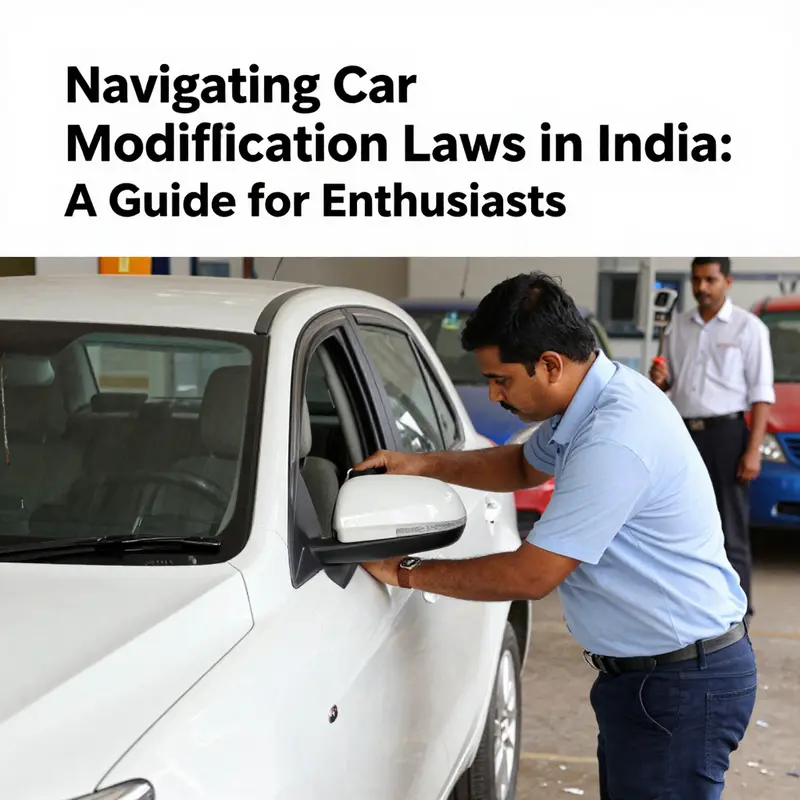
Modifying a car in India sits at the intersection of personal choice and public safety. The impulse to tailor a vehicle to taste, needs, or performance goals is tempered by a legal framework designed to ensure that any change does not compromise safety, emissions, or the vehicle’s fundamental design. In practice, this means that car modification is not an outright prohibition, but a process that funnels ambitious ideas through a rigorous corridor of standards, approvals, and inspections. The central mechanism behind this corridor is a combination of the Motor Vehicles Act of 1988, the Central Motor Vehicles Rules, and the standards set by the Automotive Research Association of India. Reading this landscape as a pathway rather than a barrier helps owners and enthusiasts understand when a modification can proceed and when it cannot, and what steps will be needed to bring a modified vehicle onto Indian roads with confidence and legality.
At the heart of the certification journey is the recognition that any alteration to a vehicle’s original design can impact safety, emissions, or performance. The Indian system uses a disciplined, multi-layered approach to assess and verify these changes before they are allowed to participate in public traffic. This is not a bureaucratic hurdle meant to stifle creativity; it is a structured safeguard designed to ensure that improvements in one area do not create vulnerabilities in another. The primary actor in this process is the Automotive Research Association of India, or ARAI, along with MoRTH-approved testing laboratories. They implement a formal type-approval regime that mirrors international principles while accommodating the country’s diverse vehicle fleet and road conditions. In practical terms, this means modifications must be evaluated against established standards, documented with technical rigor, and demonstrated through a blend of testing and production controls before a modified model can legally roll out of a workshop or into a showroom.
The starting point for any modification is classification. A technician or designer, in collaboration with the owner, must determine which aspects of the vehicle will be affected: safety systems, emissions and noise, structural components, or the vehicle’s health monitoring and electronics. This classification matters because it triggers the relevant AIS—Automotive Industry Standards—and CMVR provisions that apply to the modification. AIS standards function as the detailed hygiene rules for different subsystems: seating and restraints, lighting, emissions and noise, and in the case of newer technologies, electrified drivetrains and advanced driver assistance systems. For instance, changes to safety belts would be guided by AIS-037, while lighting alterations are governed by AIS-099, and emissions-related changes for motorcycles align with AIS-008. When the modification touches an electric vehicle’s battery safety, thermal management, or electromagnetic compatibility, the relevant criteria come from AIS-142 and related CMVR annexes. The key is that the modification must align with these standards in every material way, so it carries the same robust protection profile as the original design or an approved alternative. If a modification cannot be reconciled with the applicable AIS/CMVR requirements, it cannot be certified and thus cannot be registered for road use.
With classification in hand, the path moves to formal type approval—a process that involves documentation, testing, and verification that the modified vehicle can be manufactured and used with predictable safety and environmental performance. The first practical step is to submit a Type Approval Application to ARAI or another MoRTH-approved testing laboratory. This submission is not a mere formality; it requires a comprehensive portfolio that demonstrates, in precise terms, how the modification is implemented and how it affects the vehicle’s systems. The documentation typically includes detailed technical drawings and specifications, a complete bill of materials for any new components, a risk analysis that maps potential failure modes, evidence of quality management practices such as ISO 9001 or IATF 16949, and a thorough description of the modification along with its impact on the original type approval. In short, the application is a body of evidence showing that the altered vehicle is built to the same standards that governed the original model.
The testing phase follows. A representative sample of the modified vehicle is sent to an ARAI or MoRTH-recognized laboratory where a battery of tests is conducted in line with the relevant AIS and CMVR standards. The spectrum of tests reflects the nature of the modification, but several core areas recur. Safety testing examines braking performance, protective structures, seat belt functionality, and, where applicable, airbag systems. Where structural changes are involved, crashworthiness considerations come into play to validate residual integrity in a collision scenario. Emissions testing looks at whether engine remaps, exhaust system changes, or other alterations maintain compliance with Bharat Stage standards. Noise measurements assess external and sometimes interior levels and horn performance. For electronic and electrical systems, especially in modern vehicles or electrified platforms, laboratories evaluate EMC compatibility, battery safety, and the reliability of control systems under a range of environmental conditions. In the case of electric vehicles or advanced driver assistance systems, the testing becomes more specialized, covering battery thermal behavior, electrical insulation, and the resilience of safety systems to electrical disturbances.
But testing is only part of the verification story. ARAI also conducts a factory audit, known as conformity of production or COP. The audit verifies that the manufacturer or workshop can consistently reproduce the modified design and that the production processes, supplier controls, and quality checks align with the approved specifications. This step is crucial because it closes the loop between a one-off test article and a mass-produced or semi-assembled reality of vehicle assembly. COP ensures that what is certified on paper is what appears in production, and that ongoing manufacturing does not drift away from the validated design. When COP is satisfactory, the laboratory compiles test results and audit findings for technical evaluation. If all criteria are satisfied, a Type Approval Certificate, or TAC, is issued. The TAC marks formal recognition that the modified vehicle meets the same high standards as the baseline model, and it typically incorporates a unique designation or code that must be displayed on the vehicle to indicate compliance.
This phase is not simply a stamp of approval for the factory floor. It creates a traceable, auditable chain that covers design, material sourcing, process controls, and the ability to reproduce the modification consistently across production runs. The emphasis on reproducibility matters because it elevates the likelihood that every modified vehicle on the road performs as tested. The process also sets expectations for ongoing compliance. After certification, the manufacturer is responsible for maintaining conformity with the approved design. Surveilling checks, sometimes unannounced, may verify that vehicles in the market match the certified model. If a significant modification emerges or if the certified design requires adjustments—perhaps due to evolving environmental norms or new safety findings—the certification may need to be revisited and, in some cases, a fresh type approval may be required. These checks are not punitive in nature; they are risk-based governance designed to preserve road safety and environmental integrity.
The time and cost dimensions of this journey are non-trivial. The overall course from submission to TAC can span roughly two to four months, influenced by the complexity of the modification, the backlog of testing facilities, and the depth of the documentation required. Costs accrue from several sources: application fees, testing and inspection charges, and COP-related expenses. The exact figures vary with the modification’s breadth and the level of detail demanded by the testing laboratories. One particularly important caveat often emerges early in planning: a certification does not derive value from a foreign approval alone. Even if a vehicle model has gained approval abroad, that certification does not automatically translate into Indian legality. The CMVR and ARAI framework require compliance with the local standards, and any modification introduced in India must pass this domestic route to be legally registerable and roadworthy.
The legal landscape surrounding certification also interacts with the broader question of state-level variation. While the central framework provides the overarching architecture, state transport authorities and local RTOs retain authority to enforce additional interpretations or to emphasize particular concerns, such as noise emissions or vehicle inspection cadence. This means that the path to certification, while standardized in core elements, may encounter practical nuances in different parts of the country. A practical takeaway for anyone contemplating a modification is to engage early with the local RTO and consult MoRTH resources or MoRTH-approved testing laboratories to understand any state-specific expectations that could affect the certification timeline or the cost structure. It is also wise to keep thorough records and to maintain a precise audit trail of all components, changes, and production methods, as this makes the COP and TAC processes smoother and reduces the risk of post-certification complications.
In that sense, the certification pathway acts as a bridge between imagination and responsibility. It allows the enthusiast to pursue customizations that can enhance performance, safety, and accessibility while ensuring those changes do not undermine road safety or environmental goals. Consider the practical implications of this bridge when planning a project—especially if the modification touches critical domains such as braking, steering geometry, augmentation of occupant protection, or emission control equipment. The robust framework ensures that a well-conceived modification, thoroughly documented and properly tested, can be integrated into India’s diverse driving environments without compromising the collective safety of road users. Conversely, it also clarifies the boundaries: modifications that cannot be demonstrated to meet the relevant AIS/CMVR criteria or that cannot be replicated through COP monitoring are not permitted and would be illegal to register and operate.
For readers seeking a concise, actionable touchstone, the practical takeaway is straightforward. If the modification changes how the vehicle behaves in safety-critical ways or alters its emissions or noise profile, you should anticipate a formal approval path. You should prepare full technical documentation, engage with MoRTH-approved labs, factor in the production quality framework, and plan for a multi-stage assessment that ends with a TAC. If the modification is purely cosmetic or does not impinge on the vehicle’s core safety, emissions, or structural parameters, there may still be compliance checks, but the path could be simpler and faster. The overarching message remains clear: legality in car modification in India is not about banning adaptation; it is about ensuring that adaptation respects safety, environmental, and design integrity standards in a way that protects everyone on the road.
To further explore the legal framing and a broader discussion of how modifications can stay within the law while preserving value and performance, one can turn to resources that summarize the practical implications of these rules and provide guidelines for responsible modification practices. For readers who want a brief overview tied to the legal reality, see car-modification-legal-india. This concise reference helps frame expectations as you begin more detailed planning and engagement with testing authorities.
For authoritative standards and regulatory details, the official avenues remain essential. The Automotive Research Association of India (ARAI) site offers the most direct source of current practice, standards, and procedural guidance, including the latest CMVR amendments and AIS updates. While the certification path can be lengthy, it is a structured route designed to uphold road safety while accommodating innovation. By approaching modification projects with a clear understanding of the required documentation, testing, and production controls, you position your project to flow through the system smoothly and to reach the road with appropriate legitimacy. This disciplined approach reduces the risk of post-modification penalties, impoundment, or registration hurdles that can derail a project after significant investment of time and resources.
In sum, the certification process for car modifications in India is a rigorous, multi-layered system built to ensure that creativity and practicality do not come at the cost of public safety or environmental responsibility. It requires a careful initial classification of the modification, a comprehensive type-approval application, strict testing against AIS and CMVR standards, a COP audit to verify production reliability, and finally a Type Approval Certificate that grants legal use on public roads. While this pathway can be time-consuming and financially demanding, it represents a mature framework that aligns Indian automotive modification with global best practices while respecting the country’s specific regulatory and road-usage realities. For those who approach it with diligence, it is not a barrier but a structured opportunity to realize meaningful, safe, and compliant vehicle enhancements. And as with any legal journey, engaging early with the right authorities and documentation can help ensure that the road ahead is smooth rather than fraught with ambiguity.
External resource: For the most authoritative and up-to-date regulatory guidance, consult the official Automotive Research Association of India (ARAI) site at https://www.araiindia.com
Enforcement in Flux: Penalties, Permits, and the Patchwork of State Rules Governing Car Modifications in India

Modifying a car in India sits at a charged intersection of desire and duty, customization and caution. The core framework rests on the Motor Vehicles Act and on guidelines issued by the Ministry of Road Transport and Highways, but enforcement is highly variable across states. A modification considered acceptable in one state can trigger penalties in another; the federal structure grants broad authority to states while preserving national safety and emission norms. In practice, legality hinges on three questions: what is explicitly permitted or encouraged, what is clearly prohibited, and how registration, certification, and inspection are conducted locally. The national framework provides guardrails, but it is the state transport authorities and local police who translate them into street-level rules. Enhancements that improve safety or reduce emissions are often welcomed when properly documented; but changes that undermine safety, violate noise limits, or evade emission controls typically face penalties. The process for major modifications usually involves the RTO, a formal inspection, and, where required, a Modification Certificate. Skipping these steps can render a vehicle unregistrable. State examples illustrate the spectrum: Maharashtra and Delhi have focused enforcement against loud exhausts and engine mods, Tamil Nadu emphasizes auditable processes and prior permissions, while Karnataka requires certification from an authorized testing center. The lack of uniform national rules means owners must verify local norms before pursuing changes and plan for documentation and potential re-checks when crossing state borders. For compliance and peace of mind, owners should consult official MoRTH guidance and engage qualified professionals, retain all receipts and certification statements, and ensure that any modification remains within safety and emissions standards. In short, car modification is not categorically illegal in India, but it is tightly regulated, and the consequences of noncompliance can be severe. The practical path is to plan carefully, obtain the proper approvals, and document every step to preserve mobility and safety.
Final thoughts
The landscape of car modifications in India is vibrant and full of potential for enthusiasts looking to upgrade their vehicles. However, it is essential to stay informed about the legal boundaries and compliance requirements to foster a culture of responsible car tuning. By understanding what modifications are permissible and how to navigate the regulatory framework, you can enjoy your passion while ensuring that your vehicle remains roadworthy and legal. With this knowledge, engage confidently with fellow car enthusiasts, and let your creativity thrive within the lines of the law.