
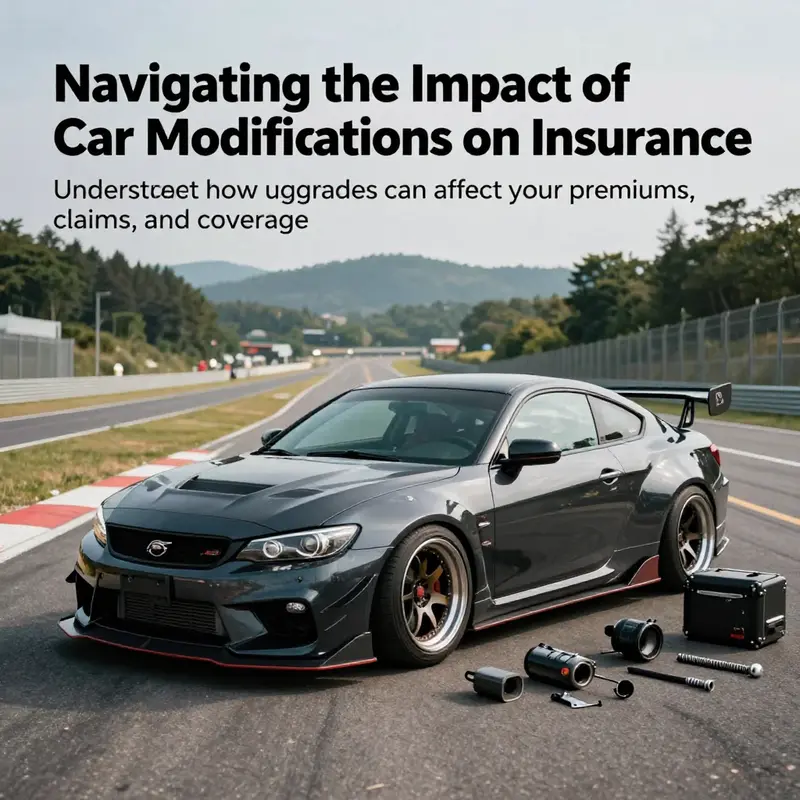
Modifying vehicles is an exhilarating journey for hobbyists, tuners, and classic car lovers alike. Yet, as you enhance your ride’s performance and aesthetics, it’s crucial to understand the implications for your car insurance. Modifications can transform not just your vehicle but also its insurance profile, affecting premiums, coverage, and claims. This comprehensive guide will delve into the intricate relationship between car modifications and insurance, covering how these changes impact your risk assessment, the necessity of declaring modifications, and the categorized effects of specific upgrades on insurance claims and vehicle valuation. By the end, you’ll gain clarity on how to enjoy your passion for modding while ensuring your insurance remains intact and beneficial.
Under the Hood of Premiums: How Car Modifications Rework Insurance Risk and Price

Modifications don’t exist in a vacuum; they affect vehicle value, repair costs, theft risk, and what coverage is needed. When a car is modified, insurers re-evaluate risk for future losses and adjust premiums accordingly. The key levers are market value, repair complexity, safety improvements, and theft appeal. If a modification raises replacement cost, premiums often rise. If upgrades enhance safety and credibility, a discount may be possible, though not guaranteed. Clear disclosure is essential: unreported changes can lead to claim denial or policy cancellation. Documentation, including receipts and installation records, helps underwriters price risk more accurately. Some policies are designed for modified vehicles, including agreed-value coverage, which can protect against depreciation but may come with higher premiums. The final impact on price depends on the insurer, the level of modification, and the driver’s overall risk profile. For readers seeking practical steps, start with a pre-modification discussion with your insurer to understand which parts affect price and what documentation will be requested. Always declare modifications that affect safety, value, or security, and keep records up to date. In short, modifications shape insurance risk through value, repair costs, safety outcomes, and theft risk, and transparency with your insurer is the best way to maintain predictable coverage.
Declaring Modifications: The Gatekeeper of Coverage, Costs, and Claims in Car Insurance

When a driver chooses to fit a performance exhaust, an engine tune, bigger wheels, or a custom body kit, the change is more than cosmetic. It is a recalibration of risk that sits at the core of any auto policy. Insurance is not a blanket guarantee that covers every possibility; it is a carefully priced contract that reflects the likelihood of events and the costs involved in repairing or replacing the vehicle. Modifications alter both sides of that equation. They can make a car faster, more attractive commercially, or more difficult and expensive to repair. Each of these consequences matters to the risk model used by insurers. The first and most crucial step is disclosure. The law in the United Kingdom, echoed by the Motor Insurers’ Bureau, makes it clear that policyholders must tell their insurer about any material changes to their vehicle. Hidden changes can invalidate a policy. A claim filed after an accident may be refused or reduced, leaving you to bear the costs personally. This is not a hypothetical risk but a practical, often costly consequence that can appear in the wake of a crash. In practice, disclosure acts as a bridge between the car you drive and the policy you hold.
This bridging is not just about avoiding penalties; it is about achieving a fair, accurate, and enforceable insurance arrangement. Insurers assess risk based on the vehicle’s condition and specifications, including alterations that influence performance, safety, or value. Engine modifications, suspension upgrades, brake enhancements, or turbochargers all change how the car behaves on the road and how it would fare in a collision. Cosmetic modifications such as a distinctive paint color, aftermarket alloy wheels, or a body kit add to the vehicle’s value and the complexity of repairs; even if these changes do not alter performance, they can shift the replacement cost in a claim. In some jurisdictions, even tinted windows or certain types of aftermarket lighting could affect the risk profile or be restricted by policy terms. The point is simple: insurance pricing is anchored in the expectation of risk, and modifications shift that expectation in nuanced ways. The result is that premiums may rise, policy terms can change, and some alterations may prompt special conditions or exclusions.
To move from principle to practice, many drivers begin with a clear inventory of changes, including the date of installation, the name of the installer, and the exact specification of each modification. This inventory helps both you and your insurer build a precise picture of the car. For some drivers, this process reveals an important tension: the modifications that provide performance gains or aesthetic appeal can also increase the cost of coverage or limit the scope of protection. It is here that the obligation and opportunity of disclosure become most evident. The insurer needs to understand not only what was added but also why it was added and how it affects safety, security, and everyday use. A high-performance engine may be great on a track day but may alter the car’s compliance with speed limits, road use restrictions, or warranty provisions. An upgraded braking system may improve safety in a high-power vehicle but can also require different maintenance schedules or insurance rules. The overall objective is to ensure that coverage remains valid under the terms of the policy rather than becoming a surprise in a claim.
In some cases, information about modifications can lead to lower premiums. If a modification reduces risk—such as a certified tracking device, a robust anti-theft system, or advanced safety features that help the vehicle stop sooner or prevent collisions—the insurer may offer a discount. In other cases, modifications may trigger constraints that limit use or require specialized coverage. For example, a vehicle with a high-performance designation might be restricted to private use or require an explicit rider specifying that it will not be used for commercial purposes. These outcomes vary by insurer, policy type, and the regulatory environment, but the underlying principle holds: disclosure allows the insurer to price risk accurately and provide coverage that reflects the car’s true profile.
The categories of modifications are broad, and each category interacts with the policy in a distinctive way. Performance upgrades, such as engine tuning, turbocharging, suspension changes, or brake enhancements, can significantly shift risk by altering acceleration, handling, and repair costs. Insurers may treat such cars as higher risk and increase the base premium or require a higher excess, a lower mileage cap, or even a more restrictive use policy. Aesthetic changes, including custom paint finishes, alloy wheels, and body kits, while not changing performance directly, influence the car’s value and the likelihood of damage or theft. If a totaled or stolen vehicle contains bespoke features or rare parts, the replacement cost can be higher, and the insurer will need to account for this in the settlement. Safety and security upgrades, while sometimes reducing risk, need to be declared accurately to ensure that the corresponding discount, if any, is applied correctly. Electronic and technological upgrades, such as enhanced driver assistance systems, upgraded navigation, or trackers that share location data with the insurer or a monitoring service, add another layer to the risk calculation. Each modification category has a story to tell about risk, and the insurer will listen to that story only if it is presented clearly and supported by documentation.
The practical benefit of disclosure rests on the ability to communicate with the insurer in a way that makes sense within the policy framework. A straightforward and transparent declaration can be paired with a policy renewal or a mid-term adjustment and can prevent the sorts of post-incident questions that delay claims or jeopardize payouts. The best practice, in many cases, is to provide a compact, evidence-based summary of what was changed, why it was changed, and how it affects safety and cost. This summary can be supported by receipts, installation photos, and engineering notes from qualified professionals. It is not enough to simply say that parts were added; the insurer wants to know the exact model or part numbers, the installation date, and, when relevant, the expected impact on performance and value. It also helps if you can show that the modifications were done by reputable installers, with appropriate warranties and aftercare. In some cases, the installation may involve third-party modifications that require periodic inspections under certain conditions. If the car is financed or leased, the lender may have additional reporting requirements, and failing to meet them could breach the loan or lease agreement. This is why the disclosure process is often a cross-bank, cross-institutional exercise rather than a single-actor task.
To illustrate how this works in everyday life, consider a driver who adds a high-performance engine and a bespoke exhaust system to a vehicle. The combination can alter power delivery, torque characteristics, exhaust temperatures, and maintenance needs. The insurer will consider the effect on risk: will the engine be operated within the typical driving profile of the policyholder, or will it encourage more aggressive driving? Will the upgrade increase the likelihood of high repair costs in a collision? Will the parts be readily available and affordable if replacement is needed after a claim? The upgrade may require new specifications or an expanded coverage for specific components that carry extraordinary costs, such as forged internals, turbochargers, or a high-performance ECU. If the policyholder provides a comprehensive documentation package that includes the precise engine specs, a copy of the installation receipt, and a professional assessment of the upgrade’s impact on safety and reliability, the insurer can incorporate the modification into the premium calculation and adjust the policy language accordingly. In some cases, the insurer may request a mechanical inspection or a revaluation of the vehicle to reflect its new status. In others, they may issue a rider or a revised schedule that lists the additional parts and assigns them a separate value, thereby preventing disputes at claim time.
The importance of a precise valuation cannot be underestimated. Modified vehicles often have higher replacement values because of bespoke parts or specialized assemblies. If the car is totaled, the payout must reflect these realities; otherwise, the policyholder could be left underinsured. On the flip side, unreported modifications can complicate valuation in a negative way. If a claim reveals that the car has been heavily altered, the insurer might contend that the modifications contributed to the incident or altered the risk class in ways not reflected by the policy. The result can be a denial of the claim, a partial settlement, or the imposition of deductibles for parts that were not originally priced into the coverage. The UK framework recognizes this risk, and the MIB emphasizes that non-disclosure can invalidate the policy. The practical takeaway is that the value you place on your modifications must be credible and well-supported by documentation, because the settlement hinges on accurately reflecting both the car’s current state and its future risk profile.
For many drivers, the question is not only how to declare, but when to declare and how to structure the conversation with the insurer to avoid friction. If you have just bought a modified vehicle, you should not assume the coverage automatically follows; you should verify the terms with the insurer and possibly with the finance or lease company. If you plan to modify a financed car, you should check the financing agreement for any constraints around modifications and ensure that the lender is informed before changes are made. If you already made modifications, many insurers allow you to backdate the disclosure to the date of installation, but this is a matter to confirm with the provider. The aim is to harmonize all aspects of the car’s status, including its ownership structure, its use, and its risk profile. The process may involve a formal declaration form, but even without a formal form, a clear, consistent email or letter that lists the changes, dates, and relevant documentation can suffice. The critical piece is not the format but the substance: you need to convey accurate information that the insurer can verify and apply.
The end result of this careful process is not only the avoidance of policy invalidation but also the opportunity to tailor the policy more closely to your risk. In some instances, modifications can be accommodated within a standard comprehensive policy with a revised schedule, an adjusted premium, and a few rider terms. In other cases, the insurer may offer a specialized policy for modified vehicles or require a form of usage limitation, such as non use for track days, or a cap on annual mileage, to reflect the higher risk profile. The overarching principle is that the policy should mirror the car’s actual state and the driver’s patterns. If it does, you can expect a more predictable claims experience, fewer disputes at payout time, and a clearer understanding of what is and is not covered in the event of theft, damage, or total loss.
The practical reality is that every modification is a potential point of negotiation in the insurance contract. The most effective approach for a driver who loves modification is to view the process as ongoing risk management rather than a one-time event. Keep a running record of all changes, update the policy promptly, and seek guidance whenever you are uncertain about the impact on coverage. The insurer’s job is to price risk accurately, and your job is to supply the information that makes that possible. Transparently stating what has changed, why, and how it affects safety and cost is a service to your future self as well as to your insurer, because it reduces the chance of a costly surprise when a claim is filed.
In closing, the importance of declaring modifications is not a bureaucratic nuisance. It is a foundational practice that ensures your coverage remains valid and aligned with the car you drive. It protects you against the risk of claim denial and protects the insurer against mispricing and misinterpretation of coverage. It creates a shared understanding that allows for fair compensation when misfortune occurs and for responsible, legitimate use of a modified vehicle. If you are seeking practical guidance on how to present a modification to your insurer, you can consult the overview here car modifications insurance. For a broader regulatory perspective and the government-backed context that informs these expectations, you can review the UK government guidance on car modifications and insurance, which underscores the responsibility to disclose material changes and the consequences of non-disclosure.
External resources
https://www.gov.uk/government/publications/car-modifications-and-insurance
How Modifications Change Claims and Value: What Insurers Look For and Why It Matters

Understanding How Modifications Shape Claims and Valuation
When you alter a vehicle, you change its risk profile, its replacement cost and the way an insurer will treat it after an incident. Modifications are not neutral additions; they are signals. They tell underwriters about likely driving behaviour, repair complexity and potential liability. They also change the economics of a claim. Some changes lower risk and cost, some raise them. Many fall somewhere between. The crucial point is that insurers do not simply insure a chassis and a registration number; they insure the car as it is used and as it is equipped. That means every meaningful change can alter cover, premiums and settlement outcomes.
Performance upgrades are the clearest example of this effect. An engine remap, turbocharger, upgraded exhaust or sport tyres directly increase a car’s speed, acceleration and cornering ability. Faster cars and faster acceleration correlate with a greater incidence of high-speed collisions and more severe damage when crashes occur. Insurers respond by classifying the vehicle into a higher risk tier. That reclassification commonly leads to higher premiums and may alter cover terms. After a crash, claims handlers examine whether a performance modification contributed to the accident. If it did, they may contest liability or apply policy exclusions. Even when liability is not disputed, repair costs can be considerably higher because performance parts and their calibration often require specialist labour and calibration tools.
Aesthetic and customisation changes invite a different set of concerns around valuation. Custom paint, body kits, alloy wheels and bespoke interiors increase the car’s subjective value to the owner, but not every insurer recognises that value automatically. Insurers usually base total-loss payouts on pre-accident market value. That market value tends to reflect broadly traded, factory-standard cars. Niche or highly personalised parts often do not boost market value proportionally, because they have a smaller pool of buyers and may demand specialist repair or replacement. Unless you secure an endorsement or add-on that specifically covers aftermarket components, you may find that a total-loss payout falls short of the money you need to replace custom elements or to compensate for the time and money invested.
There is also the timing issue. When modifications are declared to an insurer before they are fitted, the policy can be amended to reflect the new risk or value. When they are declared after an incident, you risk having a claim denied. Insurers treat non-disclosure seriously because it can conceal additional risk. If the unreported change materially influenced the likelihood of loss or increased potential claims costs, the insurer may decline the claim or void the policy. That hard rule makes transparency essential; it protects both you and the insurer and avoids costly disputes.
Not all modifications increase premiums or complicate claims. Some additions reduce risk and can produce premium discounts. Certified alarm systems, immobilisers, approved tracking devices and advanced driver assistance systems tend to lower theft and collision risk. If an insurer recognises these devices and the installation is documented, your policy can reflect lower exposure. However, insurers vary widely in how they value such features. Some will insist on manufacturer-approved systems or professional installation to accept a discount. Others will ask for proof of functioning and serial numbers for tracking devices. This inconsistency means that even safety upgrades require prior discussion with your insurer to ensure savings are actually realised.
Beyond premiums and discounts, modifications change the mechanics of a claim. Repair processes can become longer, costlier and more complex. Factory parts are generally available through dealer networks, with predictable lead times and repair procedures. Aftermarket or bespoke components may need to be sourced from specialty suppliers, custom-ordered or fabricated. Bodywork that has been modified with non-standard materials may require a particular workshop or paint match that increases costs. If an insurer is prepared to fund repairs that retain aftermarket parts, they will factor in the specialist labour and parts pricing. If not, they may opt for replacement with standard parts where possible, which can leave the policyholder to cover the difference or accept a repair that removes custom elements.
Valuation disputes are commonplace when a modified vehicle is declared a total loss. Market value assessments tend to relate to comparable sales for the same make, model and mileage. A modified car often has fewer comparable sales, making an accurate valuation more subjective. Specialist appraisers can provide evidence of additional value for high-quality modifications, but this evidence must be persuasive and well documented. Receipts, photographs, invoices for parts and installations, and proof of professional workmanship all help. Without this documentation, insurers default to market norms and may undervalue the car.
Another frequently overlooked factor is the interaction between modifications and safety systems. Many modern cars integrate engine performance, braking and stability control as part of a complex electronic system. Changing suspension geometry, altering brake balance, or installing non-standard tyres can upset the calibration of safety systems. If a modification disabled or degraded a safety function and an accident occurs, an insurer may argue contributory negligence or decline to cover aspects of the claim. This is not merely theoretical; insurers increasingly consult manufacturer guidance and technical reports to determine whether aftermarket changes impaired safety systems.
The legal environment also plays a role. In some jurisdictions, certain modifications are illegal or require formal approval and certification. Illegality can void cover directly or create regulatory obligations after a crash. Even where a modification is legal, it may still trigger administrative requirements such as registration or inspection. Failure to comply with these rules can affect the outcome of a claim and the valuation of the car.
Short-term and long-term ownership status affects decisions too. If you plan to sell soon after modifying a vehicle, you should consider the effect on resale value as perceived by buyers and insurers. Some buyers prize tasteful, well-documented upgrades and are willing to pay more. Others view modifications as a risk and prefer standard cars. Payment structures such as loans or leases complicate the picture further. Finance providers often require permission before major changes and may demand that the car is returned to factory specification at lease end. Modifying a financed or leased vehicle without permission can breach contract terms and create complications if an insurer needs to settle a claim with a lienholder.
A few practical mechanics bear emphasising. First, always record and keep evidence of any professional installation, part serial numbers and receipts. This documentation helps at claim time and makes it easier to negotiate endorsements in advance. Second, check whether your insurer requires a specialist appraisal or prior approval for particular modifications. Third, be proactive: speak to your insurer before fitting significant parts, not after. That simple step prevents denied claims and unexpected premium changes.
When negotiating endorsements, aim for clarity about what is covered. An endorsement that insures specific aftermarket parts against theft or damage will usually define the parts by make, model, serial numbers and value. It will also state the conditions under which the insurer will pay, such as whether they will replace with identical parts, pay cash value, or replace with equivalent standard parts. Pay close attention to limits, deductibles and whether labour and calibration costs are included. If you are uncertain, ask for the endorsement in writing and check the precise wording.
Claims involving modified vehicles sometimes trigger third-party disputes. For example, if a crash occurs and the other party alleges that your modification caused the accident, insurers will exchange technical reports and often commission independent forensic assessments. Forensic evidence can range from telemetry and electronic control unit logs to inspection of wear patterns and mechanical failures. These assessments can determine whether a modification directly caused or materially contributed to the crash. If so, legal costs and liability exposure can rise sharply for the owner of the modified vehicle.
There are also consequences for long-term costs such as depreciation and future premiums. A string of modifications that increase an insurer’s perceived risk may lead to persistent premium increases or restricted renewals. Conversely, consistent documentation of safety upgrades and approved installations can build a record that future insurers will consider favourably. Think of your vehicle’s insurance history as a performance file: the more complete and professional it is, the easier it becomes to obtain fair treatment.
Practical examples illustrate these dynamics. Consider a driver who fits a larger turbocharger and does not inform their insurer. After a crash, the insurer discovers the modification in the repair bill and engine logs. The insurer concludes the modification increased speed and contributed to loss. They may deny liability coverage, cancel the policy, and refuse payout for engine-related damage. In contrast, a driver who fits an approved tracking device, declares it, and has serial-numbered proof may receive a reduced premium and a faster recovery if the car is stolen. The contrast is clear: disclosure and the nature of the modification shape outcomes.
Some owners pursue extended cover products designed specifically for modified cars. These specialist policies may cover bespoke parts, custom paint, and non-standard accessories that typical policies exclude. If your modifications are extensive, seeking a specialist insurer can avoid the valuation and claims disputes that mainstream insurers commonly encounter. Specialist cover typically requires detailed inventories, receipts and sometimes photographs. It can be more expensive, but it provides tailored protection that general policies cannot match.
Insurance considerations should influence modification choices from the outset. A risk-aware approach balances desired performance or aesthetics with likely insurance consequences. Before making a decision, estimate potential premium increases and ask how a total-loss settlement would be calculated. Consider if you can afford to add an endorsement or switch to specialist cover if you need to. Remember that some modifications are hard to reverse; choose installations that are professionally documented and, where possible, reversible without damaging the vehicle.
Finally, the stakes are not limited to money. There are safety, legal and reputational consequences too. A modification that harms safety features or violates regulations can increase the chance of injury and complicate civil liability in ways that outstrip any short-term gains in performance or style. The most prudent route is transparent dialogue with insurers, careful documentation of every change, and an understanding of how a modification will affect the car’s market value and claim behaviour.
For a clear checklist you can use when planning modifications: prepare receipts and installation records; inform your insurer in advance; request written confirmation of any premium or cover changes; consider specialist insurance for extensive custom work; and keep copies of serial numbers and photos. Those steps reduce the risk of disputes, ensure better valuation if a total loss occurs, and align your expectations with industry practice.
For more detailed guidance on which modifications typically affect your insurance and how to declare them, see this focused resource on what modifications affect car insurance.
External source: For official government advice and additional context about declaring modifications and how insurers treat them, refer to the authoritative guidance from government transport authorities: https://www.gov.uk/government/publications/car-modifications-and-insurance
Final thoughts
Understanding the nuances of how car modifications influence your insurance is critical for every vehicle enthusiast. From potential premium increases to the imperative of declaring changes, knowledge is power. By being proactive in reporting modifications and evaluating their impact on your coverage, you can enjoy your customizations with peace of mind. Ultimately, ensure that your modifications enhance not just your driving experience but also your insurance protection as you glide through the roads with confidence.