
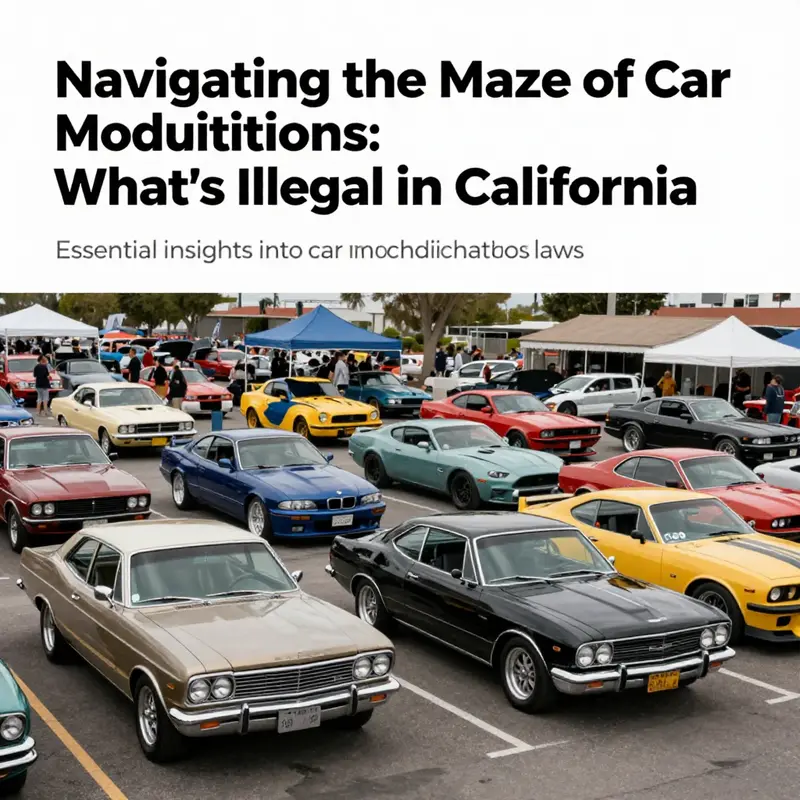
California is the epicenter of automotive culture, attracting hobbyists, tuners, and restoration experts alike. However, it harbors strict regulations that can make the journey of car modifications complex. Understanding these rules is essential to ensure that your cherished vehicle, whether a muscle car or a tuned sports car, complies with state laws. This article delves into the various aspects of car modifications deemed illegal under California law, highlighting the nuances of exhaust systems, window tinting, suspension changes, emissions controls, and lighting regulations. Each chapter will explore these topics in depth, empowering your car modification endeavors while keeping legal compliance at the forefront.
Noise, Emissions, and Compliance: The Exhaust Modifications California Holds Illegal
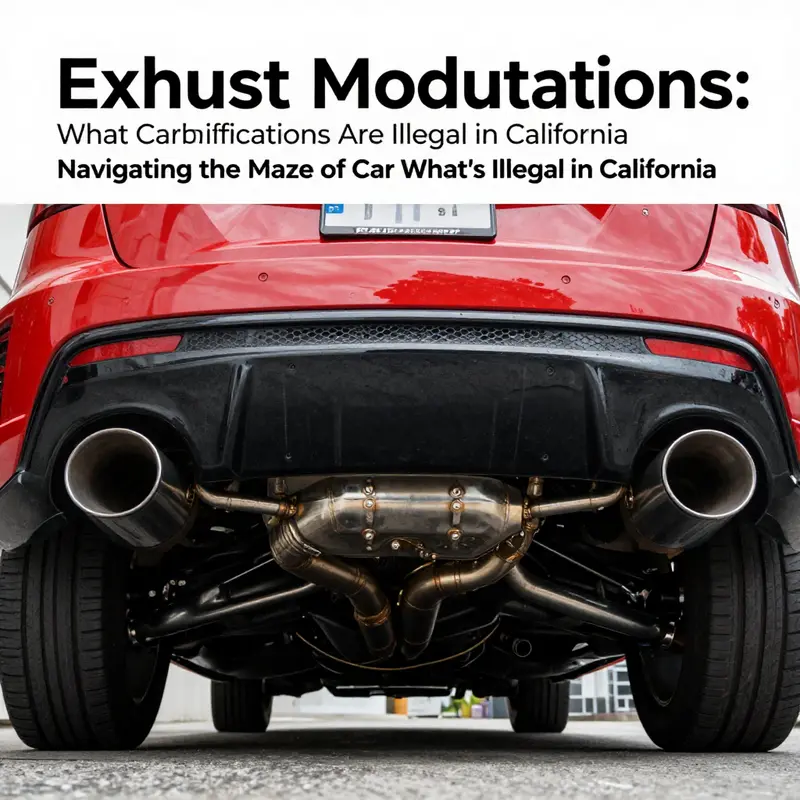
California treats exhaust work as more than just a matter of personal taste or engine performance. It sits at the intersection of safety, public health, and environmental stewardship. Within this landscape, the state’s regulatory framework is built to ensure that on-road vehicles do not produce dangerous levels of noise or emissions, and that the modifications owners apply to their cars do not undermine those protections. The rules are enforced by a combination of state agencies, primarily the California Air Resources Board (CARB) and the Department of Motor Vehicles (DMV). Taken together, these agencies create a framework in which some modifications are permissible with proper certification, while others render a vehicle illegal for use on public roads. The line between permissible and prohibited is often fine but definite, and it centers on two core objectives: keeping the air cleaner and maintaining predictable, safe levels of noise that do not disturb other road users or damage the auditory comfort of neighborhoods and drivers alike.
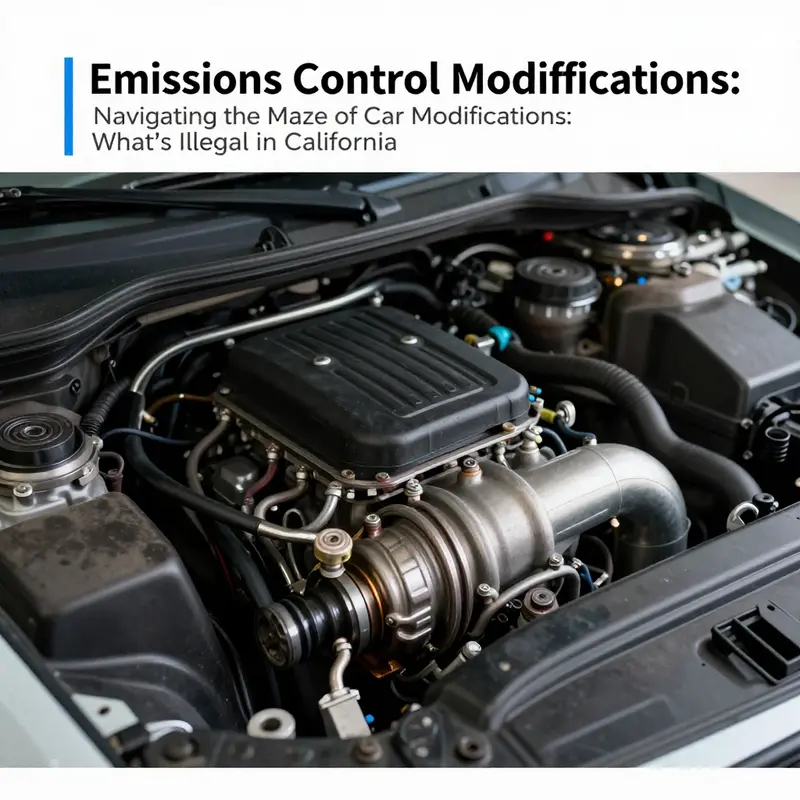
At the heart of illegal exhaust modifications is the obligation to maintain emissions control devices and to avoid introducing excess noise. The most visible and commonly scrutinized changes involve the exhaust system itself. California law prohibits removing or tampering with catalytic converters, which are the primary devices designed to reduce the release of harmful pollutants. When a driver removes a catalytic converter or installs an aftermarket converter that is not CARB-certified for use on California roads, the vehicle fails to meet state emissions standards. This failure is not merely a paperwork issue; it translates into real-world consequences during inspections and road checks. The state’s emphasis on ensuring that emission-control devices remain functional reflects a broader public health goal: to minimize smog-forming pollutants that contribute to health problems, irritate the lungs of vulnerable individuals, and degrade air quality in densely populated regions.
Beyond the catalytic converter, the rules extend to aftermarket exhaust systems and their overall performance in the context of California’s strict certification regime. Any exhaust component—mufflers, pipes, headers, or complete systems—must bear CARB certification to be legally used on public-road vehicles in the state. Systems marketed as “off-road” or used solely for racing are not appropriate for street use in California, because they are not certified for compliance with state standards. Even when a vehicle retains its original converter, installing a system that has not earned CARB certification can create compliance gaps. The result is not only a formal citation but often a failure in the annual or biennial smog check that California requires for registration renewals. The message is clear: modifications that bypass or circumvent the formal certification process undermine the safeguards CARB has put in place and open a vehicle to serious penalties.
A frequent source of contention is the use of straight pipes or resonator deletes. These modifications are designed to increase exhaust flow and, consequently, exhaust noise. In California, the amplified noise can be a violation even if the catalytic converter remains in place. The state enforces a noise threshold, commonly cited as a measure at a distance from the vehicle, to determine compliance. In many enforcement scenarios, aftermarket systems that push the sound levels above regulatory thresholds — often around a defined decibel limit and measured under standardized conditions — are treated as illegal for on-road use. The practical effect is that a vehicle owner who values the auditory character of the exhaust must balance performance considerations with the realities of road-legal noise limits. This is not a matter of personal preference; it is a public-safety and public-welfare policy that translates into real-world watchfulness by law enforcement, emissions inspectors, and DMV officials.
The legal framework also addresses how exhaust modifications interact with sensors and emission-control devices. California law prohibits any alteration that would impair the effectiveness of oxygen sensors, exhaust gas recirculation (EGR) valves, or other components that modulate combustion and curb emissions. Tampering with these sensors or bypassing them undermines the ability of the vehicle to meet air-quality standards. In practical terms, even a high-performance exhaust that seems to perform well on a dyno can become illegal once it introduces discrepancies with sensor feedback or causes exhaust gases to be released at improper ratios. This is where the line between legitimate performance upgrades and unlawful tampering becomes particularly nuanced. The CARB framework expects modifications to preserve, or at least not compromise, the integrity of the vehicle’s emission-control strategy. When a modification removes or deactivates sensors or reduces the system’s efficiency, it crosses into illegal territory.
All of these factors intersect with state inspections and the licensing framework. In California, a vehicle that has not maintained its emission-control integrity or that produces excess noise can fail a required smog check. A failed inspection often translates into a refusal to register or renew the vehicle’s license plates, unless the owner is willing and able to restore compliance. The consequences can range from fines to mandated repairs, and in some cases, the DMV may require the vehicle to be brought back to specification before it can be used on public roads again. The deterrent effect of these potential penalties reinforces the state’s broader policy goal: ensure that the cars traversing California’s roads minimize pollution while remaining predictable in their behavior and emissions output. The net effect is that choosing to modify an exhaust system without proper certification is not only a risk to air quality but also a legal risk that can affect vehicle ownership and operation.
For anyone considering exhaust work, the pathway to legality is paved with certification and careful adherence to standards. CARB-certified exhaust systems are designed to meet California’s stringent requirements while delivering the desired acoustic and performance characteristics. Owners should look for official CARB certification marks and check that the system has an approved EO (Executive Order) number. This EO number is a formal statement that the product has been tested and approved for use on California roads. Without it, even well-intentioned performance goals can become illegal. In practice, this means doing due diligence before purchasing or installing any exhaust components and avoiding systems that are marketed only for off-road or track use in contexts where they would be used on public highways.
The broader lesson extends beyond the exhaust itself. California’s approach to exhaust modifications is part and parcel of a larger philosophy: give drivers the opportunity to improve their vehicles while ensuring that such improvements do not compromise safety, noise levels, or air quality. This philosophy requires ongoing education for enthusiasts, a robust certification ecosystem, and vigilant enforcement to keep roads safe and neighborhoods peaceful. The emphasis is not simply on punitive action but on a rational, evidence-based approach that differentiates between legitimate, properly certified enhancements and tampering that undermines public welfare. The practical takeaway for readers is straightforward: if you want to pursue exhaust upgrades in California, engage with CARB-certified products, ensure that any modifications preserve the functionality of emission-control devices, and be mindful of sound levels that remain within legally accepted limits.
If you’re navigating this landscape and want to ground your decisions in broader discussions about legality and safety, you can explore related conversations on the topic of illegal car modifications. Illegal car modifications provide context on how different jurisdictions layer additional restrictions and how car owners weigh performance against compliance. This broader perspective can illuminate why California’s rules are both stricter and more explicit than certain other jurisdictions, underscoring the importance of certification, science-based thresholds, and reliable inspections.
For official guidance and the most up-to-date requirements, the California Air Resources Board remains the primary authoritative resource. You’ll find detailed information about emissions standards, approved exhaust systems, and the legal implications of noncompliance on CARB’s public-facing materials and regulatory updates. Engaging with these resources helps ensure that any modifications you consider not only improve your vehicle’s performance or sound but also keep you in good standing with state law and road-safety expectations.
External resource: California Air Resources Board. https://www.arb.ca.gov
Visible Rules, Hidden Repercussions: Window Tinting and California Car Modifications
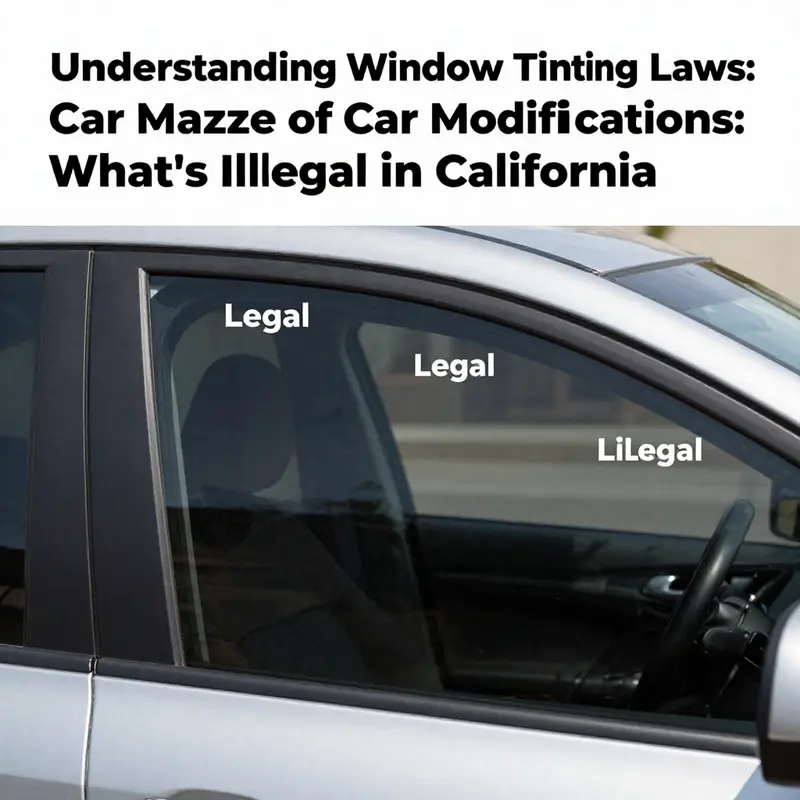
California’s roads carry more than a hundred shades of personal style. They also carry a dense layer of rules designed to balance individual expression with safety, public health, and environmental protection. Window tinting stands at the intersection of those goals in a revealing way: it is a modification that can improve comfort and privacy, yet it also tests the line between personal customization and the clear, unobstructed view that keeps everyone on the road safer. The story of tint in California is not just about how dark a film can be or how stylish the car looks. It’s about how regulations shape what drivers can do, how enforcement works, and how this single area reflects a broader system of restrictions that covers exhaust, emissions, lighting, suspension, and the use of non-compliant performance parts. Taken together, these rules form a map of what is legal and illegal on California’s streets, and tinting sits squarely in the middle of that map as a vivid, accessible example of how law and hobby converge on daily driving.
At the heart of California’s window tint policy is a straightforward safety premise: what you can see through your own windshield and windows matters for your ability to react to danger, and what others can see through your windows matters for their sense of predictability on the road. The state’s standards specify light transmission requirements that vary by window type. Front side windows must permit at least seventy percent of light to pass through. That number is not arbitrary—it is designed to ensure that drivers retain a clear field of vision, even under challenging lighting conditions, while still allowing some shading that can reduce glare and heat. The rear side windows and the rear windshield have more leeway. They may accommodate darker tints, but they cannot be completely opaque. This structure reflects a careful balance: it recognizes the practical benefits of tinting—privacy, UV protection, heat reduction—while preserving a basic level of visibility that is essential in traffic situations where the driver needs to be aware of pedestrians, cyclists, and other vehicles.
Enforcement considerations also shape how tint laws are implemented on the ground. The rules explicitly prohibit reflective or mirrored films that could interfere with license plates or that impair the driver’s or other drivers’ ability to see clearly. The intent is not to punish aesthetic choices in isolation but to prevent a tint from becoming a safety hazard or a police visibility problem at critical moments. When a tint violates these requirements, the consequences can be practical and immediate. Penalties typically include fines and the obligation to remove the non-compliant film, sometimes accompanied by a DMV inspection or reinspection to confirm that the vehicle once again meets the legal standards. In more persistent cases, a vehicle can face registration issues or other DMV actions if the modifications render it non-compliant with state safety and environmental rules.
California’s approach to window tinting also illuminates a broader logic that governs many other modifications. The state’s safety and environmental regimes are designed to operate in concert. A tint that is too dark might reduce a driver’s visibility in fog, rain, or at night, but it is not treated in isolation. The same vehicle that wears a dark front window tint may also be subject to rules about exhaust noise, lighting, and the status of its emissions-control systems. In practice, this means that a driver who wants to tint the windows should not assume they can rely on a single, blanket exemption for all other changes. Instead, they must consider how each modification interacts with California’s regulatory framework. The existence of CARB (California Air Resources Board) standards for emission controls, for instance, looms large over anything that could influence how a car runs and how cleanly it burns fuel. The department tasked with keeping these standards is vigilant about changes that bypass or undermine pollution controls, but the enforcement ecosystem also extends to how modifications impact safety measures and roadworthiness.
The conversation about tint also foregrounds a realistic skepticism about the kinds of shortcuts some drivers imagine. Tinting the glass is a visible modification, and because it is visible, it is more readily scrutinized by police and inspectors than many under-the-hood changes that are harder to detect. Yet the same person who chooses a darker rear tint might not realize that the rules are not a single ceiling but a spectrum with different thresholds by window. The front windows are the most tightly regulated because they influence the driver’s direct field of vision and the line of sight of other road users. The rear windows, while more permissive, still tie into a broader standard of safety and compliance. This structure encourages drivers to approach customization with an understanding of the consequences and a readiness to adjust their plans if a modification would push them out of compliance.
Beyond the immediate setting of tint, the broader article’s theme becomes clear: illegal car modifications in California are not a collection of isolated prohibitions but an integrated framework. The same ethos that governs tint—safety first, environmental protection second, and personal choice within tight bounds—also underpins restrictions on exhaust systems, emissions-control devices, lighting configurations, and suspension geometry. For exhaust, the line is drawn at noise intensity and the integrity of the muffling system. For emissions, the rule is to preserve the vehicle’s certified pollution-control devices and not to cheat or tamper with them. For suspension, the height and geometry must remain within certain safe limits to prevent stability issues. For lighting, extra or non-standard installations must not dazzle or distract other road users and must align with safety codes. And for high-performance parts, California requires CARB certification to ensure that even power enhancements do not compromise air quality or safety. Taken together, these rules form a cohesive, if sometimes complex, tapestry of what is legally permissible on California roads and what is not.
This is where the practical realities of owning and modifying a car in California become most apparent. A driver who loves the aesthetic or practical benefits of tinting must navigate both the explicit limitations and the implicit expectations that come with living among enforcement regimes and public policy aims. The front window requirement of seventy percent light transmission is not just a number; it is a standard that stands behind every traffic stop, every inspection, and every DMV decision about whether a vehicle remains roadworthy in the eyes of the state. The possibility of exemptions or medical considerations adds another layer of nuance, reminding readers that while laws are written to be clear, enforcement and interpretation can be context-dependent. In some cases, medical exemptions can influence how tint is applied, but these exceptions are not a universal relief and must be pursued within the proper legal channels.
The chapter also intersects with broader concerns that savvy owners consider when planning modifications. A tint that passes inspection today could interact with a future change—say, a new exhaust setup, a different lighting scheme, or a revised emissions strategy—and compel another round of approvals, inspections, or removals. The practical takeaway is that California’s modification landscape rewards informed decisions grounded in a clear view of the legal framework, rather than impulsive customization that looks appealing in the moment but risks non-compliance and costly consequences later. This is not merely about avoiding fines; it is about preserving a vehicle’s ability to be legally registered, insurable, and roadworthy without hidden penalties, recalls, or the hassle of unplanned repairs.
For readers interested in a broader view of what falls under the category of illegal car modifications, the topic of window tint provides a concrete entry point into the larger conversation. It illustrates how a single modification can illuminate the overlapping rules that cover noise, emissions, lighting, and performance parts. To explore how tint relates to the wider legal landscape and to see a broader discussion of illegal modifications, you can refer to this overview on illegal car modifications. Illegal car modifications.
As this chapter moves through the landscape of California’s vehicle rules, it becomes clear that the state’s approach to illegal modifications is about preserving safety and environmental integrity without erasing personal expression. The next sections in this article will turn to the next major category—exhaust and noise restrictions—where the tension between customization and public safety becomes even more visible. Yet even there, the same thread remains: laws are crafted to ensure that modifications do not undermine the vehicle’s core safety systems or the air we all share. The result is a regulatory environment that challenges enthusiasts to be creative within bounds, to verify compliance before modding, and to stay informed about evolving standards that can shift with new technology and new environmental commitments.
External resource: for a detailed, official perspective on window tinting requirements and enforcement, consult the California Department of Motor Vehicles’ guidance at https://www.dmv.ca.gov/portal/dmv/detail/vh/tinting. This resource provides up-to-date, authoritative information on what is legal and illegal under state law and helps drivers understand the practical implications of tint choices in the broader context of California’s vehicle regulations.
Low-Riding Regulations Reimagined: Navigating California’s Boundaries on Car Modifications
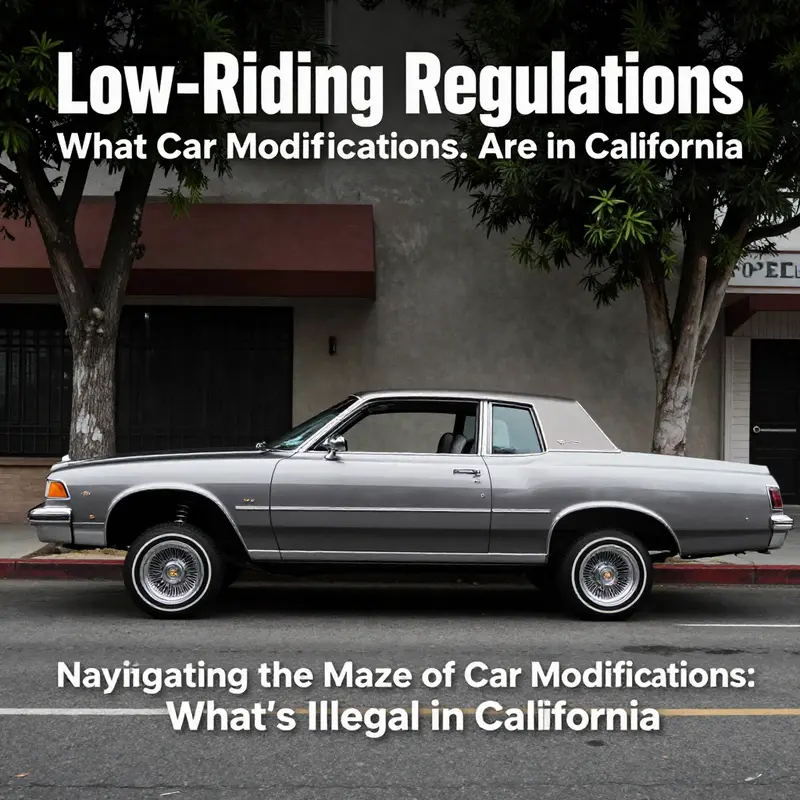
In California, the appeal of lowering a car and personalizing its stance sits at a crossroads where art meets obligation. The culture of customization has deep roots in automotive history and community identity, but it does not shield a vehicle from the law. The state has built a framework that treats certain modifications not as aesthetic choices, but as safety and environmental responsibilities. The result is a nuanced landscape where a car can be technically legal in its appearance and illegal in its function, or vice versa. As this chapter threads through the spectrum of what is and is not allowed, it keeps a clear throughline: the goal is to keep roads safe and air clean while respecting the cultural impulse that draws people to lowriding and other distinctive forms of customization.
Suspension work sits at the heart of many low riding projects and is where California’s rules bite most directly. The allure of a car that sits lower than stock, with tricks that allow dramatic elevation changes at a stoplight, can be powerful. Yet altering a vehicle’s suspension is not simply a matter of taste. If the modification compromises steering, braking, or stability, it crosses into illegality. California law emphasizes that a vehicle must be in a safe and roadworthy condition. When a lowered setup makes it harder to control the car on uneven pavement or to respond quickly to changing traffic, authorities may intervene. The practical tension is clear: the look and feel of a vehicle must coexist with predictable handling and adequate clearance for the road, gutters, and other hazards that real streets present.
The California Vehicle Code enshrines this balance in a way that few casual enthusiasts remember until a problem arises. Section by section, the code places a ceiling on how far ride height can be adjusted and how suspension components must perform. This is not a blanket ban on lowering a vehicle; rather, it is a measured approach that ensures the foundation of the car—the frame, the suspension, the tires, and the chassis—continues to meet minimum safety standards. The idea is to prevent designs that create unpredictable behavior, such as bottoms that strike the road or wheels that rub under normal driving, which could lead to loss of control or tire failure. For anyone working on a project, the practical implication is simple: before any dramatic change, check that your setup preserves predictable steering response, adequate ground clearance for typical road surfaces, and compatibility with tires engineered to handle the altered geometry.
Beyond the look of a stance, the warpath of legality also includes hydraulic systems that enable rapid ride-height changes. Hydraulics became a hallmark of certain lowrider profiles, but their permissibility hinges on how safely they operate in traffic. California has moved to curb excessive or unsafe use of these systems, particularly when the hydraulics are deployed in a way that disrupts other drivers or creates a public hazard. The safety concern is not just about the moment a car lifts or drops at a red light; it is about how those changes affect stability, braking distance, and the car’s ability to maintain control at cruising speeds. When a hydraulic setup invites jerky transitions, lifts the body excessively during travel, or undermines tire contact with the road, authorities may determine that the modification is unlawful. In short, the system that makes a car dance up and down must do so within limits that preserve smooth handling and reliable traction on normal streets and highways.
California’s approach to modifications extends into emissions and the road a car travels to get there. The state’s environmental framework, steered by CARB, keeps a rigid eye on changes that alter exhaust flow, catalytic conversion, or other emissions-control devices. Any alteration that tampers with the car’s ability to meet pollution standards is treated seriously. Removing or bypassing emission controls is not just a matter of failing a test; it is an offense that can render a vehicle illegal to operate in the state. This is not a niche issue for performance aficionados; it is a core public policy aimed at clean air and public health. Even when a modification seems purely mechanical or aesthetic, the hidden impact on emissions testing, on-board diagnostics, and overall pollution output can put a vehicle outside the law. The central message is clear: respect the built-in checks that make modern cars compliant with environmental rules, and avoid devices or maps that bypass those controls.
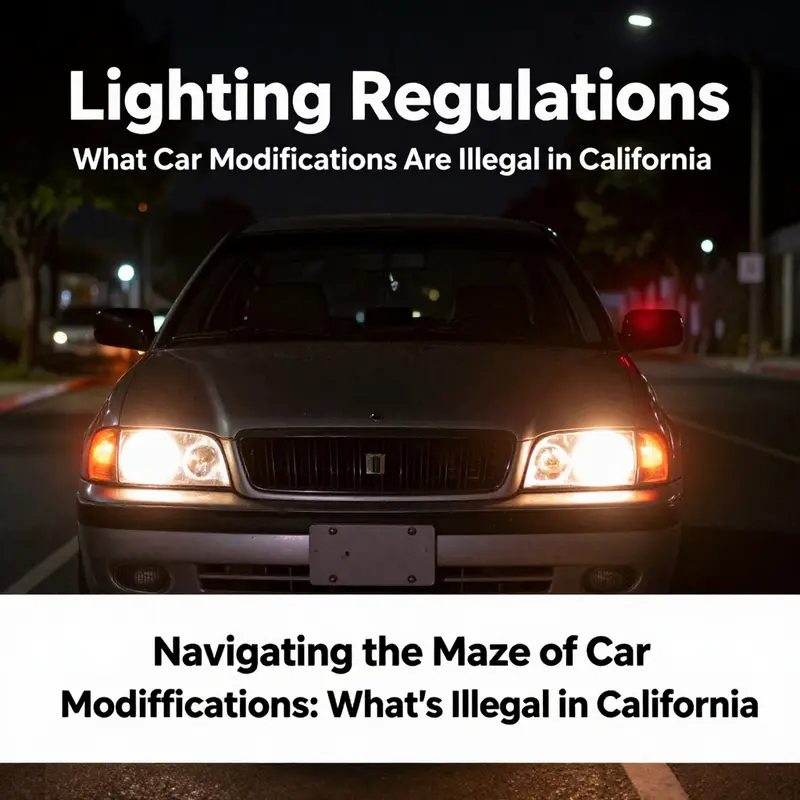
The theme of legality extends into the realm of lighting and exterior visibility. When builders experiment with unconventional lighting or overly bright headlamps, the result can be a roadway distraction or glare that compromises safety. California’s standards for vehicle lighting are designed to ensure that lights do not become a source of danger for other drivers or pedestrians. This means that modifications to lighting are not merely about personal style; they must fit within guidelines that specify intensity, placement, and purpose. A vehicle that deviates by adding nonstandard lighting may be flagged, impounded, or required to be re-engineered to bring it into compliance. The same logic extends to window tinting. The law demands sufficient light transmission for the driver and front passengers, while allowing darker tints on rear windows under certain conditions. The important point here is not a universal ban on tint; it is adherence to the light levels that maintain visibility and reduce risk on the road.
When a car projects a performance edge, the temptation to install turbochargers, superchargers, or other power-boosting parts is strong. Yet California’s regulatory posture requires that such parts be certified as compliant by CARB. Unapproved performance parts can trigger a cascade of legal consequences, from failed inspections to denied registration. The intent behind this rule is straightforward: performance enhancements should not come at the cost of increased pollution or compromised safety. Certifications provide a bridge between the desire for more power and the reality of a state with rigorous standards for air quality and vehicle safety. In practice, this means that a builder who wants more grunt must navigate the certification process, ensure compatibility with the vehicle’s emissions controls, and verify that every component remains within the boundaries set by state regulators. The result is a more disciplined approach to performance that respects public welfare and the integrity of the cruising experience.
The issue of what counts as illegal can be easy to misconstrue if one focuses only on the dramatic. It is essential to recognize that legality is not a fixed label attached to a single part; it is a holistic judgment about how a modification affects safety, emissions, and the car’s general behavior on real roads. The penalties for noncompliance are not solely administrative. They can include fines, required repairs, or even the suspension of a vehicle’s registration. In some cases, the enforcement authority may impound a vehicle until it can be returned to a compliant condition. These outcomes underscore the seriousness with which California treats the mix of artistry and engineering in vehicle customization. They also remind enthusiasts that the most satisfying builds are those that harmonize creative intent with the realities of the street and the law.
The cultural dimension of lowriding adds another layer of complexity. Lowrider clubs and communities celebrate a form of automotive artistry that has its own historic and social significance. Critics have sometimes painted the culture with a broad brush, interpreting every lowered or customized car as a problem. In reality, many builders strive to preserve safety and legal compliance while expressing personal identity and craftsmanship. The conversation around legality is not a rejection of culture but a call for responsible innovation. This perspective matters for policy and practice alike. It invites builders to engage with regulators early, seek guidance, and approach restrictions as a shared framework rather than a punitive obstacle. Those who do so discover that compliance and creativity are not mutually exclusive; they can reinforce one another when implemented with care and precision.
For readers seeking concrete guidance, the best path is to treat the DMV and CARB as partners rather than gatekeepers. Start with a thorough assessment of ride height, alignment, tire compatibility, and braking performance under everyday driving conditions. If you plan to use hydraulics, ensure that the system operates within safe limits and does not introduce jerky movements or maneuvers that could surprise other drivers. Before any installation, document the components, the installation process, and the expected performance changes. Schedule a pre-inspection if your locality offers one, and obtain any required approvals or waivers that might apply to unique configurations. The goal is to approach modifications with a clear understanding of how the changes influence safety and compliance, rather than a defensive posture after a ticket or a failed inspection.
To provide readers with a clearer sense of where to look for guidance, consider the broader legality landscape as a living set of standards. For a broader overview focused on legality regardless of subtopic, see Illegal Car Modifications. This resource can help you distinguish between what is technically possible and what is legally permissible in California. As with any specialized topic, the specifics can shift with new regulations or court rulings, so keeping up to date with official sources remains essential. For broader context about how modifications intersect with insurance, resale value, and the practicalities of ownership, the linked resources offer additional angles that complement the core regulatory discussion. The aim is to equip readers not only with a map of what is illegal but with a sense of how to pursue creative customization without compromising safety or legality. Illegal Car Modifications
In sum, the line between artistry and illegality in California is not a gray area but a clearly defined field of play. The state seeks to preserve road safety, air quality, and predictable vehicle behavior while acknowledging the cultural impulse that fuels customized and lowered cars. The most reliable path to a satisfying build is to design with safety, emissions, and regulatory compliance in mind from the outset. A careful, well-documented approach often yields a vehicle that looks distinct, handles predictably, and remains legally operable on the streets of California. The conversation about low riding is ongoing, but the practical steps to stay on the right side of the law are well within reach for those who plan ahead and engage with the right authorities. For official standards and updates, consult the California Air Resources Board and the Department of Motor Vehicles, whose guidance helps keep a bold auto-identity within the bounds that protect all road users. External resource: https://ww2.arb.ca.gov
null
null
null
null
Final thoughts
Navigating the world of car modifications in California requires a strong understanding of the laws designed to promote safety and environmental standards. Keeping your vehicle compliant not only ensures your safety but also protects your investment in the automotive hobby. Through this detailed exploration of exhaust modifications, window tinting, suspension regulations, emissions controls, and lighting modifications, you are now equipped to make informed decisions without falling foul of the law. Be passionate about your modifications, but always ensure they align with California’s regulations to enjoy the open roads without worry.