
In Florida, car enthusiasts, tuners, and modifiers must navigate a complex web of regulations to enjoy their passion safely and legally. Understanding which modifications are off-limits is crucial not only for compliance but also for ensuring safety on the roads. Each chapter of this guide delves into specific areas of concern for modifiers, from exhaust noise laws to window tint regulations, illegal body alterations, and the restrictions surrounding lighting modifications. By comprehensively unpacking these topics, enthusiasts can approach their vehicle enhancements with confidence and respect for Florida’s laws.
Ringing the Law: Navigating Florida’s Exhaust Noise Rules and the Real Boundaries of Modifications
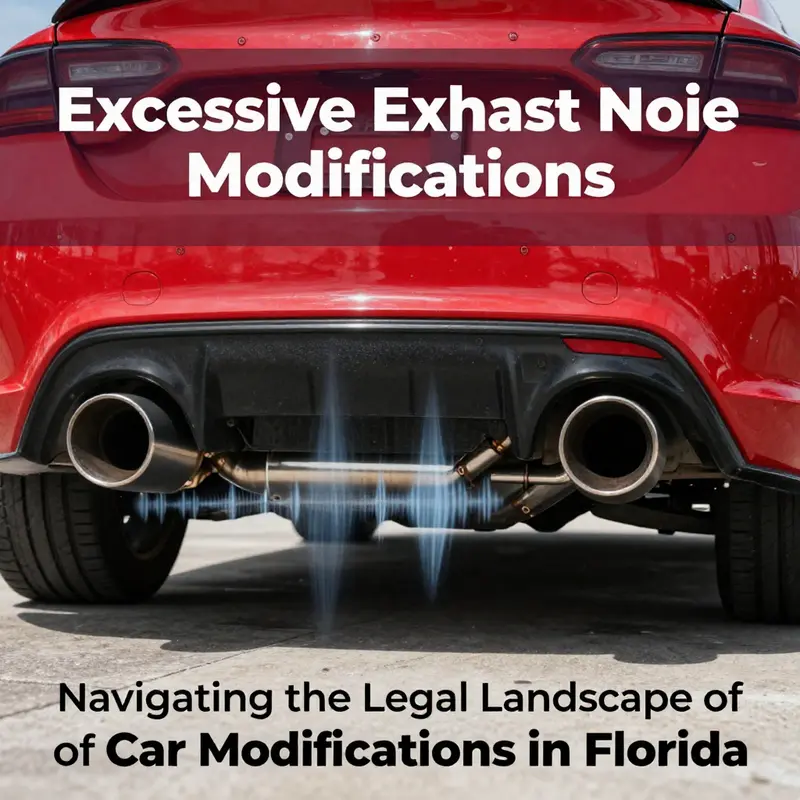
In Florida, the soundscape of a vehicle can reveal more than just a driver’s taste for loud music or a thrum that rumbles down the street. It can reveal compliance or noncompliance with state traffic rules that are designed to protect public peace, pedestrian safety, and overall road harmony. This chapter centers on one of the most common and contentious arenas of vehicle modification: exhaust systems and the noise they generate. While many owners tune their rides for performance, aesthetics, or a personal brand of presence, Florida law treats exhaust noise as a potential threat to safety and order and has clear boundaries that every modifier should understand before they bolt on a new setup. The core idea is straightforward: no modification should push the vehicle into producing excessive or unusual noise, and anything that does is a legal risk that can lead to penalties, vehicle repair demands, or even impoundment. The practical takeaway is not to shun modification altogether but to approach it with a knowledge of what the state expects and how local codes can layer on additional requirements on top of the state baseline.
Florida statutes are written to accommodate a wide range of driving contexts—from quiet suburban streets to bustling urban corridors—without sacrificing the fundamental need for predictable vehicle behavior. The heart of the matter lies in how “excessive” or “unusual” noise is interpreted and measured in real-world conditions. The state has historically used mufflers and exhaust systems as the primary tools to dampen sound and prevent a public nuisance. When a vehicle’s exhaust system is altered in a way that amplifies noise beyond the established thresholds, enforcement becomes a matter of public policy as much as of traffic safety. In practice, this means law enforcement officers and safety inspectors are on the lookout for two situations: systems that remove sound-damping devices or systems that add excessive noise through design choices intended to boost performance or attention-getting effect. Either path can trigger enforcement actions, penalties, or the obligation to revert to compliant equipment.
To understand what is prohibited, it helps to zoom in on a few concrete concepts. The state prohibits operating a motor vehicle with mufflers or exhaust systems that emit excessive or unusual noise. This is not simply a verbal admonition; it is anchored in statutory language that aims to keep road noise within limits that are broadly acceptable in a mixed-use environment. However, Florida does not rely on a single decibel number alone. The reason is practical: decibel readings can vary depending on the vehicle’s speed, gear, tuning, weather, and the surrounding environment. Local ordinances frequently translate the general prohibition into specific decibel limits for different classes of streets or times of day. A sport sedan in a quiet neighborhood at night may face the same core rule as a delivery vehicle in a busy downtown corridor, yet the practical enforcement can look different depending on context. In many cities, these local codes complement the state standard by requiring pass-through checks or noise inspections at registration or during routine traffic stops.
This layered approach—state statutes that set the baseline and local ordinances that refine it—maps directly onto how Florida actually handles exhaust-related violations. A street-legal modification, in essence, is one that preserves the vehicle’s ability to operate without creating a nuisance or a safety hazard through noise. The challenge for enthusiasts is to select components that are sound-dampening by design and certified for street use. A muffler that is EPA-certified and configured in a way that maintains a reasonable level of sound while preserving exhaust flow is the kind of balanced solution that aligns with both federal emissions standards and Florida’s noise regulations. It is not enough to claim a performance advantage or a louder voice on the road; the louder voice must still respect the community and the rule of law.
When a modification does push the boundary, the consequences can be immediate and tangible. Officers may pull over a vehicle suspected of producing excessive noise, and if the complaint or observation is verified, the driver can be cited. The penalties can range from fines to mandated repairs, and in some cases, continued violations can lead to more serious outcomes such as impoundment or probationary steps toward bringing the vehicle back into compliance. The exact penalties are not uniform across Florida because local jurisdictions still wield significant discretion in enforcing noise codes. What remains consistent is the principle that violations must be corrected and that repeat offenses attract increased scrutiny and higher stakes. In other words, compliance is not a one-and-done action; it is an ongoing commitment to maintain a sound profile that respects neighbors, law enforcement, and the rules that govern the vehicle’s operation on public roads.
The practical path to compliance starts with how a car owner approaches modification planning. Because the threshold for what constitutes excessive noise can shift with context, a thoughtful process is essential. Begin with a clear goal: choose an exhaust solution that preserves the vehicle’s integrity while delivering an acceptable acoustic footprint. This often means opting for a system that includes a quality muffler and properly designed resonators that regulate sound across a spectrum of RPMs and speeds. It also means avoiding configurations that bypass the muffler entirely or employ straight-pipe designs intended to maximize decibel output. Those choices are textbook examples of how a modification can cross the line from performance enhancement into violation. When an exhaust is designed with sound dampening in mind and validated for street use, it is better aligned with both state expectations and the practical realities of Florida roads.
The broader environment of Florida’s traffic laws also interacts with exhaust modifications in subtle ways. Emissions considerations loom large because tampering with exhaust components can indirectly affect emissions performance. While the state emphasizes noise with its own logic, federal rules on emissions still apply to vehicles operated on public highways. A modification that improves performance in a way that reduces back-pressure or alters oxygen sensor readings can trigger emissions-related concerns, even if the noise level remains within a nominal range. In this sense, a well-intentioned upgrade designed to enhance power or efficiency must still pass muster against environmental protections. The regulatory equation thus combines sound, emissions, and safety into a single standard: a mod is legal only if it preserves or improves the vehicle’s compliance with all applicable laws and does not create a danger or nuisance on the road.
For drivers who want to dig deeper into the broader landscape of modifications, it helps to view exhaust rules as part of a larger ecosystem of Florida’s road-usage standards. The state’s approach to noise is not an isolated concern; it sits alongside rules about window tint, lighting, suspension geometry, and even the integrity of identification documents. The interplay among these rules matters because a single modification can influence multiple regulatory domains. For example, a suspension change that affects handling could intersect with inspections and safety standards, or a lighting upgrade might affect visibility and attract different enforcement criteria. The central thread across these considerations is a shared commitment to safety, predictability, and the quieting of disruptions that a poorly regulated modification might cause to other road users. Even as enthusiasts chase personal expression through their builds, they must remain responsive to the social and legal boundaries that Florida has deliberately woven into the fabric of its traffic laws.
For readers seeking a concise primer on the topic, there is a broader discussion about the legality of car modifications across different contexts and jurisdictions. Some readers may wish to review a more general treatment of what counts as an illegal modification in the wider sense. The linked resource below offers an overview that connects with the Florida-specific framework discussed here. It is valuable because it helps place the state’s exhaust rules within the larger conversation about how modifiers navigate legality, safety, and insurance implications when they adjust the car’s hardware and its behavior on public roads. illegal car modifications
In practice, the path to compliance is a mix of informed decision-making, component selection, and due diligence in understanding local enforcement realities. The starting point is to recognize that excessive exhaust noise is a legitimate regulatory concern, not merely a subjective judgment from a frustrated neighbor or a skeptical patrol officer. From there, the strategy becomes straightforward: choose exhaust components that meet or exceed emissions standards, install them with proper sound dampening characteristics, and verify that the system remains within the noise thresholds applicable to your city or county. If a modification looks like it could push the vehicle into a gray area—either in terms of noise, emissions, or safety—opt for a compliant alternative or consult a professional who understands Florida’s regulatory landscape. It is a proactive stance, not an after-the-fact reaction, that saves time, money, and potential legal trouble.
The practical implications extend beyond fines or citations. A vehicle that is seized or impounded for excessive noise is more than a temporary inconvenience; it can affect insurance, registration status, and ongoing compliance. When a car remains out of service due to a noise violation, the owner faces not just the cost of restoration but potential implications for liability in accidents or claims that arise while the vehicle is out of service. In this sense, the noise rule is not merely a nuisance statute; it is part of a broader system that governs how a car is deployed in daily life. For that reason, owners should treat exhaust choices with the same seriousness they would give to any other safety-related modification. The aim is to preserve a sense of community quiet and to maintain predictable performance that does not alarm or disrupt others on the road.
If you are curious about how this topic fits into the larger conversation about legality and modifications, you can explore related discussions on the broader topic of illegal car modifications. This resource provides a context for why regulators emphasize certain changes over others and how public safety priorities shape these standards. illegal car modifications. The takeaway is that Florida’s exhaust rules are part of a shared framework where safety, environmental responsibility, and respect for neighbors converge on the same decision point: will this modification keep the vehicle lawful, safe, and socially considerate when it rolls through the state’s diverse communities?
Finally, for readers who want to anchor their understanding in the official regulatory text, the Florida statutes provide the definitive reference. The key statute addressing mufflers and exhaust systems is Florida Statutes § 316.205, which codifies the prohibition on excessive and unusual noise and sets the standard for the acceptability of mufflers and exhaust designs. It is worth reviewing the statute directly to appreciate the precise language and how it is applied in practice. This official text, along with local ordinances, shapes how Florida vehicle owners can pursue performance and aesthetic goals without stepping outside the law. For a direct, authoritative source, see the statutory language at the state’s legislative site.
External resources: Florida Statutes § 316.205 – Mufflers and exhaust systems can be consulted for the official statutory language and the precise thresholds that enforcement relies upon. https://www.flsenate.gov/Laws/Statutes/2024/316.205
null
null
Beyond Aesthetics: How Florida Regulates Illegal Car Modifications and What It Means for Your Ride
Florida’s roads mirror a delicate balance between personal customization and public safety. For many drivers, modifying a car is a way to express individuality, improve performance, or simply tailor comfort to a familiar routine. Yet the state, like many others, places clear guardrails around certain changes. Some alterations are legal when done correctly, while others cross into illegality or trigger compliance requirements tied to safety, emissions, or general roadworthiness. This chapter follows that line, threading together the practical realities of Florida’s rules with the everyday decisions that vehicle owners face. In doing so, it also uses one of the most common flashpoints—window tint—to illuminate how the law translates into street-legal realities. Window tint is a case study because it sits at the intersection of privacy and visibility, two core safety considerations that the state treats as non-negotiable. The tint rules are precise, the penalties tangible, and the guidance clear when you know where to look. If you want a broader map of what counts as illegal car modifications beyond tint, you can consult resources that catalog illegal changes more comprehensively; they often frame the same issues with practical examples and enforcement perspectives. For a concise overview of what falls into the category of illegal car modifications, you can reference a dedicated guide that outlines common prohibitions and the rationale behind them. illegal car modifications. This chapter keeps returning to the idea that legality is not about taste or preference but about predictable safety and environmental outcomes, especially when a modification could affect braking, steering, visibility, or exhaust emissions. With that premise in mind, the focus is not to quash creativity but to clarify where Florida’s lines are drawn and why. The rules are not arbitrary; they are anchored in the state’s traffic laws, the practical realities of driver visibility, and the broader federal framework that governs emissions and vehicle safety. The road-tested approach is simple: know the limits, document what you do, and ensure your vehicle remains compliant when it leaves the driveway and when it enters the highway.
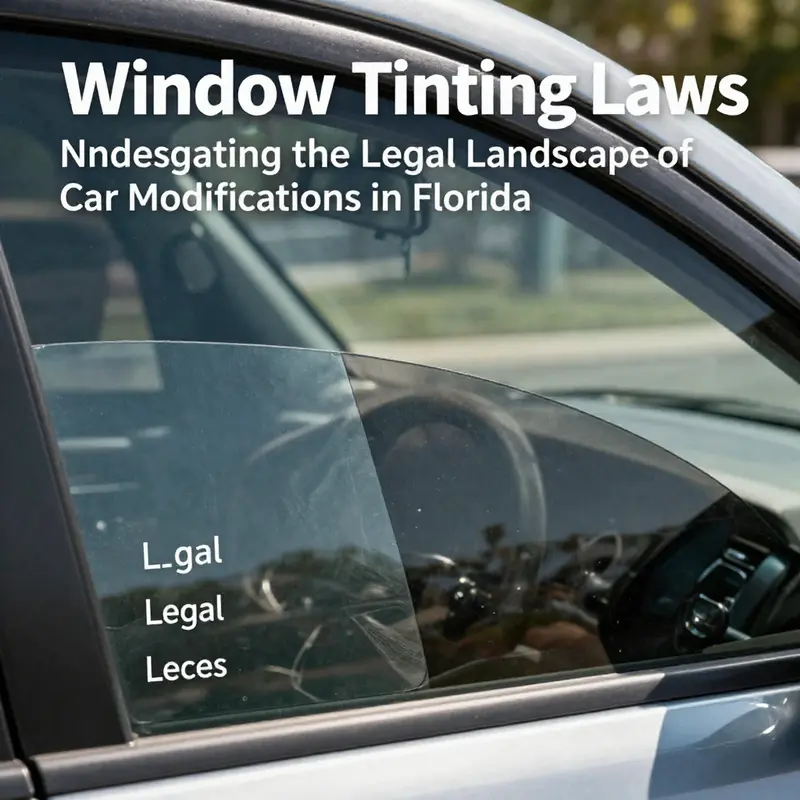
Window tint, as a gateway topic, offers a clear view of how Florida translates safety concerns into enforceable standards. The front windshield in Florida must retain a non-reflective tint that sits above the manufacturer’s AS-1 line, typically around five inches from the top. Anything applied below that line can obstruct the driver’s forward vision and, therefore, becomes illegal. The front side windows present a more quantifiable test: the tint must allow at least approximately 27% of light to pass through, a measure known as Visible Light Transmission (VLT). Darker tints than this threshold invite legal trouble during traffic stops and may lead to fines or citations. The rear side windows and the back windshield operate under far fewer restrictions; Florida law does not impose a fixed darkness limit on these panes, which is why privacy-focused films are more commonly seen there. Still, the tint must be non-reflective across all windows, meaning mirrors or shiny, reflective films are not permitted. These provisions reflect a careful calibration: protecting drivers and pedestrians from glare and impairment while preserving enough light to keep the driver’s awareness high. They also underscore a larger principle: safety first, aesthetics second.
Such precision in tint policy has practical implications for everyday driving. For one, tinting that does not meet the required VLT can trigger enforcement actions, including tickets and the possibility of the vehicle failing a roadside check. This is especially important for drivers who live in hotter climates or who believe darker tints reduce heat and UV exposure. The indisputable fact is that, within Florida’s framework, darker does not automatically mean better. Darker films may offer heat rejection and privacy, but when they cross the VLT threshold, they flip from a comfort feature into a compliance risk. The state’s insistence on non-reflective films across all windows also means that drivers cannot compensate for legal limits by applying reflective metallic films that might otherwise reduce glare. The combination of VLT requirements and non-reflectivity creates a straightforward checklist: choose a film whose VLT is compliant, have it installed by a shop familiar with Florida standards, and preserve documentation that proves the film’s light transmission characteristics. This last point is not merely bureaucratic redundancy. It is a practical safeguard in a landscape where enforcement practices can vary and where the onus remains on the vehicle owner to prove that the tint complies with the law.
Beyond the tint rules, Florida’s other prohibited or restricted modifications follow a similar logic of safety alignment. Exhaust systems that create excessive or unusual noise fall squarely into illegality because they alter the vehicle’s acoustic footprint in ways that can mask hazardous conditions or distract other drivers. Florida law targets exhaust setups that are used to achieve performance advantages or that cross a noise threshold considered disruptive or unsafe in traffic. This is not a blanket ban on louder exhausts; it is a call for a measured approach to sound that recognizes the shared use of road space. Enforcement can hinge on local ordinances, police discretion, and the context of a given situation. In practice, a muffler swap that dramatically increases noise in a residential neighborhood or near schools is likely to draw attention, with fines or required adjustments as possible consequences. The underlying principle is simple: modifications should not compromise the quiet, predictable operation of a vehicle on public roads.
Structural changes to a vehicle—the kinds that alter body dimensions, frames, or chassis—are another major category where Florida draws a line. Alterations that significantly modify a vehicle’s dimensions or its structural integrity require careful authorization and may necessitate inspection or compliance with specific safety standards. It is not enough to claim a cosmetic change; the modification must be demonstrably legal in the sense that it does not compromise the vehicle’s crashworthiness, occupant protection, or handling characteristics. In practice, this means that extreme width or height modifications, frames that have been altered beyond what the manufacturer intended, or changes that affect suspension geometry in a way that could degrade stability are discouraged or prohibited unless properly vetted and tested. The same stringent logic applies to emissions-related modifications. Tampering with emissions control devices—such as catalytic converters or oxygen sensors—remains illegal under both federal and Florida law, because it undermines environmental protections and can elevate the vehicle’s emission output beyond what the regulations permit. In a state that regularly monitors air quality and enforces emissions standards, this is a line that drivers are unlikely to want to cross.
Another layer of prohibition involves the vehicle’s identification and documentation. Altering the VIN or falsifying titles and registrations is a grave offense. It is a matter of public record, traceability, and accountability, designed to prevent fraud and ensure that a vehicle’s ownership and history are transparent. The penalties for VIN tampering are severe, reflecting the serious nature of this offense in terms of safety recalls, theft recovery, and insurance validation. In practice, homeowners or hobbyists may occasionally feel tempted to modify a vehicle in ways that affect its history or ownership documentation, but Florida’s framework makes clear that such actions are not simply frowned upon; they are illegal.
Because the landscape of modification legality interacts with inspection regimes, drivers must also consider whether their changes require a re-certification or a new inspection. If a modification affects safety or emissions, it may necessitate a state inspection before the vehicle can be legally operated on public roads. Driving a modified vehicle that fails inspection or that lacks proper documentation can lead to fines, impoundment, or more serious consequences. The interplay between modification, inspection, and enforcement underscores a broader truth: legality is often a function of the vehicle’s overall performance profile, not just the specific alteration in isolation.
Against this backdrop, there is a notable nuance regarding dyno-tuning. Unlike some states, Florida does not have a blanket statute banning dyno-tuning or prohibiting dyno-tuned vehicles on public roads. However, tuning that brings a vehicle into violation of noise, emissions, or safety standards remains within the reach of enforcement. In other words, the mere fact that a car has been dyno-tuned does not prove illegality, but if the resulting configuration pushes the vehicle into noncompliance with state or federal requirements, enforcement actions are possible. This distinction matters for enthusiasts who view tuning as a legitimate performance exercise. It reinforces the core message: modifications are not inherently illegal because they exist, but they can be illegal when they compromise safety, environmental protection, or the integrity of road traffic laws.
In practical terms, staying compliant is best achieved through a disciplined approach to modifications. Start with an honest assessment of how a change might influence safety margins, visibility, and emissions. Then consult authoritative resources, including the Florida Department of Highway Safety and Motor Vehicles (FLHSMV), to verify the current rules and any local ordinances that might add to or nuance state law. Documentation is not merely a shield against fines; it is a practical tool for avoiding delays or impoundments if a vehicle is pulled over or if a modification is questioned during a routine inspection. An experienced shop familiar with Florida’s standards can guide you through the process of selecting approved parts, ensuring correct installation, and obtaining any necessary approvals or certifications. In this context, the path to compliance is less about restricting creativity and more about enabling responsible, predictable customization that preserves safety and clarity for everyone on the road.
To connect this discussion to the broader ecosystem of modification considerations, readers are encouraged to explore broader guides that discuss how modifications intersect with insurance, resale value, financing, and even the legal implications of unapproved changes. These resources help readers understand not only what is illegal but also what counts as prudent practice—what keeps a car enjoyable to own without turning it into a legal or safety hazard. The balance is nuanced: Florida’s laws are designed to protect the public and the environment while permitting personal expression within safe boundaries. That balance is essential for any owner who plans to modify a car while staying within the law and avoiding headaches with police, insurers, or state inspectors.
For a broader sense of the legal landscape, take a look at the official regulatory language and statutes that govern these issues. The Florida Statutes provide the precise definitions, exceptions, and penalties that flesh out these principles. As you review, you’ll see how the state’s approach to tint, emissions, and structural modifications aligns with the intent to keep streets safe, vehicles reliable, and the environment protected. Access to the statutory framework is not merely academic; it is practical guidance for planning any modification project, helping you avoid missteps that could create liability or compel costly modifications later on. In short, the law sets the footing for any meaningful customization, and knowing it helps you tailor your car with confidence rather than ambiguity.
If you want to explore more about this topic from a broader perspective or see more examples of common illegal changes, you can consult additional resources that discuss the legal boundaries of car modifications. For instance, a guide focused on illegal car modifications provides a quick reference to frequent prohibitions and the underlying safety rationales. This chapter has kept the focus on Florida’s specific context, but the underlying logic—protecting visibility, emissions integrity, and structural safety—resonates across jurisdictions. As you chart a path for your own build, remember that the law rewards thoughtful planning, professional guidance, and accurate documentation. That combination helps ensure your vehicle remains a source of pride and enjoyment rather than a source of risk or legal trouble.
For the official regulatory language from the state, see Florida Statutes § 316.295. https://www.flsenate.gov/Laws/Statute/2024/316.295
When Lights Break the Law: Decoding Illegal Vehicle Lighting in Florida
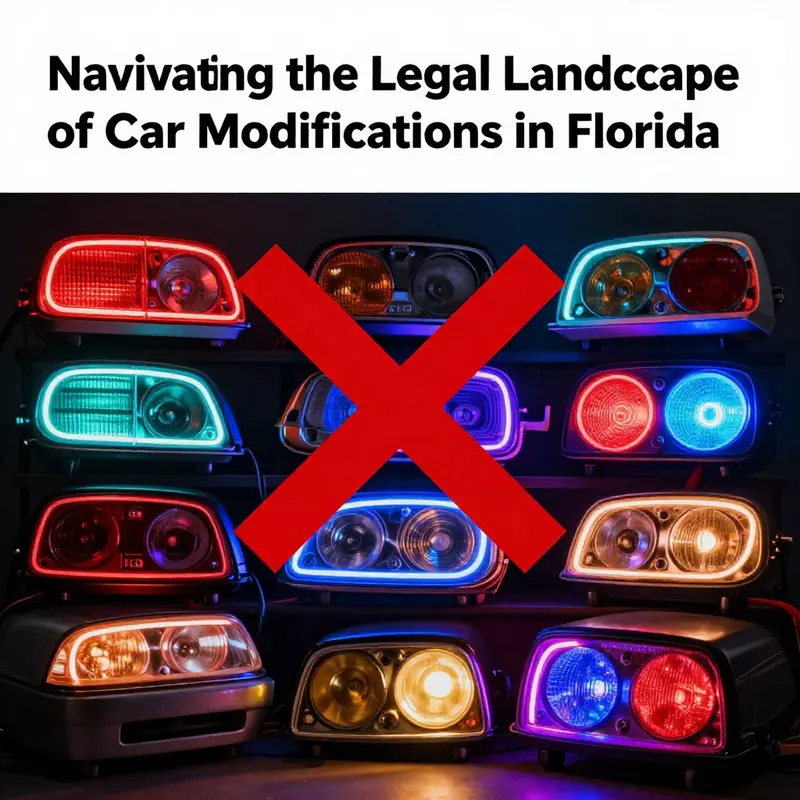
Lights are the most visible form of car customization, yet in Florida they stand under strict scrutiny. The state’s traffic-safety framework treats illumination as a non-negotiable element of road readability. Drivers who push the envelope with lighting modifications risk creating glare, misdirecting other motorists, or masking the vehicle’s signaling cues. That combination—not novelty, not aesthetics—triggers enforcement. The chapter that follows doesn’t aim to extinguish curiosity about how vehicles can look on the street; it aims to illuminate where the line is drawn and why. The result is a clearer map of what is legally permissible and what can precipitate headaches in the form of tickets, mandated corrections, or worse, vehicle impoundment. Foremost, Florida’s rules center on preserving visibility for all road users. The state’s guidelines articulate a baseline for headlamps, taillamps, and auxiliary lighting so that every vehicle remains a predictable participant in traffic, not a moving signal of confusion. The core issue with illegal lighting often lies in the tension between how light is produced and how it is perceived. A headlight that is too bright, misaligned, or colored, or a decorative underglow that distracts or disorients, can compromise oncoming drivers’ ability to discern a vehicle’s position, speed, and intent. To understand the culprits, it helps to walk through the most common violations without getting lost in a catalog of hypothetical gadgets. The Florida Department of Highway Safety and Motor Vehicles emphasizes that headlamps must meet specific technical standards for beam height, range, and color. When a modification alters the beam in a way that changes its trajectory—causing excessive scatter or a blurred cutoff—it can render a vehicle noncompliant. This is about more than looks; it is about ensuring that the light emitted from a vehicle does not impair the safety of others on the road. Within this framework, the practice of altering headlights—whether by changing bulbs to unapproved LED configurations, modifying fixtures to extend light beyond the intended field, or otherwise impairing the headlamp’s designed geometry—comes under close scrutiny. Even if such changes are marketed as plug-and-play upgrades, the Florida rules insist that only components certified by the Society of Automotive Engineers (SAE) or the Department of Transportation (DOT) and compatible with the original headlamp assembly are acceptable. The path from a marketing promise to legal compliance is not automatic; the beam must maintain its essential characteristics, including a clear cutoff and the avoidance of blinding glare for oncoming traffic. The practical implication is straightforward: before any headlamp modification is allowed on public roads, it must preserve the safety-related functions of the original system as tested by recognized authorities. A second and equally critical category concerns the color and presence of front lighting. Florida law explicitizes that front lights may only be white or yellow. This rule is not merely about taste; it is designed to prevent the use of red, blue, or other colored front illumination that could mislead or dazzle a driver or pedestrian. It also extends to dynamic lighting effects that might flash or strobe in ways that could distract other road users. In effect, the aesthetic impulse to sport a flashy front aesthetic must yield to the practical requirement that front illumination remains a stable, predictable signal to others on the road. The prohibition on nonstandard front lighting is reinforced by a broader prohibition on lighting that could interfere with visibility. Under Florida law, any lighting product or installation that reduces the driver’s ability to see or that creates confusing or distracting visuals to other drivers will likely be treated as noncompliant. With this in mind, the certification and compatibility clause becomes a crucial safeguard. The requirement that lighting fixtures be SAE or DOT certified and compatible with the original headlight assembly is not a bureaucratic hurdle but a safety check. A fixture that is certified for a separate, nonstandard mounting or one that causes beam displacement can still create glare or misalignment, potentially shifting responsibility for accidents. In practice, this means that a consumer cannot simply install a fashionable, readily accessible lighting kit and expect to skate through enforcement; the kit must pass a standardization test and integrate with the vehicle’s existing optical system. The narrative would be incomplete without addressing the realm of auxiliary and decorative lighting. In Florida, underglow, neon, and LED strips, especially those placed along the vehicle’s undercarriage or other exterior surfaces, are scrutinized for their potential to distract or dazzle. While some installations might appear visually harmless, their effect on other drivers, particularly at night or in poor weather, can violate general safety principles or specific regulatory language. Even if a device is designed to be passive when the car is stationary, the moment the vehicle moves, the lighting can introduce a moving distraction. The enforcement lens, therefore, often looks at both the intended use and the practical impact on visibility. The consequences for noncompliance can be swift and serious. A vehicle stopped by law enforcement for illegal lighting may be issued warnings, fines, or orders to correct the modification. If the lighting modification affects safety or emissions in any way, the inspection regime may require the vehicle to pass a state inspection before it can operate on public roads again. In severe cases, noncompliant lighting can contribute to vehicle seizure or impoundment, especially if the modification indicates a broader lack of compliance with safety standards. A useful way to anchor these rules is to consider the broader purpose of Florida’s lighting provisions: to ensure that every vehicle remains a predictable and safe participant in traffic, with lighting that communicates its presence, position, and actions in a clear, consistent manner. This is not about suppressing creativity; it is about protecting everyone who shares the road. The enforcement logic also recognizes that technologies evolve. The note that Florida does not maintain a blanket ban on dyno-tuning or on the use of dyno-tuned vehicles on public roads, unlike some states, shows a measured approach. The caution remains, however, that tuning should not push a vehicle into violations of emissions or safety standards. If a dyno-tuned engine or any modification results in excessive emissions, altered throttle response, or unsafe performance that affects sightlines or control, enforcement can still intervene. In that sense, the lighting rules interact with broader regulatory concerns. A vehicle can be legally compliant in terms of its lighting and still accumulate penalties if the underlying modifications impact emissions, braking, or handling, and a comprehensive inspection may uncover those issues. For readers seeking an authoritative baseline, Florida Statutes and official DHSMV guidance provide the concrete standards that shape these judgments. The statutes set forth the legal requirements for vehicle lights, including the color, intensity, position, and operation of front and rear lighting systems, along with the acceptable certifications for components. Remember that the law’s language is precise, and automobiles are subject to interpretation by law enforcement and the courts. The practical takeaway is straightforward: compliance begins with understanding the rules, then verifying that any installation or modification adheres to certified standards and remains compatible with the vehicle’s original design. A resident who is curious about the bigger picture of car modifications may wish to explore resources that place lighting within the broader spectrum of legality. For a broader context on what counts as legal car modifications, see Legal car modifications. This link provides a gateway to understanding how Florida’s lighting rules fit within general regulatory expectations. The interplay between state and federal standards means that even seemingly compliant lighting can fail if it conflicts with emissions or safety protocols or when it undermines other drivers’ ability to operate safely on the road. The balancing act is not about limiting innovation; it is about preserving predictability in a dynamic road environment. It is worth noting that the official guidance also points to a practical resource for vehicle owners and technicians: the State’s publication and statutory references outline the exact thresholds for permissible lighting. The Florida Department of Highway Safety and Motor Vehicles maintains that the key to staying compliant is to ensure color, intensity, placement, and certification align with the actual needs of safe motor vehicle operation rather than with a fashion trend. When in doubt, the prudent approach is to revert to the stock configuration or to adopt only those components that have earned SAE or DOT certification and that have been demonstrated to preserve proper beam geometry and color temperature. The enforcement landscape is pragmatic. It recognizes that a bright, well-aimed headlamp is a boon for night driving, while a misaligned or colored lamp can become a hazard. This distinction shapes everyday decisions for drivers who wish to modify their vehicles in Florida. It also places an emphasis on due diligence: obtain the right documentation, verify compatibility with the original headlamp assembly, and ensure the end result does not violate color limits or beam characteristics. The chapter’s guidance is not simply about avoiding fines; it is about keeping roads safer for everyone. In the grand scheme of vehicle modifications, lighting occupies a special place because it is both highly visible and universally consequential. A small misstep in acquiring or installing a lighting fixture can ripple into legal trouble, public safety concerns, and even civil liability if an accident results from impaired visibility. The best practice is to adopt a conservative approach—prioritize certified components, preserve standard beam behavior, and resist the urge to tint or color front lighting beyond specified limits. The safety framework is not indifferent to owners’ preferences; it simply requires that preferences be realized within the boundaries of established standards. That is why the phrase “certified by SAE or DOT and compatible with the original headlight assembly” should guide every decision about lighting upgrades. In closing, Florida’s lighting regulations are not a labyrinth to be navigated by guesswork. They are a safety-oriented framework designed to preserve visibility, prevent glare, and keep roadways predictable. For readers drafting a modification plan, the path is clear: begin with a compliant headlamp upgrade if needed, verify certification, and ensure that any decorative lighting does not obscure or distract. The state’s statutes and the DHSMV’s guidance provide the anchor points for that path. External resources at the state level, including official statutes, are the most reliable compass. As discussed earlier, the statutes that govern lights on motor vehicles provide the precise thresholds for color, placement, and operation; they should be consulted directly when considering any upgrade. For authoritative information, review the official legislative text and related guidance. External resource: https://www.flsenate.gov/Laws/Statutes/2024/Chapter526. This external reference should accompany any practical planning, and it underscores the importance of aligning modifications with both state and federal expectations. Integrating these standards into everyday practice means thinking about lighting not as a cosmetic flourish but as a critical safety feature. It is possible to achieve an personalized look without crossing the line into illegality, but it requires diligence, certification, and an understanding of how lighting affects everyone on the road. By approaching lighting with this mindset, Florida drivers can enjoy the benefits of customization while preserving the common goal that unites all road users: safe, predictable travel for all.
Final thoughts
Ensuring your car modifications adhere to Florida’s regulations is vital for not only your legal safety but also for the overall safety of all road users. By understanding the prohibitions on excessive exhaust noise, unauthorized body alterations, window tinting limitations, and lighting regulations, enthusiasts can enjoy their passion without legal repercussions. Always stay informed and compliant, transforming your vehicles into safe and legal representations of your personal style. Car modifiers can enjoy their creative freedoms responsibly, enriching their experience while respecting the law.