

Importing a car into Israel presents an exhilarating opportunity for car enthusiasts, but it comes with a hefty price tag. The modification process requires careful budgeting and planning, particularly due to the multifaceted costs associated with import duties, registration fees, compliance modifications, and more. In this journey, we will delve into the specifics of import duty and VAT, registration and technical inspection fees, the essential modifications for compliance, and the broader economic impacts of these costs on consumer choices. Understanding each component will empower hobbyist car modifiers, professional tuners, and restoration enthusiasts to navigate the complexities of importing and modifying vehicles within Israel’s unique automotive landscape.
How Import Duty and VAT Shape the True Cost of Bringing a Modified Car into Israel
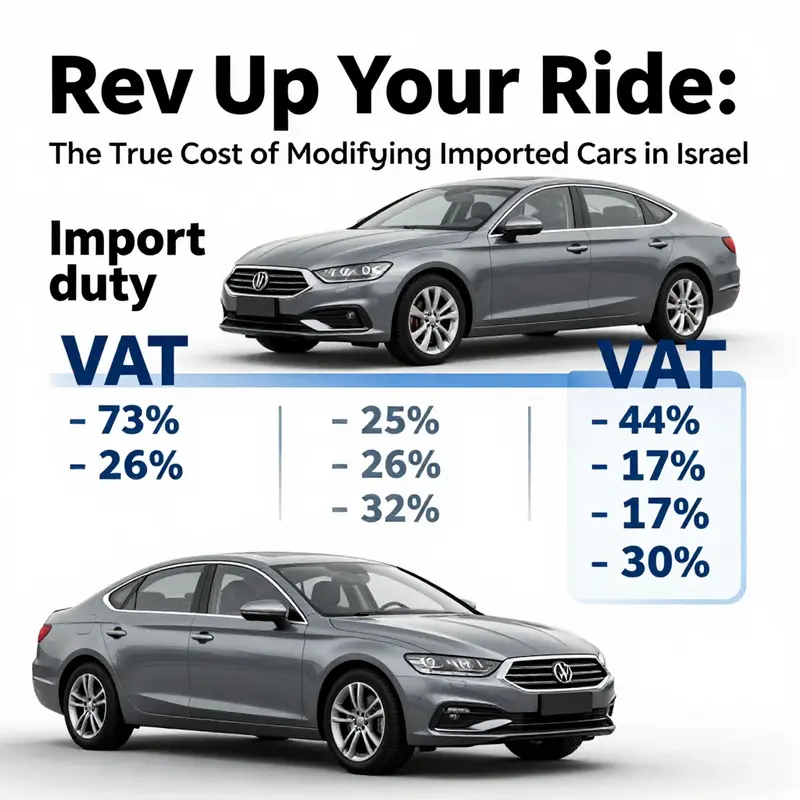
Import duty and VAT are the two tax levers that most sharply increase the price of an imported car in Israel. For anyone planning to bring in a modified vehicle, these charges are not abstract percentages. They change how you buy, where you ship, and how you schedule modifications. Understanding how the taxes are calculated, when they apply, and how they interact with modification work can prevent unpleasant surprises and help you budget realistically.
Start with the base: the car’s purchase price. Customs and tax authorities treat the declared purchase amount as the foundation for further levies. On top of that come transportation costs—freight, insurance, and handling—collectively called CIF (cost, insurance, freight). Israeli import rules apply duties and taxes to the CIF value, not simply to the invoice price, so how you ship the car matters. A low purchase price can be offset by high shipping charges, raising the taxable base.
Two primary taxes matter: import duty (sometimes called customs duty) and value added tax (VAT). Import duty for passenger vehicles typically falls in the low-to-mid double digits as a percentage of the CIF value. VAT in Israel is charged at the standard national rate and is applied to the car’s full landed cost, which already includes any import duty. That layering effect makes VAT especially significant: you pay VAT on the car, plus VAT on the duty, plus VAT on freight and insurance. In practical terms, VAT amplifies all prior charges.
There is also a purchase tax or excise element that can be applied to vehicles. This purchase tax is not a flat fee. It often varies by engine size, fuel type, and emissions. In recent years, policy has increasingly factored environmental performance into vehicle taxes. That means a fuel-efficient or low-emission vehicle can fall into a lower purchase-tax bracket. By contrast, larger engines and higher-emission models often attract steeper purchase taxes. For anyone importing a modified car, the modification’s effect on emissions or engine displacement can change the tax bracket. A modification that increases engine capacity or alters emissions controls can raise the purchase tax—sometimes significantly.
Consider timing and location of modifications. If modifications are completed before export and their cost is included on the invoice, those costs become part of the CIF value and will therefore be subject to import duty and VAT in Israel. If you perform the modifications after import, the parts and labor are taxable under Israeli VAT rules, and local labor and parts will attract VAT and possibly additional regulatory inspections. There is no universal tax advantage to doing modifications abroad versus in Israel. The difference depends on which party bears the cost, how the work is documented, and whether the modification changes the vehicle’s taxable attributes, such as emissions classification.
Customs valuation is another key variable. Authorities typically accept a declared invoice, but they also have the right to revalue if they suspect the transaction is not arm’s length, or if discounts, associated services, or bundled options conceal value. A lower declared price that lacks credible supporting documentation can trigger reassessment. Professional importers often use a customs broker for a reason: brokers know how to present invoices, shipping documents, and certificates to reduce the risk of reassessment and to ensure the declared value aligns with customs’ expectation.
To see how the math compounds, imagine a simple example for illustrative purposes. Take a car bought abroad for $20,000, and shipping and insurance of $2,000. If import duty is 12% on CIF, that duty is $2,640. Apply VAT at 17% on the sum of car price, freight, and duty: 17% of ($20,000 + $2,000 + $2,640) equals $4,086. This means, before any purchase tax or modification costs, taxes add roughly $6,726 to a $22,000 landed amount—an increase of about 30%. Now add the purchase tax. Depending on the vehicle’s classification, the purchase tax can be the largest single component. Even with conservative assumed rates, it can push total taxes well beyond 50% of the vehicle’s pre-tax price. That is why many importers report that total import costs, including taxes and required modifications, often add $10,000 to $20,000 or more to the car’s original cost.
Modifications have their own cost structure. Simple cosmetic changes incur lower costs. Structural or engine-related modifications are expensive and may affect compliance. Import regulations require technical inspections and certification for safety and emissions before registration. The inspection itself carries a fee and must be passed before the vehicle receives a license plate. If the imported vehicle needs physical modifications to meet Israeli safety or emissions rules, you must budget for parts, labor, and the time required to certify the work. If the modification affects emissions, taxes may also change, retroactively increasing the purchase tax.
Insurance and registration fees are additional, though usually smaller, expenses. Insuring an imported, modified vehicle can be costlier than insuring a stock car. Insurance companies evaluate modifications for increased risk and may charge surcharges or require specific documentation. Registration with the Ministry of Transport comes with administrative fees and paperwork. The vehicle will typically need a full technical inspection, and the results become part of the registration record.
Beyond raw numbers, several non-obvious factors influence the final price. One is currency fluctuation. A weaker or stronger foreign currency against the shekel changes the purchase price and the VAT paid in shekels. Shipping delays and quarantine or storage fees at the port can add unexpected costs. Customs brokerage fees and agent commissions for handling paperwork are modest compared to taxes, but they are not negligible.
Another consideration is legal compliance. Some modifications, such as altered exhaust systems or non-homologated safety elements, may be illegal or require special permits. Failing to comply risks fines and rework, which can multiply costs. Before any modification is done overseas, check whether Israeli technical standards will accept it. Even seemingly minor changes can trigger additional certification tasks that add time and money.
So how can an importer contain these costs? First, choose the vehicle with tax implications in mind. Lower-emission vehicles often attract lower purchase taxes. Smaller engines, hybrid systems, or models that meet strict emissions standards can save thousands in purchase tax alone. Second, decide where to do modifications based on documentation and tax treatment. If modifications abroad are included on the invoice, that can simplify warranty and liability issues, but it also grows the CIF base subject to duty and VAT. If done locally, the parts and labor will be taxed under local VAT rules and may be easier to manage from a regulatory perspective. Third, use a customs broker and a local technical expert. Brokers reduce the risk of valuation disputes and advise on proper paperwork. Technical consultants can advise whether a planned modification will trigger higher taxes or require costly certification.
Budgeting is crucial. Build a conservative estimate that treats taxes as a significant portion of the total import cost. Many experienced importers prepare two budgets: a best-case and a contingency plan. The contingency should allow for reassessment, additional inspections, or rework. Include expected VAT, estimated import duty, a buffer for the purchase tax or excise, modification costs, inspection fees, insurance surcharges, and broker fees.
Finally, many importers underestimate the administrative burden. Documentation matters. Certificates of origin, export invoices, bills of lading, and detailed descriptions of modifications all affect customs processing time and outcomes. Proper documentation speeds clearance and reduces the chance of hold-ups that produce storage or demurrage charges.
If you want a deeper dive into how Israel’s taxation approach treats vehicle imports, including the environmental considerations that inform purchase taxes, consult the OECD’s overview of Israel’s vehicle taxation policies. It explains the rationale behind green taxes and how they interplay with traditional duties, giving context for why some vehicles are taxed more heavily than others:
https://www.oecd.org/tax/transfer-pricing/israels-green-tax-on-cars.htm
If you are specifically planning modifications and need to estimate those expenses within your import budget, a practical place to start is with an estimate of modification costs and how they influence taxation. For a focused look at modification pricing, see this guide on how much car modification cost: how much does car modification cost.
In short, import duty and VAT do more than add numbers to an invoice. They change decision-making from the moment you choose a car. They determine whether you should modify abroad or locally. They shape which models make financial sense and which do not. Planning, documentation, and professional advice turn an expensive process into a manageable one. For anyone importing a modified car to Israel, treating import duty and VAT as fixed facts rather than negotiable items will lead to clearer decisions and fewer surprises.
Registering and Certifying an Imported Car in Israel: Fees, Inspections, and Real-World Modification Costs

Bringing a car into Israel turns a single financial decision into a chain of procedural costs. Among the unavoidable stages, registration and technical certification are where compliance meets cash flow. These steps determine whether a vehicle will legally and safely join Israeli roads. They also shape the final import bill in a very concrete way: failed inspections, missing documents, or necessary modifications can add days of delay and thousands of dollars. Understanding what the registration fees cover, what the technical inspection evaluates, and how common modification needs translate to expense will prepare any importer for the likely outcomes.
The registration process starts with a set of straightforward charges and then extends into annual obligations. A one-time vehicle registration fee is paid to obtain the registration certificate. This is the administrative payment that signals the state recognizes the vehicle and assigns it a registration number. The amount varies with the vehicle type, but it is typically modest compared to taxes and modification expenses. Alongside that is an administrative fee for paperwork processing and for issuing license plates. These costs are fixed and predictable; they rarely balloon unless a special request or expedited handling is necessary.
More impactful is the road tax. This is an annual levy that depends on engine capacity and emissions. Higher engine displacement and poorer emissions ratings generally increase the tax. For an importer, the road tax is payable at registration and becomes a recurring cost you must budget for. Because it is tied to environmental performance, any modifications that improve emissions can reduce this long-term outlay. Conversely, failing to meet emissions requirements may force modifications that raise your immediate expenses and potentially change the taxed classification of the vehicle.
Technical certification is the gatekeeper to registration. Vehicles imported into Israel must meet the Israeli Mandatory Requirements (IMR). The IMR cover safety, structural integrity, lighting and signaling systems, restraint systems like seat belts and airbags, and emissions standards. Inspection is performed by an accredited third-party organization. The inspection evaluates both paperwork and the vehicle itself. Documentation typically includes the manufacturer’s certificate of conformity (CoC), international test reports, and any prior homologation papers. Without complete documents, the vehicle can fail certification even if it meets the physical requirements.
During the physical inspection, technicians examine brakes, steering, suspension, tires, bodywork, and restraint systems. They test lights, indicators, horn, and windshield wipers. For emissions, petrol and diesel engines undergo specific testing to ensure they meet Israel’s environmental limits. Diesel vehicles often need additional scrutiny because particulate and NOx regulations are strict. If the vehicle has aftermarket parts, the inspector will verify they meet IMR standards or are properly documented and approved. Any discrepancy can lead to additional testing or a conditional certification contingent on repairs and re-inspection.
The practical cost of the technical inspection itself is a predictable line item. Accredited testing bodies charge a fee for the inspection and for issuing the IMR certificate when the vehicle passes. These fees vary by vehicle type and the scope of testing required. If specialized tests are needed, such as crashworthiness or in-depth emissions analysis, costs rise. A basic inspection and certification might be a few hundred dollars, whereas complex homologation processes can run into the thousands. The time component matters too: scheduling with the accredited body can take weeks. Delays increase storage or shipping layover fees and may add to the importer’s overall expense.
Modifications are where unpredictability enters. Imported vehicles often require changes to comply with local norms. Lighting adjustments are common; headlights and rear lamps sometimes need conversion to meet Israel’s beam patterns and reflector rules. Speedometers and odometers may need recalibration to display kilometers. Restraint systems and airbags must match Israeli specs and testing. Emissions equipment, especially diesel particulate filters or catalytic converters, may need upgrading or replacement. Structural alterations are rarer but can be necessary for vehicles with different safety cage designs or nonconforming body mounts.
Costs for modifications vary widely. Simple electrical or lighting work is typically among the least expensive tasks. Replacing bulbs, retrofitting headlamp units, or rewiring indicators might cost a few hundred dollars. Mechanical modifications like adding emission control devices, replacing exhaust systems, or re-tuning engine management often move costs into the mid-range. These jobs require certified workshops and sometimes factory parts. The most expensive modifications include structural changes, crash sensor recalibrations, or installing certified restraint systems. These can add several thousand dollars, especially if bespoke fabrication or manufacturer support is required.
A realistic budget must include the chain reaction of one change causing another. For example, fitting a different headlamp assembly can require changes to the wiring harness, a new lamp cover, and an alignment service. Emissions fixes may require both hardware and software work. Aftermarket parts that lower cost can also complicate certification. Using non-approved items can lead to failed inspections and rework. That rework doubles costs and adds time. The importer should always prefer certified upgrades or OEM-equivalent parts for regulated systems.
Choosing an experienced homologation agent or workshop reduces surprises. These specialists understand the IMR rules and the documentation the testing body expects. They can pre-check the vehicle, flag non-compliant items, and estimate modification needs before the official inspection. That preemptive approach shortens the path to certification and lowers the risk of expensive rework. It may cost for the pre-inspection and consultancy, but it is often money well spent. It also helps to clarify whether an imported model has previous homologation records in Israel. If a similar model was already approved, homologation can be simpler and cheaper.
Timing affects cost. Certification and registration happen in sequence, and each step has lead times. Missing a document or encountering a compliance issue can push the vehicle back into shipping or storage, piling on fees. Plan for two timelines: the minimum expected and a contingency timeline for rework and re-inspection. Those days in contingency are rarely free, so anticipate storage and workshop labor as part of your import budget.
Insurance implications are another factor. Until a vehicle is registered, it cannot have full local road insurance. Temporary insurance or transit coverage may be necessary while the vehicle is in process. If you plan modifications, check whether local insurers cover modified or recently modified cars. Certain changes may affect premiums or coverage conditions. It is wise to consult your insurer early to avoid surprises when the car finally hits the road.
There are practical ways to manage and minimize registration and certification costs. Start with detailed documentation. A complete CoC, international test reports, and clear service histories lower the chance of additional tests. Use authorized or accredited parts and services when modifications are necessary. Seek out homologation agents with proven experience for your vehicle’s make and model. Get written estimates that separate inspection, modification, parts, and administrative fees. Build a contingency buffer of at least 10-20% for unexpected work. Finally, research whether vehicles of the same model already have IMR approval in Israel; if so, homologation can be streamlined and cheaper.
Budget examples help make this concrete. A standard passenger car that requires only paperwork checks and a basic inspection might incur modest registration and certification fees plus road tax, totaling a few hundred to a low four-figure sum. If the vehicle needs common modifications like light adjustments or minor emissions work, expect an added few hundred to a few thousand dollars. When deeper modifications are necessary — structural work, sensor recalibration, or major emissions retrofits — costs can escalate toward several thousand. Combined with import duty, VAT, and freight, the registration and technical certification stage can thus tip the overall import cost significantly.
Throughout the process, transparency with your workshop and homologation agent matters. Ask for itemized invoices and a clear list of required parts. Demand compliance documentation for any modified component. That documentation supports both the IMR inspection and future resale efforts. When modifications improve emissions or safety, they may also increase the vehicle’s long-term value and reduce road tax. Conversely, undocumented or illegal modifications can hurt resale and void future warranties or insurance coverage.
For detailed procedural guidance and to initiate technical certification, the official website of the accredited testing body provides essential instructions and contacts. It clarifies the IMR homologation steps and lists required documents. Consulting that site early in the process shortens ambiguity and supports planning. https://www.tuv.com/Israel
If you plan to perform modifications yourself or oversee them, consider reading guidance on how to install modifications on a car before you commit. This resource explains the practical considerations when changing vehicle components and helps you decide when to hire professionals. https://modifiyeliarabalar.net/blog/how-to-install-modifications-car/
Navigating registration fees and technical inspection requires a blend of paperwork discipline, realistic budgeting, and sound technical advice. When managed proactively, the certification phase becomes predictable. When ignored, it turns into the most expensive surprise of the entire import process.
null

null
The True Cost at the Border: How Israel’s Import Taxes, Green Policy, and Market Shifts Shape Car Purchases

Bringing a car into Israel is rarely a single price tag. For many would-be importers, the sticker price on a vehicle sits atop a stair-step procession of charges that begin at the border and cascade through every stage of ownership. The process is not merely about handling paperwork; it is a carefully choreographed financial pathway in which duties, taxes, compliance costs, and policy-driven incentives either compound or offset the base price of the car. The result is a total cost of ownership that can dramatically tilt which models seem affordable, which powertrains command attention, and, ultimately, which consumer choices become dominant in a market that remains highly price-sensitive even as demand for mobility remains high. To understand how much it costs to import a car into Israel, one must trace the trajectory from the moment a vehicle leaves the seller’s lot to the moment it becomes a registered, road-going vehicle with insurance and maintenance plans in place. The broad categories of expense—import duty, value-added tax, registration and administrative fees, mandatory technical inspection, and any modifications required to satisfy local standards—still echo the familiar pattern seen in many jurisdictions. Yet in Israel these charges sit against a policy backdrop that actively reshapes both the costs and the incentives that drive consumer decisions, particularly as green policies push the market toward electric propulsion and away from internal combustion engines. The combined effect is a costly but evolving landscape, in which total import costs commonly land in the range of tens of thousands of dollars depending on the vehicle and the path chosen to compliance. A practical picture can help illustrate how this plays out in real life and why it matters for a household contemplating a new import, a used import, or a shift toward a different powertrain altogether.
First, the structural costs. Import duty remains a substantial component of the total bill. For passenger cars, it has typically hovered in a two-way range, often described as around 10 to 15 percent of the vehicle’s stated value. This duty is assessed as a percentage of the car’s price and, crucially, applies before other charges are calculated. Freight costs, insurance, and any handling fees that accompany the shipment are added to the base value when calculating the subsequent taxes. Then the value-added tax, set at a standard rate of 17 percent, is levied on the aggregate of the vehicle’s value, the import duty, and the freight and insurance costs. In other words, VAT multiplies the import cost by applying to the sum of purchase price, duty, and shipping, creating a tax-on-tax effect that can feel like a multiplying bridge between foreign price competition and domestic pricing realities.
Beyond these duties and taxes, there are the registration fees that accompany the formal admission of a vehicle into the Israeli system. The administrative costs of registering with the Ministry of Transport, the issuance of plates, and the initial licensing processes all carry fees that, while predictable, are not trivial. Then there is the mandatory technical inspection and certification. This step ensures compliance with safety standards and emissions requirements for imported vehicles. The inspection itself comes with a fee, but more than the price tag is the strategic expense of ensuring that the car meets Israeli regulatory expectations. If the vehicle fails or needs recertification, additional costs accrue, and the time to bring the car to compliance lengthens, potentially increasing storage or handling charges along the way.
Another layer of cost arises from modifications that may be necessary to meet local regulations. The extent of these modifications varies by vehicle and by model year, but the price tag can swing widely. Some cars may require only minimal adjustments, while others demand more substantial retrofits to headlights, signaling, emissions systems, or safety-related components. The modification costs can be a significant portion of the total import bill and, in some cases, may even determine whether an otherwise attractive vehicle is ultimately affordable for a given buyer. The total import equation, when all duties, VAT, registration, inspection, and modifications are included, can range from roughly ten thousand dollars to twenty thousand dollars or more for certain models and configurations. That spread underscores a simple reality: the cost ceiling is highly sensitive to the car’s value, its powertrain, and the specific compliance path chosen by the importer.
But the price story does not end at the border. The Israeli market itself contends with a broader set of dynamics that either amplify or ease the burden of import costs depending on policy shifts and market structure. The country has long faced an imbalance between demand and supply, a situation created in part by a small number of authorized importers and a relatively limited degree of competition among distributors. That market structure has historically enabled manufacturers and dealers to maintain higher price levels inside Israel than in international markets. The consequence for consumers has been a persistent price gap: vehicles that may be available for less abroad can arrive with a much higher total cost once all border charges are added in Israel. Yet despite these cost pressures, car ownership has remained buoyant, with mobility being a societal staple and a signal of rising living standards. The density of vehicle ownership—roughly 300 cars per 1,000 inhabitants—reflects high reliance on personal transport and, at the same time, the importance of policy in shaping which vehicles reach the road and how quickly.
In recent years, public pressure and policy reforms have nudged the market toward greater competition and more favorable conditions for importers and buyers alike. Israel has pursued a multifaceted approach: lowering import duties in some cases, promoting parallel (gray market) imports, and encouraging competition among sellers. These steps have produced measurable price reductions, especially for mid-range models and, more importantly for the long-term trajectory, electric vehicles. The policy architecture is not simply about reducing upfront costs; it is also about requiring users to confront the environmental and social costs that accompany private mobility. The introduction of a green tax—designed to account for air pollution, noise, congestion, and the wear and tear on infrastructure—adds a framework where environmental considerations become part of the cost calculus. In practice, this means that buyers are nudged toward efficient propulsion, not only by the price of fuel or electricity but by the embedded costs built into the vehicle’s life cycle.
A decisive policy shift further tilts the cost-benefit balance: a clear timetable to decarbonize transport. From 2030 onward, the policy environment is expected to permit only electric or natural gas-powered vehicles for import, effectively phasing out new gasoline and diesel cars. This policy horizon has a powerful signaling effect: it intensifies demand for electrified imports and accelerates the shift in the domestic market toward cleaner technology. It also changes the cost equation in subtle but meaningful ways. As the government chases decarbonization goals, it leverages price signals—often through taxes, subsidies, and import rules—to favor technologies that align with environmental targets. In practical terms, buyers who anticipate the 2030 deadline may choose to absorb higher upfront costs today for a vehicle that will be cleaner and potentially cheaper to operate in the long run, or they may pursue parallel import strategies and other channels that can mitigate some of the price pressure.
The 2030 horizon has not only steered consumer expectations; it has reshaped the competitive landscape for automakers. A notable development is the rise of Chinese automakers in the Israeli market. These brands have leveraged competitive pricing, technology offerings, and favorable battery architectures to capture a growing share of imports. Data from the Israel Vehicle Importers Association indicates a remarkable shift in early 2025, with Chinese carmakers accounting for the largest share of imported passenger cars in January through May 2025, driven significantly by electric vehicles. A notable portion of these EVs—approximately 82.4 percent of all EV sales during that period—was attributed to Chinese brands. BYD Auto led EV sales in that window, followed by Xpeng and others, with models that emphasize lithium iron phosphate (LFP) battery chemistry and efficient energy use. The result is not only a shift in brand preference but a reordering of the cost landscape: if domestic price points for similar capabilities are adjusted to reflect new competition, total ownership costs—when tax and duty considerations are factored in—can move in a direction that makes certain Chinese EVs particularly attractive relative to traditional offerings. The market data thus tells a story of how policy, price, and technology converge to reconfigure consumer choice in a market that was once defined more by a handful of local distributors than by global competition.
Given this confluence of costs and policy, what does this mean for the average importer weighing a purchase? The import bill, when all pieces are accounted for, is not a fixed line on a receipt but a dynamic sum that changes with the vehicle’s value, its propulsion system, and the regulatory path chosen. For some buyers, the total cost may still be prohibitive for high-end or luxury models, particularly when the vehicle’s value triggers higher duties or when modifications are extensive. For others, the equation is more favorable as green incentives align with a growing supply of mid-range and electric vehicles, often from manufacturers who entered the market with aggressive pricing to capture a new audience. The result is a market in which total cost is increasingly driven not only by the vehicle’s price tag but by the policy design that frames the value proposition of different powertrains and brands.
In this evolving environment, it becomes crucial for buyers to plan strategically around modification needs. When meeting Israeli standards, some vehicles require more extensive alterations than others, and the associated costs can vary from modest to substantial. Prospective importers may find it helpful to think of modification costs as a spectrum aligned with the vehicle’s electronics architecture, lighting systems, and emissions configuration. Those who anticipate higher impulse to customize for compliance or performance should budget for the possibility of additional work and scheduling time to accommodate certification processes. For readers who are exploring the practicalities of post-import work, a useful starting point is to understand how modifications interact with the broader cost picture and to consider how those costs might influence resale value and insurance once the car is on the road. See discussion on how modifications can affect resale value for a grounded perspective, and consider the broader implications for long-term ownership.
To illustrate the practical texture of these decisions, imagine a mid-range imported vehicle with a competitive price on the international market but facing a full suite of border charges in Israel. Import duty at roughly 12 percent, VAT at 17 percent on the combined base price plus duty and freight, and registration and inspection fees together might push the initial outlay well above the vehicle’s sticker price. Add a potential range of several thousand dollars for modifications to ensure compliance, and the total outlay can quickly approach or exceed a substantial portion of the car’s domestic market price. The buyer must not only consider the upfront cost but also the ongoing costs of ownership, including insurance, maintenance, and potential impacts on resale value. Insurance, for instance, may differ for cars that have undergone specific modifications or for vehicles in a regime where green policies influence risk assessments or taxation during the policy term. These layers of cost and risk push buyers toward a careful, scenario-based evaluation rather than a simple face-value comparison of automobile prices.
In this broader tapestry, consumers may also weigh parallel import options—the gray market—where vehicles are brought in outside official channels. Such paths can sometimes reduce upfront costs by circumventing certain intermediaries and, in some cases, by altering the duty and tax calculations through different regulatory routes. However, parallel imports introduce their own considerations: warranty coverage, after-sales support, and eligibility for standard certification checks. The policy discourse around these practices indicates that reforms aim to balance market access with consumer protection and safety standards, a balance that can shift over time as new regulations emerge. For the individual buyer, the prudent approach is to model several scenarios: a direct official import with full compliance costs, a parallel import with its own set of warranties and service implications, and an EV-focused import path that leverages the growing footprint of electric vehicles and the green tax framework while still contending with the upfront price and the cost of charging infrastructure, maintenance, and battery health over the long run.
All of this underscores a central reality for potential Israeli car importers: the financial calculus is as much about policy signals as it is about sticker prices. The green tax, the 2030 decarbonization target, and the evolving competitive landscape collectively reframe what constitutes a reasonable investment in personal mobility. This reframing is visible in consumer preferences, where a growing share of buyers shows willingness to embrace electric propulsion—even when it means navigating higher upfront costs or a longer lead time for delivery—because the long-run operating costs, reliability, and environmental considerations align with personal and public values. It also explains why, despite high initial import costs, a vibrant market for Chinese EVs has emerged, offering not just price competitiveness but a bundle of features that resonate with a consumer base increasingly attentive to technology, range, and charging infrastructure.
For readers who want a practical, action-oriented takeaway, the core message is that importing a car into Israel requires a forward-looking cost model. It is not enough to compare a vehicle’s price in the country of origin to the domestic sticker price; one must integrate import duties, VAT, registration fees, mandatory inspections, and any mandatory modifications into a holistic total. The decision to import, then, becomes a blend of financial math and policy awareness, a calculation that invites buyers to forecast how future tax regimes, environmental incentives, and market competition will affect the vehicle’s total cost of ownership over several years. In an environment where policy can move faster than a consumer’s shortest budget cycle, adopting a flexible planning mindset matters as much as the initial price tag. If you are weighing the costs of modifications after import, you may find it helpful to see a concise analysis of how modification costs accumulate and how they affect overall value how much does car modification cost. This contextual lens—combining border economics with the practicalities of compliance—can help readers navigate a market where the border is not a fixed line but a dynamic interface between global pricing, local regulation, and evolving consumer preferences.
External reading that contextualizes these shifts includes international coverage of Israel’s environmental and trade policy developments, which illuminate how policy design can alter the economics of bringing a car into the country. https://www.xinhuanet.com/english/2025-06/03/c_1310521575.htm
Final thoughts
Navigating the costs associated with importing a car into Israel involves understanding various financial factors, from import duties to modification expenses. For car modifiers, the implications of these costs are significant, not just financially but also in terms of compliance and market choices. Whether you’re a hobbyist or a professional tuner, being informed allows you to make the best decisions for your import and modification projects, ensuring you enjoy the ride while staying within legal frameworks and budgets. The vibrant community of car modifiers stands ready to embrace these challenges, transforming vehicles into unique reflections of personal identity and passion.