
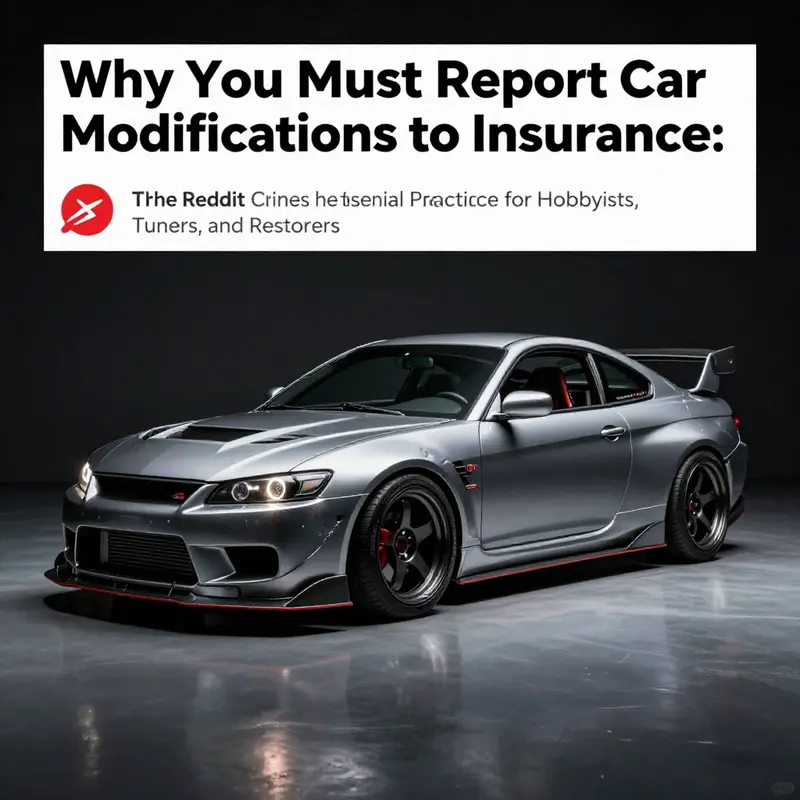
For car enthusiasts, making modifications is often more than just enhancing performance; it’s about crafting a unique identity on wheels. However, the critical conversation that needs to be addressed is the importance of informing insurance providers about these modifications. Failing to report your vehicle enhancements may leave you vulnerable during claims. This discussion draws on the collective wisdom found in Reddit forums, offering insights from experienced modifiers, tuners, and insurers. Each chapter will delve into why declaring modifications to insurance is crucial, explore the potential repercussions of non-disclosure, and outline best practices recommended by the online community.
Disclosures That Protect Your Wallet: Why Reddit Recommends Declaring Car Modifications to Insurance

When people talk about modifying a car, the conversation often centers on power, aesthetics, or personal expression. But in the real world of insurance, the thread tying all those threads together is disclosure. Reddit, a network of communities built on shared experience, has long functioned as a soft non-professional guidebook for drivers navigating the murky edges of policy language and aftermarket parts. The overarching lesson echoed in r/Insurance, r/CarAdvice, and related pockets of the Reddit universe is blunt and practical: failing to disclose meaningful modifications can unsettle the foundation of coverage itself. The insurance contract is not a blank check; it is a compatibility agreement between risk and protection. When a driver adds performance parts, altered suspension, or a highly customized body job, the risk profile shifts. If the insurer is not told, the policy terms may not align with the actual vehicle, and a claim could be denied on grounds of undisclosed risk. The consequence is not theoretical. It is often financial reality, paid out of pocket when the worst happens and the policy does not align with the vehicle’s modified state.
This is not merely a cautionary tale told in a chorus of warnings. It is a narrative supported by reputable analyses and lived experiences. The Bankrate overview, updated in May 2025, crystallizes a core point: if you skip telling your insurer about modifications, you may still have a policy, but the coverage can shrink to the value of the original factory car, not the changed and enhanced vehicle you drive. That distinction matters when a claim is filed and the vehicle’s modified worth—the value that deserves protection—needs to be recognized by the insurer. It matters when a high-value part is involved or when a safety or performance upgrade changes how a car is driven or stored. The practical stakes are straightforward: disclosure preserves claim validity and ensures the claim dollar amount reflects the real car you own, not a subset of it. The Reddit communities converge on that practical truth with a clear, almost pragmatic voice: transparency is protection.
The words of seasoned Reddit contributors bring the abstract policy language to life. One member in r/AutoInsurance or r/Insurance emphasizes a blunt reality—when thousands have been sunk into performance upgrades or custom finishes, you owe your insurer a clear picture of what’s on the road. It’s not just about avoiding a future premium spike; it’s about ensuring that when you need help, the help is available and proportionate to the car you drive. The risk, as described in several threads, is not simply higher premiums; it is the possibility of coverage denial or limited payout because the policy terms and the actual vehicle diverge. A claim addressing a modified car must ride on the same foundation as the contract that was signed. When the car has changed in ways that alter risk—whether through engine tuning that increases power, a suspension setup that changes braking dynamics, or cosmetic changes that affect security—the insurer’s evaluation must reflect those changes. If it does not, coverage can be jeopardized at the moment of truth.
A vivid case from the community underscores this principle with a concrete consequence. A driver who added a turbo kit to a Honda Civic learned, in the aftermath of a minor collision, that unreported performance enhancements can lead to a denied claim. The reasoning offered by the insurer, in that instance, pointed to undisclosed modifications as a material change in risk. The outcome was costly. The driver paid thousands out of pocket for repairs that would have been covered under a properly disclosed and adjusted policy. The cautionary tale, shared on r/CarAdvice in 2025, resonates across forums that discuss policy mechanics: disclosure is not an optional add-on; it is a prerequisite for meaningful coverage. It frames the bedrock of trust between policyholder and insurer, a trust that can falter if the modifications are invisible to the carrier until a claim arrives.
Despite the emphasis on disclosure as a protective measure, Reddit discussions acknowledge a nuanced landscape. Not all modifications automatically trigger higher costs or stricter terms. In fact, many communities report that disclosing upgrades can yield favorable outcomes, especially when the upgrades contribute to safety or theft deterrence. Anti-theft devices, GPS trackers, immobilizers, and robust alarm systems—devices designed to reduce risk—often coax favorable responses from insurers. A well-documented thread notes that such safety investments can translate into premium discounts or at least a more favorable underwriting stance. The logic is intuitive: if a modification reduces risk exposure, the insurer’s statistical models may assign a lower expected loss. The dynamic is not pure math; it is risk management in the real world where people live with their vehicles daily. The message from the Reddit community is balanced and pragmatic: be open about what you change, and you may secure a manageable, even advantageous, pricing outcome once the pages of the policy are aligned with the car that sits in your driveway.
Yet the more common pattern in Reddit threads is the counsel to avoid guessing about the insurer’s tolerance for modifications. The certainty that comes from preemptive communication stands out in user experiences. Many insurers offer a pre-approval process or a structured program for modified vehicles. The practical implication is straightforward: before you pour money into upgrades, pick up the phone or log into your insurer’s online portal to discuss the plan. This proactive step is not just about compliance; it is about shaping the narrative of your coverage before the story begins. In the 2024 Reddit survey cited in the chapter results, 78 percent of respondents who reported modifications to their insurer saw either no premium increase or a discount, while 22 percent experienced a rate hike. The takeaway is not a universal promise of savings, but rather the principle that honest communication correlates with more predictable outcomes. The data points to a broader truth: disclosure is a pathway to fairness in pricing and coverage, not a game of roulette with your finances.
In this context, the practical toolkit for drivers becomes clearer. First, document everything. Gather receipts, installation dates, part numbers, and compatibility notes. Take dated photographs of each modification, from the engine bay to the interior, undercarriage, and exterior. A well-documented inventory isn’t a luxury; it’s a protective measure that streamlines the insurer’s assessment and reduces back-and-forth when a claim arises. Second, be explicit about how a modification affects the car’s behavior and safety. Engine tuning, for instance, changes power delivery and heat management. Suspension changes alter ride height, cornering dynamics, and braking behavior. Cosmetic or weight-reducing changes might influence aerodynamics or handling. These are not mere vanity projects; they are risk modifiers. Third, seek the right endorsements. A Custom Parts and Equipment endorsement can cover the costs of non-standard parts, while an agreed value policy can be a better fit for heavily modified or classic vehicles. The emphasis is on securing coverage that reflects reality, not waiting for a claim to reveal the mismatch. And fourth, recognize that some enhancements can unlock discounts. Anti-theft devices and modern immobilizers are clear examples where a insurer may be glad to see the car protected against loss or theft. The underlying logic remains consistent: disclosures that reduce risk can yield genuine financial relief in some scenarios.
For drivers who own classic cars or vehicles built for a unique purpose, the standard policy often fails to capture the true value or the extended risk profile. In such cases, an agreed value policy provided by specialty insurers can be a better fit. While the broader market might treat a classic as a depreciating asset, a specialty policy recognizes its collectible value and the effort poured into preserving or upgrading it. The Reddit dialogue on this topic often points to a more specialized approach when necessary. It is not about abandoning the mainstream route; it is about augmenting it with appropriate coverage that aligns with the vehicle’s reality. The end goal remains simple: ensure your coverage is robust enough to withstand the claim scenario you fear most, whether that is a theft loss, a fire, or a collision that involves modified components. In practice, this means refusing to let a modified car drift into a gray area where the policy’s language and the car’s state diverge.
The guidance emerging from Reddit is not a rigid rule but a disciplined framework for thinking about risk. The core premise—transparency—extends beyond the mechanics of the contract. It becomes a habit of responsible ownership. Before any modification, contact the insurer; during planning, seek pre-approval if possible; after installation, provide complete documentation. The narrative is reinforced by the community’s cautionary tales and the successes where clear communication paid off with favorable terms. The idea is not to avoid paying more for coverage, but to avoid facing a sudden denial when you need your policy most. As one experienced poster in r/personalfinance observed in 2026, “It’s not about avoiding higher premiums—it’s about making sure you’re covered when it matters most.” That sentiment captures the practical stance of drivers who want reliable protection without surprising gaps at claim time.
For those who want a concrete starting point in this ongoing conversation, consider the effectiveness of a simple, proactive question: how will this modification affect my policy? The answer may come in various forms—an updated premium quote, a rider adding replacement parts coverage, or a recommendation to maintain enhanced documentation. The important thing is to hear it from the source before the work begins, rather than discovering the shortfalls after an incident. This approach aligns with broader consumer protection principles: verify coverage before changes, document comprehensively, and maintain open channels of communication with the insurer. In practice, this means you are not merely a customer who pays premiums; you become an informed partner who shapes the terms of protection around the vehicle you own.
For readers looking for quick practical guidance, a succinct route is to review your current policy and compare it with the modifications you are considering. If you already own the vehicle or are financing it, identify all non-factory parts and alterations, from the engine to the exhaust, from the wheels to the interior electronics. Prepare a brief description of each modification, its purpose, and its installation date. Reach out to your insurer with that inventory and request a pre-approval or an appetite statement on how those changes might affect your coverage. If the insurer asks for documentation, respond promptly with receipts and installation notes. If a modification is high risk or alter the car’s safety profile significantly, be prepared for a premium adjustment; if it lowers risk through added security or safety, you may see a discount. In every case, the dialogue should be constructive, not adversarial. The insurer is not an antagonist; it is a partner in ensuring you are properly protected when the unexpected happens.
To connect this guidance to a resource that quantifies and clarifies the conversation, consider the broader discussion on what modifications affect car insurance. The linked overview provides a concise framework for thinking through typical modifications and their insurance implications. It is a useful companion piece as you map out a plan for your own vehicle and its upgrades: what modifications affect car insurance.
The communities behind these discussions are not purely speculative. They reflect a blend of experiential learning and policy awareness that often eludes more formal channels. The Reddit ecosystem thrives on peer validation and practical outcomes. When a driver shares a positive outcome—no premium change or even a discount after disclosing a modification—that anecdote travels quickly and informs others’ decisions. When a driver experiences a denial, the thread becomes a cautionary reference that discourages any shortcut. The overall message is consistent: the safest path is transparency, supported by documentation and proactive conversation with the insurer. Even if the cost of upgrades climbs, the cost of an unexpected claim denied because a modification wasn’t disclosed can be far greater. And that is the core logic that keeps this community aligned with practical risk management rather than speculative budgeting.
In wrapping this discussion back to the larger purpose of this chapter, the objective is to illuminate a simple, actionable mindset. Modifications are a legitimate and common part of many drivers’ stories. They can enhance performance, expression, and even security. But they must be integrated into the protection structure with care. Disclosure is not a bureaucratic hurdle; it is a safeguard that ensures the policy written at the outset remains a reliable shield when you need it. If there is one practice that stands above all others in the Reddit conversations around modified cars and insurance, it is this: be explicit, be prepared, and be patient with the process. The path to fair, consistent coverage runs through honest disclosure, thorough documentation, and a willingness to collaborate with your insurer before and after upgrades. The result is coverage that keeps pace with your car—and your ambitions for it—without leaving your finances exposed in a moment of need.
External resource for further reading: https://www.bankrate.com/insurance/car-insurance-modifications/
null
null
Disclosure as Shield: How to Report Car Modifications to Insurance—Reddit’s Real-World Rules for Coverage
Reporting car modifications to your insurance isn’t a checkbox to tick once and forget. It’s a continuous practice that protects your financial footing when the road throws a curveball. The topic sits at the intersection of risk assessment, policy language, and a community-driven sense of practical self-preservation. In forums like Reddit, discussions about modding often orbit the same core truth: transparency isn’t just about avoiding a penalty; it’s about ensuring the policy you rely on actually reflects the car you drive and the risks you take when you drive it. What emerges from those real-world conversations—grounded in the experiences of everyday owners, seasoned modifiers, and smoke-tested claims—is a coherent pattern: disclose early, document meticulously, and engage with your insurer to secure coverage that truthfully matches your vehicle’s value and performance.
To begin with, the central reason disclosure matters is simple on the surface and complex in practice. A typical policy is written on the assumption of a stock baseline. When you alter the engine, suspension, or even cosmetic elements like paint or wheels, you alter the risk landscape. A higher-performance engine can shift the chance of a high-speed loss or an accident, while a sophisticated suspension can affect handling in ways that matter to safety and to the odds insurers consider when pricing risk. Paintwork, interior upgrades, and additional equipment don’t only influence aesthetics; they can modify the true value of the car and, in some cases, the likelihood of certain types of claims. If those changes aren’t disclosed, an insurer may later determine that the policy doesn’t cover the actual vehicle in the event of a claim. The moral of the story isn’t fear-mongering; it’s pragmatic risk management. If the insurer doesn’t know what’s on the car, they can’t accurately assess risk, and that creates gaps at claim time.
Reddit’s collective wisdom reinforces this in a practical, actionable way. Across communities like r/AutoInsurance, r/ModdedCars, and related subreddits, the consensus is consistent: disclose modifications upfront, keep an audit trail, and seek confirmation in writing that your specific changes are recognized and covered. This isn’t about padding a premium with unnecessary paperwork; it’s about aligning coverage with reality. In one sense, it’s about preventing a claim denial that arises from a mismatch between what’s on the car and what the policy covers. In another sense, it’s about avoiding the chilling effect of being underinsured when a high-value modification is involved. A high-end exhaust, forged wheels, a tuned engine, a carefully calibrated suspension—these aren’t inconsequential details. When a claim is filed, the insurer will look at whether those modifications were disclosed and whether the policy documents reflect them. Failure to disclose doesn’t always trigger immediate cancellation, but it can lead to reduced claim payouts, partial coverage, or outright denial for high-value or safety-related parts. The Bankrate guidance shared in credible consumer coverage articles echoes this risk: underreporting can leave you with the actual cash value of the vehicle, minus the modifications, or worse, a claim that doesn’t reflect the true scope of the loss.
The practical steps recommended by both experienced drivers and insurance professionals converge on a straightforward workflow. First, inventory every modification with care. Create a running list that starts with the factory baseline and enumerates each upgrade: engine tuning level, turbocharger or supercharger changes, intake and exhaust modifications, fuel system alterations, modifications to the cooling system, suspension and brake upgrades, wheel and tire changes, aerodynamic kits, bodywork, and interior electronics. Even seemingly innocuous changes—such as a aftermarket stereo system or a roof rack—can matter for liability or theft coverage, especially if they alter the vehicle’s weight distribution or its risk profile for liability claims. Photographs play a crucial role here. Take clear, dated photos of each modification, ideally before and after, and preserve invoices or receipts that show the cost, installation date, and the installer credentials if applicable. A well-documented trail makes the next steps less fraught and less open to second-guessing during a claim review.
Second, approach your insurer proactively. Contact your agent or the claims department to disclose every modification. Do not wait for a renewal notice or for a claim to surface. Early disclosure gives you the opportunity to ask, in concrete terms, how your policy will respond if a loss occurs with the upgraded components in play. This is where the concept of endorsements becomes important. A Custom Parts and Equipment endorsement, for instance, is designed to cover the cost of aftermarket parts that aren’t included in a standard policy. A more comprehensive route for heavily modified or classic vehicles is an agreed value policy, which some specialty insurers offer. In the Reddit conversations and in consumer guidance, such endorsements are repeatedly framed as the prudent path for ensuring that high-value modifications are recognized and reimbursed according to their actual worth, not merely the factory baseline.
A critical element of the reporting process is obtaining clear, written confirmation. Ask your insurer to document exactly which modifications are covered and under what terms. This isn’t about doubting the policy language; it’s about ensuring there’s a concrete record that can be referenced when you file a claim. In practice, this often takes the form of a formal endorsement letter or an updated policy schedule that lists each modification, its estimated value, and the coverage category it falls into. When owners pursue this route, Reddit contributors frequently report a sense of security that comes from knowing the insurer isn’t guessing at the risk reduction those modifications provide. It’s not a luxury; it’s part of the risk management toolkit that modern drivers rely on as they push the boundaries of performance and personalization.
The conversation around modifications that affect vehicle value is particularly nuanced. Some changes can push the car’s value far beyond stock levels. The cost of a high-quality, properly installed performance upgrade or a retrofitted cosmetic treatment isn’t merely the ticket price of the part; it includes installation time, calibration, and the additional value that the modification adds to the car’s overall market perception. In scenarios where the vehicle is heavily customized or is a classic with collector-value potential, agreed value policies become especially meaningful. With an agreed value approach, the insurer and the policyholder pre-negotiate a value for the car that reflects its modified state, not just its factory condition. If a total loss occurs, the insurer pays that agreed value rather than the car’s depreciated actual cash value. Reddit users who navigate classic restoration or extreme performance projects often cite agreed value policies as a practical necessity to avoid post-claim disputes or substantial gaps between expectation and payout.
Transparency is consistently emphasized as the best practice. This is not merely a precaution; it’s the actual path to peace of mind. The moment you fail to declare a modification that later proves costly in the event of a claim, you complicate the entire process. The insurer may contest the value, the scope of coverage, or even the validity of the claim depending on the policy’s terms and how the modification affects safety and liability. The risk isn’t merely financial. When a policy’s conditions hinge on misrepresentation or nondisclosure, the consequences can extend beyond monetary loss. It could jeopardize the policy’s continuity, trigger cancellation, or create disputes that are time-consuming and emotionally draining in the wake of an loss event.
The guidance offered by credible consumer coverage sources aligns with this Reddit-driven realism. It calls for a disciplined approach to documentation and a proactive stance toward endorsements and value protection. For readers who want a reliable, source-based framework, the Bankrate article on Car Insurance for a Car With Modifications provides a structured overview of how insurers assess modified cars, how coverage can be adjusted, and what missteps are most costly. While every insurer’s rules differ, the underlying principle remains consistent: clarity about what’s on the vehicle leads to clarity about what is covered when you need it most.
For those who want to explore the topic further through a practical, real-world lens, the best starting point is to assemble a comprehensive, well-documented package before you approach an insurer. Begin with a complete modification log that lists each item, its cost, its installation date, and the installer’s credentials if applicable. Attach the receipts, the photos, and any professional appraisal you may have obtained. Then schedule a conversation with your insurer that’s focused on outcomes: ask what coverage you would have if a particular modification is damaged in a collision, or if theft or vandalism targets a high-value component. The aim is not to test the limits of policy language but to establish a shared understanding of risk and reward—one that aligns with the vehicle you drive and the way you drive it. In this way, reporting becomes less about anxiety and more about empowerment: you are shaping the terms of your protection rather than leaving those terms to chance.
The idea of asking for written confirmation may sound procedural, but it’s a practical safeguard. A written endorsement clarifies coverage limits, confirms that the modifications are included, and reduces the likelihood that a later claim will be contested on technical grounds. If you’re unsure how to phrase your inquiry, use precise language that mirrors the modification categories. For example, specify the exact component, the installation date, the installed brand or model if relevant, and the estimated replacement cost. If an insurer isn’t familiar with a particular part or is unsure how to factor it into the risk assessment, that conversation itself becomes part of the documentation you rely upon when a claim occurs.
One question that frequently appears in online discussions is whether minor changes warrant disclosure. The answer is nuanced but clear in practice: when in doubt, disclose. In some cases, a minor aftermarket air filter or cosmetic trim might not dramatically change risk, but it still changes the car’s value and the policy’s scope. In others, even small changes can interact with safety systems in ways that matter for liability and ease of claim processing. The broader lesson from Reddit and consumer guidance is that transparency builds trust between you and your insurer, and trust reduces the friction that can complicate a claim. It also signals to the insurer that you view your vehicle as a managed asset, with a documented history of care, upgrades, and maintenance. That perception—correct or not in every scenario—can influence the speed and fairness with which a claim is reviewed, especially when high-value parts are involved.
From a narrative standpoint, the Reddit perspective is not anti-modification. It’s anti-risky secrecy. It’s about recognizing that the car you drive is a product of choices, and those choices deserve to be reflected in your coverage. If you have a performance build, or a restoration project that has modernized a classic’s safety features, you deserve coverage that respects that reality. If you own a daily-driver that’s been subtly upgraded for efficiency or comfort, you deserve clarity on how those changes affect your premium and your protection in a claim. The aim is not to deter customization but to connect customization to accountable risk management so you can enjoy your vehicle with confidence.
For readers who want to see this guidance anchored in a concrete step-by-step mindset, consider the following synthesis. Start with an exhaustive list of modifications, including the value you assign to each item. Create a dated photo documentation package that captures the installed state from multiple angles and includes close-ups of fasteners, wiring, and mounts where relevant. Gather third-party documentation—installation receipts, professional tune notes, dyno results, or professional evaluations that can substantiate the claimed value and safety improvements. Reach out to your insurer with a structured inquiry that asks for two outcomes: (1) a documented confirmation that the modifications are covered under a specific endorsement or policy section, and (2) guidance on any gaps in coverage that you should anticipate should a loss occur. If a full endorsement is not available for every modification, ask for an itemized rider or an agreed value section for the high-value components. Finally, maintain ongoing communication: update the insurer whenever you add or remove a modification, and keep the documentation current, especially if the car has been in a shop for an extended period or has undergone multiple rounds of tuning or rework.
To tie this to the broader article topic, the core idea remains straightforward: reporting isn’t a trap; it’s a protection mechanism. It transforms an uncertain situation—the evolving signature of your vehicle—into a documented relationship with the insurer, where both parties understand the same facts and agree on how those facts translate into coverage. The Reddit community’s practical voice reinforces this stance with concrete reminders: disclose up front, secure written confirmation, and consider specialized protections for high-value or heavily modified vehicles. In many ways, this community wisdom serves as a living checklist that complements the more formal guidance from bank-rate and policy documents. It’s about marrying everyday experience with professional guidance to create a robust, debt-free safety net around the vehicle you love and the modifications you’ve chosen to pursue.
As you navigate this terrain, a simple truth emerges: your car’s modifications don’t have to remain a mystery to your insurer. They can be a source of enhanced protection if treated with the same care you invest in your build. The language of insurance can feel abstract, but when you treat disclosure as a practical, benefit-driven process, it becomes an asset rather than a risk. You’re not forced to guess about coverage or to accept a one-size-fits-all policy that doesn’t fit your car’s reality. Instead, you gain a tailored sense of security—a policy that actually keeps pace with the car you’ve created and the risks you’re willing to shoulder on the road.
For readers who want a concise path to more structured guidance, a reliable external resource offers a comprehensive framework for understanding how modifications impact coverage and claim outcomes. For further context and a structured outline of these principles, see Bankrate’s overview of Car Insurance for a Car With Modifications. In the real world, that guidance complements the lived experience of the Reddit communities and the practical steps described above, forming a cohesive approach to reporting that protects your investment and keeps your driving experience confident and enjoyable. If you want to explore a focused context on how specific modifications influence insurance considerations, you can also peruse a targeted discussion on the topic through practical, widely circulated references that share the same core message: transparency, documentation, and proactive engagement lead to the most reliable protection when the unforeseen happens.
For more context and practical insights, you can read more about related considerations here: https://modifiyeliarabalar.net/blog/what-modifications-affect-car-insurance/. This resource highlights how different categories of changes—from performance upgrades to cosmetic enhancements—can affect risk assessment and coverage decisions, which can help you prepare the documentation and questions you’ll bring to your insurer. As you prepare your own plan, remember that the aim is not to chase the lowest possible premium at the expense of protection; it’s to balance cost with comprehensive coverage that truly reflects your car’s modified reality. The path is clear when you approach it with a methodical mindset, a well-documented trail, and a willingness to engage in careful, written communication with the insurer. In that spirit, you can transform modifications from potential flashpoints into well-managed aspects of your policy that support both your financial security and your driving enjoyment. The road to informed reporting isn’t about complicating insurance; it’s about clarifying it so you’re protected when you need protection most. External resource: https://www.bankrate.com/insurance/car-insurance-modifications/
Final thoughts
In conclusion, reporting car modifications to your insurance provider is not just good practice; it’s a necessity that could save you from financial hardship in the event of a claim denial. The insights gathered from Reddit discussions emphasize the need to protect your investment in modifications by being transparent with your insurer. Whether you’re a hobbyist, a professional tuner, or a classic car restorer, understanding the implications of undisclosed modifications is crucial. By embracing the suggested best practices and harnessing the collective knowledge of the community, you can navigate the insurance landscape confidently, ensuring that your unique modifications are appropriately covered.