
The topic of car modifications often stirs the passions of enthusiasts, luncheoning debates over aesthetics, performance, and compliance. Claims surrounding former President Donald Trump’s alleged legalization of car modifications have circulated among various online communities, fueling uncertainty among hobbyists, professional tuners, and classic car restorers. Understanding the truth behind this narrative requires an examination of the regulatory context, especially the implications of policies enacted during Trump’s administration. Each chapter of this article will dissect relevant aspects, offering insights on the impact of Trump-era policies, the relationship between vehicle modifications and emissions standards, global trends in modification regulations, and potential future directions for car modification laws.
Presidential Promises and the Car Modification Rulebook: Why There Was No Nationwide Legalization Under Trump
The question that often arises in political conversations—Did Trump legalize car modifications?—unfolds as a study in how power actually operates in the United States, and why rhetoric can outpace reality in matters of regulatory policy. The short answer, grounded in the governing structure of federal law and the architecture of automotive regulation, is no. No U.S. president, regardless of party or personality, possessed the constitutional authority to unilaterally rewrite federal rules governing vehicle modifications. The regulation of automobiles rests in a layered system. Congress enacts statutes that authorize agencies to regulate. The National Highway Traffic Safety Administration, or NHTSA, administers those statutes under the umbrella of the Motor Vehicle Safety Act, crafting standards, interpreting compliance requirements, and guiding enforcement. At the same time, state and local authorities maintain their own rules, often reflecting broader federal guidelines but sometimes adding stricter requirements. Against this backdrop, a blanket presidential act declaring all car modifications legal nationwide would run afoul of both constitutional design and the procedural nature of rulemaking. The notion of a single executive issuing a sweeping pro-modification decree fails to acknowledge the indispensable checks and balances that shape how safety, liability, and consumer protection are actually governed in the United States. In other words, presidential pronouncements can set policy agendas, but they do not automatically erase or rewrite the legal framework that governs modified vehicles.
During the Trump era, the policy conversation around vehicle modifications did tilt toward recalibrating enforcement priorities and adjusting certain regulatory angles, rather than endorsing a universal freedom to modify. The administration pursued regulatory adjustments intended to provide more flexibility in some contexts, including what has been described as looser interpretation or enforcement focus for certain custom vehicles under an off-road framework. These shifts, however, were administrative in character. They did not constitute a blanket legal exemption that would apply across the entire country. They did not extinguish state laws, nor did they replace the statutory bedrock that guides how modifications are assessed for safety, compliance, and insurance considerations. The essential dynamic remained: federal rules set a baseline for safety and standardization, while states retain the capability to impose stricter limits or more specific restrictions on modifications within their borders. The legal landscape thus stayed complex and multi-layered, resisting any claim of universal legalization anchored to a single executive action.
A pivotal reference point in this discussion is the National Highway Traffic Safety Administration’s 2019 rulemaking, which sought to clarify the regulatory status of certain modified vehicles, particularly those intended for off-road use. The clarification was important because it addressed where and how modified vehicles fit within existing safety standards and compliance regimes. Yet, even this rulemaking did not obliterate the jurisdictional boundaries that govern modified vehicles. It articulated interpretations that could be revisited or revised by a future administration or by legislative action. The prospect of reversal by subsequent administrations underscores a key reality: regulatory policy around car modifications is not a static decree; it is a dynamic framework that evolves with leadership, statutory interpretation, and ongoing safety assessments. The upshot is that while policies can be relaxed or tightened in specific respects, a universal legalization—universally allowing any and all modifications without regard to safety or interstate consistency—has not occurred and remains inconsistent with the way federal and state authorities coordinate on vehicle regulation.
The broader regulatory environment that shaped these discussions is informative beyond the borders of the United States. Context matters: in early 2026, observers noted that the Chinese Ministry of Commerce began moving toward a national standard system for vehicle modifications, signaling a concerted push for structured oversight rather than deregulation. This development mirrors a global trend toward balancing innovation with safety and standardization. It underlines a common concern among governments: as cars become more diverse and sophisticated, the regulatory scaffolding must adapt to ensure that modifications do not undermine occupant protection or road safety. These international signals matter precisely because they spotlight the tension between ingenuity in design and the public interest in safety and predictability on the road. Within the United States, a parallel emphasis has emerged as well. Reports from early 2026 indicate that the U.S. Department of Commerce was focusing on building a formal framework for managing automotive modifications, stressing the aim of “positive and orderly development” rather than outright deregulation. The language points to a policy trajectory toward regulated growth—where modification markets can flourish under clear rules and consistent safety expectations, rather than a legal landscape that absolves risk through blanket permission. In that sense, the direction is less about removing guardrails and more about refining them to accommodate innovation while maintaining safety, accountability, and fair market conditions.
So where does that leave the core question for readers following this chapter in the broader article? It leaves a landscape in which the myth of a nationwide legalization under a single president is not supported by the governing structure or the documented regulatory history. The presidency can influence regulatory priorities and can prompt agency actions, but it cannot, by itself, rewrite the basic architecture of federal law or override state-level prerogatives on vehicle modifications. The claim that one figure—whether Trump or any other president—granted universal permission to modify cars across the United States conflates political messaging with legal authority. The regulatory reality that emerges from the record is one of layered oversight: federal safety standards administered by NHTSA, state-specific rules, and the evolving administrative interpretations that can shift with administrations but rarely produce wholesale, nationwide legalization without broader statutory or regulatory change.
In discussions of this topic, it is useful to consider how the public discourse sometimes conflates policy shifts with legal transformations. When politicians highlight changes in enforcement posture or celebrate the loosening of certain compliance expectations, it can sound to a lay listener as if the entire framework has been rewritten. Yet for automotive modifications, safety and accountability remain the touchstones that anchor policy. The result is a regulatory climate that encourages innovation and customization within defined boundaries. The idea of a country-wide, unregulated freedom to modify any aspect of a vehicle remains inconsistent with both the statutory authority granted to agencies and the essential safety concerns that inform standard-setting. For readers who want a concise reference on where the boundaries lie, a dedicated overview of legal car modifications provides clarifying detail on permissible practices and the kinds of modifications that can trigger regulatory scrutiny. legal car modifications
A useful frame for understanding this is to view the system as a living manuscript rather than a single clause in a constitutional document. Agencies interpret statutes, develop rules, and adjust enforcement priorities in response to new information, technical progress, and public safety data. Courts can review and revise agency actions, and legislatures can enact new statutes to alter the baseline. All of this means that the possibility of a sweeping, nationwide legalization becomes not a matter of presidential fiat but a matter of legal process, public policy, and legislative direction. The interplay between executive actions, agency rulemaking, and state sovereignty ensures that, in practice, modernization of car modification practices occurs through a negotiated path rather than a sudden, unilateral rewrite of the law. As readers progress through the rest of the article, it becomes clearer how this negotiated path shapes both opportunities and constraints for enthusiasts, manufacturers, insurers, and regulators alike.
For readers seeking a more formal, regulatory-oriented synthesis of what counts as permissible modification—and what may trigger safety or compliance concerns—the topic is not simply about freedom to customize. It also encompasses the responsibilities that accompany altered performance, emissions profiles, and safety features. The topic invites careful consideration of how modifications intersect with insurance, liability, and consumer protection. Modifications that alter critical safety systems or emissions characteristics, for example, can raise concerns not only for compliance with federal standards but also for state-level traffic laws and insurance terms. The evolving policy dialogue—whether framed around enforcement priorities, safety research, or international governance trends—reflects the ongoing effort to balance creativity and performance with the public interest in safe, reliable transportation.
As this chapter closes on the larger question, it is helpful to tether the discussion to authoritative sources that ground these assertions in practice. For those who wish to examine the foundational regulatory structure first-hand, external resources that discuss vehicle safety standards and enforcement provide an essential reference point. See the National Highway Traffic Safety Administration for official safety standards and regulatory interpretations. This external resource offers a comprehensive view of how federal safety requirements are developed, implemented, and reviewed, which helps readers understand why blanket legalization remains inconsistent with the current regulatory framework. (External resource: https://www.nhtsa.gov/)
When Rhetoric Meets Regulation: How Trump-Era Policy Reframed Car Modifications Without a Nationwide Legalization
The question itself rests on a simple, alluring premise: did the Trump administration legalize car modifications across the United States? The answer, in its formal sense, is no. There was no executive order, no statute, and no nationwide framework explicitly designed to permit every possible aftermarket alteration to every vehicle. What happened instead was a complex, sometimes contradictory reshaping of the regulatory landscape that touched emissions rules, federal oversight, and the balance of power between federal authorities and the states. The result was not a single green light for all modifications, but a tapestry of actions that loosened some constraints while leaving many others intact. Read in that light, the era is less about a triumphant deregulation and more about a selective, often strategic reconfiguration of how and where modifications could proceed, and under what guardrails they would be judged safe, legal, and compliant with environmental objectives.
At the heart of the era’s policy trajectory lies a tension between federal rollbacks and state-level authority, especially regarding vehicle emissions. The administration pursued efforts to roll back or recalibrate federal emissions standards and to reduce the emphasis on electric vehicles as the sole or primary path forward. This shift, framed by supporters as relief from elite-driven environmental rules, aimed to empower automakers and consumers to pursue customization with greater latitude. Yet even as federal handcuffs on certain rules loosened, there was no parallel mechanism to declare an unregulated free-for-all. Modifications remained tethered to existing federal standards and, crucially, to California’s historically influential greenhouse gas (GHG) standards, which had long served as a de facto model for many regions and manufacturers. In practice, the administration’s strategy often involved challenging or scaling back California’s authority rather than issuing a blanket rule that would universally legalize aftermarket work. The upshot was mixed: in some corners, modifications could proceed with fewer Washington-imposed constraints; in others, the patchwork of state rules and safety requirements continued to constrain what could be done and how it would be tested or documented.
The narrative thus shifts from a blunt, nationwide authorization to a more nuanced story about deregulation by design. By questioning federal supremacy in the realm of emissions, the administration opened space for broader experimentation—particularly in states that chose to align with federal standards rather than California’s stricter regime. But even among supporters of deregulation, the argument remained that this was not a carte blanche grant of modification privilege. It was a recalibration that often required aftermarket entrants to navigate a still-dense lattice of compliance demands, testing regimes, and documentation requirements. The mechanics of this recalibration are instructive: what changes in law or policy tended to show up as a more permissive climate for certain modifications? The answer lies in the selective nature of regulatory shifts and the practical outcomes those shifts produced in the marketplace and on the roads.
A critical lens on this period reveals how the policy moves interacted with the broader goals of consumer choice, vehicle safety, and environmental stewardship. The administration’s focus on rolling back some federal rules accelerated a conversation about whether the federal government should defer more to states, or even to industry actors, when interpreting what constitutes safe or acceptable modification. The California example is central here. California’s authority over GHG standards had long influenced the design and modification landscape for enthusiasts and manufacturers alike. When the federal stance moved to question or dilute that authority, the immediate effect could be felt in the aftermarket sector: more flexibility in the engineering choices behind exhaust systems, engine tuning, or suspension work in jurisdictions where California’s benchmarks were not the primary constraint. Yet this influence was not an automatic clearance for every conceivable modification. The safety and durability implications of modifications continued to attract scrutiny, and federal guidance and state enforcement remained active channels for ensuring that performance gains did not come at the expense of safety or environmental integrity.
The public record from early 2026, including official channels such as the EPA, underscores a broader dynamic: the federal government signaling a push toward “positive and orderly development” of automotive modifications rather than a wholesale deregulation. This phrasing matters. It suggests an intent to foster innovation and consumer choice while maintaining guardrails designed to prevent egregious abuse, fraud, or safety hazards. The practical effect for motorists and hobbyists was often a more predictable, though still complex, regulatory terrain. Automobile enthusiasts may have found more room to experiment in certain states or with certain types of modifications, but they did so within a framework that still required compliance checks, emissions considerations, and potential impacts on insurance and resale value. The regulatory discourse, then, was less about an outright permit and more about a managed expansion of permissible customization.
The broader international and domestic context can help illuminate why these shifts occurred and how they were communicated. Global trends toward formal standards and structured oversight, rather than unbounded deregulation, converge with domestic moves to formalize a framework for modifications. Even as some actions echoed themes of deregulation, they did not erase the foundational requirements that kept the system anchored to safety, accountability, and environmental responsibility. For consumers, this translates into a practical reality: modifications may be more feasible in some settings, yet the rules governing them are still enforceable. For the aftermarket industry, the landscape remains a balancing act between creativity, compliance, and consumer protection. In short, the Trump era did not deliver a universal legalization, but it did recalibrate the boundaries of what could be pursued under the law, while leaving intact a structure that could hold enthusiasts to standards of safety and verifiability when necessary.
Within this intricate weave, the question of how to interpret policy shifts becomes essential. Policymakers, regulators, manufacturers, and drivers alike must parse signals about where the lines stand and how aggressively enforcement will proceed. The result is not a static ledger but a living set of expectations about what kinds of modifications are more or less permissible in different jurisdictions. The question of legality, then, rests less on a single act of Congress or an executive order and more on a spectrum of regulatory philosophy, state adaptation, and industry response. This is why a simple yes-or-no answer to the initial question would be misleading. The more accurate reading is that the era produced a layered, context-dependent reality in which modifications could be pursued with greater latitude in some places and under strict constraints in others, all within a framework that continued to emphasize safety, standardization, and accountability.
To those seeking a concise, current snapshot of the legal landscape around car modifications in the United States, a useful starting point is a dedicated overview that traces how modifications are treated under federal and state law. See the discussion on legal car modifications in the US for a clearer sense of how the field evolved, including how states have diverged from or aligned with federal standards over time. This resource helps illuminate how the era’s rhetoric translates into practice on the ground, and why the question of nationwide legalization remains more complex than casual summaries might suggest. legal car modifications in the US
As the contemporary regulatory conversation continues to unfold, the lingering takeaway is that the Trump years did not realize a free-for-all in vehicle customization. They did, however, alter the calculus in ways that opened doors for experimentation in certain contexts while preserving essential guardrails. The precise balance—how far the door could be opened, and under what conditions—varies by state, by vehicle type, and by the nature of the modification. And because the regulatory map is still being drawn in real time, drivers and makers alike face a dynamic environment where the safest and most enduring path combines technological innovation with rigorous compliance. The phase of policy analysis that followed these years insists on responsibility: the objective is not to erase rules but to manage modification in a way that yields both performance benefits and public safety, a goal that remains central to the ongoing dialogue about automotive regulation.
External reference: for a broader discussion of how these debates played out in policy arenas, see the EPA’s coverage of the Trump administration’s stance on vehicle GHG rules. https://www.epa.gov/air-emissions-standards/trump-administration-ramps-political-war-over-vehicle-ghg-rules
Rhetoric and Regulation: What the Trump Presidency Really Did to Car Modifications in the United States
The question of whether Donald Trump legalized car modifications in the United States sits at the crossroads of political rhetoric and regulatory reality. In public debates, the notion often circulates that a single presidential proclamation swept away all limits on how motorists could alter their vehicles. The record, however, tells a more nuanced story. There was no nationwide decree granting unrestricted permission to modify cars. What did happen was a recalibration of enforcement posture and policy priorities that shifted the incentives around modifications, emissions, and technology—without granting a blanket license to improvise beyond the rules that keep vehicles safe and street-legal. To understand this, one must trace how federal standards, state authority, and global regulatory trends intersected during and after the Trump era, and how those dynamics shaped everyday decisions by enthusiasts, shops, insurers, and manufacturers alike.
Central to the discussion is the government’s approach to emissions and fuel economy. The prior era had built a framework designed to push automakers toward cleaner powertrains and higher efficiency, drawing fuel economy targets into the design of entire vehicle platforms. When the Trump administration arrived, the emphasis shifted away from the most aggressive efficiency metrics and toward a broader deregulatory impulse. This did not erase safety or emissions obligations, but it did soften some of the explicit drive toward rapid electrification and the aggressive cost of compliance that had encouraged certain kinds of vehicle modification and platform redesign. In practical terms, the policy shift reduced the marginal cost of not pursuing deep clean-tech transformations and gave automakers greater latitude to maintain or extend existing internal combustion architectures. The goal appeared to be to lower compliance costs and stabilize domestic production, rather than to remove all barriers to modification.
The policy pivot culminated in a decisive step in late 2025. The Transportation Department announced a major relaxation of federal fuel economy standards for new passenger cars and light-duty trucks. The action did not declare a permissive free-for-all for every possible modification; rather, it rolled back some of the stringent mileage and efficiency expectations that had driven particular engineering and integration choices. The consequence for modifications was indirect but consequential: with less pressure to squeeze every mile per gallon, automakers could recalibrate their product portfolios and the incentives surrounding platform changes. That recalibration unlocked a different kind of decision-making for engineers and executives. The perceived urgency to invest billions in electric drivetrains and related supply chains diminished in the short term, which in turn altered the financial calculus for aftermarket work, lightweighting projects, and other performance-oriented modifications that had been framed within the clean-technology narrative of the preceding decade.
If one follows the thread from policy shifts to shop floors, the impact on modifications becomes clearer. When the regulatory environment rewarded high efficiency and low emissions, modifications were often designed to push those boundaries while staying within legally defined limits. Under the rollback, the same modifications could be pursued with a different risk/reward profile. The costs associated with electrification and advanced battery systems faced a recalibration, and some of the most ambitious EV project plans—those that required new manufacturing lines, new supply chains, and substantial capital—lost some of their urgency. That does not mean these projects vanished; rather, it suggests a re-prioritization of resources and timing. For some manufacturers, the shift preserved the ability to offer performance packages anchored in traditional powertrains, while others saw a tempered pace for investing in next-generation propulsion and battery technology. In short, the era’s policy action altered incentives, not a universal code change that removed every constraint on how a vehicle could be modified.
The broader global context also informs this discussion. The same period saw governments seeking to harmonize safety and environmental standards through structured oversight rather than laissez-faire deregulation. The Chinese Ministry of Commerce, for example, signaled an intent to establish a national standard system for vehicle modifications, underscoring a trend toward formalized oversight rather than open-ended permission. The United States, while pursuing its own regulatory reforms, indicated a related, albeit differently calibrated, emphasis on creating predictable frameworks that guide positive development rather than merely cutting red tape. This international backdrop highlights a shared understanding: vehicle modifications can contribute to performance, economy, or safety in some contexts, but they must be managed within guardrails that protect the public and the environment. The result is not a global race to loosen rules, but a nuanced contest over how to balance innovation with accountability.
Within the United States, there is also a domestic regulatory architecture that maintains important guardrails even as policy directions shift. The Commerce Department and related agencies remain focused on building a formal framework to manage automotive modifications in a way that supports orderly growth. The emphasis on positive and orderly development signals a preference for structured pathways—standards, compliance testing, and clear guidance—that help the industry plan for the long term. This is a move away from blanket deregulation toward a future where changes in automotive technology and consumer demand can proceed within a predictable system. Far from an invitation to ignore the rules, the approach invites manufacturers, modifier shops, and owners to navigate within clarified parameters that protect safety, air quality, and roadworthiness.
The practical implications for car owners and modifiers are real and multi-layered. Modifications that affect emissions, safety systems, or vehicle registration remain subject to federal and state requirements. Insurance considerations, warranty terms, and resale value are all shaped by how a modification interacts with existing laws and standards. The landscape is a patchwork: a modification that is permissible in one jurisdiction might face constraints in another. As a result, enthusiasts often face a calculus that weighs the thrill of better performance or aesthetics against regulatory risk, warranty implications, and potential insurance consequences. This is not a simple binary of legal versus illegal; it is a spectrum of compliance, risk, and opportunity that varies by vehicle, modification, and location. The modern ecosystem thus rewards informed decision-making and careful planning, rather than a blanket permission to do as one pleases with any vehicle on any road.
For readers curious about the legal boundaries of modification in the United States, a focused overview can help translate the regulatory language into practical terms. See this discussion on car modification legality in the US for a grounded examination of how federal and state laws intersect, how insurance factors into the equation, and where common gray areas tend to emerge for enthusiasts and shops alike. This resource does not replace professional legal advice, but it offers a pragmatic map of the terrain in which modification projects unfold, illustrating how rules adapt to new technologies and consumer expectations. It is precisely such adaptive governance that characterizes the current era: a regulatory environment that remains vigilant about safety and emissions while recognizing the evolving desires of a vibrant car culture.
In sum, the notion of nationwide legalization of car modifications under Trump rests on a misreading of regulatory action. The record does not show a sweeping declaration that altered the legal status of vehicle alterations across the board. Instead, it reveals a re-prioritization of emissions targets, a recalibration of investment incentives, and a push toward orderly, standards-based growth in a time of rapid technological change. Modifications continue to operate within a framework of federal and state rules designed to protect safety, environmental quality, and consumer interests, even as the policy environment shifts incentives and timelines. The elation or frustration that such policy tinkering generates among enthusiasts and industry participants is real, but it emerges from the interplay of innovation, accountability, and market dynamics, not from a single legal green light or its absence.
External reference: Official rule text on the federal standards for fuel economy and emissions is available in the Department of Transportation’s final rule document. See the detailed rule here: https://www.transportation.gov/regulations/federal-regulations/2025-12-04-cafe-final-rule
Myth vs. Measure: Why the Trump Era Did Not Legalize Car Modifications—And What Global Trends Really Show
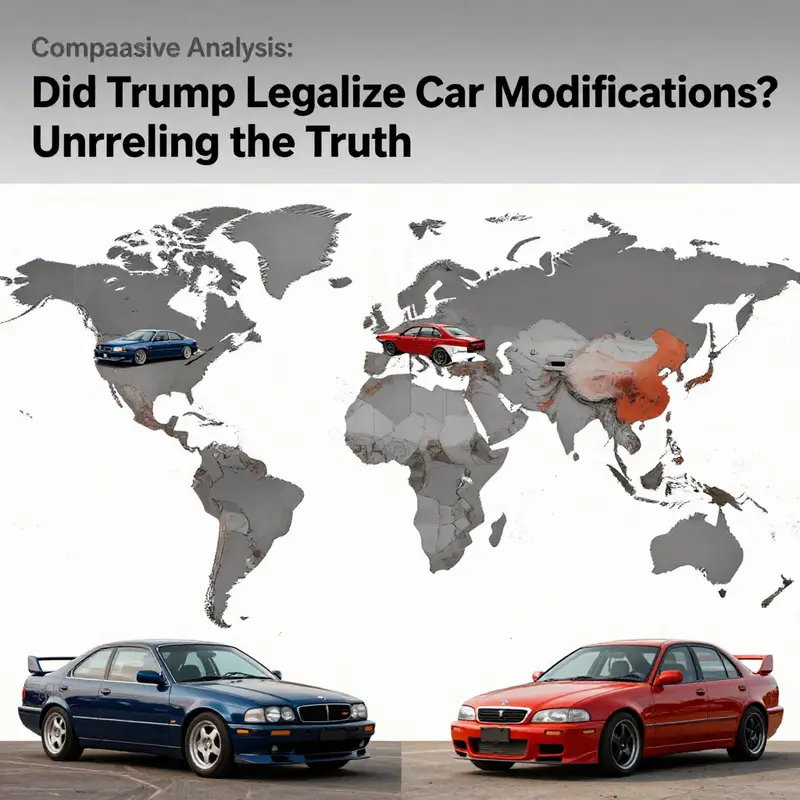
The question that threads through conversations about car culture and policy—did Trump legalize car modifications?—arrives wrapped in a chorus of bold claims and political theater. Yet a careful reading of the regulatory landscape shows a different tune. There was no executive order, no federal statute, and no nationwide shift that turned every aftermarket alteration into a blanket road-legal reality. What did happen, and what does happen across the world, is a collision of safety imperatives, local autonomy, and a growing appetite for personalization that regulators continually chase with varying degrees of stringency. Reading the record against the rhetoric reveals not a dramatic deregulation, but a complex system in which federal safety standards still hold sway, states interpret and implement those standards through their own rules, and global frameworks illustrate a spectrum of approaches to modification that range from permissive to tightly controlled. In that light, the United States’ framework remains stubbornly decentralized, even as global neighbors pursue more centralized, or at least more standardized, paths to road-legal modification.
At the core of the U.S. picture is the dual jurisdiction of federal safety governance and state-level implementation. The National Highway Traffic Safety Administration, or NHTSA, sets broad, nationwide safety standards for vehicles and equipment. These federal baselines are binding, and manufacturers and aftermarket components must meet them to be considered road-legal. But the patchwork part comes from state authorities, which apply their own rules to aftermarket parts, bodywork, and performance upgrades. California provides the most visible example of this dynamic. Through the California Air Resources Board, it enforces stringent emissions and air-quality standards that can tighten or even constrain modifications that would be permissible under federal rules. In other states, like Texas or Florida, the regulatory climate tends to be more permissive, as long as modifications comply with the overarching federal safety and emissions standards. The result is not a single national decree about what one can modify, but a mosaic of requirements that vary from one state to the next. When enthusiasts travel or move, they encounter this variability in practical terms: a modification that passes in one state might require additional verification in another, and a car that is perfectly compliant in its home jurisdiction could face extra scrutiny elsewhere. This decentralization undercuts the idea of a uniform, national permission slip for every aftermarket change and instead treats legality as a jurisdictional negotiation between federal baseline safety and state-level interpretation.
The global map of vehicle modification regulation presents a spectrum that not only informs us about American realities but also clarifies what “legal” means in other regulatory regimes. In Japan, for example, the regulation of modifications is handled by the Ministry of Land, Infrastructure, Transport and Tourism (MLIT). The Japanese framework allows extensive customization, but only within the boundaries of emissions and safety compliance, and with periodic inspections to verify continued conformity. Germany, by contrast, operates under the Straßenverkehrsordnung framework, where substantial modifications typically require official approval before a modified vehicle is deemed road-legal. The United Kingdom demonstrates yet another model, showing relatively flexible policies in certain circumstances, notably for classic vehicles, where registrations can accommodate recognized categories of modification. The underlying thread across these systems is not uniform libertarianism but a balance: enthusiasm for personalization is tempered by safety, environmental considerations, and the practicalities of road operations. The United States sits within this broader spectrum as a federation with a tradition of state experimentation and a federal framework that preserves safety standards while leaving room for local interpretation.
Public interest in car personalization has grown in tandem with social media and enthusiast networks. People want cars that reflect identity, performance goals, and the thrill of customization. This cultural demand creates pressure on regulators to acknowledge and channel innovation rather than suppress it wholesale. Yet regulatory reform, especially at the national level, does not proceed in a straight line from a political pledge to a blanket policy. Instead, it follows a process of safety validation, market feedback, and administrative alignment across scattered jurisdictions. The narrative that the Trump administration “liberalized” car modifications does not hold up under scrutiny of regulatory mechanisms. No executive order or federal law removed the core safety, emissions, and import standards that shape what modifications can be road-legal. The U.S. system remains a layered, often slow-moving process where the emphasis is on maintaining safe, compliant vehicles while allowing states to decide the degree of leniency or stringency in their own markets.
The year 2026 adds another layer to this discussion, signaling how global and domestic regulatory conversations are evolving. There were policy signals that one could misread as a drift toward deregulation, but the public record points to a direction of regulated growth rather than unbridled freedom. Reports from early 2026 describe the Chinese Ministry of Commerce outlining plans to establish a national standard system for vehicle modifications. This move exemplifies a trend toward structured oversight—an effort to harmonize safety and compliance within a centralized framework—rather than a blanket repeal of modification restrictions. Closer to home, the U.S. Department of Commerce has signaled a different call: building a formal framework for managing automotive modifications that emphasizes “positive and orderly development” instead of rapid deregulation. Taken together, these developments reveal a wider pattern in which regulators across the globe pursue control and predictability in a context of rising customization, rather than endorsing a free-for-all. Within the United States, this means more attention to how modifications are evaluated, documented, and verified rather than a wholesale relaxation of what can appear on a car’s chassis.
For individuals navigating this terrain, the practical takeaway remains straightforward yet nuanced. Car enthusiasts should pursue modifications with a strong understanding of both federal baseline safety and the specific requirements of their state. When contemplating significant changes—whether suspension, aerodynamics, lighting, or performance—owners should verify that their plans align with applicable rules and obtain any necessary approvals before driving on public roads. The risk of noncompliance, even for seemingly minor alterations, can involve fines, failed inspections, or insurance complications. In this context, a helpful reminder for readers is to consult credible resources and stay informed about evolving standards. An accessible starting point is the U.S. federal framework, which continues to shape what is permissible through safety and emissions obligations that transcend local preferences. Readers seeking practical guidance can explore the broader landscape through focused discussions on topics like how modifications influence insurance, resale value, and overall safety, all of which demonstrate why regulation matters beyond headlines. For a concise overview of the current U.S. stance, see the detailed discussion on legal car modifications in the US. legal car modifications in the US.
As this chapter threads together federal principles, state variations, and global counterparts, it becomes clear that the question is less about an epochal change and more about how societies negotiate the space between individual expression and collective safety. The Trump era is often read as a hinge in political storytelling, but the regulatory record does not point to a pivot of that magnitude in the realm of vehicle modifications. Instead, subsequent international and domestic policy dynamics show that the urge to customize remains potent, while the instruments to govern it—law, regulation, inspection, and enforcement—continue to evolve in a measured, often incremental way. In this sense, comparative analysis—assessing U.S. practice against Japan, Germany, and the UK—offers more illumination than sensational conclusions. It reveals that a modern approach to modification requires a framework capable of accommodating innovation without compromising highway safety or environmental commitments. The United States, with its decentralized model, still champions that balance by leveraging robust federal standards while granting states the latitude to design their own roads to fit local ecosystems.
Looking ahead, the regulatory conversation will likely hinge on how authorities harmonize the appetite for personalization with the imperative of consistent safety verification. The lesson is not that a leader’s rhetoric rewrites the law, but that ongoing governance must respond to a cultural demand for customization in a way that preserves roadworthiness and public trust. For scholars and readers tracking policy shifts, the essential record is clear: no nationwide legalization of car modifications occurred during the Trump years, and current developments—whether in the United States or abroad—underscore a future oriented toward structured growth and careful calibration. As the debate continues, the most reliable compass remains the careful alignment of individual modification goals with the enduring standards that keep roads safe for everyone. For further reading on the official safety framework governing modifications, the National Highway Traffic Safety Administration provides foundational resources and updates on standards and compliance. https://www.nhtsa.gov
From Deregulation to Deliberate Regulation: Mapping Car Modification Laws in the Post-Trump Era
When the question arises whether any president can or did “legalize” car modifications, the answer is rarely about a single executive order or policy shift. It is instead a reflection of how the regulatory baseline around vehicle alterations evolves over time. In the wake of the Trump years, the United States has entered a period where the core idea is not a blanket freedom to modify but a recalibrated balance—one that privileges safety, environmental accountability, and predictable markets while acknowledging that personalization of vehicles will continue to grow. The historical arc is not a straight line from deregulation to total deregulation; it is a reconsideration of what rules should govern modifications to engines, exhaust systems, emissions controls, and other components that directly influence performance, safety, and public health. The current consensus, supported by the available policy signals, is that no nationwide legalization of all car modifications has occurred. Instead, federal and state authorities are pursuing a more deliberate framework that can accommodate innovation without sacrificing essential safeguards. This nuance matters because it shapes how enthusiasts, manufacturers, insurers, and consumers plan for the road ahead and how they understand their rights and responsibilities within a regulated market.
A central thread in this evolving landscape is the return of robust federal oversight. Agencies such as the Environmental Protection Agency and the National Highway Traffic Safety Administration are repeatedly described in official channels as reclaiming or reaffirming authority over emissions and safety standards. Rather than a laissez-faire stance, the trend points toward a coordinated approach where aftermarket modifications are evaluated for their impact on air quality, fuel efficiency, and crashworthiness. The possibility of tighter emissions standards for future model years looms as a reference point in policy discussions, a reminder that the baseline of environmental accountability remains non-negotiable. In practice, this means modifications that alter how engines burn fuel or how exhaust systems release byproducts are subject to scrutiny and, when necessary, corrective action. The goal is not to stifle creativity but to ensure that any performance enhancements do not undermine public health or road safety. Such recalibration is consistent with a broader global pattern in which governments, large and small, seek a structured pathway for aftermarket changes rather than open-ended deregulation.
The sustainability dimension of this shift deserves careful attention. The modern automotive policy discourse increasingly foregrounds the climate imperative, lifecycle analysis, and the accountability of both manufacturers and aftermarket providers. In that frame, the permissibility of a modification is no longer judged solely on its legality in isolation; it is assessed in relation to a vehicle’s total environmental footprint, which includes tailpipe emissions, noise, and resource-intensive manufacturing or maintenance practices. This shift aligns with international climate goals and public health priorities, ensuring that changes to a vehicle’s performance do not translate into disproportionate harm to communities or ecosystems. For the aftermarket sector, this means a market that remains vibrant but moves toward clearer standards and standardized testing. The market can still reward ingenuity, but it must do so within a transparent regulatory ecosystem that makes expectations and consequences explicit.
Transparency and compliance are the practical corollaries of that ecosystem. As consumer demand for customized vehicles continues to rise, regulators are likely to emphasize clearer guidelines about what kinds of modifications are permissible, under what circumstances, and with what documentation or certification. The focus is less on punitive policing and more on predictable processes that reduce ambiguity for builders, buyers, and insurers. Engine and exhaust modifications, in particular, are categories where the potential for both safety risks and environmental impacts is highest. A well-ordered framework would, therefore, encourage legitimate improvements that meet established performance and emissions criteria, while curbing alterations that could compromise vehicle integrity or community health. The balance is delicate: it invites innovation while maintaining the incentives for any party aiming to bring a modified vehicle to market to do so with verifiable compliance. In this sense, consumer protection becomes a shared objective across agencies, manufacturers, repair shops, and modifier communities.
The practical implications of this direction extend to a broad spectrum of actors. Enthusiasts who pursue performance gains will need to stay informed about evolving rules, testing requirements, and potential certification processes. Shops and component makers will be guided by clearer standards for what is acceptable, how modifications must be documented, and how to demonstrate compliance to buyers and insurers. Insurers themselves face a more transparent environment in which risk is more accurately assessed when modifications are declared and validated. This transparency is not simply bureaucratic formality. It translates into consumer confidence, clearer resale value signals, and more predictable repair and maintenance costs. As a whole, the community of vehicle customization enters a period where creative expression can coexist with accountability, so long as the lines between legitimate enhancement and unlawful or unsafe alteration are well defined and consistently enforced.
The post-Trump regulatory mood also invites an expanded view of the global context. It is revealing that policy discussions across borders increasingly emphasize structured oversight rather than unconstrained experimentation. The Chinese Ministry of Commerce’s move to establish a national standard system for vehicle modifications signals a broader international trend toward harmonizing safety and compliance. While each jurisdiction operates within its own legal and market realities, the underlying logic resonates: a regulated path for modification that reduces uncertainty, protects public health, and prevents a race to the bottom in environmental performance. For the United States, this global perspective reinforces the shift toward a formal framework that can support positive and orderly development of the aftermarket sector while avoiding the pitfalls of unchecked deregulation. In this light, the future is not a simple reversion to the pre-regulatory era, but a recalibrated era defined by clearer expectations, better information, and stronger incentives for responsible innovation.
For stakeholders, the implications are both practical and strategic. Enthusiasts and hobbyists must navigate a landscape where knowledge of current standards and testing outcomes matters as much as the accessories they pick. Dealers and modification shops will need to adapt to reporting requirements, documentation practices, and compliance checks that make the most of legitimate customization opportunities. Policymakers face the challenge of balancing a thriving, personalized automotive culture with a coherent national strategy for emissions, safety, and consumer protection. The shared aim is a regulatory environment that reduces ambiguity, supports legitimate business models, and protects the public while allowing for the continued evolution of vehicle customization. It is a demanding but necessary undertaking when the promises of personalization and sustainable transport converge.
The story of post-Trump policy direction is not a tale of halted progress or stifled creativity but a careful recalibration. The federal government has signaled a return to authority in areas where consistency matters most—air quality, traffic safety, and verified compliance. At the same time, there is recognition that the aftermarket sector can contribute to performance and efficiency improvements when modifications are designed and verified within robust standards. This is not a paradox; it is a nuanced compromise that acknowledges the appetite for customization while insisting on accountability. For readers seeking a concise window into this evolving policy, the literature and official channels emphasize transparency, enforceable standards, and a collaborative approach to regulation that does not sacrifice innovation. The balance is precarious but achievable, and the path forward is marked by steady, evidence-based governance rather than sudden, sweeping transformations.
For those who want a practical entry point into understanding how these policy threads translate into daily life, a closer look at the resources aimed at clarifying what qualifies as legal car modifications in the US can be illuminating. This body of guidance helps bridge the gap between enthusiasm for personalization and the realities of compliance, ensuring that drivers and builders can pursue enhancements without unknowingly crossing regulatory lines. As the regulatory architecture continues to take shape, the central takeaway is this: modification laws are increasingly about clarity, safety, and accountability, rather than unbridled freedom. The era of ambiguous allowances is giving way to an environment where informed decisions are rewarded and risks are mitigated through standardized procedures and transparent reporting. For any reader who wants to explore the legal contours more deeply, the available guidance on the subject provides a useful starting point: legal car modifications in the US.
External resources continue to play a critical role in grounding this discussion in real-world practice. As policymakers, industry players, and consumers navigate the next phase of car modification governance, the most authoritative reference remains the federal framework governing emissions and safety. The ongoing dialogue around updating standards, implementing testing protocols, and harmonizing international practices underscores a shared objective: to foster a market that can innovate responsibly while protecting air quality, road safety, and public health. For readers who wish to consult the latest official guidance directly, the Environmental Protection Agency maintains a comprehensive repository of emission standards, compliance requirements, and enforcement actions related to vehicle modifications. Access to the official EPA portal provides the most current, authoritative information available on this topic: https://www.epa.gov.
Final thoughts
As we dissect whether Trump legalized car modifications, the reality is that no such sweeping legalization occurred during his administration. Instead, regulatory shifts indicated a structured approach to vehicle modifications, aligning with global trends focusing on safety and compliance. Enthusiasts and professionals should remain vigilant and informed about the evolving landscape of automotive laws to navigate this vibrant industry successfully. With ongoing tensions between regulation and passion, the future of car modifications will likely demand a balance that satisfies both compliance and creativity.