

Car modifications have become a fervent passion among enthusiasts, yet they often come with a hidden cost—their potential to diminish resale value. While they can enhance performance and visual appeal, it’s crucial to consider how these alterations impact a vehicle’s marketability. Chapter one unravels the notion of a narrower buyer pool and how unique modifications may deter traditional buyers. The second chapter dives into increased repair complexity, highlighting how aftermarket parts can lead to long-term maintenance costs that reduce a car’s attractiveness. Lastly, we explore the legal and safety implications of car modifications, illustrating how such issues can further diminish a vehicle’s value. Understanding these factors is essential for anyone passionate about car modifications, whether you’re an enthusiast, tuner, or shop owner.
A Narrower Audience, a Narrower Price: How Modifications Shrink Market Appeal and Car Value

Car ownership often blooms in the realm of possibility. A new set of wheels, a clean slate, the chance to shape a vehicle into something that feels personal. Yet when that personalization crosses from the driver’s preferences into a modification that remains on the car when it goes to market, the resale dynamic often shifts in ways that are less favorable for the seller. The idea that modifications automatically boost value is appealing, but the broader market reality tends to favor originality and predictability. The central tension is simple but powerful: modifications can make a vehicle look or perform more interesting to a narrow group of buyers while alienating the broad base of potential purchasers who would otherwise be willing to pay a premium for a stock, original car. In that sense, a car’s value in the resale market often tracks the size of its buyer pool as much as the condition of its parts. When a car is heavily customized, the number of people who see themselves in the purchasing position shrinks, and with fewer eyes on the car, the offers tend to be lower, on average, than they would be for a similar but unmodified vehicle.
This phenomenon begins at the most immediate level: taste. Modifications are a form of personal expression, and taste is inherently subjective. A sweeping, bold paint finish, a dramatically lowered stance, or a runway-ready body kit may be celebrated in certain circles. Those same choices, however, can be polarizing to the general public. A large fraction of potential buyers seeks a car that looks and feels like a stock model—reliable, familiar, and predictable. When a vehicle has a look that is not easily described as “factory,” it effectively narrows the circle of interested buyers. Even if the modification is high-quality and well installed, it communicates a set of preferences that not every buyer shares. The result is a smaller audience, and a smaller audience translates into a narrower range of acceptable offers. The basic math is intuitive: more buyers competing for a stock example usually means stronger demand and higher prices; when the pool is restricted, competition among the few buyers drives prices down.
Beyond aesthetics, the market’s perception of risk compounds the problem. Buyers in the resale market tend to be cautious about vehicles that carry a long and tangled modification history. Questions naturally arise: How was the car maintained after the change? Are the modifications compatible with the original drivetrain, electronics, and safety systems? Was the work performed by a skilled technician, or by a shop whose reputation is uncertain? Are aftermarket parts from reputable sources, or do they involve unproven components with unverified longevity? Each unanswered question adds a layer of risk for the next owner. In contrast, a stock car offers a clean, linear narrative: it has a known starting point, a documented maintenance history, and a predictable upgrade path if the buyer desires. The lack of ambiguity in an unmodified vehicle makes it easier for appraisers to assess condition, for insurers to quote premiums, and for lenders to evaluate a financing package. When modifications exist, this entire evaluative chain becomes more complex, and complexity is costly in the eyes of buyers who must weigh the effort and potential risk against any perceived benefits.
There is also a practical dimension to the buyer pool. A modified car can require specialized knowledge. If the buyer does not share the same enthusiasm for the modifications, they may fear future repair costs or the possibility that work done in a single shop cannot be reproduced elsewhere without losing the exact fit and finish. This is particularly true when non-original parts or bespoke components are involved. While aftermarket parts can offer improved performance or aesthetics, they can also wear differently or fail in ways that are unfamiliar to a prospective buyer who only intends to drive the car. In the hands of a shop with a sterling reputation, modifications might be a selling point for a certain buyer segment. In the larger market, however, the same modifications can elevate concerns about warranty coverage, service availability, and resale value downstream. The reassurance that comes with OEM parts and factory specifications simply does not apply as readily to heavily modified cars, and that reassurance matters when a buyer is weighing a purchase against other, stock alternatives.
Indeed, this dynamic is evident when the market views alignment with original equipment as a signal of long-term reliability. A stock car provides a clean platform for the new owner to chart its own future. If a buyer wants to revert to stock, the process is typically straightforward and predictable. Reversibility and flexibility are powerful assets in the resale market because they reduce the perceived risk of ownership. Conversely, when a car’s identity is anchored in modifications, the path to return to a familiar baseline may be costly, time-consuming, or even impractical. Reversing a complex modification kit, sorting out non-OEM parts, or restoring the original surfaces can require specialized technicians, original documentation, and potential downtime. For many buyers, the practical burden of returning to stock is a deterrent, a tacit price penalty that sellers must acknowledge in the form of lower offers.
Market data and qualitative observations alike underscore this pattern. In surveys of buyers who participate in used-car markets, those who place a high emphasis on reliability, warranty coverage, and predictable maintenance report more interest in unmodified vehicles. They also express a willingness to pay a premium for the clarity that comes with factory specifications and fully documented service histories. The same buyers are more likely to view a heavily modified vehicle as a “project” or as a niche purchase—something they can enjoy for a period, but not something they are eager to finance for the long term. Even when a modification is technically excellent, the narrative it creates around ownership—one of scarcity, customization, and specialized upkeep—tends to confine the car to a limited buyer segment. And in most cases, that segment is not large enough to support a higher resale price relative to a comparable stock car.
The exceptions to this pattern are real, but they are limited in scope and often hinge on specific market conditions. Minor cosmetic upgrades that are tasteful, reversible, and of high quality can blend into a car’s overall presentation without signaling a radical break from factory intent. For some buyers, these alterations can even be seen as value-enhancing because they reflect care and attention without eroding the car’s original identity. The key distinction is reversibility: if an upgrade can be removed or restored without impacting the underlying paint, bodywork, or structure, the risk of reducing resale value declines. A vinyl wrap, for example, is frequently cited as a reversible modification that can be undone to reveal the original surface. In the event that a new owner desires a stock appearance, the transition is straightforward and minimally disruptive to the car’s value. In such cases, the modification does not create an ongoing obligation to maintain an aftermarket environment, which broadens the pool of potential buyers and can preserve value better than permanent changes.
Another area where value can be preserved or even enhanced is in highly sought-after modifications that align with niche markets. Across the collector and enthusiast communities, there exist segments that prize certain purposeful alterations—unique factory option packages, rare configurations, or historically significant combinations that were once offered by manufacturers. When a modification matches a defined, enduring interest in a way that can be documented and verified, it can actually add resonance with a specific buyer. In those circumstances, the vehicle’s value trajectory may diverge from the norm. However, such scenarios are relatively rare and rely on tractable documentation, transparent provenance, and a buyer population that places a premium on the particular niche the modification inhabits.
These nuanced outcomes help explain why many dealers and appraisers advocate for strategic restraint when it comes to modifications. The immediate impulse to customize must be calibrated against the longer-term objective of value preservation. The broader market reward structure tends to favor cars that carry a clear, stable identity—cars that are easy to assess, easy to service, and easy to reintroduce into a future ownership chain without friction. When sellers understand that the goal is not to maximize the value of the car in the market today, but to maintain a robust and broad resale path over multiple ownership cycles, they tend to make choices that support higher liquidity and broader appeal. In practical terms, this can look like focusing on high-quality, reversible cosmetic updates rather than deep structural changes, and keeping careful records of all modifications to demonstrate quality control and care.
From a financial perspective, the narrowing of the buyer pool due to modifications translates into several concrete outcomes. First, it often reduces the sale price because fewer buyers are bidding, and the offers come from a different segment with different expectations. Second, the time on market for modified cars can be longer, as sellers must screen for buyers who share the same aesthetic or functional goals. Longer market times increase carrying costs, such as insurance, storage, and the opportunity cost of capital tied up in the vehicle. Third, the risk premium associated with modifications can manifest as higher negotiation leverage for buyers, who may demand sizeable concessions to compensate for perceived risk or to absorb anticipated maintenance costs. All of these factors combine to form a practical reality: most modifications, when viewed through the lens of resale value, tend to depress value or at least suppress upside potential, unless the modification aligns perfectly with a well-defined and sizable niche.
This overarching narrative does not imply that owners should never modify a car if their intent is personal satisfaction. It does suggest, however, that any modification intended to preserve or enhance resale value should be approached with a clear appreciation for how the market will likely perceive the change. The decision should be grounded in a careful assessment of the vehicle’s identity, the quality and provenance of the modifications, and the target buyer pool that the alterations will attract. For owners contemplating changes with resale in mind, the prudent course is to prioritize modifications that are high-quality, reversible, and well documented. These attributes help strike a balance between personal expression and marketability, allowing a car to remain alluring to enthusiasts while keeping its value accessible to a broad set of buyers in the long run.
To connect these ideas with a broader body of research, see the discussion around how consumer preferences shape resale value in modified vehicles. For a concise synthesis of market dynamics and resale considerations, you can refer to this detailed analysis: car-modifications-and-resale-value. This perspective emphasizes that while modifications can be a powerful expression of personality, they are typically best viewed through the lens of marketability and value preservation rather than straightforward value enhancement. The main takeaway is pragmatic: if the goal is long-term value, originality and clarity tend to trump personalization in the eyes of the majority of buyers.
Of course, the nuance cannot be overstated. The market for modified cars is real and active, and certain segments do exist where the right modification, executed with high standards, can command a premium. For example, intrinsic value can emerge when the modification is part of a historically significant or collector-oriented narrative, or when it forms part of a cohesive, well-documented package that appeals to a clearly defined buyer group. In such cases, the modification can coexist with strong resale channels. Still, these outcomes hinge on a convergence of factors: the modification must be desirable to a niche audience, the work must be professional and verifiable, and the car’s overall condition must remain excellent. Absent that convergence, the default market response remains cautious, with buyers erring on the side of stock condition and broad appeal.
In sum, the dominant pattern in the current resale landscape is clear: modifications, particularly those that alter the car’s look or core systems in ways that appear non-original, tend to narrow the buyer pool. This narrowing translates into slower sales and, more often than not, lower offers compared with equivalent unmodified vehicles. The practical implication for owners is straightforward: if maximizing long-term value is the aim, the safest strategy is to preserve the car’s factory essence whenever possible, or to implement changes that are clearly reversible, high quality, and thoroughly documented. The market rewards cars that offer a straightforward, well-supported ownership story—cars that future buyers can see themselves owning without a heavy upfront risk in time, money, or uncertainty.
External reference and further reading provide a broader context for these insights. For a thorough external analysis of how modifications influence resale value, see the detailed study at Autoblog: https://www.autoblog.com/2023/06/12/car-modifications-resale-value/. Readers seeking practical guidance on balancing modifications with resale considerations can also consult the linked internal resource that discusses how modifications intersect with resale value: car-modifications-and-resale-value.
Hidden Costs Under the Hood: How Modifications Drive Up Repair Bills and Lower Resale Value
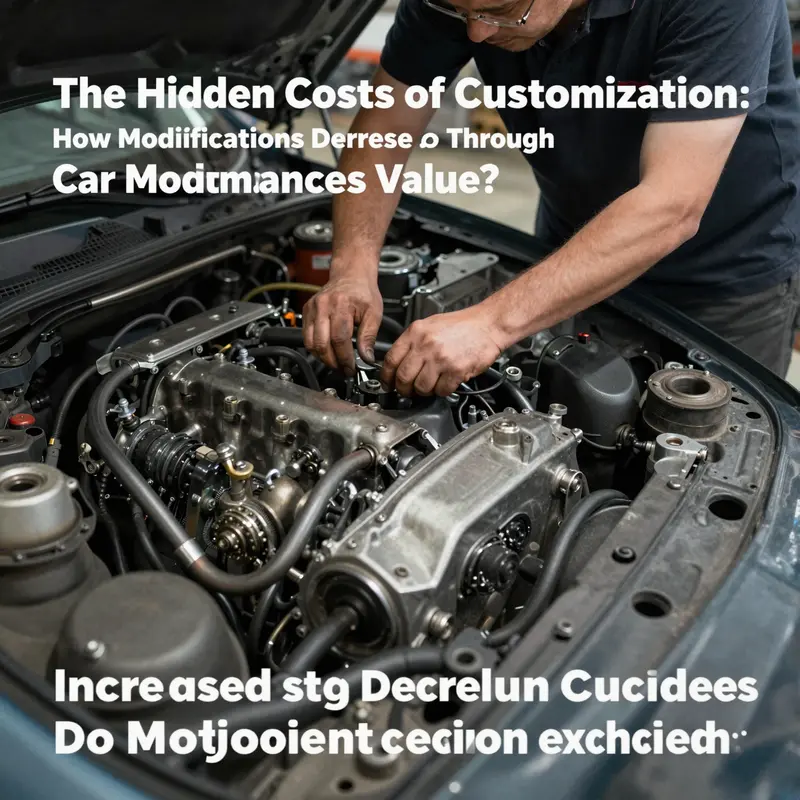
When a car leaves the factory its designers balance performance, reliability, safety, and serviceability. Every component, fastener, and electronic signal is part of a controlled system. Modifications—whether bolt-on accessories, performance upgrades, or visual overhauls—alter that balance. At first glance a mod might seem purely aesthetic or performance-driven. Over time, though, the changes compound. The result is a vehicle that costs more to maintain, is harder to repair, and becomes less attractive to buyers. That escalation in repair complexity and maintenance cost is one of the clearest ways modifications reduce a car’s resale value.
A factory vehicle is engineered to be serviced by a wide network of dealers and independent shops that know the platform. When a car is modified, that common baseline disappears. Aftermarket parts often require different tools, special procedures, or proprietary knowledge. An upgraded turbocharger, custom wiring for audio systems, or a lowered suspension with nonstandard geometry might look simple on the surface. In practice, routine tasks such as oil changes, brake jobs, or alignment checks can take longer and require diagnostic steps unfamiliar to general technicians. Extra labor time translates directly into higher bills for the next owner and a perception that the car will always be costly to keep.
Compatibility issues are common and costly. Many modifications are installed without a complete systems-level review. A performance intake and exhaust paired with an ECU tune can increase power, but it can also raise stress on the transmission, cooling system, or drivetrain components not designed for the new output. The wear pattern changes. Bearings, mounts, and seals that held up under factory settings now fail sooner. A car that appears well cared for may hide accelerated wear caused by earlier upgrades. Prospective buyers pay attention to the likelihood of near-term repairs. If that likelihood rises, the price buyers are willing to pay falls.
Warranties play a central role in ownership economics. Manufacturer warranties reduce uncertainty and financial exposure for owners and buyers. Many aftermarket modifications void parts or entire vehicle warranties. Once warranty coverage is lost, every repair becomes an out-of-pocket expense rather than something covered by the manufacturer. Even if only a specific component is affected, repair shops and insurers frequently treat the whole car as a higher risk. This change in perceived and actual risk reduces market value because buyers factor future repair costs into their offers.
Specialized parts are another factor. A custom exhaust, nonstandard suspension kit, or hand-built bodywork often requires replacement parts that are not easily sourced. When a damaged car needs repair, replacement components may need to be ordered from niche suppliers, fabricated, or matched to bespoke install methods. This increases repair lead time and cost. For older vehicles, finding compatible aftermarket parts may become impossible; the result is either expensive custom work or a downgraded restoration back to stock. Buyers dislike that uncertainty and the potential for long downtime.
Insurance companies also react to modifications. Insurers assess risk, and altered cars often present unknowns. Boosted engines, altered brakes, or raised horsepower change collision dynamics and repair costs. Some insurers will increase premiums, impose strict exclusions, or refuse coverage for modified vehicles. Others require explicit declaration of all changes and charge endorsements. Higher insurance costs reduce a car’s running affordability and thus its marketability. A buyer comparing two similar cars will prefer the one with a predictable insurance profile and intact warranty coverage.
Accident repair becomes more fraught after modifications. Bodywork that includes nonstandard panels, widened arches, or unique paint makes matching factory finishes difficult and expensive. Structural modifications, even modest ones, can complicate frame alignment and safety system calibration. Modern vehicles rely on calibrated sensors and cameras; aftermarket changes to suspension height or bumper geometry can disrupt calibration. Repair facilities may need manufacturer-level diagnostic tools or specialized recalibration equipment to restore the car to safe operating condition. If the vehicle’s safety systems cannot be restored with full confidence, buyers will discount the price or avoid the car altogether.
Beyond the direct cost increases, modifications create information gaps. A well-known problem in any used market is asymmetric information: sellers know the full history; buyers do not. Modifications widen that knowledge gap. A buyer cannot easily verify the quality of the installation, whether the work introduced hidden faults, or if supporting systems have been stressed. Even when modifications are reversible, the history of alteration remains. Appraisers and potential buyers treat modifications as a risk factor, and risk equals discount. The unknowns increase the cost of capital for the buyer and reduce the numeric value they assign to the vehicle.
The market for modified cars is narrower. Enthusiasts may pay a premium for certain changes, but most buyers prefer reliable, predictable cars. A unique car is harder to price and harder to sell quickly. Sellers who need a timely transaction are often forced to accept lower offers. That pressure directly reduces realized resale values. Moreover, shops that specialize in high-performance or custom work frequently carry higher hourly rates than general service centers. If a prospective buyer calculates future maintenance at those specialist rates, the purchase calculus shifts toward a lower offer.
There are also legal and compliance costs that affect repair complexity. In many jurisdictions, modifications must meet regulatory standards for emissions, noise, and safety. If a past owner installed noncompliant parts, a subsequent owner may face fines, mandatory repairs, or difficulty registering the car. Correcting these issues after the fact often requires reverting to stock components or investing in compliance equipment and testing. That added cost reduces the valuation a prudent buyer will accept.
Not all modifications are equal, and the market recognizes that. Minor cosmetic upgrades, high-quality tires, or tasteful interior improvements can be neutral or slightly positive influences on value. However, modifications that alter core mechanical systems or safety features are where repair complexity—and value erosion—becomes acute. For the average buyer, the likelihood and scale of future repairs matter more than a particular performance gain that appealed to the previous owner.
The repair record of a modified car matters more than for a stock vehicle. Comprehensive documentation showing professional installations, receipts, and service history can mitigate buyer concerns. A well-documented modification performed by a reputable shop reduces perceived risk because it signals competence and care. Even so, many buyers discount the value because of the additional labor and parts costs they expect in the future. The presence of documentation rarely fully offsets the higher baseline cost of maintenance and repair.
Reversibility affects value too. Mods that can be removed without damage—such as a vinyl wrap, bolt-on cosmetic parts, or easily detachable electronics—tend to harm value less. Reversible changes give buyers the option to restore the car to factory condition. But reversible does not always mean cost-free. Removing a wrap may reveal paint imperfections, and aftermarket wiring can leave traces that require correction. Still, reversible mods keep open the possibility of returning to stock, which softens the discount buyers apply.
The cumulative effect of these repair-related factors is measurable in the market. Adjusted values for modified cars typically show steeper depreciation curves compared with stock equivalents. Dealers and private buyers apply markdowns to compensate for unknowns, specialized maintenance, and potential legal headaches. For sellers, this means that the money spent on many types of modifications is rarely recovered. Enthusiasts who modify primarily for personal enjoyment should understand that the financial return on most modifications is negative once repair complexity and resale reality are considered.
Knowing this, owners who plan to sell can take steps to limit value loss. Keeping detailed records of all modifications and professional installations reduces uncertainty. Choosing reversible modifications when possible preserves the option of returning to stock before sale. Selecting high-quality parts from reputable suppliers minimizes premature failures. Finally, evaluating modifications against likely buyer preferences in your market helps avoid niche choices that reduce the buyer pool.
The relationship between repair complexity and value is not abstract; it is practical. A car that requires unique tools, specialized technicians, or is likely to need earlier-than-expected repairs will sell for less. Buyers price in the future costs they expect to bear. Modifications increase those expectations. Whether motivated by performance or personalization, alterations that change how a car is serviced or repaired create a lasting economic ripple that depresses resale value.
For readers who want a deeper look at how modifications affect used car sales and buyer perceptions, industry analyses explore these dynamics and offer real-world examples. One useful examination of why modified cars are harder to sell highlights how increased repair complexity and maintenance costs deter buyers and lower prices. (External source: https://www.autocar.co.uk/car-review/used-car-advice/why-modified-cars-are-harder-to-sell)
For guidance on how modifications tie directly to resale outcomes and what to consider before altering a daily driver, consult our detailed coverage on modifications and resale value. That resource walks through which changes are least damaging and how to document work to retain as much value as possible: https://modifiyeliarabalar.net/blog/car-modifications-and-resale-value/
In short, modifications reshape a car’s future expenses. They increase repair complexity, shorten component life in some cases, and create uncertainty for future owners. These effects combine to reduce market demand and lower resale prices. Owners who budget for long-term maintenance and keep changes reversible and well-documented can reduce the impact, but the baseline truth remains: most modifications increase the car’s cost to own and therefore decrease its value in the used-car marketplace.
null

null
Final thoughts
The intricate world of car modifications comes with its fair share of dilemmas. While they offer enhanced performance and unique aesthetics, the risks to resale value shouldn’t be underestimated. A narrower buyer pool, increased repair complexities, and looming legal issues often overshadow the genuine enjoyment derived from these customizations. For hobbyists and professionals alike, understanding these factors is paramount to making informed decisions that balance personal expression with long-term value retention. In the end, striking the right chord between custom flair and market viability may just be the secret to maximizing not only your driving experience but also ensuring your investment holds its worth.