
Car modification is a passion for many, be it hobbyist modifiers, professional tuners, or classic car enthusiasts. In India, the landscape of car modification is shaped by legal regulations that must be navigated carefully. While minor enhancements like changing alloy wheels or adding body kits are feasible, significant changes may lead to legal pitfalls if not approached correctly. This guide delves into the intricacies of car modifications in India, exploring the legal frameworks, permissible modifications, consequences of illegal changes, the approval process for major modifications, and the overall impact modifications can have on vehicle safety and compliance.
Navigating India’s Legal Framework for Car Modifications: Safety, Emissions, and Compliance in a Changing Landscape
On India’s busy roads, the urge to tailor a car to personal taste or practical needs runs alongside the obligation to keep every vehicle within the bounds of safety and environmental rules. The question is not simply whether modification is allowed, but how far a driver can go before the law starts asking questions. The backbone of this landscape is the Motor Vehicles Act of 1988, sharpened over the years by amendments and the Central Motor Vehicle Rules that together outline what counts as a legitimate alteration and what does not. This framework is not a static checklist but a living set of principles designed to balance individual freedom with public safety, traffic efficiency, and air quality. In practical terms, it means that some changes are welcomed as sensible upgrades while others trigger a formal process of approval, testing, and verification. The result is a complex but navigable environment for those who approach modifications with a clear understanding of the regulations and a commitment to compliance. For those entering this space, the key is to distinguish between tweaks that merely personalize a vehicle and changes that alter performance, safety margins, or emissions. The difference can be subtle, yet it has immediate legal consequences and, more importantly, direct implications for safety and longevity on the road. As with many regulatory regimes, the intent is not to stifle creativity but to preserve roadworthiness and environmental standards while allowing space for innovation within a controlled framework. The overarching message is simple: modifications are permissible when they respect safety, do not undermine emissions norms, and are properly documented and approved where required. When this principle is kept in view, the process of modifying a car in India becomes a disciplined practice rather than a risk-laden gamble. For a concise overview of what counts as legal in India, see car modification legal India.
Indian authorities have consistently underscored that any change affecting a vehicle’s structure, performance, or emission profile must be scrutinized for safety and environmental impact. In practice, this translates into a spectrum of allowable modifications: a new set of alloy wheels, upgraded audio systems, or cosmetic body kits may be permissible within certain limits, while substantial changes—especially those altering the engine, exhaust configuration, or crucial safety components—usually require prior authorization from the regional transport office, commonly known as the RTO. The distinction between minor and major modifications is not arbitrary. It rests on measurable criteria such as whether a change alters weight distribution, braking performance, chassis integrity, or the ability to meet Bharat Stage emission standards. The philosophy behind these rules is straightforward: any modification that could impair road safety or degrade air quality is subject to closer review and, when necessary, formal permission. This is why the legal process often begins with a consultation under the Central Motor Vehicle Rules, continues through an assessment by the relevant authorities, and ends with registration updates or a certificate of compliance when a modification is approved. The practical implication for car owners is clear: before you bolt on that turbo kit, or before you lift the suspension to a height that would alter geometry and handling, pause to consider the regulatory pathway and the potential consequences of proceeding without authorization. The law is not an obstacle to personal expression alone; it is a mechanism to ensure that any change does not introduce new risks into the traffic stream or create broader environmental concerns. The regulatory intent is further reinforced by the ongoing emphasis on emission standards. India has embraced stringent norms, most notably the BS-VI framework, applying across the country with uniform expectations for emission control and fuel efficiency. Any attempt to bypass or weaken these standards by altering engines or exhaust configurations is not just a regulatory violation; it undermines the environmental protections that the system seeks to uphold. Thus, even when a modification is technically feasible, it must align with established emission norms. The law does not bar ambition; it channels it toward changes that can be validated and monitored in a way that preserves air quality while allowing reasonable customization. The enforcement philosophy reflects this balance. Across states, enforcement practices vary in intensity and focus, yet the core requirement remains the same: modifications must be traceable, justifiable, and demonstrably safe. A robust documentation trail is not an optional add-on but a core component of the modification process. Documentation ensures accountability, facilitates future inspections, and supports the long-term reliability of the vehicle on Indian roads. In this sense, the modification journey resembles compliance with a regulatory contract between the car owner, the manufacturer, and the state authorities. It is a contract that requires transparency about intent, detail about the modifications, and evidence that the altered vehicle will continue to meet safety and environmental standards. Those who embark on this journey should prepare to engage with the RTO or authorized modification centers in a formal dialogue, presenting technical specifications, safety validations, and, where required, manufacturer certifications that validate the safety and compliance of the proposed changes. The emphasis on a formal process is not merely bureaucratic. It is a practical shield against unsafe deployments of performance parts or unverified structural changes that could compromise crash-worthiness or alter braking and steering dynamics. For instance, while a larger wheel may improve grip and aesthetics, it also changes rolling radius and suspension geometry, potentially impacting braking distances and stability. If such a modification is pursued, it must be accompanied by the appropriate approvals and, often, a re-certification of the vehicle’s compliance with CMVR and other relevant standards. The same scrutiny extends to changes in noise levels and exhaust configurations. Loud exhausts or modifications that elevate noise beyond statutory limits are not only an annoyance to others on the road; they can be indicators of non-compliance with emission and safety norms. The regulatory framework therefore frames modifications as a spectrum of risk, with safety and environmental considerations at the core. Those who understand this spectrum approach modification with a mindset of gradual, documented change rather than impulsive, high-risk alterations. The practical advice that follows emerges from this recognition. First, consult the RTO or an authorized vehicle modification center before any significant change. This step is crucial to validate what is permissible and to obtain the clearances or certifications needed to register the modified vehicle. Second, maintain comprehensive records. Documentation should capture technical specifications, testing results, certifications, and any correspondence with the authorities. Such a dossier can prove invaluable during follow-up inspections or future sales, offering proof of compliance and a transparent modification history. Third, recognize that not all modifications are created equal in the eyes of the law. Minor enhancements that do not affect emissions or structural integrity are typically treated more leniently, but even these options require alignment with safety standards and regulatory expectations. Fourth, understand that state-level variations exist. The law provides a national framework, but enforcement and administrative practices can differ across states. When in doubt, rely on the local authority’s guidance, and ensure that the modification plan can withstand scrutiny wherever the vehicle travels. The modern regulatory journey also invites contemplation of the future. As technology evolves—electric propulsion, advanced driver assistance systems, and new materials—the legal framework is likely to adapt. Regulators will be tasked with designing pathways that accommodate innovation without compromising safety or the hard-won gains in emissions reduction. This evolution will demand ongoing dialogue among manufacturers, policymakers, and the driving public, ensuring that new capabilities can be integrated into vehicles in a controlled, auditable manner. The end goal remains constant: a road network where innovation and safety reinforce one another, where drivers enjoy the benefits of customization without compromising the safety of others or the health of the environment. While the possibility of modification in India is real and varied, it is inseparable from responsibility—an obligation to prove that any change is safe, compliant, and verifiable. In navigating this landscape, car owners can take confidence from the fact that the rule of law does not seek to prohibit individuality; it seeks to preserve the shared trust that underpins modern mobility. The path is clear if approached with informed planning, professional guidance, and a respect for the regulatory framework that binds every vehicle to the public road. For readers seeking deeper regulatory specifics, official standards and rules are published by the central authorities and are periodically updated to reflect technological progress and environmental priorities. As you plan thoughtful, compliant modifications, keep in mind that the law rewards preparation and transparency while offering room for technical ingenuity within that framework. The journey is not a fixed destination but a continuous process of alignment between personal preference and public safety. In this sense, modified cars can coexist with safe roads and clean air when every change is entered into a documented and authorized process. For those who want a concrete starting point, a careful review of the official regulations and a professional consultation can make the difference between a creative upgrade and a regulatory setback. As the field progresses, the interplay between user aspiration and policy will shape both what is possible and what is prudent. In a landscape where technology moves quickly and safety remains non-negotiable, the responsible modification path offers both opportunity and assurance, enabling enthusiasts to personalize their vehicles without compromising the standards that protect everyone on India’s roads. This is the core premise of the legal framework that governs car modifications in India, and understanding it thoroughly is the first step toward making modifications that endure.
External resource for deeper context on regulatory standards can be found at the official government site of the Ministry of Road Transport and Highways: MoRTH official site.
What You Can and Cannot Change: A Practical Guide to Allowed Car Modifications in India
Understanding which car modifications are permitted in India requires balancing personal preference with legal and safety responsibilities. The Motor Vehicles Act and guidelines from the Ministry of Road Transport and Highways (MoRTH) set the frame: minor aesthetic and comfort upgrades are generally acceptable, but any change that affects emissions, structural integrity, or vehicle identification demands formal approval. This chapter walks through the kinds of changes most vehicle owners consider, explains the limits and conditions that apply, and highlights practical steps to stay compliant while customizing your car.
Interior upgrades are the simplest and safest way to personalize a vehicle, and most of them are allowed without complex approvals. Replacing seat covers, adding premium floor mats, fitting steering wheel covers, and installing non-intrusive rearview enhancements are typical examples. These modifications improve comfort and protect factory fittings. The key rule is that they must not interfere with critical systems: seat covers and steering wheel wraps must never block airbags or obstruct drivers’ controls, and floor mats should be non-slip and securely anchored to prevent pedal entrapment. When selecting fabrics and designs, prioritize breathability and fire-resistant materials given India’s climate and road use.
Exterior cosmetic changes carry more caveats. Simple repainting or vinyl wraps for personalization are allowed, but a color change that might confuse authorities—such as colors reserved for emergency vehicles—requires registration updates. If you choose a new paint or wrap color, be ready to report it to your local RTO and update your vehicle documents where required. Small body kits, trims, and spoilers that preserve the vehicle’s original dimensions and structural integrity are usually tolerated. However, adding pronounced aerodynamic components, cutting or welding to the chassis, or altering load-bearing sections moves a modification from cosmetic to structural and triggers inspection and approval processes.
Window tinting is another area with clear numeric limits. India enforces Visible Light Transmission (VLT) norms: front and side windows generally must allow at least 50% light, while rear windows and the rear windshield have slightly lower thresholds in many states. Overly dark tints are frequently cited during traffic stops and can lead to fines and the requirement to remove the film. If privacy is your objective, choose films that comply with legal VLT ratings and are certified by recognized testing authorities. Keep a copy of the certificate in the car to ease checks.
Performance and mechanical modifications are the most heavily regulated category. Owners frequently ask about engine tuning, turbo or supercharger installation, and aftermarket performance chips. These changes almost always demand certification from recognized agencies such as the Automotive Research Association of India (ARAI) and prior approval from MoRTH. The reason is straightforward: altering engine behavior can change emissions, affect braking and handling balance, and render the vehicle non-compliant with pollution-control laws. Unapproved modifications in this realm may void insurance coverage and attract heavy penalties. Equally sensitive are modifications to the exhaust system; louder, non-compliant silencers violate noise standards and can lead to seizure or fines.
Suspension changes, including lowering or lifting the vehicle, sit between aesthetics and safety. Minor adjustable suspension tweaks that retain adequate ground clearance and do not compromise steering geometry are typically permissible. But drastic lifts or reductions in ride height can alter center of gravity, handling characteristics, and crash performance. Such changes need to remain within limits set by RTO inspections and may require a fitness certificate. If you plan to fit heavier wheels or tires, ensure the axles, brakes, and wheel well clearances are compatible; oversized tires that rub bodywork or compromise steering must be avoided.
Some modifications are explicitly encouraged because they improve safety. The legal framework permits and supports the installation of certified safety devices such as child safety seats, parking sensors, rear cameras, and ADAS features, provided they meet ISI or ARAI standards. These systems can reduce accident risk and, when installed professionally, integrate safely with existing electronics. Anti-theft devices like GPS trackers and immobilizers are also allowed and can be valuable for security and recovery.
Administrative obligations are a vital part of responsible modification. Any alteration that changes the vehicle’s declared specifications must be reported to the RTO. This includes changes in engine capacity, body type, color, seating capacity, or any structural modification. The standard administrative path often involves filing an application for a modification certificate—commonly Form 34 or its state-specific equivalent—followed by a physical inspection and fee payment. Failing to follow this process can lead to penalties, insurance denial, or problems when selling the vehicle. For guidance on declaring changes to your insurer and maintaining coverage, consult resources that explain how modification declaration affects policy terms. For example, see this guide on declaring car modifications for insurance purposes: declare car modifications.
Practical compliance starts with planning and professional advice. Before undertaking any notable change—especially those touching engine, exhaust, suspension, or body structure—consult a qualified workshop familiar with RTO procedures. Seek parts and components that come with certification or clear manufacturer specifications. Keep invoices, certificates of conformity, and installation receipts; these documents are crucial if the vehicle undergoes a fitness test, pollution under control (PUC) check, or verification during a sale. Professional installation minimizes the risk of faulty workmanship that could compromise safety and attract regulatory scrutiny.
There are also financial and legal side effects to consider. Modifying a financed car or a leased vehicle may require lender or lessor permission. Changes without consent can breach loan terms or lease agreements and may expose you to penalties. Additionally, many insurers require notification of specific modifications; failure to declare can void claims after an accident. When evaluating cost-benefit trade-offs, weigh the desirability of a mod against potential resale implications: some modifications enhance resale appeal, while others may reduce it or complicate transfer formalities.
Finally, remember why these restrictions exist. Vehicle standards, emissions norms, and safety rules safeguard everyone on the road. Even well-intentioned customizations can unintentionally increase risk if they alter crash performance, visibility, or emission control systems. Staying within legal limits preserves your mobility, keeps insurance valid, and protects you from penalties that can be costly and disruptive.
For authoritative details and updates to vehicle modification rules, consult the Ministry of Road Transport and Highways. Official guidance and the procedural framework for reporting and certifying modifications are available on the MoRTH website: https://morth.nic.in/.
When Modifications Cross the Line: Legal, Safety, and Financial Consequences in India
When upgrades become liabilities
Many car owners in India see modification as a way to personalize or boost performance. Some changes are harmless and legal. Others cross regulatory, safety, or insurance lines. Understanding the consequences of illegal or unapproved modifications keeps you compliant and safe. It also protects your finances and freedom.
Tampering with a vehicle’s engine, chassis, emission controls, or structure may violate the Motor Vehicles Act, 1988, and state RTO rules. Penalties vary, but they are concrete. For routine traffic enforcement, police can issue fines for illegal visible changes such as excessively loud exhausts, non-standard lights, or tinted glass beyond legal limits. These fines are immediate and payable on the spot in many cases. More serious breaches invite heavier penalties: vehicle seizure, notice to remove modifications, and prosecution that can lead to larger fines or court appearances. If a modification is linked to evasion of taxes, registration fraud, or other criminal intent, authorities may pursue criminal charges. That escalates legal exposure and can lead to long-term consequences.
Beyond formal penalties, enforcement has practical, everyday effects. An impounded vehicle disrupts work and family life. Time spent fighting a notice at the RTO can be long and stressful. Even a small unauthorized change may require a formal re-certification or reversal to restore legality. That process often involves certified workshops, parts replacement, and RTO inspections — all costing time and money.
Safety risks are immediate and sometimes catastrophic. Modifications that change power output, alter cooling, or bypass emission systems often skip engineering validation. A forced induction add-on, for example, raises stress on engine internals. Without supporting upgrades to fuel delivery, cooling, and engine mapping, the result can be overheating, oil starvation, or sudden failure on the road. Exhaust changes meant solely for sound can impair backpressure and catalytic converter function, increasing pollution and reducing engine longevity. Brake, suspension, and wheel alterations also carry acute hazards. Increasing wheel size without recalibrating suspension geometry or brakes alters handling and braking distance. Lowering or raising ride height without correct spring and damper tuning can make the vehicle unstable at speed.
Structural modifications are no less dangerous. Cutting or welding body panels, or altering the chassis, can compromise crash structures designed to absorb energy. A modified roll cage installed incorrectly can itself become a hazard, concentrating impact forces rather than distributing them safely. Even seemingly cosmetic changes, when poorly executed, may impair pedestrian safety features or disrupt airbag sensors. In short, illegal modifications often trade certified safety for an unverified sense of performance or aesthetics.
Insurance implications compound legal and safety problems. Most insurers require disclosure of material changes to a vehicle. An unapproved modification that contributes to an accident or increases risk often voids policy coverage. That leaves owners liable for all repair costs, third-party claims, medical expenses, and potential legal suits. Insurers may also refuse to renew a policy if modifications are discovered during routine checks or claims processing. To understand the nuances and required disclosures, consult resources on insurance for modified cars. This clarification helps owners decide what to declare and what approvals to seek.
Resale value and marketability suffer too. A modified vehicle that does not comply with regulations is a harder sell. Buyers worry about legal risks, insurance complications, and future inspections. Even when changes are technically reversible, the uncertainty reduces the pool of potential buyers and drives prices down. Certified installations, documented approvals, and receipts mitigate this effect. But undocumented or amateur changes tend to signal risk and invite steep discounts at resale.
There is also a community and reputational cost. Driving a vehicle with visibly illegal modifications attracts attention from law enforcement and the public. Repeated infractions can place a vehicle on local enforcement radars. For businesses that rely on a fleet, unauthorized changes can disrupt operations and damage professional reputation. For private owners, fines and repeated notices create stress and potentially long-term records that complicate future registrations or transfers.
Practical enforcement mechanisms in India are evolving. Regular fitness and Pollution Under Control (PUC) checks aim to detect emission tampering. Traffic police and RTO inspectors check for compliance with lighting, glass tint, and noise norms. In some states, specialized squads target illegally modified vehicles at public events or hotspots. Technology has improved detection, but the primary remedy remains procedural: notice, order to rectify, and fines. For persistent non-compliance, seizure and prosecution are options.
If you find your vehicle cited for illegal modifications, a pragmatic approach reduces harm. First, understand the specific breach and the legal basis cited. RTO notices typically reference the relevant section of the Motor Vehicles Act or state rules. Second, engage a reputable, authorized workshop or service center. Certified technicians can assess whether the change can be reversed or certified with additional work. Third, gather documentation: invoices, installation certificates, and any prior approvals. Fourth, seek official approval if the modification can be made compliant. Some changes may be regularized through testing, certification, and updating registration documents, although the process varies by state and modification type.
Preventive steps are simpler and less costly than remediation. Before altering a vehicle, check RTO rules and MoRTH guidelines. Confirm whether the change requires prior approval. If in doubt, seek written clarification from the RTO. Use licensed workshops and insist on documentation for any installation. Keep receipts and technical specifications. Notify your insurer before making material changes and obtain written confirmation on whether the policy covers the modification and at what premium.
There are lawful pathways for many desirable upgrades. Manufacturers and approved aftermarket vendors offer certified parts that meet Indian standards. Some performance enhancements are permissible if installed and certified correctly. Even cosmetic personalization, like body kits and alloys, may be legal when they meet dimensional, lighting, and safety requirements. Documentation is the key: certification from recognized testing bodies, installation reports from authorized centers, and RTO approval where required.
Ultimately, the consequences of illegal car modifications in India are layered and avoidable. Legal fines, seizure, and prosecution are immediate risks. Safety hazards may cause injury or worse. Insurance voids and lowered resale value create enduring financial damage. Yet, with informed choices, certified installations, and timely approvals, most legitimate personalization goals remain achievable without stepping into illegality. For authoritative guidance on vehicle standards and regulatory procedures, consult the Ministry of Road Transport and Highways website: https://www.morth.gov.in
For a focused discussion on insurance and how modifications affect your policy, see this detailed guide on insurance for modified cars: https://modifiyeliarabalar.net/blog/insurance-for-modified-cars/.
Navigating the Rigorous Approval Pathway for Major Car Modifications in India
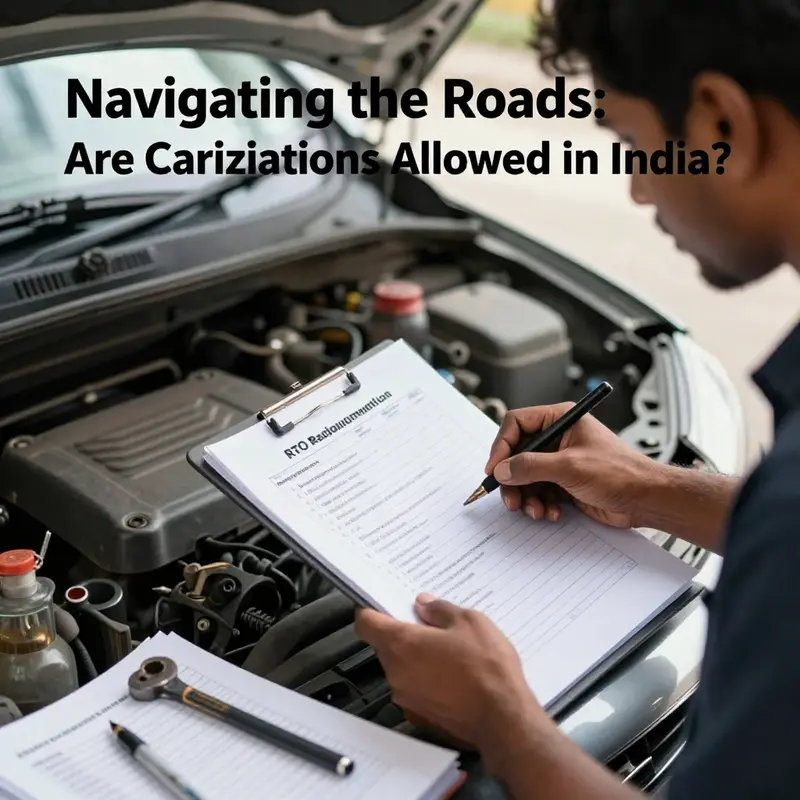
Navigating the Rigorous Approval Pathway for Major Car Modifications in India
Engaging in major car modifications in India is far more intricate than simple cosmetic changes. While minor adjustments like swapping wheels or upgrading a car audio system generally fall under permissible limits, any substantial alterations—especially those impacting safety, emissions, or structural integrity—must undergo a stringent approval process. This regulatory framework is primarily enforced through the provisions of the Motor Vehicles Act, 1988, and operationalized by regional authorities such as the Regional Transport Offices (RTOs) and, on a national level, by the Automotive Research Association of India (ARAI).
When a vehicle manufacturer or importer intends to introduce or modify a vehicle model significantly, the process does not simply revolve around adhering to arbitrary standards; it is a comprehensive, technically detailed, and multilayered evaluation designed to uphold road safety, environmental norms, and consumer confidence across India’s automotive landscape. This chapter unravels the detailed pathway to obtaining official approval for major vehicle modifications or new vehicle type approvals, emphasizing the critical role played by ARAI.
The journey begins with the submission of a formal application for Type Approval to the Automotive Research Association of India. This is not a mere paperwork formality but demands a thorough compilation of technical documentation. The applicant must prepare an exhaustive dossier containing detailed product specifications displaying how the vehicle or component is engineered, supported by precise engineering drawings and design schematics. Every material used in construction is itemized in a Bill of Materials (BOM), alongside comprehensive risk analysis reports that demonstrate the safety considerations embedded in the design. Furthermore, proof of adherence to internationally recognized quality management standards, such as ISO 9001 or IATF 16949, must accompany the application to affirm a robust manufacturing process and organizational capability.
Upon receipt, ARAI delegates sample vehicles or components to approved laboratories for rigorous and multidimensional testing. These tests are not limited to one aspect but collectively ensure the vehicle’s conformity with all Indian regulatory demands. Safety tests cover critical operational systems including braking efficiency, crashworthiness under simulated collision scenarios, the performance of restraining devices like seat belts, and airbag deployment mechanisms. To meet these benchmarks is essential not just for compliance but for genuinely safeguarding occupants.
In unison with safety, emission tests verify conformity with Bharat Stage VI (BS-VI) emission norms, which are equivalent to Europe’s Euro 6 standards. The vehicle’s engine and exhaust systems must meet strict limits on pollutants, regardless of modifications. Any alteration that elevates emissions beyond these legal thresholds will result in rejection or demands for reengineering. This aspect underscores the government’s commitment to battling air pollution and its support of sustainable automotive innovations.
Equally important are noise tests, which assess the vehicle for both external noise pollution and horn sound levels. These parameters safeguard public health and urban tranquility by controlling loudness, especially when modifications affect exhaust or audio systems. For electric vehicles undergoing modification, specialized tests evaluate battery safety, including resistance to thermal runaway, vibration tolerance, and event simulations such as drop tests. These are complemented by measuring the Ingress Protection (IP) rating to confirm adequate resistance to water and dust intrusion, critical for ensuring reliability.
Once technical testing is complete, ARAI proceeds with a factory audit known as Conformity of Production (COP). This phase is vital to guarantee that the vehicle or components at scale match the approved prototype. Inspectors audit manufacturing lines, quality control processes, and procedural adherence. This assures regulators and consumers that every unit produced is consistent with the certified standard and no deviation compromises safety or compliance after approval has been granted.
Following successful test results and factory audits, ARAI conducts a thorough final technical evaluation. On passing, the organization issues a Type Approval Certificate (TAC) which officially sanctions the manufacture, sale, and registration of the modified vehicle or component in India. The TAC symbolizes governmental endorsement and is mandatory for bringing any significantly altered vehicle to market legally. The certificate must be visibly affixed to the product, creating a traceable compliance record.
It is critical to recognize that obtaining this approval is not a one-off process but involves ongoing compliance requirements. The manufacturer must undergo periodic supervision audits to maintain certification validity, ensuring sustained adherence to standards over time. Updates to regulations can also mandate retesting or supplementary trials, pushing manufacturers to perpetually upgrade and verify their vehicles against evolving norms.
This structured approval route stands distinct from the procedures individual vehicle owners face when modifying personal cars. While owners must still seek local RTO clearances—particularly for changes affecting registration particulars or compliance with safety and emission checks—the comprehensive ARAI Type Approval process caters primarily to manufacturers and importers dealing with commercial vehicle introductions or wholesale modifications.
By enforcing these exacting procedures, India effectively balances the freedom to innovate and customize vehicles with the imperative to maintain public safety and environmental protection. For someone keen on significant modifications such as engine upgrades or structural changes, this pathway provides a clear, but challenging blueprint to work within the legal framework.
For those looking to undertake modifications on financed vehicles or understanding how alterations may impact insurance and resale considerations, it is advisable to investigate related regulatory nuances and market dynamics thoroughly. Awareness of the formal approval procedures and their implications can safeguard buyers and modifiers alike from legal hassles or financial penalties. Practical guidance on these angles enhances understanding of permissible modifications in India’s complex regulatory environment.
A resourceful overview of these aspects can be explored in detail in the article about modifying financed vehicles and risks.
Further comprehensive details, procedures, and technical specifications about the Type Approval and vehicle modification certifications are available directly from ARAI’s regulatory publications and official communications, ensuring that stakeholders remain informed of the latest regulatory frameworks and compliance expectations.
More information about these processes can be found through the Automotive Research Association of India (ARAI) website:
https://araiindia.com/
Through understanding and adhering to these regulatory channels, enthusiasts, manufacturers, and importers can ensure that their vehicle modifications not only comply with Indian laws but also advance the standards of safety, sustainability, and performance on India’s roads.
When Style Meets Statute: How Modifications Affect Safety and Legal Compliance in India

Impact of Modifications on Safety and Compliance
Modifying a car in India is more than a matter of taste. Each change can shift how a vehicle behaves, how safe it is, and whether it remains legal to drive on public roads. Owners often begin with small, cosmetic upgrades. They may add alloy wheels, change seat upholstery, or fit a new audio system. These appear harmless. Yet even small alterations can change vehicle dynamics, emergency handling, and visibility. That is why the rules exist. They aim to protect occupants and other road users by keeping vehicles within tested and certified limits.
Engine and performance changes illustrate this tension clearly. Increasing engine power without matching upgrades to cooling, brakes, or transmission creates risk. A boosted engine generates more heat. Without improved cooling, the car may overheat and fail. Power upgrades also stress the braking system. Standard brakes are tuned to the factory power and weight. When engine output rises, stopping distances increase unless brakes are upgraded. Poorly matched tires compound the risk. High-performance tires require correct suspension geometry to maintain traction. If modifications ignore these links, a car that accelerates faster may also handle worse and stop later.
Structural and suspension changes carry similar dangers. Lowering a vehicle for looks alters suspension travel. That reduces the margin for absorbing bumps. It can change wheel alignment and camber. These changes accelerate tire wear and reduce contact patch under cornering. Lifted or significantly modified suspensions designed for off-road use alter center of gravity. If not engineered correctly, roll stability suffers. Even body kits that seem cosmetic may interfere with crumple zones or pedestrian safety structures. Any alteration to structural elements, chassis components, or mounting points can undermine crashworthiness.
Exhaust and emission-related modifications are a major compliance issue. Removing or disabling emission control devices can increase pollutants dramatically. Diesel particulate filters and catalytic converters are crucial for meeting legal limits. Tampering with these systems often results in failing mandatory Pollution Under Control (PUC) tests. Emission control removal also attracts enforcement. Authorities routinely inspect vehicles and penalize non-compliance. Beyond fines, a vehicle that fails emission norms may be deregistered or prevented from renewing its fitness certificate.
Lighting and visibility changes are also regulated. Headlamp upgrades and auxiliary lights that dazzle other drivers increase accident risk. Overly dark window tints reduce outward visibility at night. Several states in India set visible light transmission limits for windows. Exceeding these limits not only compromises driver vision but also invites penalties. Mirror modifications that reduce field of view or obstruct sight lines are similarly dangerous. Safety depends on clear sight lines and predictable vehicle behavior.
Legal compliance in India rests on specific frameworks. The Motor Vehicles Act and Central Motor Vehicle Rules set basic standards. Automotive Industry Standards and certifications guide approvals for parts and systems. The Ministry of Road Transport and Highways has emphasized that any change to a vehicle’s original design should receive manufacturer or authorized certification. RTOs enforce these requirements at registration, fitness testing, and during spot checks. Modifications without approval can render a vehicle non-compliant, leading to fines or impoundment.
Inspection failures are a common consequence of unapproved modifications. Fitness tests check emissions, brakes, steering, and structural integrity. Modified cars frequently fail on altered suspension geometry, changed braking performance, and tampered emission systems. Failed tests have practical consequences. Owners must revert modifications or seek retroactive approval. That process can be costly and time-consuming. In extreme cases, refusal to comply can lead to registration cancellation.
Insurance and financial implications are intertwined with safety and legality. Insurers expect vehicles to be driven within the factory specifications disclosed at the time of underwriting. Unreported modifications that increase risk or value can void coverage. For instance, performance upgrades often increase the likelihood of accidents. If an insurer discovers undisclosed engine changes after a claim, they may deny the claim. This leaves vehicle owners personally liable for repair costs and third-party damages. It is prudent to check how any planned modification affects insurance. Some operators offer cover for approved modifications at an added premium.
To reduce risk, the use of certified aftermarket components is essential. Certified parts are tested to meet safety and emission norms. Labels and documentation provide traceability and indicate compliance with standards. Bodies like vehicle research associations and industry groups advocate for standardized testing. When parts pass recognized tests, they are less likely to damage vehicle systems or fail inspections. Where available, manufacturer-approved customization packages are the safest route. These packages preserve warranty coverage and maintain factory tuning across systems.
Professional installation matters as well. Certified technicians understand how components interact. They can advise on required supporting upgrades, such as improved cooling for power increases or upgraded brakes for enhanced speed. DIY installations often miss these system-level considerations. Poor installations can introduce new failure points. Wiring errors, incorrect mounting, or incompatible components may create electrical fires, mechanical failures, or unsafe handling.
Regulatory enforcement has tightened in recent years. Authorities focus on emissions and crashworthiness. Public safety campaigns highlight the risks of unauthorized modifications. Penalties now extend beyond fines to include vehicle immobilization and legal action in severe cases. The goal is to deter changes that pose public hazards or harm the environment. At the same time, regulators recognize legitimate customization needs. They encourage owners to seek prior approval and use certified components.
For owners considering modifications, a practical approach reduces legal and safety risks. First, consult the local RTO to understand state-specific rules. Requirements can vary across jurisdictions. Second, prioritize changes that do not alter core safety systems. Cosmetic upgrades and interior enhancements pose the least risk when done correctly. Third, choose certified parts and demand documentation. Fourth, use authorized technicians or centers that can provide warranty and compliance paperwork. Finally, inform your insurer and update the vehicle’s declared specifications where necessary.
Modifications can enhance enjoyment and utility. They can personalize a vehicle and improve functionality. But each change ripples through a car’s integrated systems. Safety, emissions, and legal compliance are linked. Responsible modifications respect these links. They favor certified components, professional installation, and prior approval when required. This balance preserves the freedom to customize while keeping roads safer for everyone.
For further reference on the legal framework governing vehicle modifications and compliance in India, consult the Central Motor Vehicle Rules, 2018: https://www.morth.gov.in/sites/default/files/central-motor-vehicle-rules-2018.pdf
You can also read practical guidance on when modifications are legally allowed in India at this article about car modification legal India: https://modifiyeliarabalar.net/blog/car-modification-legal-india/
Final thoughts
Understanding the legal landscape surrounding car modifications in India is crucial for anyone looking to enhance their vehicle. Adhering to guidelines not only keeps drivers compliant with the law but also ensures the safety and integrity of their vehicles. As the automotive culture in India grows and evolves, it is essential for modifiers, tuners, and enthusiasts to remain informed and engaged with regulations that impact their passion.