
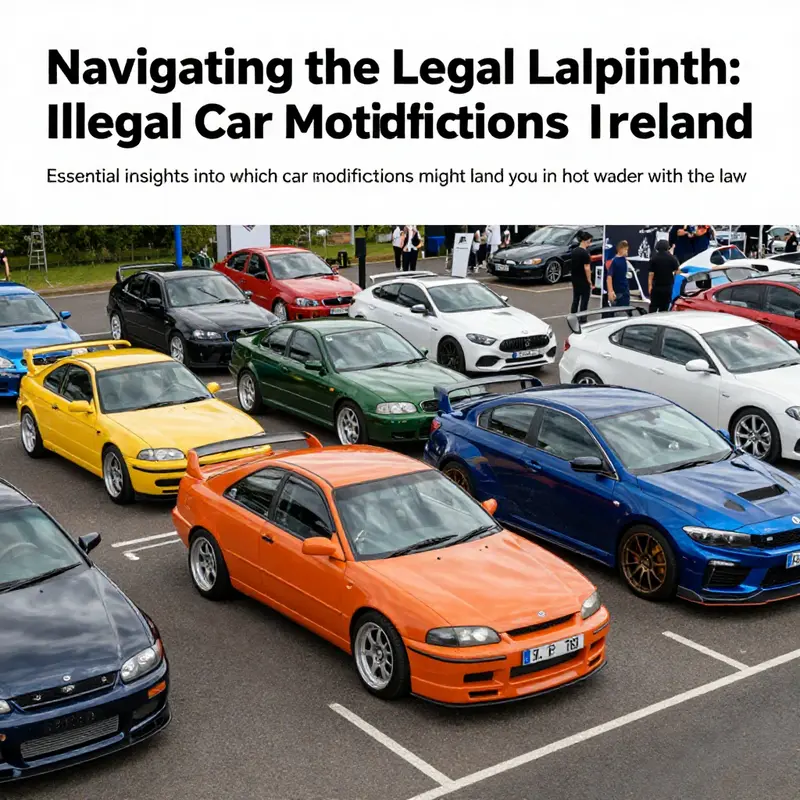
Car modifications can be a thrilling way to personalize and enhance vehicle performance, yet enthusiasts in Ireland must navigate a complex web of regulations to avoid legal pitfalls. From exhaust systems that are too loud to lighting alterations that compromise safety, understanding which modifications are deemed illegal under Irish law is crucial. In this exploration, we will delve into the specifics of illegal modifications across four vital areas: exhaust systems, lighting setups, bodywork and chassis alterations, and tinted windows. Each chapter will arm hobbyist car modifiers, professional tuners, classic car restorers, and global enthusiasts with the knowledge necessary to ensure their modifications align with the law while still expressing their unique automotive identities.
Silence Tested: The Legal Boundaries of Exhausts and Noise in Ireland’s Car Modifications
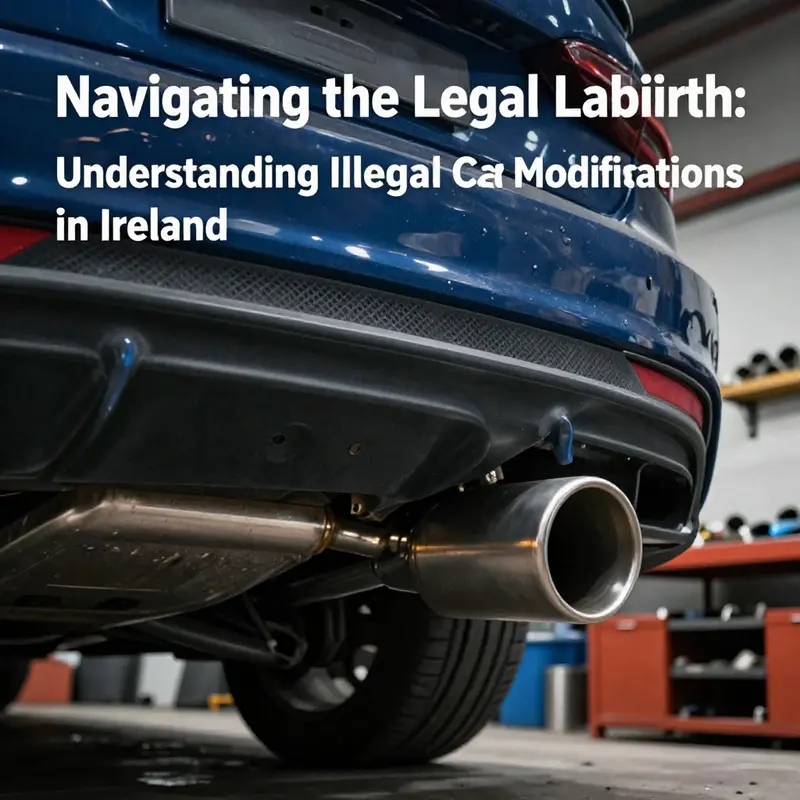
Across Ireland’s roads, a quiet current of compliance runs beneath the more visible culture of car tuning. The state, through the Road Safety Authority (RSA) and the Environmental Protection Agency (EPA), draws a clear line between what a driver may modify and what must stay as the vehicle rolled off the assembly line. This boundary is not a capricious rule but a framework built to protect health, reduce noise pollution, and maintain roadworthiness. In practice, this means that an exhaust system is not just a sound to be considered by car enthusiasts; it is a regulated component, judged against emissions, noise, and the overall safety of the vehicle. Within this framework, the typical Irish citizen encounters a fundamental truth: when a modification pushes emissions above legal limits or drives noise beyond what the national testing regime tolerates, authorities treat the vehicle as non-compliant until it is brought back into line. The consequences can be immediate and tangible, affecting the vehicle’s ability to operate on public roads, the owner’s finances, and even the ability to use a car for daily tasks while work is carried out to restore compliance.
The core concern centers on the exhaust system and the way it interacts with both pollution controls and the acoustic environment of streets and neighbourhoods. Ireland’s noise standards are designed to prevent a car from becoming a moving source of nuisance, while emissions controls ensure air quality remains within national and European guidelines. When a modification such as a muffler cut-out or a bypass system is fitted, and that change results in louder operation or higher emissions than what the law allows, the vehicle is at risk of failing the annual National Car Test (NCT) or, in some cases, being deemed unfit for road use until remedial work is completed. The RSA explicitly ties NCT outcomes to the condition of the exhaust and its components, so modifications that alter these aspects without approved certification are frequently flagged during inspection. In effect, the NCT becomes a practical gatekeeper: it checks that the exhaust system still respects both noise levels and emission thresholds, alongside the mechanical integrity required for safe driving.
To understand why certain alterations are restricted, it helps to recognise how different regulatory bodies work together. The RSA administers the testing framework that vehicles must pass every year or so, but the environmental dimension comes in through the EPA and local authorities who monitor air quality and issue guidance on permissible emissions. Together, these agencies create a set of expectations about how a modified exhaust should behave in real-world driving. While the specifics of decibel limits or threshold values can vary with vehicle class and test cycle, the underlying principle is consistent: modifications that materially change how a vehicle breathes or sounds must be demonstrably approved and compliant. In practical terms, this means that a system designed to dramatically increase exhaust noise is not simply a matter of personal preference. It triggers a legal and administrative process that recognises the broader impact on neighbours, on other road users, and on the integrity of the road network.
Among the most common illegal modifications are devices and configurations designed to bypass or defeat standard silencers and catalytic converters, or to route exhaust flow in a way that raises noise without a corresponding, approved test. A muffler cut-out, a device intended to bypass the muffler, or other alterations that significantly amplify sound can violate the Road Traffic Act and related regulations. These actions are not only a matter of nuisance; they can also undermine the controlled emissions system a modern car relies on to meet environmental standards. When such a modification is detected, the consequence is not merely a warning. The car may be required to be returned to a compliant state, the owner may face penalties or points on their driving record, and the vehicle may be prevented from being driven until it passes the appropriate checks. In jurisdictions with similar enforcement philosophies, authorities emphasise that the act of making a vehicle noisier is inseparable from the broader responsibility of operating a vehicle safely and in harmony with community expectations.
The enforcement environment has evolved in recent years to address two related concerns: the growth of a sector that moves quickly to create new noise-raising configurations, and the public calls for more consistent action against disturbances linked to modified cars. Ireland’s approach combines routine testing with targeted enforcement, particularly as urban areas report rising complaints about loud exhausts and street racing. When a noise issue is raised, authorities do not rely on a single measure alone; they triangulate information from the vehicle’s inspection history, maintenance records, and the observed operational characteristics of the exhaust system. This layered assessment helps prevent overreach while preserving the rights of drivers who keep their vehicles compliant. The result is a regulatory environment that rewards owners who choose to invest in certified, compliant components and discourages approaches that threaten safety or community peace.
For vehicle owners, the practical path to staying legal begins with an informed understanding of what counts as a compliant exhaust system. A modern exhaust is not a cosmetic add-on; it is a functional part of the vehicle’s emissions control and acoustic profile. Any modification must be compatible with the vehicle’s original design intent and certified for use in Ireland. If a component is not specifically approved for a given model, or if a design claim cannot be verified through official documentation, authorities will treat it as non-compliant. The responsibility falls on the owner to ensure that the exhaust, including any mufflers, pipes, or ancillary devices, meets the standards set by the RSA and the EPA. This means selecting parts that carry recognized certification, retaining proper catalytic efficiency, and ensuring that any changes to flow dynamics do not undermine safety, structural integrity, or the effectiveness of emissions controls. It also means retaining records of approval and installation, so when the NCT or any regulatory review occurs, there is clear evidence that the modifications were evaluated within the bounds of the law.
The inspection process itself is a critical phase in maintaining compliance. During the NCT, technicians assess more than just the mechanical condition of the engine and brakes. They listen for abnormal exhaust tones, inspect mounting hardware, and verify that the exhaust path remains properly routed, with no obvious bypass or disconnection that would cause excessive noise or emissions leakage. A vehicle that has undergone an unapproved exhaust modification is likely to fail the test, or incur an additional diagnostic or corrective requirement before it can be tested again. The penalties for non-compliance can be significant. In addition to the potential for a failed NCT, owners may face fines and penalty points on their driving record. In cases where the modification creates a safety risk or a substantial breach of environmental regulations, there can even be impounding or more severe enforcement actions. While these outcomes may seem severe, they reflect a deliberate policy choice: to preserve quiet roads, clean air, and predictable safety performance for all road users.
It is essential to distinguish between legitimate performance enhancements that comply with the law and what might be described as an attempt to defeat the regulatory framework. A lawful approach to improving exhaust performance generally involves components that have been thoroughly tested for a specific vehicle, that meet emissions standards, and that carry formal certification. Such an approach also includes verifying that any changes integrate with other vehicle systems, including the ECU, emissions controls, and the exhaust flow management itself. The goal is not to suppress innovation, but to ensure that ongoing experimentation does not jeopardize safety or community well-being. A compliant modification balances the right to tailor a vehicle with the obligation to operate within the rules created to protect the public and the environment.
From the perspective of a reader standing at the intersection of curiosity and caution, one practical takeaway is that compliance is not a one-off task of purchase and installation. It is an ongoing commitment. Owners should consult official standards, keep thorough documentation, and be prepared to revert to original components if a test or investigation reveals concerns. The RSA’s NCT standards page, which lays out the vehicle technical inspection criteria, is a primary reference in this regard. If a modification appears to push the envelope, many in the field would advise taking a conservative approach: choose exhaust solutions that are explicitly approved for the model, retain the ability to return to the standard factory configuration, and schedule pre-test inspections to anticipate any issues before the NCT appointment. This proactive stance reduces risk and fosters a culture where personal expression in vehicle modification does not come at the expense of public safety or the quality of life in communities around roads and neighborhoods.
For readers seeking a broader frame beyond exhausts, there is value in understanding how illegal modifications intersect with other regulated areas such as lighting, bodywork, and visibility. While the focus here is exhaust and noise, these additional factors illustrate how the regulatory system operates in a cohesive way. A vehicle that is loud but legally compliant in its emissions, or a car with a compliant exhaust that has altered lighting or tint, still faces regulatory scrutiny. The goal of these rules is not to quash creativity, but to ensure that every change maintains roadworthiness and respects the rights of others to a peaceful and safe travel environment. This integrated view helps explain why the regulatory landscape tends to favour modifications that demonstrate tested performance, documented approval, and straightforward compliance rather than ad hoc alterations made in the pursuit of louder sound or flashier appearance.
For readers looking to explore these ideas further, a broader discussion about illegal car modifications and their implications can provide additional context. illegal-car-modifications
External resource: Official standards and testing criteria are detailed by the Road Safety Authority. See the National Car Test Standards page for authoritative guidance on exhaust, emissions, and noise requirements: https://www.rsa.ie/vehicle/national-car-test/nct-standards/
Shining by the Rules: The Real Roadmap for Lighting Modifications in Ireland
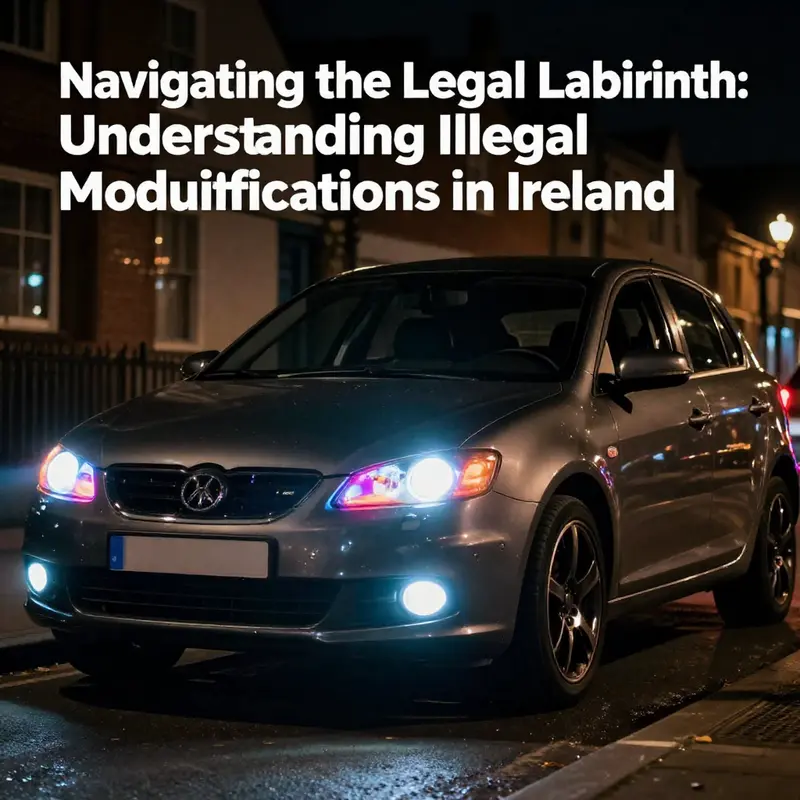
Light is more than a stylistic choice when it comes to driving. It is a language that communicates to other road users and to the vehicle’s own systems about intent, proximity, and warning. In Ireland, as elsewhere in Europe, that language is governed by a precise set of standards designed to preserve safety, visibility, and predictability on the road. When a driver contemplates altering the lighting system, they are not just tweaking a bulb or a lens; they are entering a zone where the line between personal preference and public responsibility becomes sharply defined. That boundary is not merely about what looks good in the showroom or on social media. It rests on decades of research, testing, and real-world experience about glare, beam patterns, and the ability of other drivers to see and react in time. The chapter that follows synthesizes how Irish authorities classify lighting modifications as illegal, why the rules exist, and what that means for owners, technicians, and insurers who live in the daily continuum between legality and risk.
A core premise of the lighting framework in Ireland is clarity of color. The color of a vehicle’s forward lighting system has been standardized to ensure that the beam is visible, non-dazzling, and recognizable at a distance. Headlights that emit light other than white or selective yellow for certain types of lamps break with this standard and can confuse oncoming traffic or obscure pedestrians. The appeal of shifting to blue-tinted or purple-tinged light is immediately tempered by the fact that such colors frequently fall outside regulatory expectations. The safety calculus is simple: white or selectively yellow illumination preserves contrast on the road and reduces ambiguity about a vehicle’s position, proximity, and speed. When a modification would cause a color that diverges from these expectations, it can quickly enter the territory of illegality. The enforcement logic is not about policing aesthetics; it is about gating a parameter that directly affects safety in real time, night after night, in weather and traffic conditions that demand maximum predictability.
Beyond color, brightness and aim are critical. Modern lighting systems are designed with fixed beam patterns and calibrated intensity to avoid blinding other drivers while ensuring the road ahead is properly illuminated. In practice, this means that any upgrade or alteration that increases brightness beyond what the manufacturer intended or that misaligns the headlamp aim can become a violation. Excessive glare unequips the driver behind the wheel of the necessary time to react, while misalignment reduces the driver’s own ability to see pedestrians or hazards in the periphery. The authorities do not rely on subjective impressions of brightness. They rely on measurable criteria and standardized testing to determine compliance. A lamp that is too bright or misaligned can fail a national test, be subject to fines, or even lead to more severe penalties if it creates a significant safety hazard.
Auxiliary lights present a parallel area of concern. The road code has grown stricter over time on the use of additional lamps beyond the standard headlamps, indicators, and rear lighting. Only lights that are approved for road use and that meet specific standards may be added. Any added lighting that cannot demonstrate roadworthiness or that has not received explicit authorization is considered noncompliant. The practical implication is that a car may bear extra lamps in the driveway but be deemed unfit for road use if those lamps do not meet the established criteria. The logic here mirrors the broader European regulatory philosophy: additional lighting must serve safety, not style, and must be demonstrably compatible with the vehicle’s electrical system and the vehicle’s overall lighting performance.
The color, brightness, and auxiliary lighting considerations sit within a broader legal frame that binds lighting to both national and EU-wide standards. Ireland aligns with the Road Safety Act 2006, a cornerstone document that codifies the expected performance of vehicle lighting, among other safety features. The act references the necessity for lighting to meet defined standards so that all road users can anticipate and respond to signals consistently. In addition, European regulations, notably ECE Regulation 48, govern headlight performance including beam pattern, intensity, and color. This EU regulation provides harmonized criteria that shape Irish interpretations and enforcement. The effect is a seamless continuum: a vehicle designed to meet EU standards in its lighting is more likely to pass inspection and be safe on Irish roads, whereas deviations tend to yield penalties or failed tests. The enforcement architecture supporting these standards involves the National Roads Authority, which collaborates with local Gardaí to conduct inspections and random checks that verify compliance during roadworthiness assessments and at the point of traffic stops.
The practical consequences of noncompliance extend beyond a single vehicle’s failure at the NCT or a hands-on inspection. Penalties may include fines and demerit points, and in more severe cases a vehicle can be seized if the lighting modification is judged to pose a significant safety risk. The combination of penalties acts as a deterrent against casual or ill-considered changes that could jeopardize safety for other drivers, cyclists, and pedestrians. The risk calculus for a driver contemplating a change to the lighting system thus grows complex: the prospective gain in aesthetics or perceived visibility must be weighed against the potential costs of noncompliance, including the possibility of an NCT failure later, which can trigger a cascade of consequences such as insurance implications and required restoration to standard specification.
For those who want to understand the scope of what constitutes illegal lighting modifications, it helps to keep two questions in mind. First, does the modification alter the color of the forward lighting in a way that violates the allowed spectrum? If the answer is yes, the modification is likely illegal. Second, does the modification affect the module’s brightness or alignment in a manner that can create glare or reduce the driver’s own visibility? If the answer is yes, the modification is a potential violation. In both cases the governing principle is safety: any change that undermines the driver’s ability to see or to be seen by others, or that makes the vehicle harder to judge by other road users, falls under scrutiny. This is consistent with the broader regulatory approach that governs not just lighting but every modification that can influence vehicle behavior on public roads.
The enforcement narrative is as important as the technical one. Gardaí and the NRA do not rely solely on the letter of the law; they rely on practical assessment during regular patrols, at checkpoints, and during NCT sessions. They assess whether a modification has the appropriate approvals and whether its execution adheres to the described standards. If a vehicle is flagged for lighting noncompliance, the consequences can range from fines to a failed test, to a requirement to revert to compliant equipment before the vehicle can be legally operated. The recurring message to drivers and technicians is clear: changes must be traceable to standards and supported by legitimate testing data that confirms conformance with both national and European requirements.
For technicians, the landscape is equally exacting. install work must be performed using components that meet the standards and that align with the vehicle’s electrical system, with proper wiring and load management to avoid electrical faults that could emit unsafe levels of heat or cause short circuits. The notion of a quick fix in the garage, while sometimes tempting in the pursuit of a novel look or a perceived improvement in performance, often runs directly counter to the regulatory framework. A well-intentioned modification can become unlawful if it bypasses diagnostic checks, fails to pass the required tests, or lacks the necessary approvals. In that sense, the regulatory approach protects not only other road users but also the integrity of the vehicle’s electrical architecture and the reliability of its safety features.
In thinking about what this means for owners considering modifications, the practical takeaway is to approach lighting changes with a mindset of compliance rather than customization alone. Begin by identifying parts that are designed or certified for road use. Seek components that carry appropriate approvals and are known to align with the standards referenced by the Road Safety Act 2006 and ECE Regulation 48. Consider professional installation that documents the process, ensuring that beam alignment and aim are verified through proper checks. Keep in mind that even seemingly minor adjustments, such as adding a high-intensity upgrade or repositioning a lamp housing, can shift the beam pattern enough to cause glare or misalignment, thereby inviting scrutiny.
The broader context also includes how lighting decisions interact with other aspects of vehicle safety and regulation. Vehicle lighting does not operate in isolation from other lighting and signaling systems. The indicators and brake lights must harmonize with headlamps in terms of brightness and timing. The overall effect is a cohesive system that communicates the vehicle’s actions to others on the road. A modification that disrupts this harmony can be misinterpreted by other drivers, increasing the risk of collisions or near misses. The intention behind these integrated standards is straightforward: to preserve a predictable visual landscape on the roads, where every vehicle’s signals are legible, timely, and consistent.
For readers seeking a deeper dive into the legal specifics, a concise overview of the general principles and potential consequences of illegal lighting modifications can be found in public-facing discussions on the subject. If you want to explore a broader discussion of illegal car modifications, you can visit a detailed guide on illegal car modifications. This resource provides a comprehensive context for why certain lighting changes are disallowed, how they are evaluated, and what remedies are commonly pursued when regulations are breached. It is a useful companion for readers who are weighing whether a particular lighting upgrade is worth the risk given the regulatory risk profile described above. (Illegal car modifications)
In addition to the internal and local considerations, any Irish owner should consider official guidance from national authorities. The Department of Transport maintains resources that spell out the standards and expectations for lighting and other safety features. Accessing these official materials helps ensure that decisions are grounded in the latest regulatory expectations, rather than in anecdotal or out-of-date information. For a concise overview of formal standards and how they apply to lighting, you can consult the Department of Transport’s official guidance and related documents. Official standards are explained through the Department of Transport site: https://www.transport.gov.ie
As this chapter has traced, lighting is a linchpin in the safety architecture of modern road transport. In Ireland, the rules are designed not to stifle innovation or personal expression, but to ensure that the signals vehicles send are unambiguous and safe for everyone who shares the road. The balance between innovation and safety is delicate. When it is maintained, drivers can benefit from improved visibility and functionality without creating risk for others. When it is neglected, the consequences are not merely cosmetic; they become a public safety concern that the state takes seriously through inspection regimes, penalties, and the threat of seizures.
The conversation around lighting modifications is part of a broader ethic that permeates all discussions of vehicle modification in Ireland. It is about responsibility. It is about ensuring that enhancements do not compromise the well-being of other road users. It is about recognizing that a car is part of a larger system. The system thrives when every component, including the lights, behaves as the designers and regulators intended. Those who approach modification with this awareness—seeking compliance, seeking professional validation, and seeking to keep the road safe for everyone—are the ones most likely to enjoy the benefits of lighting upgrades without risking penalties or endangering others. And for those who want to explore more about this landscape, the path is straightforward: understand the standards, engage with certified practitioners, and keep the dialogue with the authorities open and proactive.
- Internal link to further context: Illegal car modifications
- External reference: For official standards, see the Department of Transport guidance at https://www.transport.gov.ie
Under the Skin: Ireland’s Legal Boundaries on Bodywork and Chassis Modifications
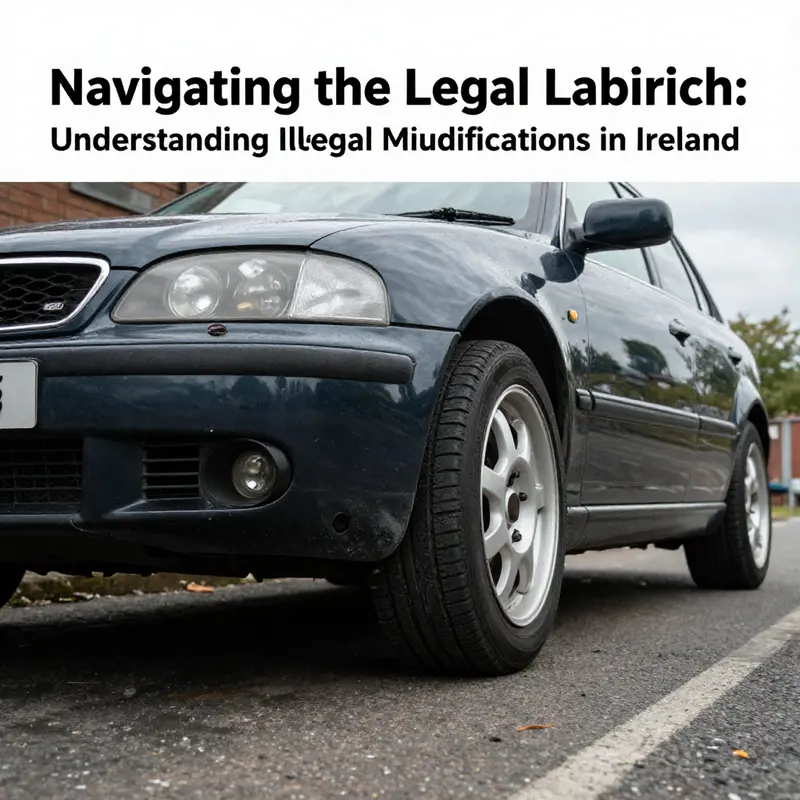
To many car enthusiasts, the appeal of shaping a vehicle’s silhouette or sharpening its chassis is part of the passion of ownership. Yet in Ireland, changes to a car’s bodywork or its fundamental structure do not belong to the realm of personal preference alone. They are governed by a framework designed to protect safety, ensure roadworthiness, and uphold a predictable standard of performance across the fleet. When a modification affects how the vehicle stands up to the road—not just how it looks—the question becomes not ‘how far can I push this?’ but ‘how far can I push this within the law without compromising safety or insurance?’
The rules around bodywork and chassis are explicit about the line between permissible and prohibited work. Any alteration that changes how the car handles, protects occupants, or interacts with the road’s forces must be justifiable to a regulatory authority and supported by appropriate documentation. This is not merely a bureaucratic hurdle; it is a safeguard against hidden weaknesses that can emerge in a crash, or when a car is tested on Irish roads, in different weather and traffic conditions. The National Roads Authority (NRA) and the Road Safety Authority (RSA) oversee these standards, and they can require demonstrations of safety and structural integrity before an approval is granted. The annual National Car Test (NCT) is the practical gatekeeper for most Irish vehicles over four years old; any meaningful body or chassis changes that have not been vetted are likely to fail that test, inviting penalties, the cost of rectification, or more serious consequences.
Common sense tells most drivers what is risky: cutting into the frame to lower a vehicle, altering load paths, or bolts and welds that modify suspension geometry without design validation. The law recognizes this by requiring modifications to be performed by qualified professionals and to carry certification that the modification will not degrade passenger safety. A vehicle body is not a cosmetic shell; it is a load-bearing structure in most designs. When someone welds a different panel, or lowers the ride height beyond what the suspension geometry can safely accommodate, the risk isn’t only cosmetic. It can affect crash dynamics, steering responsiveness, and even the way a car consumes energy in a collision. The problem extends beyond the moment of the modification. Insurance policies are crafted around the vehicle’s original design parameters. If a change is made without disclosure or without approval, insurers may deny a claim, or void coverage altogether. The legal framework tightens that risk with potential penalties under the Road Traffic Act 1988 and related regulations, including fines, vehicle seizure, or prosecution in sentencing scenarios where the modification is deemed to undermine road safety.
Consider how a chassis or body modification might come under scrutiny. Lowering a car, which is a common aesthetic and performance tweak, can alter suspension travel, bump steer, and the effective clearance between critical components and road surfaces. In a worst-case scenario, the altered geometry can cause steering bind, compromised braking performance, or contact with the fenders or unibody structure under load. Wide exemptions may exist if a professional engineer certifies the modification and the installation is carried out within approved tolerances and with compliant components. But the absence of such certification is a red flag. The same holds for alterations that affect how panels align, how doors latch, or how the structural members integrate with safety systems like airbags. Even seemingly small changes to body rigidity can influence how a car behaves in a rollover or side impact, and regulators will examine whether the vehicle remains within the design envelope that the NCT testing procedure expects.
To navigate this landscape, many owners turn to official guidance and formal approval routes. The RSA provides detailed information on what modifications are permitted, what documentation is required, and how to seek approval for planned alterations. The process often involves consulting approved manufacturers or engineers, submitting drawings or specifications, and obtaining certification that the modification complies with safety standards. It is not enough to assume that a finish or a patch will pass muster; the test is designed to verify the integrity of the structure and the functionality of safety systems after any work. When a change is completed, owners should retain receipts, certification, and any homologation documents. These documents can be essential if the vehicle is inspected, or if questions arise from insurers or law enforcement. This careful approach not only reduces risk but also preserves the vehicle’s resale value, because an inventory of properly authorized work resonates with prospective buyers who are looking for a vehicle with predictable condition and documented history.
Within this framework, the consequences of unauthorized modifications extend beyond the immediate repair costs or the burden of rework. An NCT failure due to an unapproved body or chassis change can trigger fines and potentially impoundment. More ominously, a modification that departs from the vehicle’s approved design can erode the baseline insurance coverage, leaving owners exposed to dispute at the time of a claim. The combination of regulatory, safety, and insurance implications means that the prudent course for those who love to tinkerer is to ask the right questions before any hammer meets metal. Is the proposed change within the RSA’s approved categories? Does it pass the safety tests that the NCT will apply? Will there be a certified engineer’s sign-off, and are there compliant parts in place? What paperwork will I need to show when renewing the NCT and reporting to my insurer? The answers rarely lie in a quick consensus on forums or in glossy magazines; they are grounded in formal approval paths and surveillance that keeps Irish roads predictable for everyone.
Of course, not every alteration is forbidden, and not every modification should stay on a shelf as a potential dream. Some changes improve safety or efficiency when they are executed with oversight and documentation. For sure, there are legitimate routes to adjust body panels for repair following a collision, to replace corroded structural members, or to upgrade components using homologated parts that have been designed to maintain or improve a vehicle’s crash performance. The key is to proceed with the understanding that road safety is non-negotiable and that the law expects a clear chain of responsibility from the workshop to the road. As such, the decision to modify should begin with a careful assessment of the vehicle’s baseline integrity. If you are planning any work that touches load-bearing structures, or if you intend to alter where or how panels meet, start by seeking guidance. Contact the RSA’s vehicle modifications guidance, and document every stage of the plan. Seek sign-off from an engineer or a recognized authority who can attest to the modification’s safety. Ensure the parts used are approved for use in Ireland and reflect the manufacturer’s originally intended performance envelopes. Keep a tidy record, including before-and-after measurements, installation procedures, and any calibration data. Present these materials to the NCT inspector when the time comes, and be prepared to explain how the modification preserves or enhances safety. In practice, this disciplined approach often yields a smoother NCT outcome, a more confident insurance stance, and a vehicle that remains a source of pride rather than a legal headache.
Within the wider discussion of modifications, the chapter on bodywork and chassis should be read in connection with the broader regulatory ecosystem. Noise and lighting restrictions, while not directly tied to structure, share the same objective: prevent hazards and ensure predictable vehicle behavior. The NCT is designed to catch issues that inspectors believe could lead to unsafe operation, from a precarious body frame to a suspension that could fail under load. These checks are not punitive by themselves; they are preventive tools that help maintain a safe highway system. For readers who want to explore further, there is value in understanding the official posture toward modifications and how to integrate legitimate upgrades into your vehicle’s architecture. The RSA’s modification page provides a roadmap for those who want to stay within the lines while preserving the car’s character and performance. If a modification is undertaken correctly, with the right certifications and within approved guidelines, the result can be a safer and more efficient vehicle that still adheres to Irish law.
Finally, the practical steps of compliance can be summarized in one line: plan, document, certify, and verify. Start with a clear plan that describes how the change will affect the car’s load paths, structural joints, and safety systems. Gather supplier documentation, drawings, and test results from the components and professionals involved. Seek sign-off from an engineer or a recognized authority who can attest to the modification’s safety. Ensure the parts used are approved for use in Ireland and reflect the manufacturer’s originally intended performance envelopes. Keep a tidy record, including before-and-after measurements, installation procedures, and any calibration data. Present these materials to the NCT inspector when the time comes, and be prepared to explain how the modification preserves or enhances safety. In practice, this disciplined approach often yields a smoother NCT outcome, a more confident insurance stance, and a vehicle that remains a source of pride rather than a legal headache.
Ultimately, the goal is to celebrate innovation within the safety envelope. A vehicle that looks closer to the owner’s vision is not inherently dangerous if the work is done with professional oversight, transparent documentation, and a clear understanding of the regulatory boundaries. The law does not ban creativity; it channels it toward changes that do not compromise the vehicle’s fundamental purpose—a machine designed to transport people and goods safely. When in doubt, step back and consult the RSA’s guidelines, seek professional validation, and remember that the road ahead will thank you for a decision grounded in safety, accountability, and compliance. For readers who want to connect with practical advice about reporting illegitimate modifications, a useful resource is here: How to report illegal car modifications.
Official guidance and detailed regulations can be found on the Road Safety Authority’s site, which outlines the official categories of approved modifications, the documentation required, and the steps to obtain approval before proceeding with any work. This official resource is essential for anyone contemplating a modification that touches a car’s structure, as it clarifies what qualifies as a compliant alteration versus what constitutes an unauthorized change. For comprehensive guidance, you can consult the RSA’s vehicle modifications page and follow the recommended procedures to keep your project compliant, safe, and legally robust. External resource: https://www.rsa.ie/vehicles/vehicle-modifications/.
Tinted Windows and Visibility Standards: Navigating Ireland’s Legal Window on Car Modifications
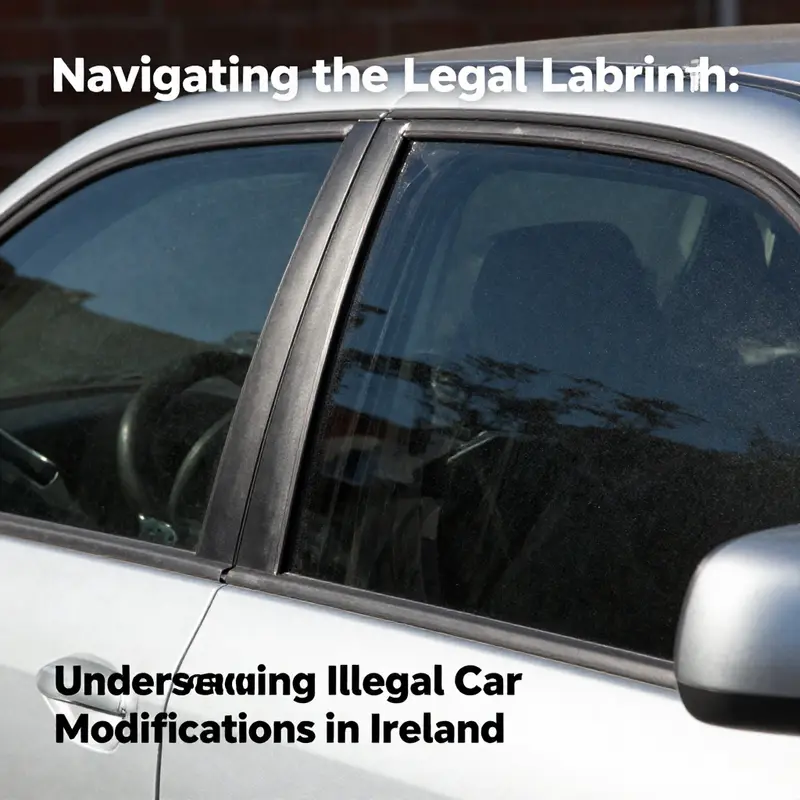
In Ireland, the glass that stands between a driver and the road is more than a window; it is a critical safety interface. The Road Safety Authority (RSA) treats window tinting as more than a cosmetic preference because it directly affects how well a driver can see other road users, pedestrians, and hazards at night or in poor light. This is why the regulations surrounding tinted windows are precise and enforceable. The core rule for front-side windows is straightforward: they must allow at least 70 percent of visible light to pass through the glass, a standard known as visible light transmission, or VLT. This threshold is not a mere guideline but a tested requirement that makes compliance measurable during inspections. The rationale is simple and compelling. If the glass is too dark, a driver’s ability to detect a cyclist on a dim street, a pedestrian stepping into the roadway, or a motorcyclist signaling a lane change can be compromised. When visibility is compromised, reaction times lag and the margin for error increases, elevating the risk for everyone on the road. The RSA’s emphasis on front-side windows is rooted in the reality that these panes are most critical for early hazard detection. While the rear windows become less regulated in daylight and require less stringent light transmission, they still contribute to overall rearward visibility, and any tint that obstructs vision through the rearview mirror should raise concerns for safety and compliance. The distinction drawn by the RSA recognizes that drivers rely on a balance: enough tint to reduce glare and protect privacy without eroding the essential ability to see, react, and maneuver safely.
The practical implication of these rules is that most aftermarket tint films, especially those marketed as “car accessorizing” products, must pass the 70 percent VLT test on the front-side windows if they are installed in Ireland. It is not enough to claim compliance; inspectors use handheld devices that measure the exact amount of light passing through the glass. If the measurement falls below the required threshold, the vehicle will fail its National Car Test (NCT), and the owner may face fines or be required to remove or replace the tint to achieve compliance. In some cases, drivers can be stopped by police for non-compliant tint, which carries penalties beyond an NCT failure. The stakes are not merely about keeping a device in tune with a rulebook; they are about ensuring that a driver’s field of view remains clear enough to identify a child stepping onto a street, a car emerging from a driveway, or a skateboarder crossing a bike lane at dusk.
This regulatory framework is complemented by guidance on rear side windows and the rear windscreen. While the legal emphasis centers on front-side windows, the RSA guidance makes clear that tinting should not eliminate visibility or distort depth perception when looking through the rearview mirror. In other words, even if the rear windows can be tinted more than the front ones, the overall effect must not undermine the driver’s ability to scan the road behind effectively. The logic is pragmatic: a driver who cannot see clearly through the rear window in heavy traffic will be unable to assess gaps, judge following distances, or anticipate vehicles changing lanes. When such capabilities are impaired, the risk of a collision increases. The spirit of the law, therefore, is not to ban all tinting but to ensure that any tint remains a safety feature rather than a hidden flaw that could hide danger.
Beyond the letter of the law, drivers should be mindful of the broader safety ecosystem. The RSA’s tinting standards sit alongside other vehicle-modification controls that protect road safety and environmental integrity. The emphasis on visibility is inseparable from the wider project of reducing road hazards. When a vehicle’s emissions, noise levels, or structural integrity are altered, the responsible route is to achieve proper certification and ensure that any modification remains compatible with roadworthiness standards. Tinting is a particularly sensitive example because it sits at the intersection of personal customization and public safety. A vehicle can be visually customized in countless ways, yet modifications that impede essential perception or that obscure critical signals can undermine the safety services that keep all road users safe. As a result, even seemingly minor changes—such as a tint that looks modest in daylight—must be evaluated under the law’s careful lens. The RSA has designed these rules not to hinder personal style but to preserve the fundamental requirement that a vehicle remain a transparent, responsive, and predictable participant in traffic.
The enforcement environment reflects this balance. NCT stations routinely evaluate window tint as part of the overall safety assessment. Inspectors rely on a handheld metering device to determine whether the front-side window VLT meets or exceeds 70 percent. If a vehicle’s tint reads below the threshold, the NCT will flag the vehicle as unsafe, and the owner will need to address the issue to pass the test. The consequences extend beyond the annual test. Police enforcement can result in fines or other penalties when non-compliant tint is observed during regular road checks. The practical takeaway is clear: drivers who consider tint as a mere aesthetic feature should reframe it as a safety-critical visibility parameter with legal implications. In this sense, tinting becomes a measured decision—one that weighs privacy or style against the responsibility to maintain clear sightlines and to stay within regulatory bounds. The RSA and police authorities collaborate in creating a culture of compliance, recognizing that consistent visibility enhances safety for all road users, including those most vulnerable in low-light conditions.
For those navigating the decision to tint, the landscape can appear murky, especially when tinting products advertise themselves as compliant or when professional installers promise guaranteed results. It is prudent to approach window tinting as a regulated modification rather than a cosmetic upgrade. While some films may claim to comply with the law, the only reliable proof is an official measurement taken on the installed glass and, ideally, documentation from a reputable installer that confirms the VLT rating. The difference between a tint that seems to comply and one that truly complies can hinge on a few percentage points of light transmission, a detail that might barely register under casual scrutiny but decides an NCT outcome. A proactive approach, therefore, involves verifying the product’s specifications before installation, asking for certification, and even requesting a post-installation measurement to confirm that the 70 percent front-side window requirement remains intact after fitting. This diligence helps avoid the embarrassment and disruption of an NCT fail, the potential cost of replacement, and the legal risks associated with non-compliance.
An additional layer of caution concerns the front windshield and, in some cases, the broader glare management and privacy considerations. The landscape of tinting guidance makes clear that windscreen tinting must preserve high transmission of light, preventing dangerous distortion or obstruction of the driver’s direct line of sight. In practice, this means that while some films may be designed to reduce glare and heat in the front area, there is little room for reducing visibility to dangerous levels anywhere in the main field of view. Drivers who contemplate heavier tints or reflective coatings risk creating conditions in which the driver’s awareness is diminished at crucial moments—such as the moment a pedestrian steps into the road or a vehicle’s brake lights illuminate from a distance. The RSA framework, therefore, underscores not only compliance with numerical thresholds but also the broader objective of preserving natural visibility across varying lighting conditions and weather scenarios. In this sense, tinting is not simply a fixed standard but a living guideline that adapts to the complexities of real-world driving, where visibility can rapidly shift from bright to shadowed, and where a moment’s obscurity can convert into a dangerous situation.
For readers seeking a concise route to compliance, the RSA’s official guidance is essential reading. It emphasizes that the responsibility lies with the vehicle owner to ensure their tinting remains within legal limits and that it is maintained in good condition, free from bubbling, peeling, or discoloration that might further impede visibility. It also notes that regulations apply regardless of whether the tint was professionally applied or performed by the owner. This universality matters because it prevents a simple excuse—such as a DIY tint—from excusing non-compliance. In other words, the law does not distinguish between a professional tint and a do-it-yourself job when it comes to the core test of visibility. The practical implication is straightforward: if you are unsure whether your tint is compliant, you should seek a definitive measurement before heading to the NCT or stepping into traffic on a routine day. The RSA website provides the authoritative framework and the most current standards, which can change as safety research and enforcement practices evolve.
In this chapter, the focus has been on tinted windows as a specific illustration of how Irish modification rules operate. Yet the same mindset applies across other potential modifications: seek proper certification, understand the safety rationale, and recognize that regulations are designed to keep roads safer for everyone. A car that looks sleek in a showroom but carries a tint that undermines visibility at night undermines the very purpose of road safety. The calculation is simple: if a tint reduces the ability to detect hazards in time, it increases the risk for all road users. That is why the RSA’s 70 percent rule for front-side windows exists, why the NCT measures VLT with precision, and why police enforcement remains vigilant. For drivers who want to stay within the law while preserving their preferred appearance or privacy, the path is clear: measure, document, and verify, then maintain, rather than guess, at every step.
To place this discussion in a broader context, consider how tinting fits into the larger conversation about car modifications in Ireland. It exemplifies the balancing act between personal customization and collective safety. If readers wish to explore more on the spectrum of modifications—ranging from exhaust noise to light configurations and body alterations—they can consult broader resources on illegal modifications and their implications. For a broader context on illegal car modifications, see illegal-car-modifications. The aim is not to discourage individual expression but to encourage responsible choices that keep drivers and pedestrians safe while satisfying regulatory requirements. Keeping the lines clear between what is permissible and what is not helps protect families, supports insurance and warranty considerations, and ensures that a vehicle remains a lawful, reliable part of the road network. This approach reflects a pragmatic understanding of laws as guardians of safety rather than obstacles to personal preference.
In conclusion, while Ireland’s tinting rules are specific, they serve a wider purpose: to preserve high visibility, reduce the risk of nighttime accidents, and maintain consistency in how vehicles are observed by other road users and law enforcement. The 70 percent VLT standard for front-side windows is a clear, measurable target that drivers can verify. The consequences of non-compliance—NCT failure, fines, or legal action—are real and avoidable with careful preparation. By engaging with official resources, verifying tint specifications, and maintaining documentation, motorists can enjoy the benefits of tinted windows—privacy, glare reduction, and heat control—without compromising safety or legality. The road safety framework depends on this shared commitment to visibility, and it is this commitment that underpins the practical, enforceable standards that govern modified cars in Ireland. External reference for further detail: https://www.rsa.ie/en/road-users/vehicle-safety/vehicle-modifications-and-tinting.aspx.
External resource: https://www.rsa.ie/en/road-users/vehicle-safety/vehicle-modifications-and-tinting.aspx
Final thoughts
Understanding the nuances of car modification legality in Ireland is not just a matter of compliance; it’s about ensuring safety on the roads and protecting the integrity of your vehicle. By avoiding illegal modifications, car enthusiasts can continue to express their passion for vehicles without the looming threat of fines, failed inspections, or legal repercussions. This guide serves as a roadmap through the complex landscape of vehicle regulations, empowering you to make informed decisions that resonate with both your style and sensibilities. Always prioritize compliance, safety, and roadworthiness in your modifications to safeguard your passion for cars.