
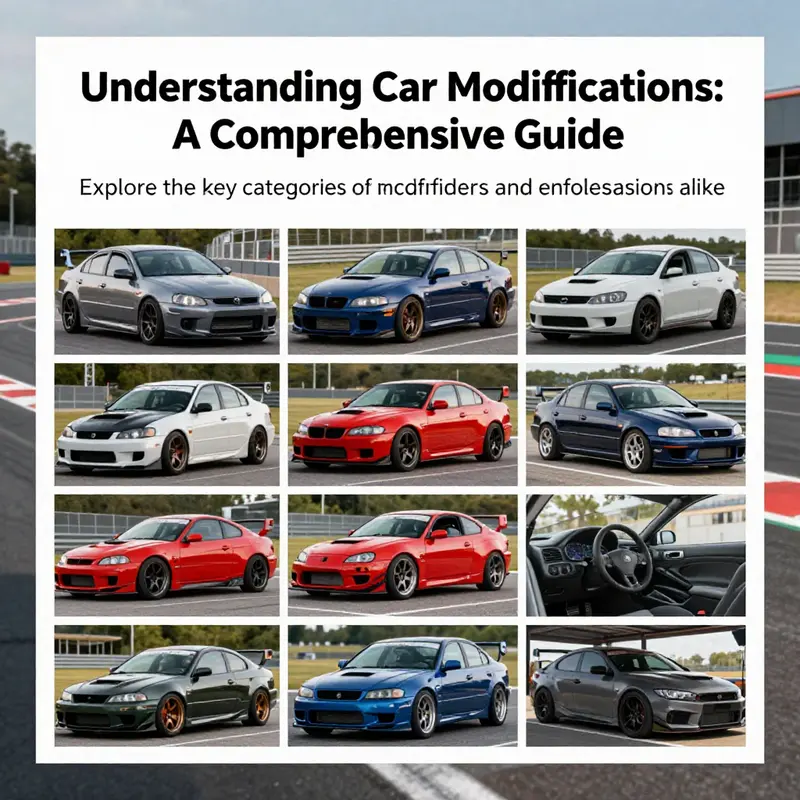
Car modifications represent a vibrant aspect of automotive culture, appealing to hobbyists, enthusiasts, and professionals aiming to enhance vehicle aesthetics, performance, and functionality. Understanding what constitutes a car modification is crucial for anyone involved in the automotive scene, whether you’re a dedicated modifier, a professional tuner, or a classic car restoration expert. This guide delves into the primary categories of car modifications: exterior, interior, performance, and specialized modifications. Each chapter will provide insight into the various types of modifications, their legal considerations, and how they can personalize and improve your vehicle. Join us as we navigate the exciting world of car modifications, ensuring that your passion aligns with the latest trends and regulations.
Exterior Modifications: The Visible Edge of Car Customization and the Language of Performance

Exterior Modifications: The Visible Edge of Car Customization and the Language of Performance
Exterior modifications sit where personal expression meets engineering. They are the most immediately legible form of alteration, the first impression a car makes before any sounds, sensations, or specifications are felt. This chapter surveys the exterior terrain—not just to decorate a vehicle, but to alter its aerodynamics, balance, and even how it behaves on the road. It asks what counts as a modification in the eyes of the car community and the roads we share, and how those changes are weighed by aesthetics, function, and law.
At the heart of exterior modifications are body components that reshape a car’s silhouette and its interaction with air. Body kits exemplify this shift. They comprise front lips, side skirts, and rear diffusers that work in concert to influence airflow around the vehicle. The intent is rarely merely to look aggressive; it is often to reduce drag, guide airflow toward critical surfaces, and alter lift at speed. As an automotive dynamics engineer named Marcus Tran observes, these components can transform a car from a passive transport into a more engaged, responsive machine. A well-tuned front lip can smooth the air entering the underbody, while strategically placed side skirts manage the vortices that form at the wheel wells. The overall effect, when well integrated, is a car that feels more planted, more alert to driver input, and more capable at higher speeds or on twisting roads. Yet this is not about a single part; it is about the choreography of parts that work together to change the car’s character. The exterior becomes a language through which the car speaks about intention: speed, grip, and the promise of precision.
Beyond the lines and angles, color and surface treatment are equally vital. Custom paint finishes and wraps extend the vocabulary of the exterior far beyond the factory palette. A high-gloss finish gleams with depth, catching the light across curves and edges in a way that can heighten perceived speed or presence. Matte finishes, in contrast, absorb light and emphasize contours, offering a more understated but equally deliberate stance. Color-shifting options move with the observer, producing shifting tones as the vantage point changes, a subtle reminder that what we see is as much about perspective as pigment. Each choice carries a personality imprint: gloss signals energy and assertion; matte signals composure and restraint; color-shift speaks to novelty and the delight of perception. The value of these finishes lies not just in aesthetics but in how they influence the car’s interaction with its environment—how reflections emphasize lines, how textures alter perceived weight, and how the car is framed in the street’s constant choreography of illumination and shadow.
Wheels and tires are another dominant axis of exterior modification, and they illustrate the axis between appearance and function. Upgrading rims and tires changes more than just the look; it can alter unsprung mass, grip, and compliance with road surfaces. Wider tires can widen the contact patch, potentially boosting grip in corners and under hard braking, but they can also compromise ride quality and fuel economy if not matched to suspension, alignment, and power output. Legal approvals or regulatory restrictions may come into play in some regions, adding another layer of consideration to the decision. When done thoughtfully, wheels and tires complete a look while informing how a car plants itself to the road, how it communicates speed, and how it translates a driver’s intent into motion. The same balance exists in lighting and visibility upgrades. Aftermarket lighting, such as LED accents or auxiliary lamps, can heighten visibility and give a distinctive signature to a vehicle. Window tinting, meanwhile, frames the interior’s relationship with the outside world, changing contrast and perceived proportions. Taken together, exterior lighting and shading become instruments of presence, legibility, and personal style.
As with any category of modification, the exterior presents a spectrum of possible choices, each with its own set of considerations. Some practical constraints are obvious, such as compatibility with the car’s geometry and the risk of increased road noise or altered ride height. Alterations to the suspension to lower a vehicle, for instance, can lower the car’s center of gravity but also raise the risk of scraping or undercarriage damage on uneven surfaces or steep driveways. Wider tires can cause more road noise and alter steering feel, while aggressive body kits may improve airflow but reduce clearance and, in some markets, appeal to only a subset of buyers at sale time. The trade-offs are real and often context dependent. Aesthetic upgrades may bring peak display value, but they can also affect resale appeal. A loud color or an outlandish shape might turn heads, yet it can limit the pool of potential buyers who want a more conventional vehicle. The point is not to abandon balance for bravado, but to recognize the dual impulse at work: to craft a look that communicates purpose and to ensure that the car’s other qualities—handling, comfort, and reliability—remain coherent with that exterior stance.
Another layer of complexity comes from the technical considerations behind exterior performance. Engineers and designers think in terms of airflow, weight distribution, and material properties when selecting components. Aerodynamic elements aren’t just about reducing drag; they’re about guiding air across the car so that downforce and stability are improved where they matter most. A diffuser’s fins, a spoiler’s angle, or a front lip’s alignment can shift how air interacts with the tires, the radiator, and the underbody, influencing grip and cooling. Materials—from composites to metals—carry different trade-offs in stiffness, weight, cost, and durability. The goal is to strike a balance that respects the car’s original engineering while integrating new surfaces and edges that enhance performance without compromising safety or reliability. Industry professionals frequently emphasize that any exterior modification should be evaluated for its impact on weight distribution and thermal management. These are not merely theoretical concerns; they translate into tangible changes in how the car responds to steering input, throttle, and braking under real road or track conditions.
The subject of exterior modification cannot be detached from the broader framework of safety and compliance. Modifications must align with road rules and regulatory expectations. Some regions require modifications to be documented and registered, while others insist on inspections that verify that changes do not misrepresent the vehicle’s identity or capabilities. The legal framework can influence what a driver can and cannot do with the exterior. It also affects insurance, maintenance, and even parking in certain areas. The public conversation about these changes is rarely purely about aesthetics. It is about how a car’s outward form communicates its intent and how that form interacts with laws designed to keep roads safe and predictable for everyone. In the same breath, the exterior becomes a point of negotiation between personal expression and collective responsibility. The car becomes a statement, but also a participant in a system of traffic rules, safety standards, and accountability.
Within this landscape, one can observe a useful pattern: successful exterior modifications tend to respect the integrity of the original design while extending its expressive potential. They avoid extremes that undermine structural balance, and they prefer cohesive sets of components that work together rather than a disjointed collection of parts. An integrated approach often yields the most satisfying results—cars that look purposeful and feel predictable, that reward precise inputs with confident responses rather than sensational but erratic behavior. This coherence is not about denying individuality; it is about channeling it through the car’s own architecture so the vehicle remains a unified system rather than a collection of bits.
For readers who want to ground their exploration in practical guidance, the exterior domain offers a clear through line: start with a concept of the car’s purpose and the kind of driving you most enjoy. If you prize track-inspired handling, you might lean toward aero elements that sharpen corners and balance downforce with weight distribution. If your aim is head-turning street presence, you may focus on paint finishes and body lines that project character without compromising ride quality. If you value daily usability, you would weigh the impact of upgrades on weatherproofing, maintenance, and resale value. The best projects emerge when the modification strategy is honest about trade-offs and guided by a clear vision of how the exterior supports the car’s overall personality and performance envelope.
To deepen the reader’s sense of the field, a reference point for broader context is helpful. A car modifications guide offers a comprehensive panorama of how exterior and other categories interlock, helping you map ideas to feasibility and consequence. The guide highlights the importance of aligning parts, ensuring proper fit, and respecting the vehicle’s dynamics. It also serves as a reminder that exterior aesthetics and aerodynamic function are not isolated goals; they often define how a car interacts with the road and how a driver feels while piloting it. For those who want a practical blueprint that connects design intent to concrete steps, this resource becomes a valuable companion, complementing the insights shared here.
In the end, exterior modifications are not merely cosmetic bling. They are a form of design thinking applied to a dynamic machine. They require a balance of taste and restraint, of ambition and caution. They demand attention to the details—how a lip sits against the bumper, how a wrap sits on a curved surface, how a wheel’s offset interacts with fender arches. The result is a car that communicates its driver’s priorities through line and texture, a vehicle that tells a story not with words but with form, light, and motion. The exterior is the front line of the modification conversation, bridging artistry with engineering and inviting owners to participate in a living dialogue with their machines.
Internal link for broader context: readers who want a broad overview of the entire modification landscape can consult the car modifications guide for a detailed context and actionable steps. car modifications guide
External resource for technical depth: for a deeper dive into the technical specifications and best practices underlying exterior decoration, see Car Exterior Decoration Explained. External resource: Car Exterior Decoration Explained (Nina Flores, February 21, 2026).
Interior Modifications: Crafting Comfort, Style, and Personal Meaning in the Car Cabin
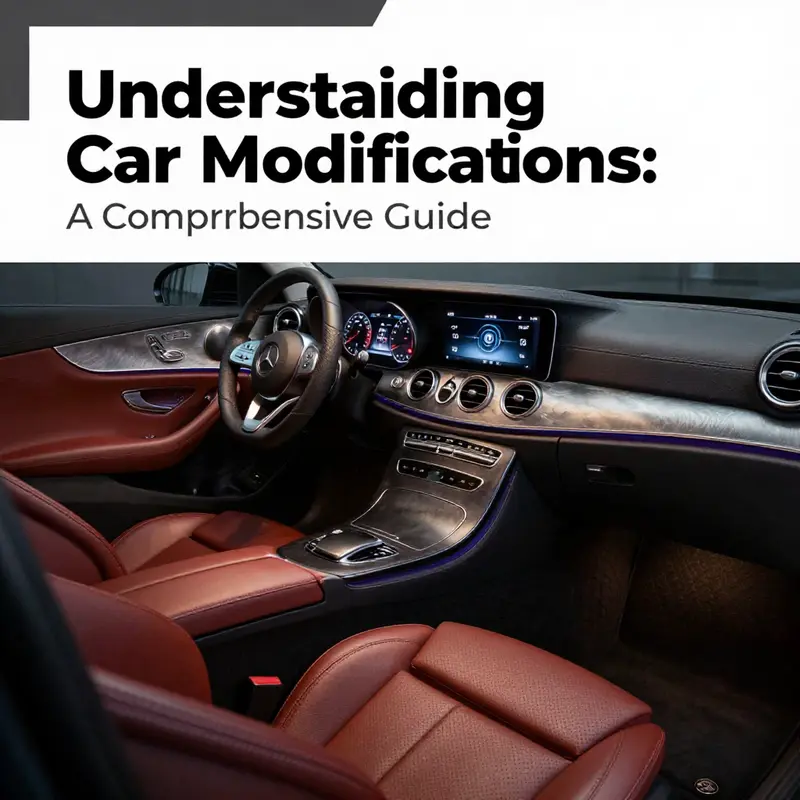
The cabin of a car is more than a place to sit; it is the room where daily life unfolds on four wheels. Interior modifications, sometimes overlooked in favor of more dramatic exterior or performance tweaks, define the car’s personality and how it feels to drive and ride in it. They shape comfort, influence perception, and can transform how a vehicle fits into everyday routines. When done with care, interior changes align with personal needs without compromising safety or reliability. The goal is not simply to adorn the cabin, but to tune the environment so that it supports the way a person lives, works, and travels, whether the ride is a daily commute, a weekend adventure, or a family chore of hauling gear and friends. In this realm, the modifications are quietly practical while still offering a strong sense of identity. They blur the line between utility and luxury, function and feeling, and they invite the owner to inhabit the vehicle more fully, day after day.
Seat upgrades sit at the heart of interior modification. They are not merely about looks; they change how the body and the car interact. Replacing factory seats with higher performance options or custom upholstery can enhance lateral support, reduce fatigue, and improve long-haul comfort. Materials such as leather, Alcantara, or carbon fiber offer tactile feedback and a premium feel, while sport seats or bucket seats provide firmer side support during spirited driving. The choice of seat is a statement about the car’s purpose and the driver’s habits. Yet the decision must consider ergonomics, adjustability, and safety. Seats contain or interact with critical systems like airbags and occupancy sensors, so installation should preserve these functions. Mounting positions, rail compatibility, and seat weight all matter for overall balance and braking behavior. A thoughtful interior upgrade respects the car’s chassis harmony and avoids creating new blind spots or visibility challenges. In other words, comfort and safety should advance together, not in tension.
Steering wheel customization is another intimate modification. A sport wheel or a wheel with a smaller diameter can sharpen steering response and provide a more immediate sense of connection to the road. A flat-bottom design often signifies a driver-first intent, and paddle shifters accommodate rapid gear changes in automatic or dual-clutch transmissions. The tactile feel—the grip, the texture, the warmth from a well-wrapped wheel—shapes confidence at the helm. Compatibility with airbags, horn functions, and steering-column electronics is essential. Any change that alters the steering feel must preserve the car’s safety signaling and control layout. When done with professional care, a redesigned wheel can complement seat upgrades and enhance the overall cockpit experience without upsetting the vehicle’s electronic ecosystem.
Dashboard and trim enhancements play a crucial role in defining the interior’s character. Custom trim pieces, carbon fiber accents, wood veneers, or brushed metal inserts can elevate perceived quality and sophistication. These touches do not directly improve performance, yet they influence how the car feels when the driver sits behind the wheel. The right combination of materials and finishes can transform creaks, textures, and reflections into a coherent aesthetic. This is where interior design meets engineering practice: the weight and stiffness of panels, the integration of ambient lighting, and the way trim pieces interface with switches and displays all matter for durability and long-term appeal. A well-executed upgrade preserves the car’s proportional balance, ensuring that added chrome, matte, or satin surfaces do not clash with seat geometry or instrument placement. Proper finishing also protects resale value, signaling care and a thoughtful approach to personalization.
Audio systems and acoustic comfort deserve close attention. Upgrading the factory setup often means adding higher-fidelity speakers, a subwoofer, and amplifiers to deliver cleaner highs, deeper bass, and more accurate imaging. The cabin’s acoustics play a decisive role in how music or podcasts accompany daily travel, but so does the vehicle’s insulation. Noise-dampening materials, improved door seals, and under-carpet padding can suppress road and wind noise, making the listening experience more immersive without overpowering conversation or alerts from the car’s safety systems. Yet the integration of a sophisticated audio network must respect power demands, heat management, and the vehicle’s CAN bus architecture. A misstep can lead to electrical noise, interference with sensors, or battery drain. The most successful installations blend form and function: audio quality that sounds effortless across various speeds while preserving the cabin’s quiet refuge when the engine is off.
Interior lighting is a small but potent tool for mood and usability. Ambient lighting, whether subtle LEDs tucked under the dash or footwell illumination, sets a tone for how the cabin feels at dawn, dusk, or night. Color choices can reflect personality—calm neutrals for a serene cabin, vibrant hues for a sportier atmosphere—or respond to driving modes that shift the mood with the turn of a dial. Beyond aesthetics, lighting improves practicality: better visibility of controls at night, clearer foot placement, and easier access to essential items. Modern interior lighting systems can synchronize with drive modes, climate, or audio scenes, creating a cohesive sensory package that reinforces how the car is used. The best setups balance brightness, color intensity, and power consumption so that the cabin remains comfortable and energy-efficient.
Flooring and carpeting may seem modest, but they anchor the cabin’s durability and cleanliness. Replacing routine floor mats with performance mats or heavy-duty liners protects the original carpet from wear and spills. Some owners opt for modular floor decking to create a more organized cargo area or to simplify maintenance after weekend adventures. Good flooring choices consider foot traffic, heel wear, and ease of cleaning, especially in climates with mud, snow, or frequent sand. A clean, well-protected floor contributes to the sense of order inside the cabin and reduces maintenance time, which in turn supports more time behind the wheel rather than near the vacuum cleaner. These practical adjustments also communicate a commitment to the car’s long-term condition, a signal that the interior is valued as a living space rather than a disposable shell.
Gauges and instrumentation offer a bridge between comfort and information. Aftermarket gauges or digital display modules can provide enhanced monitoring of critical engine or environmental parameters. Oil pressure, water temperature, boost, voltage, or air-fuel ratio can be tracked in a more granular way than the stock cluster allows. While some drivers prize a sterile, minimalist cockpit, others crave a technical cockpit feel where data is readily visible at a glance. The key is to integrate new gauges without creating visual clutter or distracting the driver. A clean, well-routed gauge cluster or digital readout improves situational awareness, especially on longer trips or during track days. It is also important that any additional instrumentation does not conflict with the car’s existing warning systems or driver-assist features. As with all cabin electronics, the installation should be mindful of heat, accessibility, and reliability over time.
Custom electronics and displays extend the cabin’s capabilities beyond the stock configuration. Head-up displays, backup cameras, and touchscreen infotainment systems can add practical value, safety features, and intuitive control. A properly integrated system presents information where the driver expects it and does so without requiring a heavy lift of the eyes from the road. When adding new displays or interfaces, the installer must respect the vehicle’s power distribution, data networks, and safety features. Compatibility with parking sensors, camera feeds, and voice control can influence how seamlessly the upgrade fits into everyday use. The best installations blend seamlessly with the car’s interior lines, preserving the cockpit’s aesthetic while expanding its functional horizon. They also keep data privacy and cybersecurity in mind, ensuring that a connected system does not expose the vehicle to unnecessary risk.
Rear seat and cargo area modifications focus on utility and ergonomics. Foldable tables, storage organizers, or custom cargo nets can make the rear cabin a more versatile workspace or family helper. These changes can be especially valuable for road trips, business travel, or transporting equipment. The aim is to enhance organization without compromising passenger comfort or safety. Clever design choices consider how often the rear space is used, how easy it is to clean, and how readily the configuration can be adjusted for different loads. This often involves modular components that can be stowed or deployed without tools, maintaining a clutter-free environment that still adapts to changing needs. In some cases, rear modifications may touch on climate control or audio paths, requiring careful routing to avoid interference with the front seating area and the vehicle’s primary systems.
All interior modifications carry a shared caveat: safety and practicality must guide every decision. Anything that alters the cabin’s geometry, adds weight in ways that affect balance, or interferes with airbag deployment, seat occupancy sensors, or seat belt pretensioners requires careful assessment. The interior is the most intimate space in a car, and changes should support the driver’s tasks without introducing new risks. This is why many enthusiasts work with professionals who understand automotive electronics, upholstery, and safety standards. A thoughtful interior project begins with a clear sense of priorities: whether comfort, usability, or presentation matters most, and how to preserve the car’s original character while accommodating new needs. The result should feel like a natural evolution of the vehicle rather than a clash between the stock configuration and aftermarket vision.
Beyond personal taste, interior modifications also interact with broader concerns of value and longevity. Perceived quality within the cabin can elevate the overall sense of luxury and care, which can influence resale appeal. Yet excessive or poorly executed changes may detract from a vehicle’s originality or raise questions for future buyers. For this reason, many owners prioritize reversible or well-documented modifications. For example, modular installs or high-quality leather and trim that can be removed with minimal trace helps safeguard the car’s originality. Documentation of materials, installation steps, and electrical schematics provides transparency for future owners and can ease potential resale negotiations. The most lasting interior projects are those that respect the vehicle’s architecture, preserve critical safety features, and demonstrate thoughtful alignment with the owner’s lifestyle.
When thinking about interior modifications, it helps to approach the process as a project with a coherent plan rather than a series of impulse upgrades. Start with honest assessments of how you use the car, what you value during daily drives, and which aspects of the cabin most influence your well being on the road. Then consider how each modification affects others: will a new seat require different rails or a redesigned steering wheel change the available space around the instrument cluster? Can a brighter ambient lighting scheme distract at night, or does it enhance readability of controls in low light? Asking these questions early keeps the project cohesive and reduces the risk of a compartmentalized interior that feels disjointed. A well-integrated approach results in a cabin that not only looks tailored but also functions harmoniously, supporting the way the vehicle is used rather than forcing the user to adapt to a patchwork of add-ons.
For readers curious about taking practical steps toward interior upgrades, a useful starting point is to learn about installation best practices and safety considerations. A guided approach helps ensure that enhancements are secure, durable, and compliant with safety standards. How-to resources can offer structured checklists and professional guidance, helping avoid common missteps and ensuring that upgrades age gracefully with the car. See a practical guide on interior modifications to begin planning your own project: how-to-install-modifications-car. This kind of resource can help you map out a pathway from concept to completed cabin upgrade while keeping your vehicle’s core systems intact.
Ultimately, interior modifications are about shaping a space that supports a person’s life on the road. They are an expression of taste, a statement about how a car should feel, and a commitment to making daily transportation a more enjoyable, efficient, and meaningful experience. When approached with care for safety, durability, and future usability, interior changes can enrich the ownership experience without sacrificing reliability or the car’s fundamental character. The cabin becomes less a static shell and more a dynamic arena where function, comfort, and personality converge every time the doors open and the ignition is engaged. As with any meaningful customization, the best interior modifications are those that respect the vehicle’s original design while elevating the everyday driving experience to something that feels tailor-made for the owner’s life and ambitions.
External resource for further reading: https://www.autoblog.com/interior-car-modifications-what-you-need-to-know
Power, Precision, and the Road: Understanding Performance and Mechanical Modifications

Modifications to a car stretch far beyond paint jobs and badge swaps. They are a deliberate reconfiguration of a vehicle’s core systems, aimed at altering how a car delivers power, how it handles, and how it communicates its presence to the road. When you focus on performance and mechanical changes, you step into a realm where every bolt, bolt pattern, air path, and calibration decision can shift the way a car feels on the throttle, through a corner, or under braking. This chapter follows that thread, tracing how these modifications are categorized, what they do in practical terms, and how drivers balance the thrill of performance with the realities of reliability, safety, and legality. The aim is to articulate a cohesive framework for understanding modifications that truly touch a car’s mechanical core, rather than cosmetic upgrades that merely alter appearance or perception.
At the heart of performance modifications is a simple but powerful idea: you want the car to respond more quickly, accelerate with less delay, and corner with greater control. Achieving that requires changes that affect power delivery, energy management, and the way the drivetrain transfers torque to the wheels. These are the modifications that excite enthusiasts who track their cars, drive spiritedly on winding roads, or simply want a more engaging daily experience. Yet the path from concept to real-world result is not a straight line. Each modification interacts with the others, with the baseline design of the engine, the cooling system, and the chassis, and with the reliability requirements that come with more aggressive performance.
To understand why these changes matter, it helps to break down the core domains where performance and mechanical modifications typically occur. Engine upgrades are the most obvious category, because they directly affect how much power the car can produce. Engine upgrades often involve forced induction or boosted air intake in a way that increases air and fuel flow, creating more opportunities for the engine to generate torque and horsepower. Turbochargers and superchargers are the archetypal examples here, though the broader idea includes camshaft work, mild valvetrain adjustments, and carefully balanced enhancements to the intake and exhaust paths. The key is not simply to shove more air in, but to do so in a controlled way that preserves efficiency and safety margins across the entire operating range. Upstream and downstream components—such as intercoolers, intake manifolds, fuel injectors, and fuel pumps—must be considered in concert with any engine power goal. Without these supporting elements, the engine can run hotter, sip fuel less efficiently, or deliver power in a way that is unpredictable or unsafe.
Intake and exhaust modifications represent another essential lever. A cold air intake, a higher flow intake, or a freer exhaust path can lower backpressure and improve engine breathing. The result is often crisper throttle response and a more pronounced engine note. However, increased airflow is not a cure-all. If fuel delivery, ignition timing, and cooling are not aligned to the new flow characteristics, you risk knocking, detonation, or excessive heat near the exhaust system. The synergy between air intake, combustion control, and exhaust exit is why many teams approach this category with careful dyno testing and a structured calibration plan. A well-designed upgrade in this area will feel immediate at lower rpm while preserving tractable, street-friendly manners at normal driving speeds. For readers seeking a concise overview of how such modifications fit into a broader plan, see car-modifications-guide.
Engine management and ECU tuning form the cognitive core of performance work. The engine control unit does more than fine-tuning fuel and ignition; it harmonizes boost pressure, timing, and air-fuel ratios with sensor feedback that reflects real-time conditions. Reprogramming or software updates alter those relationships to extract more consistent power output, better throttle response, and sometimes greater efficiency. The art here is to push performance without compromising reliability. Tuning must respect the engine’s mechanical limits, fuel supply, cooling capacity, and transmission strength. A miscalibration can introduce a safety margin that is too narrow, leading to detonation under load, unusual fuel economy, or abrupt fuel cutoffs. Car owners who pursue ECU tuning typically rely on reputable tuners or calibrated software that maps power delivery across the engine’s entire rev range, including safe limits in high-heat, high-load scenarios such as hot weather or track sessions.
Beyond the engine itself, transmission and drivetrain modifications refine how that power translates to motion. A shorter gear ratio or a short-throw shift kit can shorten the time between gear selections, tightening the perception of acceleration. Upgrading a clutch or introducing a limited-slip differential can improve power transfer to the wheels, especially when torque is high. These changes often accompany power upgrades to preserve a balanced, predictable feel. In practice, the drivetrain is the bridge between the promise of more power and the actual experience of engaging that power on the road. When executed well, transmission and clutch enhancements reduce the tendency to overwhelm the tires, maintain stable launch characteristics, and support consistent lap times on a circuit.
Suspension and brake systems anchor the chassis performance that makes power usable. Performance-oriented suspension work aims to reduce body roll, sharpen steering response, and keep tires in optimal contact with the road through corners and over irregularities. Adjustability, such as through coilover systems, can let a driver tailor ride height, damping, and spring rates to the driving environment—whether it is a daily commute, a canyon road at dusk, or a race circuit. Brakes must keep pace with heightened power and faster pace. Upgrading rotors, calipers, and pads—along with properly matched brake fluid and cooling—helps maintain stopping confidence under higher temperatures and greater loads. The objective is not to trade comfort for speed, but to preserve controllability when the car is pushed beyond stock limits.
A common thread through these mechanical domains is the insistence on compatibility. The parts you add or modify rarely exist in isolation. Replacing the exhaust with a freer path, for example, changes exhaust gas temperatures that influence engine knock margins and turbo efficiency. ECU tuning then calibrates fueling and ignition to match those temperatures and flows. Suspension upgrades alter chassis stiffness and aerodynamics slightly, which in turn affects how the wheels contact the pavement under load. In short, each modification has a ripple effect that must be considered with a systems thinking approach. This is where professional assessment and testing become crucial. The goal is to realize the desired performance gains without inviting new problems—such as abnormal wear, overheating, or unpredictable handling under stress.
The idea of synergy also ties into how performance upgrades interact with the car’s cooling system and fuel system. A higher power level demands better cooling to dissipate heat that would otherwise erode performance or shorten component life. A more aggressive air intake and exhaust path can increase intake noise and exhaust gas temperatures, which downshift the engine’s efficiency if not properly managed. In the same vein, fuel delivery must keep pace with the increased air entering the engine, especially at high loads. This often means larger or more capable injectors, a stronger fuel pump, and a tune that matches the engine’s enhanced breathing with its fuel supply. Without this balanced approach, a car can become thrilling to drive at small bursts of power but unreliable in everyday use.
From a practical standpoint, the path to performance and mechanical upgrades begins with a clear objective. Some drivers prioritize ultimate straight-line acceleration; others seek sharper cornering, improved midrange torque, or a more linear throttle response. The planning phase also demands a candid assessment of the car’s baseline limitations, such as the strength of the engine internals, the cooling system’s capacity, and the drivetrain’s ability to handle higher torque. A well-executed program typically includes a phased plan that starts with safe, reversible changes and progresses to more integrated modifications once the system’s response is understood. Testing, whether on a dyno, a controlled track environment, or controlled street runs, is essential to verify improvements and to quantify the impact of each change.
In discussing performance modifications, it is important to acknowledge the legal and safety dimensions that frame what is permissible or advisable. Modifications that alter the vehicle’s powertrain or chassis can affect stability, braking balance, and emissions compliance. Some jurisdictions require that changes to the engine or exhaust be registered, inspected, or certified. Unauthorized or illegal modifications can lead to fines, vehicle impoundment, or mandatory restoration to stock configuration. Even when a modification is technically feasible, it may have implications for insurance coverage, warranty status, resale value, and long-term maintenance costs. For readers exploring these paths in earnest, the journey should begin with a careful assessment of regulatory expectations and a plan to document compliance where required. A balanced approach often involves collaborating with a qualified technician, ensuring documents and approvals are in order, and maintaining a log of changes that can be traced in the event of future inspections or ownership transfers.
To connect these ideas to a practical starting point, consider the resources that guide modifications as a field. A concise, structured overview can be found in car-modifications-guide, which summarizes how performance modifications are categorized and how to approach them responsibly. This kind of guide helps frame decisions around which upgrades align with a driver’s goals and which paths preserve the car’s overall reliability and safety. While it is possible to chase power alone, the most satisfying outcomes emerge when performance improvements are matched with appropriate supporting systems and a clear understanding of the vehicle’s operating envelope.
For readers seeking broader context on how performance concepts translate into real-world practice, a deeper technical explainer provides insights into the mechanics and theory behind car mods. The Autocar explainer on car mods explains the technical details, features, and practical implications of modifications, offering perspective beyond the individual components described here. External reference: https://www.autocar.co.uk/article/car-mods-explained-technical-details-features-and-industrial-implementation
Specialized vs Functional Modifications: Crafting Performance, Appearance, and Practicality in Modern Cars

Modifications on a car do not exist in a single dimension. They sit along a spectrum that ranges from raw, track-ready performance to subtle, functional upgrades that improve daily usability. When the idea of modifying a car is framed as a choice between specialized and functional modifications, the discussion becomes less about chasing trends and more about shaping the vehicle to fit the owner’s goals, driving environment, and practical constraints. This classification helps owners navigate decisions around power, aesthetics, safety, and upkeep, while also clarifying how changes interact with registration, insurance, and maintenance responsibilities. The two categories are not mutually exclusive. A single modification can carry both functional benefits and aesthetic impact, and some upgrades straddle boundaries so comfortably that they become almost inseparable from the car’s character and how it is used. Yet recognizing the distinction remains useful, because it foregrounds the motives behind each choice: performance and personality on one side, reliability, safety, and intelligence on the other.
Specialized modifications center on altering the vehicle’s behavior or its presence in the world of driving. On the performance front, owners often seek to extract more power and torque, sharpen throttle response, and improve the way the engine breathes and delivers its electricity to the wheels. Engine tuning or remapping is a core example. By recalibrating the engine control unit, the engine can deliver more usable power within the safe operating envelope of the hardware, which might also translate to a more linear power curve and faster response under load. In many setups, the path to higher performance goes through the intake and exhaust systems. A higher-flow air intake reduces restriction, while a refined exhaust path can free up some potential in the exhaust note and engine efficiency. The goal here is not just louder sound or a higher number on a dyno; it is a more engaging driving experience—one that rewards precise throttle control and purposeful gear selection, especially in spirited driving or on a circuit where the car’s chassis can truly shine.
Where the specialized path sometimes departs from brutal performance into visual dominance, body styling packages enter the conversation. Front lips, side skirts, rear diffusers, and wings or spoilers are designed to alter the car’s stance and aerodynamics, sometimes with real, measurable gains in downforce, sometimes primarily to create an imposing silhouette. The distinction matters: in many jurisdictions, certain aero elements may require adjustments to suspension, tires, or even wing mounting points to maintain safety and compatibility with the car’s handling balance. Aesthetic modifications—such as bespoke paint finishes, matte or gloss wraps, and carefully chosen color accents—do more to shape perception than to alter fundamental engineering. They influence how the car is read on the road, how it reflects the owner’s taste, and how it sits within a particular automotive subculture. The excitement of a unique color or a sculpted kit is real; it often becomes the first impression a car leaves, even before performance data is taken into account.
On the functional side, modifications emphasize how a car gathers data, informs its driver, and maintains itself. The modern vehicle is a networked system of sensors, controllers, and communication channels. A key functional upgrade is the installation of a data-logging system based on access to the onboard diagnostics, commonly referred to as OBD data. An OBD-II data logger can capture engine speed, load, fuel trims, temperatures, and error codes. This information is invaluable for proactive maintenance, diagnosing anomalies, and understanding how driving styles influence fuel economy and component wear. Beyond data collection, functional modifications often expand the vehicle’s ability to warn and assist. A remote diagnostic system or a telematics module can alert the owner or a service provider to parameter deviations, enabling faster interventions and reducing the risk of unexpected failures. In some configurations, these upgrades weave into a broader smart-vehicle strategy, where sensors and software cooperate with the car’s existing control logic to optimize performance, efficiency, and safety.
The functional path also embraces safety-oriented enhancements that do not push for raw power but rather for better awareness and control. Advanced driver assistance features, collision avoidance aids, lane-keeping assistance, and adaptive cruise control—when implemented through aftermarket integrations or enhanced software—represent a commitment to modern safety norms. While these systems must be compatible with the vehicle’s electrical architecture, they emphasize reliability and clarity of information: what the driver sees, how the car responds, and how the road conditions are conveyed back through the instrument cluster. In practical terms, functional upgrades may involve the addition of smarter wiring, more robust connectors, and higher-quality sensors, all calibrated to deliver real-time data without confusing the driver or interrupting existing systems. The intent is not to overwhelm the cockpit with gadgets but to elevate the driver’s understanding of the car’s health and to provide actionable insights that improve daily operation and long-term reliability.
The distinction between specialized and functional modifications remains a useful lens, yet reality often requires a pragmatic blend. A performance exhaust is a notable example: it serves a functional purpose by reducing backpressure and tuning the exhaust flow, but it also changes the car’s auditory signature and visual cues. A suspension upgrade designed to improve handling can be equally affective in daily life—if it’s paired with careful alignment and tire selection, it becomes a practical upgrade rather than a reckless alteration. Another example is carbon-fiber body panels or light-weighting strategies that not only alter the aesthetic rhythm of the car but can influence cornering behavior and braking performance by reducing unsprung mass. In this sense, the boundary is porous; the most satisfying modifications often address more than one goal at once, enhancing both the way a car looks and the way it behaves under pressure.
This integration invites a broader consideration of how a modification program is planned. A thoughtful owner begins by articulating driving goals: Is the priority the thrill of acceleration and track readiness, or is it keeping the car safer, more efficient, and easier to diagnose if something goes wrong? Budget naturally follows these questions, as performance-oriented work can demand expensive hardware, precise tuning, and meticulous installation. Yet the long-term cost picture also includes labor, potential warranty implications, and insurance considerations. The reality is that modifications, no matter how well intentioned, are not standalone changes. They interact with the car’s architecture, its registration status, and its daily use, and they must harmonize with the existing mechanical and electronic systems to avoid diminishing the car’s reliability.
To support a balanced approach, many owners consult comprehensive guides that walk through both the theory and the practice of modifying a car. A practical, step-by-step overview can help align aspiration with feasibility. For readers seeking a structured primer, a dedicated car modifications guide offers a grounded starting point that emphasizes planful, responsible customization while outlining the regulatory and safety dimensions involved in most markets. car modifications guide.
As the discussion deepens, it is important to acknowledge the legal and regulatory frame that governs modifications. A disciplined approach to changes must account for vehicle registration, safety inspections, and the possibility of warranty or insurance implications. In many regions, altering critical systems—such as the chassis, braking architecture, or powertrain—can require official documentation, inspection, and compliance with emission and safety standards. Even aesthetic choices, if they affect visibility, lighting, or structural components, may be subject to limitations. The overarching principle is clear: modifications should enhance the car’s function or its expression without compromising roadworthiness, accountability, or the ability to verify its identity against registration records.
Within that framework, a practical pathway emerges. Start with a thorough inventory of the car’s current limits and the owner’s aims. Do not assume that more power is always the right answer; consider how the drivetrain, cooling, suspension, and tires will respond to added force. For a street car, the objective often leans toward a coherent balance: a modest power uplift paired with a calibrated handling package and tires tailored to the chosen setup. For a track-day enthusiast, the focus might shift toward the full spectrum of modifications—engine, intake, exhaust, braking, suspension—but with a plan for heat management, reliability, and service intervals that keep the car predictable under repeated high-stress cycles. In both scenarios, functional mods like data capture and remote diagnostics should be integrated early in the plan. They provide a compass for tuning decisions and a safety net for the owner by enabling proactive maintenance rather than reactive fixes.
The conversation about modifications then becomes more than a catalog of parts. It evolves into a philosophy of car ownership that values intention, consequence, and accountability. A practical mindset asks questions that frame the path forward: Is the modification aligned with how the car is used daily or reserved for weekends on a track? Does it maintain or enhance the car’s reliability, or does it invite unplanned downtime? How will the change affect insurance, legal compliance, and resale value? By answering these questions, owners can build a coherent story around their car’s evolution—one that respects the balance between performance, appearance, and practicality while avoiding the pitfalls of uncoordinated modifications.
The two core categories—specialized and functional—also illuminate how a car’s identity can evolve over time. A vehicle that starts with a tasteful aesthetic upgrade may gradually absorb performance elements as the owner’s goals shift. Conversely, a car bought for daily use can become a laboratory for data-driven improvements that enhance safety and maintenance. Even then, the changes should be harmonized with the car’s existing architecture and the driver’s expectations. The best outcomes are those where the modifications feel like a natural extension of the vehicle’s character rather than a jarring departure from it. When that alignment happens, the result is a car that resonates with the driver on multiple levels: the thrill of control, the clarity of feedback through instrumentation, and the assurance that the car remains a reliable companion on every journey.
For further exploration of how modifications intersect with broader automotive trends and practical constraints, consider the comprehensive discussion offered in industry coverage on performance, aesthetics, and functionality. External perspectives can broaden a reader’s understanding of what is feasible, how different markets regulate changes, and how professionals evaluate risk and reward in customization. External resource: https://www.autocar.co.uk/car-news/new-cars/car-modifications-performance-vs-aesthetic-vs-functional
Final thoughts
Car modifications encompass a wide range of enhancements that allow enthusiasts to tailor their vehicles to personal tastes and performance preferences. From eye-catching exterior designs to comfort-driven interior updates, and from performance enhancements to specialized functional adaptations, the possibilities are vast. However, with this freedom comes the responsibility to adhere to legal guidelines that ensure safety and compliance. Embracing modifications thoughtfully not only elevates the driving experience but also fosters a vibrant community of automotive innovation. Whether you’re a hobbyist or a professional, maintaining a balance between creativity and legality will lead to lasting satisfaction in your automotive journey.