
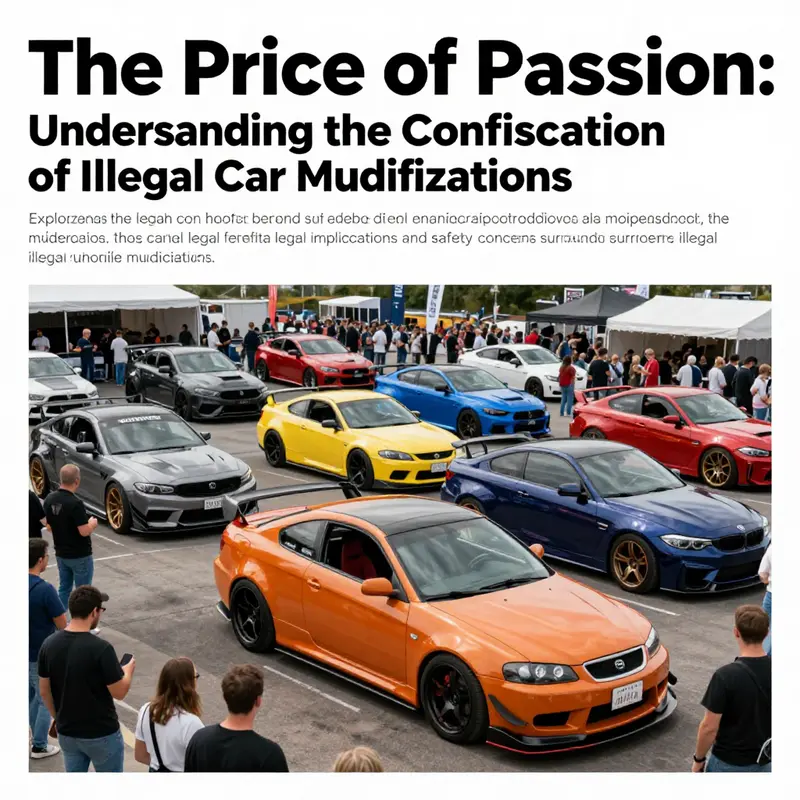
Car modifications are a beloved pursuit for many enthusiasts, allowing them to express their individuality and enhance performance. Yet, such modifications can run afoul of the law, leading to serious repercussions. With authorities increasingly cracking down on illegal alterations, understanding how these modifications can be confiscated becomes critical for hobbyists, professional tuners, and classic car restorers alike. This article delves into the legal framework that governs car modifications, exploring how safety concerns impact regulations and outlining the potential enforcement measures and penalties for illegal modifications. Each chapter contributes to a comprehensive understanding of the risks and responsibilities associated with car modding, helping enthusiasts navigate this complex landscape.
Confiscation on the Road: The Legal Leverage Behind Illegal Car Modifications
Car culture thrives on personal expression and technical curiosity, yet in the realm of public roads a line is drawn by safety and regulatory standards. In China, the menu of modifications is broad, but not all modifications are allowed. The Road Traffic Safety Law, particularly after its 2023 revisions, sets out a clear framework for what qualifies as illegal and what authorities may do in response. The core idea is simple: when a modification undermines safety, emissions conformity, or the vehicle’s identifiable configuration, it becomes a matter for the police and regulatory agencies. The consequences can be harsh, extending beyond fines to the confiscation of the vehicle or its components, and in the most serious cases, to the revocation of the driver s license. This is not a capricious system; it is a carefully calibrated structure designed to preserve road safety while allowing for legitimate, compliant customization within a well defined boundary. Enforcement operates at the intersection of practical policing and policy objectives, grounded in the need to keep thousands of different models and configurations aligned with a shared set of standards. When perceived as a threat, illegal modifications trigger a procedural response that aims to restore compliance rather than to punish indiscriminately. The public interest, after all, rests on road users sharing a predictable environment where vehicles can be inspected, traced, and maintained according to national norms. For readers interested in the legal contours and their practical implications, the official materials and guidance published by the Ministry of Public Security provide the most authoritative map of the landscape. In the meantime, the lived experience of enforcement becomes a clear reminder that what looks like a clever tweak can rapidly become a legal liability if it crosses the boundary into noncompliance. A practical window into this process is provided by the January 2026 Shanghai case, where a driver who attempted a radical powertrain modification faced straightforward consequences: the vehicle was seized, illegal components were confiscated, the driver was fined, and the license was revoked. That incident crystallizes a few core truths about the legal regime. First, the state does not permit a freewheeling approach to engine tuning or VIN manipulation on a public road; second, the enforcement apparatus can apply both corrective and punitive measures in a single sweep; and third, the line between permissible and illegal is defined with enough precision that it can be applied consistently across cases that vary in scale and risk. The underlying policy intent is to prevent unsafe configurations from circulating, to maintain compatibility with safety inspections, and to ensure that vehicles remain trackable through their VIN, registration, and insurance histories. This is why the framework is as concerned with the legality of a modification as with the practical outcomes such as performance or aesthetics. For those who want to explore how this looks in a broader Chinese context, a detailed discussion of legal car modifications in China can offer a useful comparative lens. See the dedicated resource on legal car modifications in China for more context on how these principles are applied in everyday practice: https://modifiyeliarabalar.net/blog/legal-car-modifications-china/. The official regulatory backbone remains the Road Traffic Safety Law and its implementing provisions, with the Ministry of Public Security serving as the primary custodian of guidance and enforcement standards. External insight into how these processes operate in real time can be found on the government portal, which provides the formal procedures and the basis for administrative actions in these matters: https://www.mps.gov.cn.
Confiscation at the Edge: How Illegal Car Modifications Trigger Enforcement, Sanctions, and the Silence of the Law
Modifying a car is often framed as personal expression, but illegal modifications can trigger enforcement actions including fines, restoration orders, license suspensions, and, in severe cases, confiscation. This chapter explains why confiscation exists, how it operates under the Road Traffic Safety Law and the Administrative Compulsory Law, and what drivers can do to stay within legal boundaries. It discusses the risk hierarchy of modifications—from appearance changes to powertrain tampering—and the practical steps authorities take during inspections and seizures. It highlights a representative case in Shanghai and the penalties described in the post-2023 updates, which outline the spectrum from warnings to confiscation and compulsory scrapping. The goal is to understand the balance between customization and public safety, and to provide a quick checklist for lawful modification: ensure regulatory compliance, document changes, maintain VIN and registered data, and be prepared for restoration if necessary.
Confiscation and Compliance: How Authorities Enforce Illegal Car Modifications and Restore Road Safety
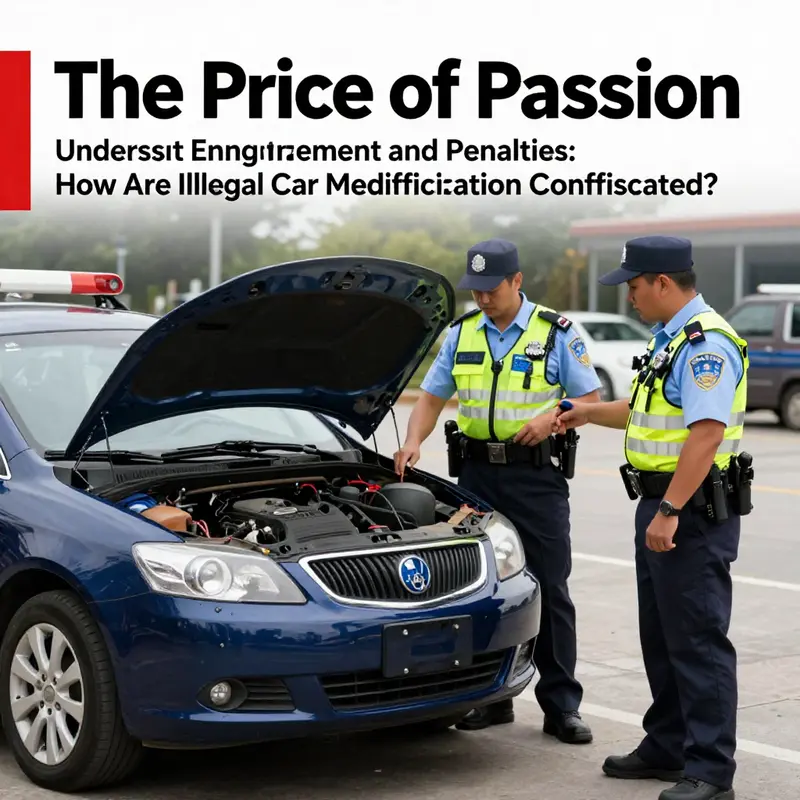
When a vehicle modification crosses safety or registration boundaries, authorities respond with a structured sequence of checks, orders, and penalties designed to restore roadworthiness while preserving public trust in the vehicle registry.
Enforcement actions start with on-site assessment and may lead to immediate restoration orders, removal of illegal devices, and, in clear safety threats, temporary seizure or impoundment. The confiscation authority is anchored in statutory provisions that empower officers to seize devices that fail to meet standards.
Confiscation scope includes devices such as unauthorized lighting, sirens, or performance modifications that compromise safety. In the most severe cases, the entire vehicle can be impounded or confiscated, though this happens only when the risk to road safety is demonstrable.
Fines and penalties are tiered by severity, with smaller infractions carrying modest sums and larger violations potentially triggering higher fines, points on the driver license, and even insurance complications.
The process emphasizes restoration: owners are required to revert the vehicle to its original specification, remove aftermarket components, and ensure the VIN and documentation align with the registry. Appeals exist but the default aim is to return the vehicle to compliant condition quickly.
Public guidance and official portals provide up-to-date rules, forms, and contacts. For official procedures, consult the National Traffic Management System, such as 122.gov.cn.
Final thoughts
The world of car modifications holds both excitement and risk, especially as illegal alterations can lead to significant legal consequences. Understanding the legal framework surrounding vehicle modifications is essential for enthusiasts to avoid pitfalls. This knowledge, coupled with awareness of the potential safety risks these modifications pose, equips car enthusiasts, professional tuners, and shops with the tools necessary to make informed decisions. As the laws continue to evolve, staying educated on enforcement practices and penalties is crucial for anyone passionate about modifying vehicles. Embrace your passion for modification responsibly and within the law.