
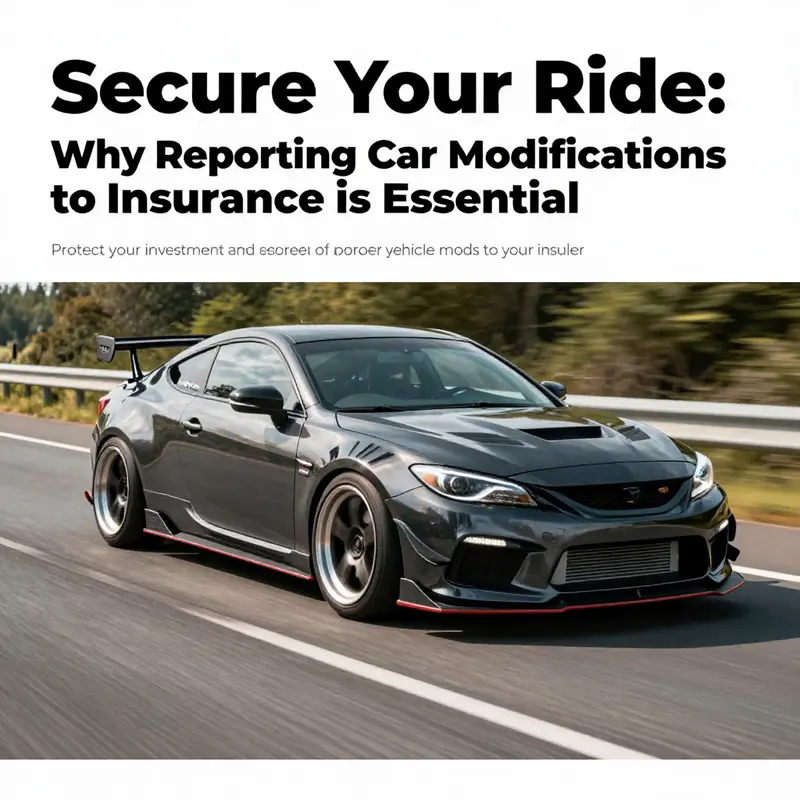
In the vibrant world of car modification, enthusiasts from hobbyists to professional tuners pour passion, skill, and resources into their vehicles. Whether it’s enhancing performance, aesthetics, or both, modifying a car can significantly alter its value and risk profile. However, while the thrill of customizing your ride is undeniable, failing to report these changes to your insurance can jeopardize your financial security. This guide delves into the necessity of disclosing car modifications to your insurance provider, the potential repercussions of neglecting this duty, and how insurance policies relate to the modifications you’re passionate about. By understanding these facets, you can protect your investment and enjoy your modified vehicle with peace of mind.
Guarding Your Coverage: Why You Should Report Car Modifications to Insurance

When you think about modifying a car, your mind often focuses on aesthetics, performance, or personal expression. Yet the moment you sign up for auto insurance, a practical, sometimes less glamorous reality takes center stage: the policy you rely on is built on information. The idea that your car’s insurance hinges on accurate, complete disclosure isn’t a dry formality. It is the very mechanism that keeps the contract between you and the insurer honest, predictable, and protective when you need it most. In that sense, reporting car modifications to your insurance provider is not merely a courtesy or a bureaucratic step; it is a fundamental safeguard for the coverage you count on. The principle is straightforward: when you modify a vehicle, you change its risk profile, and that change must be reflected in your policy so that your protection remains valid and your financial exposure remains manageable.
The policy you carry rests on a mutual understanding. The insurer agrees to provide coverage, and you agree to disclose information about the vehicle and its risks honestly. If the car has undergone alterations that affect safety, performance, or value, those changes influence the probability of a claim and the amount that might be paid. The concept at stake is material misrepresentation. If a modification is significant enough to alter risk and you fail to disclose it, you may be breaching the contract. In practical terms, this breach can lead to a denied claim or, in the worst case, cancellation of the policy. That is not merely about losing coverage for one incident; it can create a longer-term vulnerability, especially if you continue to drive without a valid policy in force.
To understand why reporting matters, it helps to picture risk as a moving target. A car that’s equipped with a high-performance engine, a reinforced suspension, a sportier exhaust system, or a heavy-duty body kit does not behave the same as the stock version. It might accelerate faster, brake later, or respond differently in emergency maneuvers. It could be more valuable, making theft or total loss a larger potential payout. Some modifications even affect repair costs because after-market parts can fluctuate in price, availability, and compatibility with standard repair methods. Insurance companies price risk, and when that risk shifts, premiums, coverage limits, deductibles, or even the types of coverage offered can change as well.
An important refrain to keep in mind is simple and pragmatic: when in doubt, report it. This approach protects you by ensuring your policy reflects the reality of your vehicle’s condition and value. Most insurers have clear procedures for disclosing modifications, and engaging with that process promptly helps prevent unpleasant surprises during a claim. The path to proper coverage is rarely complicated, but it does require proactive steps and organized recordkeeping.
Consider the breadth of possible modifications. Some changes are cosmetic: custom wheels, window tints, or a paint job. Others are mechanical or structural: a high-performance engine, upgraded cooling systems, turbo or supercharger installations, altered drivetrain configurations, or reinforced chassis components. Then there are modifications that alter the car’s value or risk of theft, such as aftermarket audio systems with high power draws, advanced alarm systems, or unique body kits that affect aerodynamics or pedestrian safety. Each category carries its own implications for coverage. A few seemingly minor upgrades can disproportionately affect risk, especially if they interact with other features like the car’s safety systems, brakes, or airbag deployment thresholds. The important point is not to attach a judgment about what counts as important, but to recognize that risk can shift in ways that aren’t always obvious at first glance.
From a practical standpoint, the impact of modifications on insurance will hinge on several factors. First, insurers evaluate risk based on the vehicle’s condition, usage, and value. A high-performance engine often increases both the car’s market value and its potential for faster speeds, which, in turn, can raise the likelihood of accidents or theft. Aesthetic alterations that enhance value can also influence premiums if they change the car’s overall replacement cost. Second, insurers consider how modifications affect safety and repair costs. Structural changes, altered suspension geometry, or non-standard components can alter how a vehicle behaves in a crash or during routine maintenance. Third, the availability of coverage for the modified components matters. Not all insurers offer the same level of coverage for modified cars, and some may require additional endorsements, higher deductibles, or specialized policies to adequately insure these changes. In short, the more a modification shifts risk, the more likely it is that your premium and policy terms will reflect that shift.
Because the landscape can vary between insurers, it is worth reviewing a practical principle: most car modifications can be covered, but securing coverage often requires extra steps. You may need to provide detailed documentation of the changes, including the type of modification, the date of installation, and the cost. Receipts, installation records, and even professional appraisals can help establish a clear picture of what exists and its value. Some companies will ask for before-and-after photos, the specifications of after-market parts, and the expected lifespan or warranty coverage of those components. If a modification is especially substantial or high-risk, the insurer might request a rider or endorsement to your existing policy, or they may quote a separate policy designed for modified vehicles. While this can lead to higher premiums, it also preserves the integrity of your coverage and prevents gaps in protection when you most need it.
Reporting reforms how insurance is priced. Premiums may rise to reflect increased risk, but disclosure can also prevent a sudden, post-claim dispute about whether the modification had been disclosed. A well-documented disclosure can assist the insurer in accurately valuing the vehicle and setting appropriate coverage limits. In some cases, disclosing a modification could even result in better terms—if the change meaningfully reduces risk in a way the insurer values, or if the modification is accompanied by appropriate safety enhancements, such as upgraded brakes, a fortified locking system, or improved crashworthiness. However, that kind of favorable adjustment is not guaranteed and varies by insurer and policy. The general rule remains pragmatic and conservative: transparency is protective. It helps keep the policy active, the claims process smoother, and the financial exposure predictable when a loss occurs.
From a claims perspective, accurate declarations about vehicle alterations ensure smoother processing and fair compensation. If a vehicle is damaged in an accident or is stolen, the payout often depends on declared value and the coverage terms attached to it. If the recorded value does not reflect the true replacement cost or the true market value after modifications, you risk receiving a payout that falls short of your actual needs. Conversely, a claim settlement that aligns with a fully disclosed, accurately valued vehicle is less likely to become a point of contention between you and the insurer. Keeping your policy aligned with your car’s current state reduces ambiguity, speeds up the claims process, and protects your financial position in the event of a loss.
There is also a legal and contractual dimension to this decision. Insurance agreements are contracts, and misrepresentation—even if unintentional—can create disputes that drag on for months. The evidence in many jurisdictions points to the principle that material facts should be disclosed to obtain the right level of coverage. When you don’t disclose modifications, you may be arguing with your insurer about the same facts that should have been shared before the policy existed. The safer, smarter approach is to build the disclosure into your ongoing routine. Document what was changed, why you changed it, and how you intend to use the car going forward. If you operate with a clear record, you reduce the chance of a later dispute and the risk of being left underinsured or uninsured when you need to file a claim.
For readers seeking a concise guide to how modifications influence coverage, a helpful starting point is to explore the article What Modifications Affect Car Insurance. It distills common trends and offers practical steps for disclosure that align with many insurers’ expectations. This resource can help you prepare the information your insurer will want and understand how different changes may affect premium decisions and coverage terms.
Beyond individual decisions, it is worth thinking about the broader context of modified-vehicle coverage. If you financed or leased your car, disclosures take on additional weight. Financing agreements frequently require lenders to be kept apprised of major changes to the vehicle. Some lenders may have their own requirements about modifications, and failing to comply can put the loan or lease at risk if the insurer subsequently disputes coverage or if the lender requests policy documentation during a default or a claim investigation. In these scenarios, the combination of a clear, documented disclosure to both the insurer and the lender can protect your ownership rights and prevent unwelcome surprises. It is a practical reminder that modification disclosure helps align all parties’ expectations and safeguards your investment.
The process of disclosure, while seemingly administrative, does not have to be arduous. The key is to collect and present information in a structured way. Start with a comprehensive inventory of changes: what was modified, the original specifications, the new specifications, dates of installation, the retailer or shop that performed the work, and any warranties or certifications connected to the modification. Gather verification of costs, such as invoices or credit card receipts, and include a current appraisal or valuation if your car’s market value has shifted as a result of the upgrade. Take clear photographs of the modifications, including close-ups of critical components and any installed safety devices. If the modification impacts safety features—such as upgraded brakes, enhanced stability control, or improved lighting—document how these systems function and any maintenance routines that accompany them. Presenting a well-organized dossier makes the disclosure straightforward for your insurer and reduces back-and-forth exchange that can delay coverage decisions.
When you initiate the disclosure, you’ll likely connect with an agent or a broker, or you may use an online portal. Provide a narrative that ties each modification to its practical implications: how the part changes the car’s performance, how it affects safety, how it changes potential repair costs, and how it informs the vehicle’s value. Be prepared to answer follow-up questions, such as whether the parts are original equipment manufacturer (OEM) replacements or third-party aftermarket components, the reliability and warranty status of those parts, and whether the modifications are reversible. Some insurers require third-party verification or professional appraisals for high-value modifications, while others may accept a documented statement from you accompanied by receipts. The goal is not to complicate the process, but to ensure the insurer has a complete, credible picture of your vehicle’s current configuration.
The decision to report is not just about whether a modification exists; it is about evaluating how the modification changes risk and what that means for your financial protection. If you are uncertain about a modification’s impact, err on the side of disclosure. The ongoing message to keep in mind is that disclosure is a protective act—a way of preserving policy validity, ensuring accurate claims handling, and maintaining financial control during unforeseen events. In other words, the best approach is transparent, thorough communication from day one, followed by timely updates whenever new changes occur. This approach reduces the chance of post-loss disputes and helps your insurer respond to your claim in a way that reflects the actual car you drive.
To bring these ideas into a practical frame, consider how to approach a conversation about disclosures with your insurer. Before you speak, prepare a concise summary of each modification, its purpose, and its cost. Use clear, straightforward language to describe how the modification alters the vehicle’s performance and risk profile. If a modification is ongoing, note whether it is a temporary or permanent change, and whether it affects maintenance schedules or warranty coverage. When you finish, ask about the exact documentation the insurer wants, the form of endorsement or rider if needed, and the expected impact on premium or policy limits. It is perfectly reasonable to request a written confirmation of any changes to your policy terms so that you have an official, dated record of what has been disclosed and agreed upon. This approach protects you, the insurer, and your lender—creating a transparent trail that supports fair treatment in the event of a claim.
There are times when modifications might be left out of a policy entirely, either because the insurer does not cover certain types of changes or because the risk is deemed too high without a specialized product. In such cases, you may explore insurers that offer more comprehensive coverage for modified vehicles or seek endorsements that specifically address the kinds of changes you’ve made. While this path can involve higher costs, it provides the assurance that your modifications are acknowledged, valued, and protected under your policy. The objective is not to chase the cheapest option but to secure robust protection that aligns with your car’s current state and your financial needs. This mindset aligns with the broader goal of responsible car ownership: balancing personal expression and performance with predictable, reliable protection against the unknowns of the road.
In sum, reporting car modifications to your insurance provider is a prudent, protective habit. It preserves policy validity, improves the accuracy of risk assessment, helps you secure appropriate coverage for modifications, and supports smoother claims processing. It also aligns with legal and contractual obligations in most scenarios, reducing the risk of disputes after a loss. The practice is not a bureaucratic hurdle but a cornerstone of responsible ownership that keeps your financial posture secure when your car is most valuable to you. If you are unsure how a particular modification will be treated, consult your insurer and, when appropriate, consult the relevant guidance available in widely circulated resources such as What Modifications Affect Car Insurance. The guidance you obtain will reflect the specifics of your policy and the details of your car, helping you decide how and when to disclose changes.
As you consider the steps outlined above, remember that the objective is to protect what you’ve invested in your vehicle and to ensure the coverage you rely on remains aligned with reality. The process may seem meticulous, but it is a short-term effort that safeguards long-term financial security. When in doubt, take the extra step to disclose. The benefits extend beyond a single claim—they extend to the confidence of knowing that your protection matches the car you drive. This is especially true for modified vehicles, where the risk landscape can shift in meaningful ways. By documenting changes, communicating openly with your insurer, and understanding the terms of your policy, you build a resilient foundation for your car’s future use, value, and safety. If you want a concise starting point to gauge how your specific changes may affect coverage, consult the resource linked earlier for practical considerations; and, importantly, keep the line of communication open with your insurer as you continue to customize your ride. The road to secure coverage is a collaborative process, one that rewards transparency with reliability when you need it most.
Internal resource for further context: What Modifications Affect Car Insurance. This article can help you anticipate which changes are most likely to influence your premium and coverage terms and offers practical steps for disclosure that align with many insurers’ expectations. What Modifications Affect Car Insurance.
External guidance can provide a broader perspective on managing modified-vehicle coverage and the practical steps to protect your investment. For further guidance on how modifications can influence insurance, see Bankrate’s overview of Car Insurance for a Car With Modifications. It offers useful insights into coverage considerations, documentation, and the interplay between modifications and premium adjustments: https://www.bankrate.com/insurance/car-insurance-for-a-car-with-modifications/ .
Beyond the Premium: Why Failing to Report Car Modifications Can Wreck Your Coverage and Your Wallet

When a driver signs an insurance policy, the relationship rests on a simple, often overlooked principle: transparency. The insurer agrees to cover the vehicle and its risks in exchange for accurate, complete information about the car and how it is used. Modifications alter that equation. They can shift the balance of risk in ways that are invisible to a bare glance but are highly visible to an underwriter poring over stateful risk models and historical claims. The tension between modification and disclosure is not just about paperwork; it is about safeguarding a financial safety net that becomes most valuable precisely when an crash or failure occurs. Failing to report modifications, especially those that touch the engine, drivetrain, safety systems, or structural components, can be classified as material misrepresentation. That phrase isn’t rhetorical flourish; it is a precise legal and contractual concept that can unravel coverage when you need it most.
To understand the stakes, imagine an insurance policy as a mutual agreement. The insurer provides protection in return for information that accurately reflects the vehicle’s risk profile. If you install a high-performance engine, alter the suspension, or add heavy aftermarket parts, you are not just tweaking aesthetics. You are changing the vehicle’s dynamics, braking characteristics, acceleration, steering behavior, and repair costs. Each of these changes can influence the probability of a claim and the cost of repairs. When the insurer discovers unreported changes after an incident, they may argue that the risk was not considered in the premium you paid. In many jurisdictions, that argument gives rise to a denial of the claim, a policy cancellation, or both. This is not merely a theoretical hazard; it appears in real-world outcomes where modifications of significant scope become a wedge that drives between policy language and actual events on the road.
The most immediate and stark consequence is the denial of insurance claims. If a crash occurs and the damage relates in any way to an unreported modification, the insurer can assert that the modification materially increased the risk and was not disclosed. They may argue that the premium you paid did not reflect the altered risk, and therefore the claim cannot be paid under the terms of the policy. The logic is straightforward once you step into the insurer’s shoes: the policy is priced for a certain risk level; when that level shifts upward and the shift is undisclosed, the contract’s integrity is compromised. A widely cited principle in insurance literature is that if a modification significantly increases the risk of an accident, the insurer has the right to deny compensation. This is not a rhetorical alarm; it is a standard consideration in how underwriters assess risk and determine coverage boundaries. A practical illustration involves a modified pickup whose electrical system, upgraded lighting, and enhanced electrical load created a fire hazard the original policy did not anticipate. The resulting claim, even for seemingly unrelated damage, might be denied because the underlying risk profile failed to match the policy’s original assumptions.
The other piece of the denial equation concerns the recovery of modified parts themselves. Even if the main damage claim remains technically eligible, the insurer often refuses to cover the cost of repairs or replacements for the modifications that were not declared. Without a specific endorsement such as additional equipment coverage, the framework of most vehicle policies is to cover the vehicle’s value in its stock condition. In such cases, the modified components—custom wheels, upgraded engines, performance-tocused exhaust systems, or added structural elements—fall outside the base coverage. You may find yourself paying out of pocket for parts you purchased with the intent of enhancing the vehicle’s performance or appearance. The statement that the modification will not be covered under the vehicle damage insurance policy is not an exaggeration; it reflects a practical consequence of misalignment between policy language and the actual configuration of the car.
The implications extend beyond a single claim or a single incident. Increased risk can cascade into questions of liability. If an accident happens and a modification contributed to the incident or worsened its consequences, the insurer could argue that the modification was a direct factor in the harm. A rear bumper deemed more rigid than stock or a poorly installed aerodynamic component that altered handling at highway speeds could become, in the insurer’s view, a liability fulcrum. The legal and financial consequences can escalate quickly: partial liability coverage may be denied, or a portion of damages may fall on the policyholder’s shoulders. This is not just about repairs; it’s about the possibility of substantial personal financial exposure when the accident involves injuries or extensive property damage in which the modification played a role.
The legal and regulatory landscape adds another layer of risk. Many modifications require registration with the appropriate authorities, and some alterations may affect emissions, safety, or identification marks. Failing to comply with these requirements can result in penalties, fines, or even impoundment of the vehicle until paperwork is resolved. In extremes, authorities could enforce a prohibition on driving the vehicle until modifications are brought into compliance. The friction between the modify-and-drive impulse and the formal regulatory framework is real and costly. The broader system expects that any change with a material impact on safety or roadworthiness will be disclosed and, where necessary, approved. When disclosure is neglected, the road from modification to enforcement can be a long, expensive journey that ends with inconvenience, fines, or a vehicle that cannot be legally driven.
Another practical consequence concerns vehicle inspections and compliance checks. In jurisdictions that require periodic testing or inspections, unreported modifications can trigger failures that bar continued operation until corrected. This is not only a matter of legality; it is a logistical and financial obstacle that can slow your ability to use the car as intended. If an inspector discovers unauthorized changes, the result can be a direct order to restore the vehicle to its approved spec or to obtain a formal endorsement from the insurer and relevant authorities. The disruption may extend beyond a single appointment; it can create a chain reaction of repairs, receipts, and administrative steps that consume time and money.
In aggregate, these consequences create a compelling argument for a cautious, proactive approach: report modifications before they become a problem. The guidance offered by government resources and insurer policy documents consistently emphasizes that disclosing changes protects both the policyholder and the insurer by ensuring the policy reflects the actual risk. The goal is not to punish curiosity or experimentation but to maintain financial resilience when the unexpected happens. The moment you consider a modification, you should have a clear plan for communicating with your insurer, clarifying what you intend to change, and understanding how those changes will affect your premium, coverage terms, and any necessary endorsements.
Yet for many drivers, the path from modification to disclosure can feel murky. What counts as a material modification? Do minor cosmetic changes, such as aftermarket wheels or tinted windows, trigger the same level of scrutiny as engine work or safety-system alterations? The line is not always bright, and policies differ. This is where the practical takeaway becomes essential: when in doubt, report it. Most insurers have a process designed to handle disclosures without leading to punitive price hikes or coverage gaps. The safest approach is transparent communication before making any alteration, with a thorough description of the change and its anticipated impact on vehicle performance and safety. By initiating that conversation, you can negotiate coverage terms, obtain necessary endorsements, and adjust your premium in a way that reflects the actual risk.
From a behavioral standpoint, the decision to disclose is as much about trust as about policy language. When drivers share modifications, they demonstrate a willingness to maintain the integrity of the contract. When they withhold information, they create an environment where disputes over coverage become likely. Insurance products are complex, and the terms can be difficult to parse in the moment. A clear, proactive disclosure process reduces ambiguity and aligns expectations. It also creates a record—an audit trail—that can be invaluable if a claim is later challenged. Documentation matters: keep receipts, fitment dates, technical specifications, installation notes, and professional certifications when applicable. Presenting a coherent package to the insurer supports a smoother underwriting process and a more predictable adjustment to premiums or endorsements.
Despite the weight of caution, there is a practical, if sometimes overlooked, upside to disclosure. Some modifications, once properly disclosed and endorsed, may actually be recognized as value-adding features that enhance the vehicle’s safety or resilience. For example, performance upgrades might come with improved braking or suspension systems that reduce the risk of certain accidents; high-quality safety-oriented modifications could lead to more favorable risk assessments. The policyholder who collaborates with the insurer can often access tailored coverage options, including endorsements that specifically cover aftermarket parts or reconstruction costs for modified components. These endorsements can make sense financially if the modification aligns with the insured vehicle’s use and the expected repair landscape. It’s essential to compare the total cost—premiums, endorsements, and potential out-of-pocket expenses—against the baseline, and to consider how the change affects resale value and long-term coverage.
The decision to disclose should be integrated into a broader ownership and risk-management strategy. For people who finance or lease their vehicles, the situation may be more delicate. Many lenders and lessees require notification of modifications to protect collateral and ensure that the asset remains compliant with financing terms. In some cases, modifications may influence depreciation, resale value, or the terms of the loan or lease. A careful, documented disclosure helps preserve the lender’s confidence and reduces the likelihood of disputes if the asset default becomes relevant. It also aligns with the practical reality of owning a modified car: you are responsible for ensuring that every change you make can be documented, approved, and insured in a way that prevents gaps in protection.
An important note for readers exploring this topic is that the discussion often hinges on jurisdiction-specific rules and policy wording. While general guidance emphasizes disclosure and risk-aligned endorsements, the exact consequences of non-disclosure can vary widely. Some regions have more stringent penalties for unreported modifications, while others place greater emphasis on the insurer’s duty to prove that the undisclosed change increased risk to a level not covered by the original premium. Regardless of the geography, the underlying principle holds: no modification should become a surprise to your insurer. The safest practice is to review your policy, ask explicit questions about material changes, and document every step of the modification journey.
If you are seeking a practical starting point for policyholders who want to understand how modifications affect insurance and where to begin, consider reading about the specific interactions between modifications and insurance coverage. For instance, you can explore how various changes impact insurance terms and what a responsible disclosure process looks like by visiting a resource focused on the intersection of modifications and insurance. This kind of resource can help you translate the technical language of policies into actionable steps you can take before you touch a tool or part of your car. What Modifications Affect Car Insurance offers a concise overview of how different changes can influence coverage, premiums, and the availability of endorsements. It’s not a substitute for your own insurer’s guidance, but it provides a useful framework for conversations with your agent or underwriter.
The core takeaway remains simple: when you plan a modification, you should contact your insurer early, document the intended changes, and seek confirmation about coverage terms and any endorsements you may need. This proactive approach minimizes the risk of claim denial and helps you avoid the financial shock of paying for unreimbursed repairs or replacements. It also reinforces the broader truth that insurance is not merely a policy on a page; it is a dynamic arrangement that must reflect the car as it actually exists on the road.
If you want to see how these principles translate into real-world practice, you can also review government guidance on vehicle modifications and insurance requirements. The UK Government publication provides a formal framework for understanding how modifications relate to coverage, legality, and roadworthiness. While every policy is different, the overarching message is consistent: transparency, compliance, and proactive communication with insurers are the best protections against costly surprises after an accident. For readers who are navigating this topic for the first time, this context can be invaluable in shaping a careful, informed approach to modifying a vehicle.
In closing, not reporting car modifications is a high-risk strategy that can jeopardize financial protection when you least expect it. The consequences—denied claims, lost coverage for customized parts, heightened liability, regulatory penalties, and inspection challenges—are not abstract. They are real and cumulative, often turning a simple bolt-on upgrade into a costly problem. By prioritizing disclosure, you safeguard not only your policy but your peace of mind. You protect yourself against the volatility of accidents and the unpredictable costs of repair. You support the integrity of the insurance contract that makes recovery possible after a crash. And you align yourself with a practical path that recognizes modification as part of modern car ownership, not a reckless deviation from it. The question, then, is not whether to modify, but how to modify responsibly. Start with disclosure, proceed with documentation, and engage in a dialogue with your insurer. The result is coverage that truly reflects your car—and you—as you use them together on the road.
External reference: For a formal, jurisdictional understanding of how modifications intersect with insurance requirements, see the UK Government guidance on vehicle modifications and insurance requirements. This resource provides an authoritative backdrop to the principles discussed here and underscores the importance of compliance and transparency in coverage decisions.
Disclosure as Defense: Why Reporting Car Modifications Matters for Insurance Coverage
When people invest time, money, and imagination into a car, the instinct is often to keep the upgrades quiet until something goes wrong. Yet in the world of auto insurance, silence is rarely the friend of a policyholder. Insurance is a contract built on trust and accurate information. Modifications change the vehicle’s risk profile, and that shift matters to the insurer just as it matters to you when you file a claim. The decision to disclose, or not disclose, is not a petty formality; it is a decision about financial protection, safety, and the practical reality of how a claim will be evaluated and paid. Understanding why disclosure matters helps frame the broader question at the heart of this chapter: should you report car modifications to your insurance, and if so, how should you approach that conversation to keep your coverage valid and your financial exposure manageable? The answer begins with a clear understanding of the contract you entered into when you bought coverage and how even seemingly cosmetic changes can ripple through the policy’s terms and the claims process.
At its core, insurance is a mutual agreement. The insurer promises to cover defined risks in exchange for accurate information about the vehicle and its risk factors. When you modify a car, you are changing those risk factors. A higher-performing engine, upgraded suspension, or aerodynamic body parts can alter acceleration, handling, braking, and repair costs. These are not abstract concerns; they translate into real-world probabilities—likelihood of a crash, severity of a future claim, likelihood of parts shortages or specialized repairs, and the overall cost of replacement or repair. If an insurer discovers undisclosed changes after an accident, the consequences can echo through the entire claim process. A denial of coverage is not merely a paperwork annoyance; it is a financial hit when you are already navigating the stress and expense of a loss. In some cases, undisclosed modifications may be treated as material misrepresentation, which can void the policy or lead to derecognition of the claim. That consequence, while severe, is avoidable through proactive disclosure and collaboration with the insurer to align coverage with the vehicle’s true risk profile.
Disclosures are not a barrier to coverage, but a gateway to appropriate protection. The simplest way to understand this is to think about risk the same way an underwriter does: how likely is the car to be involved in a loss, and how costly would a loss be to repair or replace? Modifications can affect both the probability and the cost. A modest interior upgrade may barely shift risk, while a turbocharged engine or reinforced chassis can meaningfully alter the likelihood of high-speed incidents and the expense of repairs. Insurers may view such modifications through several lenses: safety implications, potential for increased liability exposure, and the demand for specialized parts and service when a claim arises. When you disclose, you create a transparent baseline from which the policy can be recalibrated—often with a corresponding adjustment to premium or coverage terms that mirrors the altered risk. The alternative—undisclosed changes—creates a mismatched risk picture. That mismatch is what underpins the serious consequences of misrepresentation.
The practical implications of disclosure vary across policies and providers, but several universal truths apply. First, most standard auto policies cover modifications in some form, but not all modifications are automatically included. Insurers differ in how they classify modifications, which parts they consider material, and whether a given change triggers a premium adjustment or a separate endorsement. This is where the nuance matters: a small cosmetic change such as new wheels or tinted windows might be inconsequential for some insurers but highly material for others. A full engine rebuild or a suspension swap designed for performance, on the other hand, is almost certainly material and needs explicit discussion. When you think about disclosure, approach it with the mindset of listing every modification, from functionally significant to aesthetically pleasing. The goal is to provide the insurer with a comprehensive picture of the vehicle’s current state and how it operates on the road.
Second, the universe of potential consequences for nondisclosure is not simply about paying a claim differently. It can include policy cancellation or non-renewal in some scenarios. If a modification is discovered and judged to have increased risk, an insurer might propose a change to terms or, in extreme cases, decline to renew the policy when the time comes. A different but equally troubling outcome is a claim denial because a modification was not disclosed. Think of it as a quality-control check on the information that shapes every aspect of the policy—from the premium you pay to the coverage you expect to receive if you need it. The relationship between disclosure and claim payment is not a legal abstraction. It is the practical, day-to-day reason why people in the car-modification community often say, when in doubt, declare it. The act of disclosure itself does not guarantee approval of every modification, but it does guarantee that your insurer has a clear, enforceable basis for the terms they set.
To navigate this landscape, it helps to distinguish between the most common categories of modifications. Cosmetic enhancements—things like aftermarket wheels, window tint, or interior trimming—can range from trivial to complex. Some insurers will accept these with minimal talk, while others will require a formal endorsement or an adjusted premium. Performance-oriented changes—engine tuning, turbochargers, exhaust systems, or altered intake pathways—almost always fall under heightened scrutiny. Structural changes to the chassis, upgraded suspension, or reinforced braking systems also demand careful evaluation because they alter how the car behaves in emergencies and under load. Safety-focused modifications, such as upgraded airbags, improved crash structures, or advanced driver-assistance components, can be viewed in two ways: they may reduce risk in some respects, particularly if they enhance the car’s protective features, or they may introduce new exposure if the parts used are untested or not compliant with safety standards. In short, the more you alter the architecture of the vehicle, the more critical it becomes to have a candid conversation with your insurer about how coverage should be adjusted to reflect that architecture.
In practice, this conversation looks different from one insurer to another, but a reliable pattern emerges: disclosure is best framed not as a hurdle but as an opportunity to tailor coverage to fit the car’s new reality. Some insurers offer specialized policies or endorsements that directly address modified vehicles. These endorsements can add higher liability limits, provide explicit coverage for custom parts, or offer broader terms for out-of-pocket repair costs beyond the standard policy. They may also specify how to handle parts that are customized or not OEM, how to account for the vehicle’s increased value, and what happens in a total-loss scenario where a modified vehicle’s value might far exceed a stock version. The existence of such endorsements is encouraging because they acknowledge the legitimate value and risks of modified cars. They tell you that coverage can be fine-tuned rather than forced into a one-size-fits-all framework.
The broader takeaway is that disclosure is not simply a compliance ritual. It is a practical step toward preserving your protection when you need it most. When modifications are declared, the insurer can verify which parts are legitimate, safe, and properly installed. They can confirm that the vehicle’s updated value is documented and that the policy reflects the actual risk profile. The process may involve providing receipts, installation dates, and professional certifications for certain upgrades. Providing a clear trail of documentation helps prevent disputes later on, especially in the aftermath of a claim. It also reduces the likelihood of disputes about the coverage’s scope—claims are processed against a policy that accurately reflects the vehicle’s condition and history.
This is where the research literature on modified vehicles and insurance converges with practical guidance for drivers. It emphasizes two persistent themes: first, the need for proactive disclosure before changes are made or as soon as changes are completed; and second, the importance of selecting a carrier willing to work with your vehicle’s profile rather than denying coverage outright. Thorough disclosure does not automatically guarantee perfect coverage, but it does guarantee that you and your insurer are operating from the same, known baseline. It allows for a meaningful rate adjustment if necessary, and for endorsements that provide more predictable protection for the parts and values involved in your build. In many cases, policyholders who take the time to disclose and document their modifications discover that the right endorsement can actually improve coverage terms, or at least prevent unwelcome gaps in protection.
The practical path to disclosure is straightforward, though it may require a shift in habits. Start with a comprehensive inventory of every modification, big or small. Create a running list that includes the part name, model, installation date, and the installer or shop that performed the work. Collect receipts and appraisal documents where available. Take clear photos of the modifications from multiple angles, especially for custom parts that might not be easily found in standard parts catalogs. This visual record is not only useful for your own records but can serve as a helpful supplement to the information you provide to your insurer. When you are ready to report, consider doing it in a structured way: share the list, attach supporting documentation, and explain the rationale behind each modification. Give the insurer a sense of how these changes affect the vehicle’s performance and safety profile. The goal is transparency and precision, not ambiguity. If you are unsure whether a transformation qualifies as a modification, your instincts may point in the right direction, but a direct inquiry to your insurer will provide clarity. There is no penalty for asking questions in advance; there is a penalty for guessing and finding out only after a claim is necessary.
In some cases, a single flagrant modification can define the conversation with an insurer, either opening the door to a specialized policy or prompting a careful recalibration of premiums. In others, a bouquet of modest changes can collectively alter the risk landscape enough to justify a modest uplift in premium or to trigger additional endorsements that cover those changes more comprehensively. The bottom line is simple: disclosure starts the process of aligning policy protections with reality. It protects you from gaps in coverage and from the risk of claim denial rooted in undisclosed, material modifications. It can also lead to better risk management practices, because once the insurer sees the full picture, they may offer guidance on building a safer, more durable vehicle that still reflects your personal style and performance goals.
To illustrate how this plays out in everyday life, consider a few scenarios that capture common modification patterns. A driver installs a high-performance exhaust and revised intake to improve engine efficiency and power. For some insurers, this is a red flag; for others, it is a non-issue if the installation is done by a qualified shop and documented with receipts. If disclosed properly, this modification might lead to a higher premium because of increased risk or, in certain cases, to a permissive endorsement that covers the upgraded parts and their costs in a total-loss scenario. A different driver adds a suspension upgrade designed to improve handling on winding roads. The handling changes raise new liability and accident risks, particularly if the car’s maintenance schedule becomes more demanding or if parts wear differently under aggressive driving. Disclosure helps the insurer adjust coverage and pricing accordingly, and it may also introduce a maintenance rider that ensures part replacements are covered as expected. Cosmetic alterations—aftermarket wheels, a new body kit, or tinted glass—often prompt the most questions. Depending on the insurer and the policy, these could be considered minor or may require a clarifying note to ensure the car’s declared value aligns with the market value of the modifications. Even here, transparency helps avoid post-loss disputes about whether the car’s condition constitutes a loss within the policy’s terms.
Another dimension to consider is the situation where a car is financed or leased. Lenders and leasing companies frequently impose their own rules about modifications. Because the vehicle remains collateral for the loan, the institution may require notification and specific approvals before certain changes are made. Failure to disclose modifications to the lender can trigger penalties or even default in some arrangements, complicating the insurance landscape further. In many cases, the lender will coordinate with the insurer to ensure that the coverage meets both parties’ requirements. This is not a conspiracy of red tape, but a practical alignment of financial risk with the car’s new capabilities and future value. When you approach modifications in a coordinated way—car owner, insurer, and lender all aligned—you minimize the risk of coverage gaps and you preserve the ability to use the vehicle with confidence.
The literature and practical guidance converge on a straightforward recommendation: disclose upfront and document, document, document. The value of early disclosure extends beyond acceptance or denial of a specific modification. It protects the policy’s integrity, maintains the vehicle’s insurability, and reduces the likelihood that a claim will be delayed or compromised by later questions about what was, or was not, disclosed. It also empowers you to shop with confidence. If a prospective insurer appears reluctant to cover a modified vehicle or demands terms that feel impractical given your build, you can compare alternatives—seek endorsements that more accurately reflect the vehicle’s value and risk or, if necessary, switch insurers to one who is more comfortable with your configuration. This approach not only preserves protection but can also reveal insurers who value customized vehicles for the unique driving experiences they offer, rather than treating them as outliers to be avoided.
For readers seeking a concise reference point on how modifications intersect with insurance, a detailed guide from a reputable consumer media source offers broader context and practical steps. It underscores that modifications can be covered by standard auto policies, but that the key challenge is finding an insurer willing to provide coverage for a modified vehicle. It highlights that some insurers will refuse to insure certain aftermarket parts or performance enhancements, and that switching providers may be the most viable path to securing appropriate coverage. A practical takeaway from that guidance is to initiate the disclosure process early and to explore specialized policies or endorsements designed for modified vehicles. This proactive approach reduces risk and lays a clearer foundation for coverage when you need it most.
For readers who want a deeper dive into how modifications affect insurance, the Bankrate resource offers a comprehensive overview, including scenarios, considerations, and practical steps for those with modified vehicles. While it is a valuable external guide, the core message remains consistent with the guidance above: transparency, documentation, and collaboration with the insurer are the pillars of maintaining reliable coverage as your car evolves. As you navigate the specifics of your build, keep in mind that the end goal is to protect yourself financially, safeguard the vehicle’s value, and ensure that the road ahead is secured by a policy that reflects reality rather than a past snapshot of the car’s capabilities.
If you are curious to see how this translates into everyday decision-making, consider the following practical approach: start with a complete inventory of every modification, including the parts list, installation dates, and installer details. Gather receipts and any professional certifications. Photograph all changes and store the images with timestamps that corroborate the records. Reach out to your insurer with a clear, organized report, including a narrative that describes how each modification affects performance, safety, and maintenance. Ask specifically whether any endorsement or rider would be appropriate for your build and what the expected premium impact would be. If the insurer requires an appraisal or an inspection, prepare for that step by scheduling a qualified technician to assess the vehicle’s current state and to provide any necessary documentation. Keep track of correspondence, confirmations, and policy amendments, and make sure the declarations page of the policy reflects the modifications and the agreed-upon coverage terms. By treating disclosure as a collaborative, ongoing process rather than a one-time formality, you position yourself to enjoy your modified vehicle with the confidence that your protection is aligned with reality.
As a final reflection, the central question—should you report car modifications to your insurance?—has a straightforward answer when viewed through the lens of risk, honesty, and practical protection: yes. Report openly, accurately, and promptly. Make the disclosure process a habit, not a one-off event. Recognize that the goal of disclosure is not to punish your curiosity or curb your creativity, but to enable the insurer to price risk fairly and to tailor protection to your actual circumstances. In most cases, thoughtful disclosure strengthens coverage and can even yield options that acknowledge the greater value of a customized vehicle. And if you ever feel unsure about a specific modification’s impact, remember that a quick consultation with your insurer often clarifies the path forward far more efficiently than risking a claim dispute after an accident. The upshot is simple and powerful: transparency today preserves protection tomorrow, and that clarity is what ensures your investment in a modified car remains a source of pride rather than a source of financial worry.
Internal link to a deeper dive on how modifications intersect with insurance: what modifications affect car insurance.
External resource for broader context and guidance: https://www.bankrate.com/insurance/car-insurance-modified-vehicles/
Final thoughts
Navigating the relationship between car modifications and insurance can feel daunting, but understanding the importance of reporting your changes ensures both your investment and your freedom to enjoy your vehicle are protected. By staying transparent with your insurance provider about modifications, you not only comply with your policy terms but also minimize the risks of claim denials and policy cancellations. Enthusiasts and professionals alike must recognize that every enhancement made to a vehicle can impact coverage and safety. Make it a habit to disclose these updates to ensure that your joyride remains protected through every twist and turn.