

Stage 3 car modification represents the pinnacle of automotive tuning, where enthusiasts seek to transcend conventional performance limits. This journey encompasses advanced upgrades that dramatically enhance engine output and overall vehicle capability. By going beyond mere tweaks and bolt-on enhancements, this stage requires a thoughtful approach to both mechanical and structural modifications to ensure seamless integration and optimal functionality. In the chapters that follow, each facet of Stage 3 will unravel, from key components and essential upgrades to navigating the technical complexities and setting realistic performance expectations, ultimately guiding you towards a more powerful driving experience.
Stage 3 for Car Modification: From Advanced Tuning to Purpose-Built Performance
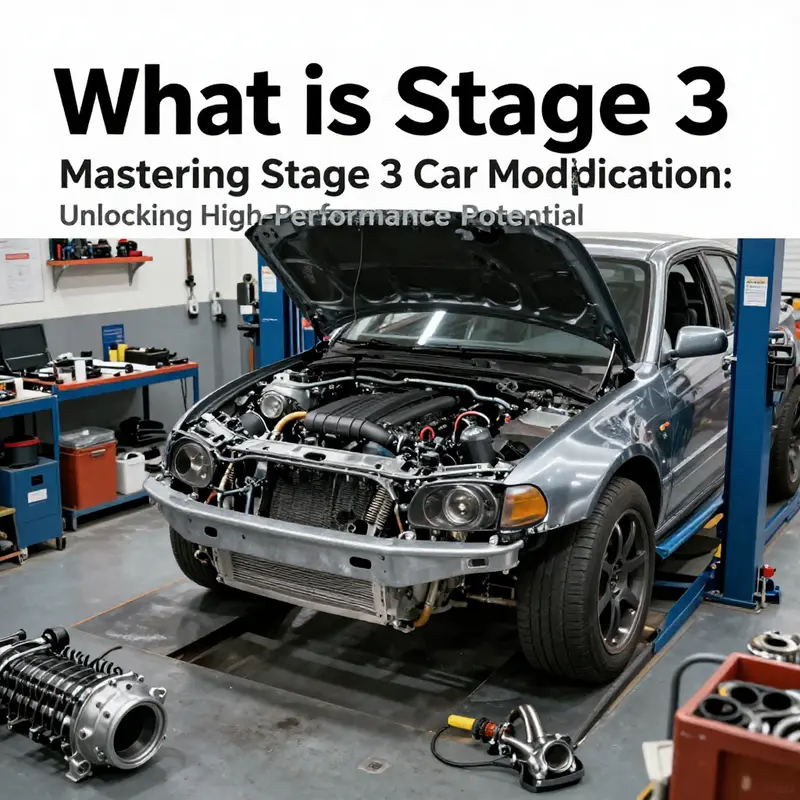
Stage 3 for car modification stands as the apex of performance work. It is where a project morphs from a collection of high-performance parts into a cohesive, purpose-built machine with the handling, reliability, and raw capability to meet precise goals. This chapter treats Stage 3 not merely as a set of parts, but as a strategic art form that demands deep foresight, meticulous planning, and a readiness to live with the consequences of elevated power. It is the point at which the car ceases to be a daily driver and begins to behave as a finely tuned piece of engineering crafted for specific environments—whether that means the competitive pressure of the track, the immediate thrill of extreme street performance, or a dedicated track-day weekend car that remains street-legal only by careful design and ongoing upkeep.
At the heart of Stage 3 is a deliberate shift from bolt-on improvements to fundamental changes that touch the core systems of the vehicle. The engine may gain a more potent heart through swaps, replacements, or extensive remapping. Forced induction—turbocharging or supercharging—often becomes the engine’s lifeblood, delivering horsepower that can dramatically exceed stock numbers. An ECU replacement or comprehensive remapping forms a bridge between the raw hardware and the vehicle’s control software, enabling precise calibration of fueling, ignition timing, boost, and torque delivery. Combined, these elements can push output to levels that reframe what the chassis, cooling system, and drivetrain are expected to handle. The result is a dramatic shift in acceleration, a broader and more usable power band, and a proportionately altered relationship between speed, grip, and steering feel.
Yet the horsepower gain is only part of the story. Stage 3 is as much about how a car performs in the real world as it is about raw numbers. The increased power must be matched by a robust and sympathetic approach to the rest of the vehicle. A suspension system designed for Stage 1 or Stage 2 can falter under the new load without re-tuning or upgrading to a higher-performance setup. The same applies to braking, which must be reinforced to manage the heavier, faster, and more dynamic car on both street and track surfaces. A heavier pack of torque traveling through a fortified drivetrain imposes unusual stresses on driveshafts, differentials, and gear trains. The cooling system must be capable of dissipating heat not just during a single lap but across repeated high-load events, where heat soak and thermal fatigue can erode power and reliability just when it matters most. In short, Stage 3 asks for a holistic approach, one that coordinates every major subsystem rather than optimizing a single facet in isolation.
Engine swaps are emblematic of Stage 3’s transformative potential. A well-conceived swap can unlock a level of performance that a car’s original architecture could never have approached. The choice of replacement engine is guided by the chassis’ architecture, weight distribution, and the intended use of the vehicle. A compact sports car, for instance, might receive a larger V8 or a high-output straight-six, transforming its character from lithe and nimble to muscular and imposing. An engine swap is rarely a simple bolt-in; it involves custom engine mounts, an upgraded or reworked exhaust path, a redesigned intake and fuel system, and a reimagined cooling strategy to manage the new thermal load. The integration extends to the engine’s controls, where the engine control unit may be replaced or heavily reprogrammed to harmonize with the new hardware, sensors, and actuators. Wiring harnesses often require reconfiguration to accommodate different layouts, power requirements, and sensor placements. This is where the line between a high-performance project and a professionally engineered masterpiece is drawn. A swap also imposes changes across the transmission and drivetrain. The gear ratios, torque capacity, and differential behavior must align with the engine’s torque curve and the car’s intended cadence, whether that means rapid, high-rev acceleration on a track or predictable, controllable power delivery on the street.
ECU work—the remap or a full replacement—acts as the conductor for this orchestra of hardware changes. The engine’s cognitive core determines how much fuel is delivered, how ignition timing advances, when boost arrives, and how torque is distributed across rev range and wheel speed. In Stage 3, the ECU is more than a control device; it is a sophisticated tuning system that synchronizes with upgraded fuel systems, turbocharger or supercharger boost control, intercooling, engine cooling, and even variable valve timing to extract maximum efficiency and reliability. The calibration is not a one-time event. It requires careful testing, data logging, and iterative tuning to balance power with fuel quality, ambient conditions, and the vehicle’s weight and aerodynamics. When done well, the result is a linear yet explosive power delivery that remains tractable under everyday use while offering a surge of capability for high-speed runs, timed laps, or controlled slides through a tight corner.
Forced induction is another hallmark of Stage 3. Turbocharging or supercharging can unlock horsepower and torque that would have been impractical or impossible with naturally aspirated configurations. The benefits are not simply a higher ceiling; they include a broader, more usable torque curve and a faster response time at lower RPMs. However, the introduction of forced induction also carries risk. The engine must be able to withstand the increased cylinder pressure, higher intake temperatures, and augmented heat in both the combustion chamber and the oil and cooling systems. The supporting hardware is expanded and reinforced. Larger intercoolers, piping with smoother bends, higher-capacity fuel pumps, and more robust fuel injectors become standard fare in Stage 3 builds. Oiling systems may be upgraded to assure sustained high-speed operation, and cooling layouts are redesigned to keep intake air and engine fluids at safe temperatures through repeated high-load cycles. In practice, this means that Stage 3 is less about a single upgrade and more about a comprehensive reshaping of the powertrain’s supply chain—from air and fuel to heat rejection and lubrication.
The significance of Stage 3 extends beyond propulsion. The car’s chassis, structure, and safety envelope must be reinforced to handle the new dynamics. A car that once relied on a compliant suspension and modest braking now demands stiffer chassis bracing, upgraded bushings, and a suspension system that can translate high grip into controlled, predictable movement. Big brake kits and upgraded calipers become common to manage the increased heat and fading risk that come with high-speed track use or aggressive street driving. The steering system often receives attention as well, with redesigned assist mapping, stiffer steering racks, and higher-traction tires to maintain a communicative feel at the limit. All of these modifications contribute to a vehicle that can place power down, rotate around its mass, and stop from higher speeds with confidence. The cumulative effect is not only more speed but better stability under cornering, reduced chassis flex, and a more coherent response to driver input.
This level of modification also changes the car’s maintenance regime and lifecycle costs. The expectation shifts from occasional service to vigilant, ongoing monitoring of elevated temperatures, wear rates, and component fatigue. Regular inspections of mounts, exhaust hardware, fuel lines, and cooling circuits become essential. The owner must plan for more frequent fluid changes, more robust cooling strategies, and careful attention to drivetrain alignment and universal joints, all while preserving road legality and emissions compliance in various jurisdictions. In many regions, Stage 3 builds must undergo inspections or meet stricter standards, especially where emissions and safety regulations are stringent. The legal landscape is a reality that cannot be ignored, and it informs every practical decision about engine choice, exhaust routing, and overall behavior on public roads. A well-done Stage 3 project, therefore, is not an irresponsible leap into performance. It is a disciplined, engineering-driven evolution that honors regulatory boundaries while pursuing maximum capability.
Realizing a Stage 3 objective requires more than technical prowess. It demands a thoughtful project plan, a clear understanding of the intended operating environment, and a willingness to collaborate with specialists who can translate theory into reliable practice. A true Stage 3 build often operates as a long-running partnership among the vehicle owner, a tuning shop, an engine builder, and, when necessary, a fabricator. The planning phase addresses a sequence of critical questions: What are the exact performance targets? How will the vehicle be used in daily life versus track days? What budget and time frame are available? How will reliability be preserved, and what are acceptable compromises? How do one balance power with weight, aerodynamics, and drivetrain strength? The answers guide decisions about engine choices, boost levels, cooling capacity, and chassis reinforcement. They shape the final configuration so that it feels seamless, even when the car is pushed to its limits. The careful alignment of goals with engineering realities helps ensure that Stage 3 remains a controllable, repeatable process rather than a one-off impulse.
The broader context of Stage 3 is essential for understanding its place in the spectrum of car modification. It sits between the more modest gains of Stage 1 and Stage 2 and the ambitious, race-oriented projects that some enthusiasts pursue. Stage 3 is where a car becomes a platform for experimental engineering, a canvas on which custom solutions can be developed to meet precise performance criteria. It is where the line between hobby and craft blurs, and where passion intersects with the discipline of engineering. It is also where the boundaries of what can be achieved in a road-legal, street-credible package are continually redefined. In this sense, Stage 3 represents the final frontier for those who view their car not just as transportation but as a serious, evolving engineering project that tests the limits of what a vehicle can reliably tolerate and still deliver the experience its owner seeks.
For readers who want to explore the broader map of modification practices, a comprehensive guide to the Car Modifications Guide can provide additional context and pathways for learning. This resource helps frame how Stage 3 fits into a larger strategy of vehicle development and how enthusiasts move between stages as their goals evolve. Car Modifications Guide
As a practical matter, the decision to pursue Stage 3 should be anchored in a realistic appraisal of one’s technical capability and resource availability. It is not a path for quick results or for the faint of heart. It requires access to skilled technicians, specialized equipment, and a workshop environment capable of managing the precise tolerances and safety considerations involved. It also calls for a commitment to ongoing maintenance, data-driven tuning, and compliance with local regulations. When approached with purpose and discipline, Stage 3 can transform a car into a high-performance platform that resonates with the driver’s goals, delivering a level of responsiveness, speed, and control that is unmatched by more incremental upgrades. The truth of Stage 3 is that the thrill is real, but so is the responsibility: to engineer, test, validate, and continually refine in pursuit of not just faster lap times, but a coherent, safe, and enjoyable driving experience.
External resource: https://www.autocar.co.uk/article/car-modification-stages-1-2-3-guide
Stage 3 Unleashed: Crafting Race-Ready Power Through Core Upgrades
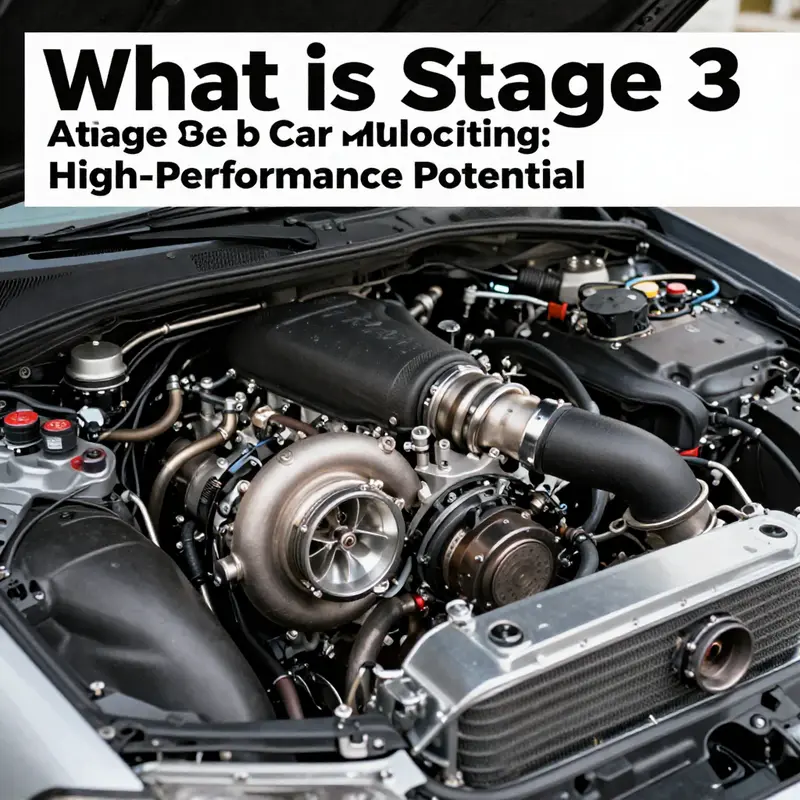
Stage 3 for car modification is often described as the summit of practical performance upgrades. But the truth goes deeper than adding a bigger turbo or a more aggressive exhaust. Stage 3 represents a holistic pursuit: you reshape the powertrain, you tune the brain that governs fuel and timing, you optimize the intake and exhaust for better flow, and you ensure the chassis, brakes, and suspension can manage the extra grip, speed, and heat. It is an approach that accepts risk as part of the payoff, demanding careful planning, precise execution, and a long view of how every change interacts with the others. In this sense, Stage 3 is less about a single bolt-on and more about a concert of improvements that, when harmonized, push a street machine toward race-ready behavior without turning it into a reckless, unreliable prototype. The journey begins with a clear picture of goals, constraints, and the realities of engine operation under elevated load, and it proceeds through a sequence of integrated decisions rather than isolated upgrades.
At its core, Stage 3 starts with a powertrain that breathes more efficiently and reacts more aggressively to throttle input. Turbochargers and superchargers are still the loudest signals of higher ambition, but the emphasis is on choosing a unit that suits the engine’s displacement, compression, and cooling capacity, and on pairing it with an ECU strategy that truly unlocks the new potential. A larger, appropriately matched turbo or a more capable supercharger compels the engine to inhale more air under higher boost pressures. Yet air alone does not produce power; fuel must also rise in step. This is where high-flow fuel injectors and upgraded pumps come into play, ensuring that the engine receives a steady, controllable supply of fuel across the entire map. The fuel system becomes a critical stage, not an afterthought, because the last thing a tuned engine needs is lean misfire or drop in cylinder-to-cylinder pressure stability during hard acceleration or nonstop track sessions.
The control software, meanwhile, should evolve from a generic map to a purpose-built tune. A high-performance ECU or standalone engine-management system is not merely about forcing more fuel into the cylinders; it is about orchestrating air, fuel, timing, boost, and cooling to work in concert. The result is a broader, faster, and more predictable response to driver input, with safe knock thresholds and thermal margins. It is this orchestration that defines Stage 3 as a coherent system rather than a cluster of powerful parts. A well-tuned engine wakes up with a crisp, linear throttle response and a torque curve that remains reliable long after the initial surge. To support this, cold-air intake and intercooler upgrades are often prerequisite. A higher-capacity intercooler or a more efficient intercooler circuit lowers intake air temperatures, increases air density, and reduces the likelihood of heat soak under duress. It may also enable more aggressive boost settings without crossing detonation limits, which translates directly into faster acceleration and sustained performance on long pulls or aggressive driving sessions.
Alongside the powertrain, the exhaust and intake paths are redesigned to minimize back pressure and maximize flow. A high-performance exhaust system reduces flow restrictions while preserving engine reliability and emissions compliance where applicable. The pipes, catalysts (or high-flow, legally compliant equivalents), and a well-chosen exhaust geometry work together to extract energy from the combustion process without suffocating the engine’s breathing. The intake side follows a complementary philosophy. A properly engineered cold-air intake system helps deliver denser air to the engine, while an upgraded intercooler cools the compressed air flowing in from the turbo or supercharger. In combination, these changes expand the engine’s usable RPM range, enhance peak power, and improve the consistency of power delivery during sustained high-load operation. The result is not just a louder engine, but a more efficient and repeatable source of power that responds with intent to the driver’s commands.
Yet power alone is only part of the equation. A Stage 3 build must address the vehicle’s ability to transfer that power to the road without sacrificing safety or control. That is where the chassis and drivetrain come into sharper focus. Upgraded suspension components—such as stiffer springs, dampers tailored to higher spring rates, or full coilovers—help the car maintain stability under abrupt power delivery and heavy lateral loads. The goal is to keep tires planted during aggressive cornering, braking, and mid-corner acceleration. Sway bars and strut braces add chassis rigidity, reducing body roll and preserving steering feel when the car is pushed toward the limits of adhesion. These changes do not merely improve grip; they stabilize the vehicle’s attitude, which in turn makes the enhanced power more usable in real-world driving, whether on a track or a spirited back-road session.
Braking systems must rise in step with speed and power. Upgrading pads, rotors, and sometimes calipers helps manage heat and maintain consistent stopping performance as the engine’s torque curve pushes the car harder and longer. The objective is to prevent fade during repeated hard braking and to preserve pedal feel when the car is on the edge of grip. A well-balanced upgrade philosophy avoids the trap of simply making the car faster without ensuring the brakes can reliably slow it down. Similarly, wheels and tires are part of the same conversation. Lightweight performance wheels reduce unsprung mass and improve steering response and suspension efficiency. Matching them with high-performance tires—chosen for heat resistance, grip, and predictable behavior at the limit—ensures that the extra power translates into real acceleration and cornering speed rather than wasted energy in excessive chassis movement or drive-line shock.
Inside the mechanical, there is also a consideration of reliability and lasting performance. Stage 3 builds are capital-intensive, and the increased stresses on the engine, cooling system, and drivetrain demand meticulous attention to lubrication and thermal management. Oil cooling strategies, upgraded oil pumps, and robust intake plumbing all contribute to keeping the heart of the machine within safe operating temperatures during extended high-power runs. The driver’s experience must evolve as well. Sports seats, a purpose-built steering wheel, and a more supportive driving environment can help the operator stay in control under high loads and dynamic conditions. Yet while such interior refinements matter, they belong to the realm of practical usability rather than mere vanity; they are a recognition that the machine’s performance is meaningful only if the driver can exploit it safely and consistently.
All of these components must be planned within a framework of careful evaluation. Stage 3 is not a random selection of powerful parts. It is a balance between power, control, reliability, and road legality. The cost of the build, the potential impact on the vehicle’s warranty, and the legality of certain modifications under local regulations are real considerations. The maintenance burden also grows. A Stage 3 car requires more frequent inspections, more precise monitoring of temperatures and pressures, and a disciplined maintenance routine to prevent minor issues from becoming major failures under the stress of high-performance operation. In practice, this means a structured approach: establish driving goals, translate them into a blueprint of required upgrades, confirm compatibility between components, and secure professional talent to perform the work and tune the system. The plan should include contingency margins for parts compatibility, cooling capacity, and drivetrain durability so the car can perform over multiple sessions without sudden compromises.
The conversation around upgrades frequently touches the broader implications, including how to navigate insurance and ownership responsibilities. It is common to encounter questions about whether modifications affect coverage, premiums, or eligibility for warranties. A practical approach is to anticipate these realities and engage with qualified professionals who can help map out the risks and protections. For readers exploring these practicalities, consider the question: Do car modifications increase insurance? This topic surfaces often in discussions about Stage 3 builds and is worth examining in detail as part of early planning. Do car modifications increase insurance.
The path from concept to street- and track-capable reality demands patience, precision, and collaboration. Dyno sessions are not optional at this level; they quantify gains, verify fueling and timing, and ensure that the tune respects the engine’s limits under real-world loads. Many builders rely on a staged testing approach: incremental power checks, monitored temperatures, and controlled road or track testing. This disciplined workflow helps detect detonation, fuel starvation, or cooling bottlenecks before they become costly failures. It is easy to imagine Stage 3 as a series of flashy upgrades, but the truth is that the most enduring stage-3 machines are the ones that survive repeated sessions with stable performance and predictable behavior. The line between a thrilling street weapon and an unpredictable project is thin, and maintaining that balance requires honesty about capability versus ambition.
There is also a strategic dimension to Stage 3. It is not always ideal to chase the highest possible power if the car’s chassis, transmission, or drive layout cannot handle it safely. A car with a robust torque curve, well-mated gearing, and a cooling system designed for sustained workloads will perform better in real life than a car tuned only for peak horsepower on a dyno. The conversation about strategy also invites consideration of the broader ownership experience: maintenance cost, parts availability, and the practical realities of daily driving with a high-performance machine. The best Stage 3 builds become a fusion of engineering discipline, measured risk, and a driver’s willingness to learn the limits with care. In the end, the measure of success is not just peak numbers but the confidence to push the car stronger in controlled environments while preserving reliability on the street.
As this chapter moves toward its natural cadence, it becomes evident how Stage 3 upgrades connect with the preceding and following chapters in this article. Stage 3 is the culmination of a progression from bolt-ons and moderate upgrades to a coherent system that can deliver race-level performance when managed properly. It is not a shortcut to speed; it is a commitment to a comprehensive scope of work, a disciplined tuning process, and an ongoing maintenance discipline. The result, when done well, is a vehicle with enhanced acceleration, sharper handling, better braking feedback, and an overall sense of enthusiast-driven purpose that remains controllable and manageable rather than volatile. The narrative here aims to illuminate the core components and their relationships, not to prescribe a one-size-fits-all blueprint. Every build must begin with a clear understanding of the car’s baseline, the owner’s goals, and the constraints of the platform. From there, the path to Stage 3 becomes a careful art: selecting compatible powertrain changes, aligning them with cooling, fuel, and airflow improvements, and ensuring the chassis can carry the extra load with precision and safety.
In summary, Stage 3 is a disciplined orchestration of power, control, and reliability. It requires a thoughtful selection of turbo or supercharger options paired with a tuned engine management strategy, sufficient fuel delivery, and a breathing system designed to sustain higher flows. It demands a revised exhaust and intake path that compliments the mechanical upgrades, while a reimagined suspension, brakes, and wheels lock in the true handling potential. It calls for a weight-conscious balance and a focus on thermal management, so the car can perform under pressure for extended periods. It asks for professional guidance and careful testing, with a willingness to reassess goals as the project evolves. It invites the driver to grow with the machine, learning to coax the best possible performance out of a coordinated system rather than chasing raw numbers in isolation. And it leaves space for the reader to explore the broader implications of modification in everyday life, including insurance, resale value, and long-term ownership—a reminder that speed without responsible stewardship does not endure. For readers who want a broader frame of reference on tuning concepts beyond the specifics of a single build, an external resource such as Engine tuning provides helpful context about the principles that underpin Stage 3 transformations. https://en.wikipedia.org/wiki/Engine_tuning
Stage 3 for Car Modification: Engineering, Risk, and the Pursuit of Race-Grade Power
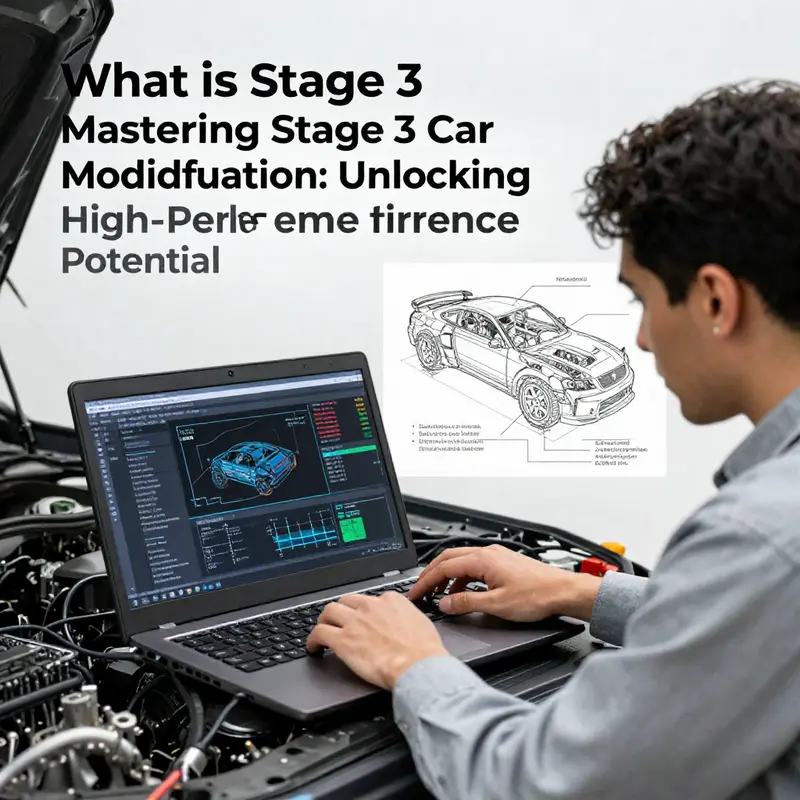
Stage 3 for car modification stands at the challenging summit of customization. It is where the most ambitious owners move beyond bolt-on parts and tuning presets to reinvent parts of the car itself. This chapter explores how Stage 3 is defined in practice, what it demands from a vehicle, and how careful planning, engineering discipline, and clear risk assessment separate a high-performance project from a reckless one. The aim is not to glorify speed alone but to illuminate the continuum of change from a stock platform to a purpose-built machine that can deliver race-level capability while remaining controllable, reliable, and safe in real-world conditions. At its core, Stage 3 is less about what you install and more about how you integrate a constellation of changes so that the whole car behaves as a cohesive system rather than a collection of parts. The distinction between stages matters because power is only one part of the equation. Balance, control, thermal stability, and legal operation all determine whether Stage 3 yields a meaningful and dependable upgrade or a fragile, misbehaving vehicle that guards its driver with a heavy dose of luck.
When we speak of Stage 3, the most visible element is often the engine itself or the means by which it breathes more freely. Engine swaps, turbocharging or supercharging, and sophisticated ECU remapping sit at the center of the upgrade. Each option carries its own web of integration challenges. Swapping engines is not simply a matter of dropping in a larger displacement block and waving a wrench. It requires aligning engine mounts, transmission interfaces, and auxiliary systems so that the new heart can be mounted securely and cooled effectively. The cooling system must be scaled to handle higher heat flux; radiators, intercoolers, oil coolers, and even the routing of coolant and oil lines need careful design to prevent bottlenecks. Exhaust paths must be engineered to minimize backpressure while complying with emissions controls where required. In practice, even a seemingly straightforward engine swap may demand bespoke fabrication, precise alignment, and a thorough rethinking of the engine bay’s layout to preserve serviceability and accessibility. The ECU, fuel delivery strategy, and ignition timing must be re-tuned with a deep understanding of how the new configuration behaves under load, at high RPM, and during relief events like deceleration. This is where the line between a well-calibrated high-performance vehicle and a fragile, unreliable car often runs.
The electronics that govern modern powertrains add another layer of complexity. Engine management is no longer a simple mapping exercise; it is a dialogue with sensors that monitor temperature, pressure, airflow, and torque delivery. Remapping or replacing the ECU must account for emissions regulations, safety interlocks, and even the vehicle’s fault-detection logic. Improper tuning can trigger check-engine lights, degrade reliability, or cause unintended responses—such as surge during throttle application or misfires under high boost. The risk is not limited to performance disappointment. In many regions, strict emissions rules mean that certain Stage 3 configurations may require retrospective approvals, inspections, or may be outright illegal to operate on public roads. This reality underscores the need for a robust plan that anticipates regulatory constraints as much as mechanical needs.
Thermal management emerges as one of Stage 3’s most demanding disciplines. High-power setups generate substantial heat, and the existing cooling architecture often proves insufficient. A car that makes peak power on a dyno may become an overheating liability in street use or track sessions if cooling isn’t scaled accordingly. Solutions range from larger radiators and twin intercoolers to dedicated oil coolers and enhanced airflow paths through the engine bay. Even seemingly small details—like fan control strategies, ducting to reduce hot air recirculation, and the placement of heat-sensitive components—can determine whether a car maintains performance under sustained load or slips into thermal throttling. In real-world practice, teams often model heat management as a closed-loop system. They monitor coolant and oil temperatures, boost temperatures, and ambient conditions, then iteratively adjust components and airflow to keep temperatures within safe bounds while preserving power delivery. The end result is a car whose power output remains stable rather than a dataset that looks impressive for a few seconds but falls off quickly.
Achieving reliable Stage 3 performance also demands rethinking the suspension and drivetrain to handle increased loads. The moment power rises beyond factory specifications, the drivetrain faces higher torque, elevated stress in the differential, stronger driveshafts, and potentially altered weight distribution. Upgrades such as limited-slip differentials that can manage torque without creating driveline lash become almost mandatory. The suspension must be tuned for stiffer springs, more capable dampers, and reinforced bushings to maintain predictable handling under the deeper grip that high-performance tires provide. Without these changes, a car can exhibit excessive understeer or oversteer, compromised corner entry stability, and reduced tire life. The chassis itself must be evaluated for rigidity; additional bracing or subframe reinforcement may be needed to resist flex that can undermine steering feel and alignment. Every corner on a high-power setup becomes a test of precision: you want the tires to grip, the steering to convey direct feedback, and the chassis to stay planted without transmitting the full force of a tire’s grip back through the driver’s hands.
The choice of tires and brakes is inseparable from Stage 3 dynamics. A high-power engine is only as useful as the vehicle’s ability to translate power into controlled speed. This means selecting tires with a compound and construction that can handle sustained loads, and upgrading braking systems to avoid fade during aggressive driving. The relationship between tire grip, chassis stiffness, and braking performance governs how aggressively you can push the car in corners and how quickly you can decelerate from high speeds. Braking hardware must be matched to the power level and weight distribution of the modified car, often requiring larger rotors, more robust calipers, and upgraded fluid coolers. In tandem with braking upgrades, attention to weight distribution and aerodynamics can yield meaningful gains in stopping power and stability. These considerations remind us that the Stage 3 objective is not simply to accelerate faster, but to maintain control across acceleration, cornering, and deceleration cycles.
Beyond the mechanical and electronic systems, Stage 3 introduces a cascade of integration challenges that touch almost every aspect of vehicle ownership. The more extreme the modifications, the more likely you are to encounter compatibility issues among components sourced from different eras or manufacturers. Even components designed to fit together can require bespoke fabrication, precise tolerances, and iterative testing. This is where the project moves from a weekend project into a dedicated engineering effort. Skilled labor, specialized equipment, and a disciplined project plan become not luxuries but prerequisites. Planning must address not only the installation but the calibration, testing, and validation sequence that determine whether the car behaves as intended under a wide range of conditions. A Stage 3 project, therefore, is as much about process discipline as it is about parts selection. Without a clear plan, the likelihood of misalignment, intermittent failures, and safety concerns grows significantly.
For those navigating this path, a practical approach centers on modularity and iterative validation. Rather than attempting to leap from Stage 2 to Stage 3 in one operation, many projects adopt a staged sequence within Stage 3 itself: core powertrain upgrades first, followed by the cooling and intake systems, then the drivetrain, and finally the chassis and suspension refinements. This phased approach allows critical systems to mature in a controlled manner, with performance verified at each step. It also helps owners budget realistically, as the total investment becomes a function of the cumulative scope rather than a single leap into high risk. It is essential to document each change, test methodically, and validate performance with repeatable benchmarks. When the car demonstrates consistent behavior and reliability under higher power, the project gains legitimacy and confidence. Without such discipline, Stage 3 risks devolving into a patchwork that looks impressive on a dyno but fails the test of real-world reliability and safety.
The human element remains a pivotal factor. Stage 3 work demands a blend of theoretical knowledge and hands-on expertise. It is not enough to purchase premium components; one must understand how those components interact within the vehicle’s broader ecosystem. Strong collaboration with qualified technicians, engineers, and tuners is essential. Transparent communication about goals, constraints, and risk tolerance helps align expectations with what is technically feasible. The temptation to chase maximal horsepower can overshadow the central priorities of drivability, safety, and longevity. A well-executed Stage 3 project honors these priorities by balancing ambition with restraint, ensuring that the car remains a usable machine rather than a specialized exhibit that spends more time in the shop than on the road.
From a regulatory and ownership standpoint, Stage 3 also invites careful attention to legality and insurance implications. In many regions, dramatic power increases trigger inspections, registrations, or disclosures. Some modifications may void warranties, complicate claims, or alter the vehicle’s classification for road use. Insurance approaches can vary widely, with some policies adapting to the changed risk profile, while others exclude modified vehicles or impose premiums commensurate with the performance level. Owners who pursue Stage 3 should engage early with their insurer and local authorities to understand coverage, compliance, and any required certifications. This proactive stance reduces the risk of surprises later and helps preserve peace of mind as the car’s capabilities expand.
A final lens through which to view Stage 3 is the broader ecosystem of knowledge and practice that sustains advanced automotive modification. The engineering literature and professional forums increasingly emphasize integrated system design, thermal-aware engineering, and robust validation methodologies. While individual parts can be swapped in, true Stage 3 performance emerges from the thoughtful orchestration of power, cooling, chassis dynamics, and control software. The SAE International body offers authoritative insights into high-performance vehicle engineering, touching on ECU tuning, thermal management, and structural reinforcement in modified vehicles. For authoritative insights into advanced car modification practices, including technical specifications and real-world case studies, refer to the official SAE publication at the following link: https://www.sae.org/publications/technical-papers/content/2024-01-0123. This resource anchors the practical considerations described here in peer-reviewed research and real-world engineering practice, reinforcing why Stage 3 remains a rigorous, multidisciplinary undertaking rather than a simple upgrade path.
For readers seeking to connect theory to everyday decision-making, an important bridge is the conversation about legality and responsibility. An internal link to guidance on what qualifies as lawful modifications can be a practical compass. Consider the concept of legal car modifications as a starting point for navigating the regulatory maze. This resource helps align ambition with compliance, ensuring that performance goals are pursued within the boundaries of road-use rules, warranty considerations, and insurance frameworks. The balance between performance and responsibility is central to Stage 3. When done with discipline, it can yield a vehicle that delivers exhilarating power without sacrificing predictability, safety, or accountability. For many enthusiasts, that balance is the essence of what makes Stage 3 compelling: a culmination of engineering rigor, thoughtful design, and a measured appreciation for what a car can become when power is liberated in harmony with chassis, electronics, and legality.
In closing, Stage 3 represents more than a set of upgrades. It is a journey into advanced engineering where power, control, and reliability must coexist. The challenges are real: engine compatibility, electronic integration, thermal management, structural dynamics, ballast on the suspension, braking and tire demands, and the legal and financial dimensions of ownership. The reward, when approached with skill and caution, is a machine that embodies race-grade capability while remaining a controllable, road-legal instrument of performance. This is the art and science of Stage 3: not a reckless sprint toward raw horsepower, but a deliberate, comprehensive enhancement of the vehicle’s entire system. Each stage of modification has its own logic, and Stage 3 operates on the premise that ultimate performance emerges from a harmonious alliance of engineering excellence, disciplined execution, and prudent governance of risk. The result is a car that can return meaningful, repeatable performance across street and track, with a managed footprint in terms of reliability, legality, and everyday usability.
Stage 3 Unleashed: Navigating Peak Power, Precision, and the Practical Price of Extreme Car Tuning
Stage 3 modifications sit at the far edge of what most drivers consider street-friendly performance. They are not mere bolt-ons; they are structural and mechanical reconfigurations designed to extract power and sharpen dynamics in ways that transform a car’s everyday persona into a race-inspired instrument. To understand Stage 3 is to recognize that the lines between factory engineering and aftermarket mastery blur. The engine, its management, and the supporting systems must operate as a cohesive package where every change triggers a cascade of reinforcing upgrades. In this sense, Stage 3 is less a collection of parts than a philosophy: you push the limits of what the original design can endure, while aligning every subsystem to handle the new reality of higher torque, higher heat, and sharper response. The result is not a mere number on a dyno sheet but a fundamentally altered driving experience that demands skill, commitment, and an understanding of the risks and responsibilities that accompany extreme performance work.
At the heart of Stage 3 is a shift in focus from bolt-on capability to architectural change. The most visible hallmark is access to significantly more air and fuel for the engine, paired with a management system capable of exploiting that airflow without the timing, mixture, and fuel delivery wandering off into detonation or overheating. A high-flow intake system feeds the engine with a greater volume of air, while performance exhaust headers reduce back pressure, ensuring the burn products exit the cylinders more efficiently and with less resistance. Yet these improvements do not operate in isolation. The engine control unit becomes the conductor of an orchestra that includes fuel injectors capable of delivering more fuel to match the increased air, and a tune that carefully coordinates air, fuel, and ignition to preserve reliability while extracting every drop of potential. The tune is not a hobbyist adjustment; it is a carefully calibrated map that must account for ambient temperature, humidity, fuel quality, and the unique breathing characteristics of the chosen induction system. Even with a perfect tune, the engine will demand stronger internal components, because the mechanical stresses rise in step with the power output. Forged pistons and connecting rods are common to Stage 3, chosen for their resilience to higher peak pressures and higher piston speeds. The aim is not simply to reach a higher horsepower figure, but to sustain a predictable and repeatable level of performance across a broad range of operating conditions.
Forced induction—turbocharging or supercharging—often stands at the core of Stage 3 power gains. The dramatic rise in cylinder pressure and intake air density unlocks a much larger portion of the engine’s potential, especially when paired with a revised cam profile and a fueling strategy that can maintain a safe air-fuel ratio under rapid transients. The integration of forced induction, however, creates a web of interdependencies. Heat becomes a critical adversary. Intercoolers, upgraded radiators, and oil cooling circuits must be sized to keep temperatures within the engine’s comfort zone. If temperatures run high, efficiency drops, power trails off, and the risk of detonation climbs. This is why Stage 3 builds often feature enhanced cooling capacity, not as a cosmetic flourish but as a functional necessity. The cooling system becomes part of the performance package, with attention given to airflow management, heat soak prevention, and redundancy in critical paths so that a long race stint or a hot daily commute does not degrade performance.
With more power comes a need for more trusted power transfer. The drivetrain that was adequate for Stage 1 and Stage 2 will often reach its limit when torque and horsepower rise by a substantial margin. Transmission components—gear sets, clutches, and torque handling capability—are reinforced or swapped to maintain reliability and to preserve the feel of shifting without introducing slippage that could lead to pelvic-whiplash or unpredictable behavior at the limit. The differential, too, must be capable of distributing power cleanly to the wheels under aggressive acceleration, especially on vehicles with rear- or all-wheel drive. A limited-slip differential or a more robust mechanical diff can tame wheel spin, giving the driver more predictable cornering and improved traction when conditions are less than ideal. Suspensions, likewise, are upgraded to manage the added weight and the stiffer chassis dynamics that accompany high-power applications. Springs and dampers are calibrated to balance a compressed ride height with body control, while anti-roll bars and bushings are tuned for precise feedback rather than mere comfort. The result is a chassis that can translate the raw power into usable, track-ready handling without the car turning into an unruly beast at the first stern corner.
The braking system, too, must evolve in step with the increased performance. High-performance pads and rotors, larger calipers, and enhanced cooling paths become essential to maintain consistent braking performance during repeated hard stops. Inadequate braking is not merely uncomfortable; it is dangerous because it creates a mismatch between the car’s speed and the driver’s ability to control it. The safety margin in Stage 3 builds thus hinges on a well-rounded approach that treats brakes as a performance component in its own right, not as an afterthought. Within this holistic framework, the tires deserve careful consideration as well. Sticky, purpose-built rubber with the right compound and tread design becomes a crucial ally, converting the power and the chassis’ improvements into actual road or track grip. Tire choices often reflect a compromise between maximum performance and durability in daily driving, as Stage 3 power can accelerate wear patterns noticeably.
All these mechanical upgrades support a broader objective: transforming a stock vehicle into a high-performance machine capable of race-like behavior under controlled conditions. The empowerment is sensorial—faster throttle response, more aggressive midrange, and a sense of immediacy that redefines the relationship between driver input and road feedback. The car’s personality becomes more intense, and that intensity must be matched with a disciplined driving approach. A Stage 3 build invites a different rhythm: smooth, deliberate inputs rather than casual, last-moment interventions. It rewards a measured line into corners, a patient brake release, and a rhythm that matches the engine’s augmented breathing. The driving experience thus becomes a dialogue between upgraded hardware and human skill, with the track or the open road as the stage.
Yet this elevated performance is inseparable from its cost and its consequences. The economics of Stage 3 extend beyond the sticker price of parts. Installed by professionals who understand the interdependencies of air, fuel, ignition, cooling, and load paths, these builds usually require a surrounding investment: reinforced transmissions, upgraded cooling modules, and a suspension system tuned not just for speed but for repeatable laps or consistent daily performance. Maintenance becomes a constant obligation rather than a periodic task. Fluids are traded for upgraded formulations that tolerate higher operating temperatures, and regular checks are intensified to monitor for signs of unusual wear or stress in the internals that the increased power imposes. Ownership costs grow, and so does the need for a pro-active maintenance mindset. The vehicle may also experience longer startup and warm-up routines as the ECU and sensors calibrate themselves to the new baseline after each modification cycle.
The decision to pursue Stage 3 should be framed by clear goals and realistic constraints. Enthusiasts often pursue maximum straight-line speed or cornering prowess on a race track, but the road to those outcomes requires a long-term commitment to reliability and safety. It is not simply a matter of picking a handful of performance parts and hoping for the best. Each upgrade influences another: the fuel system’s capacity, the exhaust gas temperatures, the engine’s thermal envelope, and the chassis’ ability to absorb the added energy. This interconnectedness means a Stage 3 project benefits from an integrated plan that begins with a candid appraisal of the car’s current condition, follows through with a precise scope of upgrades, and continues with rigorous testing, including dyno runs and track sessions, to verify that the package behaves as intended under a variety of conditions. In many cases, a staged rollout—starting with tuning and smaller reinforcing upgrades, then adding more substantial components after validation—helps manage risk while preserving the vehicle’s daily usability.
Despite the allure, Stage 3 is not a universal path. The same rules that justify its appeal—exhilarating power, sharpened dynamics, and a vehicle that feels transformed—also illuminate its caveats. Emissions compliance may become a hurdle in regions with stringent regulations, and inspections can hinge on the exact configuration and the vehicle’s ability to meet local standards after modifications. Insurance costs typically reflect the heightened risk, and coverage can become more complex, with some policies requiring explicit disclosure of the work and increased premiums to address the greater likelihood of drivetrain failures or higher repair costs. The financial calculus extends to resale value as well. A vehicle tuned to Stage 3 may attract buyers with specialized expectations, and if the car is not aligned with those expectations, selling it later can prove challenging. This is why, once again, the value of a well-documented, professionally installed, properly maintained build cannot be overstated. For readers curious about how such tuning can affect resale outcomes, a thoughtful look at car modifications and resale value provides useful context and practical considerations.
In sum, Stage 3 represents a deliberate, high-stakes pursuit of peak performance that foregrounds engineering unity over individual part gains. It demands an integrated approach where intake, induction, management, cooling, power transfer, chassis dynamics, and braking are treated as a single system. The rewards are substantial: a vehicle that accelerates with astonishing immediacy, handles with precision, and communicates a level of driving intensity that only such a deeply engineered machine can deliver. The costs—financial, mechanical, regulatory, and experiential—are equally real and demand careful planning, professional execution, and ongoing stewardship. For the motivated driver, Stage 3 offers a pathway to a truly personal apex of performance, a point where the car stops being merely fast and begins to feel almost bound to the driver’s instincts. And in that bond between machine and operator lies the essence of the Stage 3 philosophy: not just more power, but controlled, repeatable, and accountable performance that can be enjoyed on the street, tuned to track days, or summoned when a road invites a challenge.
For readers who want to explore how these considerations translate into financial and ownership realities, the discussion around resale value can be a practical compass. See car modifications and resale value for an in-depth look at how high-level tuning can impact a car’s market trajectory, including considerations around documentation, component quality, and the maintenance trajectory that supports a lasting performance identity. https://modifiyeliarabalar.net/blog/car-modifications-and-resale-value/
External resource: https://www.autocar.co.uk/car-review/tesla-model-3-performance
Final thoughts
Stage 3 car modification opens a world of possibilities for performance enthusiasts, but it also demands a thorough understanding of the complexities involved. With advanced tuning comes the responsibility to ensure that all upgrades are complements to one another and that the vehicle remains safe, reliable, and street-legal. As you consider diving into the depths of Stage 3 modifications, reflect on your driving goals, the potential impacts of your upgrades, and the exhilarating experience that awaits on the road or track. Embrace this journey, and let your passion for performance guide you.