
The realm of automotive modifications is vast, appealing to hobbyists and professionals alike. As we delve into the intricate landscape formed by regulatory changes during Donald Trump’s presidency, understanding the direct and indirect impacts on car modifications becomes crucial. The focus primarily revolves around fuel efficiency standards, emissions regulations, and economic implications surrounding these shifts. Each chapter outlines critical aspects: from the policies abolishing stringent fuel economy rules to the economic impact of repealed EV tax credits, social reactions to these changes, and the broader geopolitical context. By the end of this exploration, we’ll clarify how the modifications legal and practical under Trump’s administration shaped today’s automotive landscape.
Reassessing Rollbacks: How Fuel-Standards Revisions Reshaped Car Modification Culture
The question of what Trump-era policy changes meant for car modifications is not answered by a single decree. There was no federal order that broadly legalized aftermarket parts. Instead, rollbacks to fuel economy targets and the removal of incentives changed the financial and regulatory calculus that automakers, shops, and enthusiasts navigate. A lower Corporate Average Fuel Economy target reduces the push toward electrification and ultra-clean propulsion, nudging investment back toward traditional internal combustion designs, horsepower, and handling. In this environment, modifications that emphasize power and reliability can become more appealing while regulators maintain emissions and safety guardrails.
Alongside the EV-related changes, penalties for not meeting fuel economy targets were reduced, easing some regulatory risk for volume-focused brands and smaller shops. In practical terms, this shifts the risk-reward balance for modifications that could affect fuel economy or emissions, without granting a free pass from compliance. Enthusiasts may sense a more permissive climate for performance work on ICE platforms, even as the overarching rules still apply.
The federal EV tax credit was eliminated, changing consumer economics and long term ownership calculations. Fewer buyers pursue EV-focused upgrades in the near term, and automakers tilt product portfolios toward non-EV propulsion paths. This reorientation reduces immediate demand for high-voltage battery upgrades and related systems, while not abolishing the longer-term push toward electrification for some segments.
California’s state-level EV regulations and the federal stance toward state rules also influence the landscape. Rolling back federal leverage over state targets can create a more uneven terrain for modifications, but it also avoids a single nationwide mandate. For people who love the visceral feel of gasoline power, these policy shifts may reinforce a culture that prioritizes engine sound, torque, and driving engagement over rapid electrification, even as emissions and safety constraints remain in force.
In short, the policy shifts did not legalize a new class of aftermarket parts; they rebalanced incentives and risk. The resulting climate supports a continued interest in performance enhancements for ICE platforms, while keeping faithful to emissions and safety laws. For readers seeking official framing and rationale, regulatory materials from agencies such as the National Highway Traffic Safety Administration offer the authoritative context. External reference: https://www.nhtsa.gov
Policy Shifts on the Highway: What Trump’s Regulatory Rollbacks Really Did for Car Modifications
When readers ask whether a presidency can “make legal” something as hands-on as car modifications, they are really asking about the boundary between federal regulation and private customization. The short, historically accurate answer is that the Trump administration did not enact a blanket legalization of aftermarket modifications. Instead, it pursued a set of regulatory rollbacks aimed at emissions rules, vehicle efficiency targets, and the incentives and penalties that shape how a car is bought, operated, and repaired. In practical terms, federal policy during that period did not publish a permission slip for a broad class of modifications. It changed the incentive structure and the cost of compliance in ways that could influence what people choose to modify or how readily a dealership or shop will support those changes. The result, paradoxically, is a landscape where modification decisions are less about a singular federal “green light” and more about a shifting mix of rules, markets, and regional standards that together determine what counts as lawful, safe, and affordable tinkering.
To understand this, it helps to start with the core shifts that did occur. The administration sought to repeal or roll back Biden-era fuel efficiency standards, restoring a regulatory climate that many automakers and buyers perceived as less burdensome in terms of compliance costs. The Department of Transportation moved toward finalizing rules that would cancel stricter fuel economy targets for the future, while the administration canceled penalties that had been imposed on automakers for failing to meet certain efficiency targets. In the same vein, the removal of the federal $7,500 electric vehicle tax credit signalized a recalibration of the financial incentives that influence the economics of owning and modifying cars. Finally, the rollback of California’s aggressive zero-emission vehicle regulations—efforts to require higher shares of EVs—signaled a federal stance that was more permissive toward gasoline-powered cars, at least in the near term. Taken together, these steps primarily affect the financial and regulatory environment surrounding vehicle choice, not the explicit legality of performing specific aftermarket modifications.
What this means for the broader question of legality is that the federal action did not codify a sweeping policy allowing or legalizing a class of physical modifications—from engine swaps to exhaust changes or body alterations. Instead, modifications remain governed by a patchwork of rules. Safety standards, federal and state emissions laws, and consumer protection norms still set the baseline. Any modification that alters emissions in a way that violates statutory limits, or that undermines safety, remains subject to enforcement. In other words, federal policy did not erase the line that keeps certain modifications out of compliance; it altered the cost-benefit calculus around compliance by shifting which standards are front-and-center and by changing the incentives to pursue particular kinds of upgrades.
This dynamic helps explain a critical reality: even when there is no explicit federal decree approving a broad category of modifications, the way those modifications are perceived and pursued is deeply influenced by regulatory signaling. The rollback of penalties for non-compliance and the scaling back of aggressive efficiency targets may reduce the immediate fiscal pressure on manufacturers and some buyers. But for the private modifier—whether a hobbyist working in a garage or an authorized shop advising customers—the ongoing requirement to meet emissions and safety compliance remains an unavoidable constraint. When a federal regime signals that compliance costs are being lowered, some consumers might be more inclined to explore performance-oriented changes that could affect emissions or fuel use. Conversely, the same shift can also push modifiers toward more conservative, certified approaches that align with existing safety regimes and test procedures to avoid potential liability. The interplay of incentives, enforcement, and testing creates a nuanced environment where legality is less about a single decree and more about consistent adherence to core regulatory limits.
This nuanced landscape is echoed in the way the aftermarket and auto-modification communities frame the issue. The conversation often centers on risk, cost, and resale value, rather than on a formal declaration of legality. A key point that frequently surfaces in discussions about legal modification is not whether a particular tweak is allowed, but whether it remains within emissions boundaries, safety standards, and warranty conditions. In that sense, the question of what counts as legal modification is less about a universal permission than about a dynamic compliance posture that requires ongoing attention to federal, state, and sometimes local rules. For readers seeking a consolidated view of how law treats modifications, there is value in examining how the legal framework defines legality in practice—through testing, certification, and enforcement rather than through a single omnibus grant of permission. This broader perspective helps reconcile the impulse to customize with the legal responsibilities that come with operating and altering a vehicle.
The legal landscape also intersects with international and trade considerations, a facet that sometimes colors the practicalities of modification. While the main public debate about emissions and EV incentives focused on domestic standards, the broader policy environment sometimes featured debates about how imports and component parts are taxed and regulated. A Supreme Court ruling on the authority to impose broad-based tariffs—rooted in the International Emergency Economic Powers Act (IEEPA)—and the subsequent attempts to deploy a 15% tariff plan illustrate how regulatory authority and executive action can become unstable and unpredictable. Although these tariff actions were not aimed at car modifications per se, they affected the affordability and availability of auto parts, performance-enhancing components, and maintenance services that aftermarket shops depend on. The upshot is that a volatile policy backdrop increases the compliance costs for businesses that sell or install modifications and introduces a layer of legal risk that consumers and shops must navigate. As policy commentators like Felicity Dean and analysts such as John Bryson have noted, the most enduring effect of repeated policy reversals is not immediate change but uncertainty—the kind of unpredictability that reshapes investment and strategic planning across the sector.
Within this broader frame, the role of state regulation remains salient. Even as federal policy moved toward moderation, California and other states pressed ahead with stringent emissions and zero-emission vehicle mandates. The tension between a federal rollback and a state-level push creates a complex environment for anyone contemplating modifications. A modification that could be interpreted as rendering a vehicle cleaner in one jurisdiction might be viewed differently in another, especially if the modification affects test procedures or certification requirements. For car owners, technicians, and shop operators, this means a practical approach to modification involves careful, case-by-case evaluation rather than reliance on a national green light. It also means staying attuned to evolving enforcement priorities and to the kinds of modifications that have historically raised concerns about emissions integrity or safety compliance. In short, the question of legality becomes a matter of navigating a layered regulatory space rather than awaiting a single, universal directive.
For readers who want a concise synthesis on how these debates translate into everyday practice, the answer remains that there is no simple federal endorsement of all modifications. What exists is a shifting balance of policy signals that can influence what people choose to modify and how shops advise customers. The absence of a clear, across-the-board federal legalization does not leave modification entirely in the shadows; it does, however, push enthusiasts toward approaches that align with tested standards and transparent compliance processes. Those who pursue performance-oriented changes should be prepared to demonstrate that their alterations comply with emissions limits, safety requirements, and any applicable warranty terms. And they should recognize that state rules, testing regimes, and regional enforcement priorities can produce a mosaic of outcomes that may differ from one jurisdiction to another. This reality—more nuanced than a simple yes-or-no verdict—defines the practical meaning of legality in the Trump-era regulatory environment.
In sum, the period did not deliver a blanket authorization for car modifications. It delivered a recalibration of the environment in which modifications occur, with emphasis on cost, compliance, and the stability (or instability) of regulatory expectations. The practical takeaway for enthusiasts, researchers, and policymakers is that the legality of modifications depends less on a single presidential decree and more on how individuals and providers interpret and comply with a layered framework of emissions, safety, and warranty standards today. As this series continues, the aim is to illuminate how state and local rules interact with federal policy to shape the actual choices people make when they customize their vehicles. For readers seeking a deeper dive into the legal debates around modification, see the discussion on legal car modifications. legal car modifications.
External resources offer additional context on how regulatory reform, at the broadest level, reframes the risk calculus for businesses and consumers alike. For a broader look at how executive actions seek to reduce regulatory burdens and the implications for industry, see this external overview: https://www.sidley.com/en/insights/publications/2026/02/president-trumps-executive-order-seeks-to-reduce-regulatory-burden.
Deregulation and the Car: How Reversing Emissions Rules Reshaped Costs, Incentives, and the Perceived Legality of Modifications
When people ask what car modifications Trump made legal, the quick answer in policy summaries is that no specific aftermarket part or alteration was sanctioned by a presidential order or law. What did shift under his administration were the rules that framed how cars are built, sold, and taxed. The result was not a green light for particular engine tunes or exhaust kits, but a reshaping of the economic and regulatory terrain that determines what kinds of modifications seem feasible, affordable, or even necessary in the first place. The central thread of this chapter follows that terrain: the repeal or rollback of vehicle-emissions standards and the removal of electric-vehicle (EV) incentives, and how those moves ripple through consumer choices, industry investments, and the everyday decisions drivers make about their cars. In this sense, the discussion moves beyond a catalog of parts to a broader inquiry into how policy choices redefine the boundary between what is permissible and what is prudent for car owners who want to tailor their vehicles to personal preferences or performance goals.
Crucially, the policy shifts under consideration did not declare a catalog of aftermarket modifications legal. Instead, they targeted the framework within which modifications are judged, priced, or even contemplated. Emissions standards—tailpipe and fuel-economy requirements—set the baseline for what a modern car must achieve in terms of efficiency and pollution. When those standards are rolled back, the baseline becomes looser. Vehicles built to meet looser targets generally require less investment in high-efficiency technologies. The immediate consumer-facing effect can be subtle: a marginally lower sticker price for new cars that meet weaker targets, fewer incentives to adopt new, cleaner technologies, and a greater tolerance for designs that prioritize performance or affordability over ultra-tight emissions performance. The broader implication, however, is more consequential. If the regulatory climate signals that the cost of achieving cleaner air and lower greenhouse gas emissions can be borne more quietly, the perceived urgency to pursue certain kinds of modifications—those aimed at improving efficiency or reducing emissions—diminishes in the marketplace. In that sense, the administration’s actions shaped a new cost-benefit calculus for modifications even when they did not approve or prohibit any single aftermarket part.
From the consumer’s vantage point, the EPA’s analysis of rolling back current emissions standards is striking. It estimates a substantial economic burden tied to fuel use if standards are repealed or relaxed. Approximately $350 billion per year could flow out of household budgets because vehicles would spend more on fuel as efficiency declines. The intuition is straightforward: looser emissions targets tend to loosen the cadence of innovations that push fleets toward better miles per gallon. When the fleet’s average efficiency drifts lower, the cost of daily driving rises, and what drivers are willing to invest in their cars—whether for performance, reliability, or aesthetics—shifts accordingly. If a DIY-enthusiast owner is weighing a costly modification intended to shave a few tenths of a mile per gallon off a trip, the economic incentive might be further eroded by higher fuel bills that reduce discretionary spending. In other words, the financial landscape around modifications—both the upfront cost and the expected savings—becomes less favorable when the sum of driving costs increases, even as some aftermarket options promise dramatic performance gains.
The economic argument grows more layered when EV incentives are removed or diminished. The federal tax credit for EV purchases, worth up to $7,500, functioned as a substantial subsidy to accelerate adoption of battery electric vehicles. When that incentive is repealed or weakened, a cascade of effects follows. Fewer drivers transition to EVs, more buyers opt for traditional internal-combustion or hybrid vehicles, and demand for vehicles that optimize high-performance gasoline power rather than electrified propulsion may rise. The policy shift thus alters the landscape of modifications in a more indirect way: fewer opportunities or incentives exist to modify a vehicle to optimize electric propulsion, battery efficiency, or charging integration. For the aftermarket world, this can translate into a reshaped market where high-voltage systems, advanced battery management, or sophisticated regenerative-braking enhancements are evaluated within a different risk-reward framework. As the share of EVs in the fleet changes, the required infrastructure for servicing and upgrading those systems also shifts, influencing what kinds of modifications are practical, financially sensible, or supported by insurance and warranties.
The policy pivot also included rolling back California’s stringent zero-emission vehicle (ZEV) requirements at a state level. California has long operated as a laboratory for stricter emissions regimes, often influencing national standards through a process known as “carrot and stick” regulation: states adopt tight standards, which in turn pressure federal rules. Reversing or diluting these state-level mandates reduces the likelihood that automakers will pursue broad, aggressive electrification strategies in the U.S. market. That, in turn, affects the aftermarket ecosystem in a subtle but real way. If automakers push fewer electrified platforms, the appetite for high-tech, battery-powered modifications—ranging from charging integration to software-tocused performance calibrations—may wane in the absence of a robust market baseline. In combination with weaker federal incentives, the net effect is a slower evolution of the car world toward low-emission or zero-emission configurations. For enthusiasts who chase performance or distinctive aesthetics through modifications, the climate becomes more permissive for gasoline-powered vehicles, but the cost-benefit calculus remains highly individual and highly dependent on personal priorities, existing vehicle choice, and long-term financial considerations.
Within this broader frame, it is useful to reflect on the nature of regulatory governance and its translation into everyday car ownership. The deregulation impulse, particularly when it targets emissions and incentives, does not just alter what is legally permissible in a vacuum. It redefines the market’s risk, cost structure, and timing for all forms of vehicle enhancement. Owners who veer toward modifications that claim to boost power or speed may find a more favorable market in the short run, as prices for conventional performance upgrades may—ceteris paribus—come down when the perceived urgency of compliance diminishes. Yet the longer-term consequences are more ambiguous. The same deregulation that shortens the tether to strict emissions performance also risks undermining the competitive advantage of advanced clean-technology industries. The EPA’s own analysis cautions that reversing standards could slow investment in domestic EV manufacturing and reduce innovation in clean technology. This is a reminder that the question of what is legal, at the end of the day, is intertwined with questions about what is economically viable and environmentally prudent, and how those calculations shift with political winds.
The empirical results highlighted by the EPA are sobering. If both tailpipe emissions regulations and EV tax credits were repealed, one notable outcome would be a dramatic drop in EV sales—estimates suggest as much as a 70 percent decline over the next decade. Such a shift would reverberate through jobs, supply chains, and regional development tied to green technology. In a country where manufacturing and high-tech design ambitions collide with practical concerns about price and performance, the policy environment can tip the balance in favor of one business model over another. The repercussions extend beyond the showroom: they influence where investment flows, which firms win or lose market access, and how much capital is directed toward research and development for cleaner propulsion and more efficient designs.
The narrative here is not a simple tally of what parts are allowed or disallowed. It is a story about how regulatory choices shape the habitat in which car owners contemplate modifications. When standards are tightened, the value proposition of certain upgrades—such as those that help a vehicle meet or exceed stricter targets—becomes more compelling or necessary for compliance. When standards loosen, the urgency wanes, and the perceived payoff from such upgrades shifts. The removal of EV tax incentives further tilts the landscape away from electrification, thereby reducing not only the demand for electric-vehicle modifications but also the market for services and products that support those platforms. In this sense, the chapter’s core question—what car modifications did Trump make legal?—requires a careful reading: the legal status of specific modifications did not change, but the economic and regulatory backdrop against which modifications are planned and executed did change, with consequences that could influence which modifications people pursue in practice.
For readers seeking to connect these policy dynamics to practical, everyday concerns about modifying cars, consider how the policy environment influences the decision-making process behind a modification project. The costs, the perceived reliability, the impact on resale value, and the availability of insurance all interact with the regulatory context. Modifications do not occur in a vacuum; they hinge on the surrounding incentives and constraints. A modification that once seemed financially sensible can become less attractive if fuel costs rise sharply or if the market becomes less supportive of electrified platforms. Conversely, a deregulated climate could free up experimentation, allowing for more aggressive gasoline-powered performance upgrades that appeal to a subset of enthusiasts. The tension here—between personal customization desires and macroeconomic and regulatory realities—remains a central theme as this chapter situates itself within the broader article’s inquiry about what is legally feasible for car enthusiasts in a shifting political climate.
To those tracing the thread from policy to practical modification, the relevance of this analysis is not limited to debates about compliance costs. It also touches on broader questions about how a nation can balance affordability, consumer choice, and environmental responsibility. If the aim is to keep prices down and reduce perceived discrimination against gasoline-powered vehicles, deregulation can deliver short-term relief for buyers and builders of certain kinds of cars. But the longer-term economic signals—slower innovation in clean technologies, reduced domestic investment in EV manufacturing, and higher long-run fuel costs—may undermine the very ecosystem that supports a vibrant aftermarket culture focused on efficient, high-tech, and scalable modifications. In sum, while this chapter has not cataloged a list of aftermarket parts that became legal under a president’s orders, it has traced how the interplay of emissions standards, tax incentives, and state-level regulations shapes what modifications make financial sense, what consumers can realistically expect to gain, and how these choices echo through the economy at large.
Internal link: For readers curious about how the legality of modifications translates into practice for everyday car owners, see the discussion on legal car modifications in the US, which offers a grounded look at what is and isn’t allowed in the current landscape: Legal car modifications in the US.
External resource: The following official analysis provides a comprehensive view of the economic impacts of repealing vehicle emission standards and EV incentives, useful for understanding the broader context and long-term implications: https://www.epa.gov/regulations-guidance/vehicle-emissions-standards-repeal-consumer-impact.
Regulatory Winds and Car Culture: How Era-Shifting Rollbacks Shaped Attitudes Toward Modifications
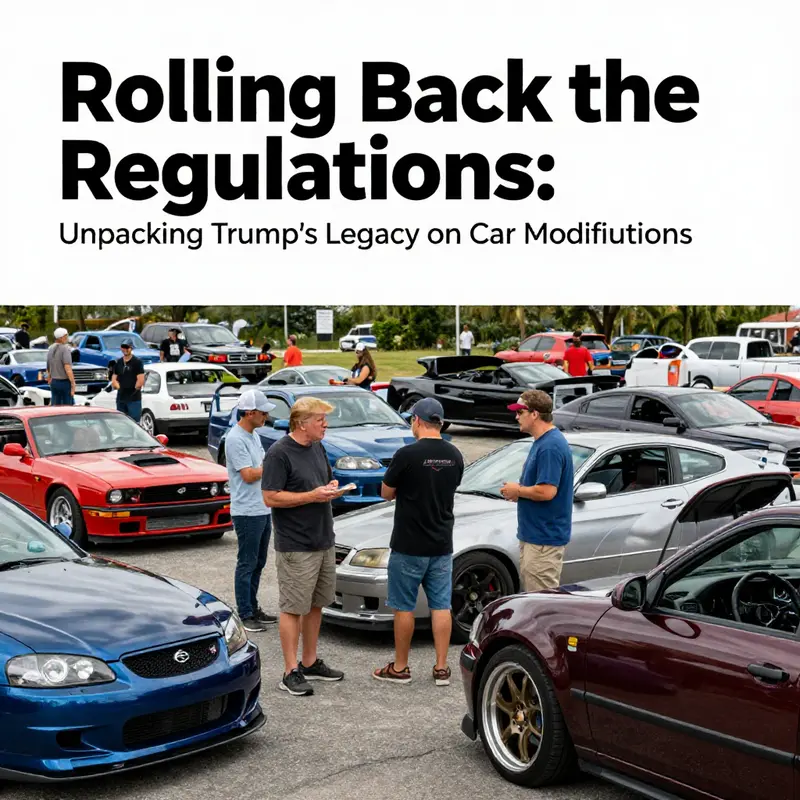
People often ask whether the changes in federal policy under the Trump administration made specific car modifications legal. The short answer is that the policy focus did not hinge on granting or denying permission for aftermarket parts or engine tweaks. Instead, it swept through the rules that govern emissions, compliance penalties, and incentives—areas where state and federal authorities act to shape what cars can and cannot do in practice. Across debates about energy independence and consumer affordability, the administration emphasized reducing regulatory costs and, in the eyes of supporters, restoring a sense of equal treatment for gasoline powered vehicles. The policy moves were framed as rolling back what were described as burdensome standards, not as signaling a green light for a catalog of mechanical alterations. For many readers this distinction matters because modifications tend to be regulated at the level of safety and emissions, not as discretionary tweaks that agencies grant in a policy niche. In other words, a roll back of standards changes the baseline conditions under which modifications are considered safe rather than a blanket invitation to alter hardware at will.
Key actions included repealing the stricter fuel economy targets introduced during the Biden administration, eliminating penalties for automakers that failed to meet earlier targets, removing the federal tax credit for EV purchases, and undermining California s rules that sought higher sales of zero emission vehicles. Taken together, these changes reshaped the financial and regulatory landscape for vehicle buyers and manufacturers. Yet they did not replace a legal framework that governs modifications like exhaust changes, engine calibrations, or other hardware alterations. Those matters remain subject to safety, emissions, and registration laws that continue to be enforced at both federal and state levels. The practical upshot is that the market environment becomes more sensitive to consumer choices and to the willingness of buyers to stretch investment in new technology. A car with an older engine or less efficient drivetrain does not gain a statutory exemption for modifications; it simply operates in a world where the price signals and compliance expectations have shifted. This is why discussions about legality can seem at cross purposes with conversations about what car enthusiasts want to do in their own garages.
Public reaction to these policy shifts has been layered. Some drivers and industry participants welcomed the move as a way to cut costs and expand choice, particularly in regions where vehicle affordability is a barrier. Others worried about environmental impacts, the reliability of older or cheaper vehicles, and the potential for a patchwork of rules as states differ in enforcement. In neighborhoods with limited charging infrastructure, the argument that EV incentives should be trimmed was cast as an inflationary risk to households already juggling budgets. In places that rely heavily on driving, the rollback was interpreted as a defense of personal freedom and a check on what some viewed as governmental overreach into daily mobility. The effect on the aftermarket is nuanced: some dealers and independent shops anticipated steadier demand for traditional gasoline powered platforms, while others worried that a slower push toward electrification would dampen investments in new equipment and training. Across communities, opinions coalesced around a core theme: regulation should protect the public while allowing room for personal judgment, but the specific mix of incentives and penalties changes how people value parts, service, and the act of modifying a car itself.
Beyond economics, society often reads vehicle policy as a proxy for who gets to participate in the benefits of modern technology. The rollout of autonomous driving features and advanced safety systems has intensified debates about safety, privacy, and equity. Some committees and researchers argue that regulatory clarity is essential to unlocking trust in new technologies, while others warn that rapid experimentation without robust safeguards can expose the public to new risks. The political frame matters: when policymakers speak of leveling the playing field for traditional cars, supporters hear reassurance about autonomy and reliability; critics hear a pushback against environmental stewardship and long term systemic change. The tension underscores how policy choices become cultural signals that extend far beyond the lab or the showroom. It also shapes expectations about maintenance and ownership. If a car has more electronics for driver assistance, owners may anticipate more comprehensive service networks and more complex maintenance, regardless of whether this is paired with incentives or penalties at the federal level.
Within the industry, a similar transformation unfolds. The public narrative around cars is shifting from performance and ownership to sustainability and shared mobility. The result is a subtle redefinition of car culture one where customization exists, but in a context shaped by safety rules, energy policy, and urban design. Car enthusiasts continue to pursue personal expression, but the terrain of what counts as acceptable modification is now braided with environmental compliance and consumer incentives. The aftermarket garages and tuning communities adapt by focusing on modifications that improve efficiency, safety, or reliability within legal bounds, while still offering room for creativity. Manufacturers respond by aligning product lines with shifting demand for cleaner powertrains and smarter technologies, even as some customers seek to maintain a sense of individuality through exterior styling or tailored performance in ways that stay within the law. The social value of car ownership remains, yet the frame through which people view that ownership—costs, responsibilities, and future flexibility—has been altered by policy choices that emphasize sustainability and resilience.
Because the heart of the question concerns legality rather than aesthetics, readers may seek a clearer map of what counts as legal for modifications in the United States. See legal car modifications in the US for a discussion of how federal and state rules interact with popular customization practices. This helps frame the conversation not as a catalog of permissions but as a practical understanding of how the law constrains and enables different kinds of car work. The mapping is not static; it shifts as court rulings, state legislation, and federal guidance evolve. Still, the current climate makes clear that modifications must respect emissions requirements, safety inspections, and registration processes, even when the broader policy frame aims to reduce or reallocate incentives for propulsion choices.
Ultimately, the Trump era policy shifts are best understood as changes in incentives and rules that influence the context in which modifications happen rather than as a simple declaration about which upgrades are allowed. They affected the price of ownership the appeal of different propulsion choices and the risk calculus around maintenance and reliability. They also highlighted the broader societal debate about the pace of technological change the responsibility of industry to innovate safely and the degree to which regulation should chase environmental goals while preserving consumer freedom. As the culture around cars continues to evolve with debates over emissions autonomous systems and urban mobility the conversation about what modifications look like and what they signify will keep reappearing in public discourse in courtroom arguments and in the garages where enthusiasts turn concept into metal. The underlying message is not a free pass for any modification but a reminder that regulatory context shapes what is feasible and who bears the costs when things go wrong.
External perspective: For a broader scholarly framing of automobility and governance that situates these debates in longer histories of technology and policy see Automobility on ScienceDirect: https://www.sciencedirect.com/topics/engineering/automobility
The Geopolitics of the Car Rulebook: How Trump’s Rollbacks Reshaped Federal-State Power on the Road
Policy shifts around car rules rarely stay confined to the garage or the ballot box. When a national leader frames vehicle efficiency standards as a matter of price, choice, and national pride, the effects ripple through state governments, industry captains, foreign investors, and the global climate conversation. This chapter situates the 2026 regulatory moment not as a narrow set of executive decisions, but as a pivotal episode in a broader geopolitical calculus. It is a story about federalism, industrial strategy, and the contested future of energy technology, converging on the rules that govern how a car meets the road in a country divided along political lines.
At the core lies a long-standing tension over regulatory authority. California possesses a unique prerogative under the Clean Air Act to seek stricter emission standards than the federal baseline. That authority has been exercised for decades, and it has been quietly transformative. Eleven other states have adopted California’s standards, creating a sizable bloc in the American auto market that pushes automakers toward lower emissions and electrification. This arrangement—federal baseline with a California-driven upward push—has functioned as a de facto national standard-setting mechanism. It has been defended by supporters as a pragmatic compromise that accelerates climate goals while preserving flexibility for states with persuasive mandates.
The Trump administration, in contrast, treats the California exemption as leverage to recalibrate the national policy terrain. The movement to curtail or revoke California’s exemption is not simply about dialing back environmental targets; it is a symbolic assertion of federal prerogative over state experimentation. When the federal government signals that it may roll back or override the waiver framework, a cascade of legal, economic, and strategic consequences follows. The legal battleground becomes a proxy over who writes the national rulebook: centralized federal authority prioritizing uniformity, or a constellation of state standards reflecting regional concerns and political values. The tension has practical effects: automakers navigate a more complex compliance map, engineers project product plans against a shifting horizon, and investors weigh policy volatility against the prospect of a familiar, cheaper baseline.
This interstate contest has domestic dimensions, but it also has expansive global reverberations. The automotive sector is a frontline in decarbonizing transport. A federal rollback paired with the elimination of a federal EV tax credit sends a signal to international manufacturers and financiers that the U.S. policy environment tolerates slower adoption of zero-emission technology and a reduced incentive structure for electrification. In a period of global supply chains and technological leadership tied to geopolitical stature, such a shift influences how foreign partners evaluate profitability and reliability of investing in U.S. plants, batteries, and research ecosystems. It can deter capital inflows as China and the EU race to become hubs for clean-energy automotive tech. That divergence matters; it shapes today’s prices and tomorrow’s labor markets, research pipelines, and climate diplomacy commitments.
The economic consequences of policy instability are not abstract. When policy signals shift abruptly, automakers reallocate capital, adjust plants, and reframe supplier contracts. The result is a chilling effect on long-term investments in U.S. facilities that aim to deliver cleaner cars at lower costs. The numbers cited by observers are stark: tens of billions of dollars in potential investment may be at risk when a single policy decision unsettles expectations about electrification and the relative price of compliance. It is not merely about what modifications a consumer can legally adopt; it is about where a nation positions itself in a global market that prizes regulatory clarity and forward-looking support for advanced manufacturing. The drama thus tests a nation’s industrial strategy and credibility as a long-term partner in climate technology.
Legal contests in this space illustrate a broader debate about the balance of powers in governance. If California’s exemption is revoked, the United States could drift toward a patchwork of state standards that diverge on timelines and compliance. That fragmentation would complicate interstate commerce and create administrative uncertainty for manufacturers with multi-state footprints. The Congressional Review Act adds more procedural theatre to the policy struggle. The outcome will signal whether the U.S. wants a uniform national approach or a federated, state-centered path that resembles a policy laboratory but tests the durability of a unified market across a diverse political landscape.
As this governance drama unfolds, the international community watches the United States’ commitments on climate and technology leadership. The posture chosen today will influence COP-style diplomacy, environmental regimes, and the U.S. role as a partner for green technology investment. The global auto industry has become more electrified by battery breakthroughs, emissions targets, and demand for cleaner transportation. When the United States shifts toward a more permissive approach to emissions and a lighter incentive structure for electrification, it recalibrates multinational automakers and suppliers. Firms must decide where to build, what technologies to prioritize, and how to hedge against policy shifts.
This is not a narrative about a single policy tweak. It is about the ideas policy codifies and the visions it reinforces. The Trump move to roll back certain emissions standards, remove penalties for non-compliance, and reduce the federal EV tax credit is framed by supporters as a means to lower car prices and restore national consumer choice. Critics warn of climate risk, weakening the U.S. industrial base in the clean-energy sector, and undermining American leadership. The debate centers on who writes the rules about how a modern car should perform, and under what economic and environmental conditions it should be produced and sold. The ultimate question is power: who has the authority to set the standards that shape a nation’s car culture, manufacturing ecosystems, and its role in a rapidly decarbonizing world.
For readers seeking broader context on car modifications and legality, there is a concise explainer that meshes with this chapter’s concerns: Are car modifications illegal? It distinguishes consumer curiosity about aftermarket parts from the regulatory framework governing emissions, safety, and consumer protection. It reminds that the central thread tying federal actions, state resistance, and global competition is the architecture of the rulebook that governs how cars are engineered, priced, and deployed on a shifting global stage.
In sum, the geopolitical context surrounding car regulation moves reveals more than a clash over a federal rollback. It exposes a contest about national strategy in energy, industry, and climate leadership. It asks which power—federal, state, or a combination—will shape the road ahead. It questions how a single policy choice can reverberate across supply chains, investment decisions, and international credibility. And it underscores that the road to electrification and consumer choice is a circuitous journey through legal doctrines, economic incentives, and geopolitical calculations. The outcome—whether the United States remains a unified market or becomes a mosaic of standards—will have consequences for decades to come.
External source: Reuters: US automakers face 55 billion e-car investment losses https://www.reuters.com/business/environment/us-automakers-face-55-billion-e-car-investment-losses-2026-02-19/
Final thoughts
The legacy of Trump’s policies on car modifications reveals a complex nexus of automotive regulations that have endured lasting effects on hobbyists and the industry. As we dissect the influence of deregulation on fuel standards, emission control, and consumer incentives for modifications, we gain a fuller understanding of the automotive landscape we’ve navigated since. From the excitement of personalizing vehicles to the implications of economic shifts, Trump’s era opened doors while also raising questions about sustainability and industry direction. The ongoing dialogue among enthusiasts, professionals, and policymakers remains pivotal as we chart the future amidst evolving regulations.