

Car modifications have evolved beyond mere aesthetics into an expression of individuality and performance enhancement. However, as exciting as it is to personalize your ride, enthusiasts must navigate the complexities of Indian regulations surrounding these changes. Understanding what modifications are deemed legal is crucial for hobbyists, professional tuners, and restoration enthusiasts alike. This comprehensive guide will delve into the legal landscape of car modifications in India across four critical areas: what modifications you can legally make, an overview of prohibited modifications, the regulatory role of the Automotive Research Association of India (ARAI), and the imperative safety and environmental considerations that must be adhered to. Armed with this knowledge, you can confidently explore the world of car customization while ensuring compliance with legal standards.
Under the Hood, Within the Law: A Practical Guide to Legal Car Modifications in India

Modifying a car in India is as much a question of streetcraft as it is of law. The curiosity to personalize a vehicle sits alongside a framework designed to safeguard road users, curb emissions, and maintain a standard that makes every road space safer and more predictable. This chapter threads together the regulatory tapestry that governs what a car owner may alter, what must stay pristine, and how to navigate the path from a proposal in a workshop to a properly registered vehicle on the highway. Rather than presenting a rigid list of dos and don’ts, the aim is to illuminate how the governing logic works so that readers can assess their ideas against safety, environmental, and regulatory benchmarks. The lens is India’s evolving yet consistent emphasis on compatibility with the Automotive Research Association of India (ARAI) standards and the Central Motor Vehicle Rules (CMVR), 1989, as amended. The core message is simple: modifications are permissible when they enhance function or utility without compromising safety or emissions, and when they pass the tests and certifications that authorities require for road use and registration.
At the heart of this system lies a dual mandate: safeguard and standardization. The Motor Vehicles Act of 1988, together with CMVR provisions implemented and periodically updated by the Ministry of Road Transport and Highways, places a duty on vehicle owners to ensure that any change does not erode the reliability of the vehicle’s safety systems, its roadworthiness, or its environmental footprint. This is not a prohibition on creativity; it is a framework that channels that creativity into forms that the road system can accommodate without compromising others’ safety. The practical upshot is that modifications must be aligned with safety norms, technical feasibility, and the emissions regime. In addition, most meaningful alterations require some form of approval, certification, or testing, often anchored in an ARAI certificate or a certification from the workshop that performed the work, and always backed by an RTO registration path.
The regulatory architecture is designed to strike a balance. There is room to alter or upgrade certain aspects of a vehicle — for instance, tyre choices or interior comforts — as long as these changes do not undermine core safety features or push the vehicle beyond what the law defines as safe for the operating environment. The dialogue between what is technically possible and what is legally permissible is ongoing, and MoRTH periodically updates guidance as technology and road conditions evolve. This ongoing evolution is important for anyone contemplating modifications, because a change that might have been permissible a few years ago could require new certifications today. The MoRTH site and CMVR amendments are the official maps through which this landscape is navigated, and they are the most reliable reference points for current rules.
One of the most practical entry points for a thoughtful car owner is to consider modifications through two broad lenses: safety and emissions. If a change does not impinge on safety systems or violate emission norms, it is more likely to be considered admissible, subject to the correct approvals and fitment standards. This approach turns modification into a careful, consultative process rather than a gamble with license plates and penalties. Within this framework emerge several categories that are commonly discussed in workshops, motoring forums, and insurance conversations: exterior changes, interior upgrades, performance-oriented adjustments, lighting changes, and regulatory compliance steps. Each category carries its own set of expectations, and the distinctions are not arbitrary; they map onto real-world considerations like how a modification might affect a car’s center of gravity, visibility, or noise footprint, or how it might alter a vehicle’s exhaust composition or tailpipe emissions.
When we talk about what can be changed, some changes are widely accepted because they either improve safety or enhance the vehicle’s practicality, provided they align with the manufacturer’s specifications and the law’s safety and emission thresholds. Exterior body kits, for example, can be added if they do not alter the vehicle’s original dimensions in a way that would make it unstable or harder to control. A spoiler or a modestly styled body kit may be acceptable if properly installed and if it does not raise the vehicle’s height, widen the track, or interfere with visibility or sensors. The same logic applies to interior upgrades. Upgrading seats for comfort or replacing an audio system is common, but such changes must not obstruct the driver’s controls, compromise seat belt integrity, or in any way interfere with essential safety features. The line is drawn where a modification begins to impair safety or distract the driver or passengers, or where it jeopardizes evacuation routes in case of emergency.
Tyres and wheels frequently appear in conversations about legality because they are among the most visible and practical changes a owner might consider. The rule of thumb is that tyre and wheel changes are acceptable within the manufacturer’s specifications for size, load index, and speed rating. The critical caveat is that the overall width should not exceed legal limits in a way that would alter the vehicle’s dynamics or road compliance. If a wheel upgrade or staggered setup changes the vehicle’s stance significantly or affects braking performance or suspension geometry, it triggers a more careful review. The same is true for engine tuning, where minor adjustments such as ECU remapping can be permissible if they do not breach emission norms or exceed factory-rated power outputs. These are not blanket permissions to push a car toward higher performance without consequence; rather, they represent the possibility of optimization within boundaries that the law and regulatory bodies have defined.
Lighting upgrades occupy a more nuanced space. The law allows certain enhancements such as LED fog lamps or auxiliary lighting, but these must meet specified brightness and color standards and should not violate visibility or glare norms for other road users. The policing of lighting is pragmatic: it seeks to ensure that additional lights aid visibility without turning a vehicle into a moving beacon that distracts or blinds others. In the same breath, certain lighting configurations such as low-mounted neon underglow or flashing police-style lights are generally incompatible with road rules and may invite penalties. The underlying principle remains consistent: any lighting modification must serve safety and visibility objectives and stay within the color and intensity boundaries established by the CMVR and related guidelines.
The conversation also involves more sensitive alterations that rarely come with a green light. Modifications that directly affect the vehicle’s structure or safety infrastructure frequently require closer scrutiny or are outright restricted. Altering a vehicle’s chassis, frame, or fundamental dimensions without explicit approval, removing or modifying airbags, seat belts, or ABS, and tampering with essential safety equipment are typically prohibited because they create latent risks for occupants and other road users. The same logic applies to certain aesthetic choices that could obscure the license plate or impair visibility, such as oversized decals or misapplied tints that contravene the window transparency limits. The legal boundaries here are not about taste but about predictability and safety on the road.
Tinted windows are a common bone of contention in the modification dialogue. The rule is not a simplification but a safety and privacy calculus: windows must conform to legal limits for Visible Light Transmission. Front and side windows are generally expected to admit a certain minimum amount of light to ensure that drivers and pedestrians can be seen clearly, while rear windows may have more leniency. In practice this often translates to a 50 percent limit for front and side windows and a more permissive limit for rear windows, yet these numbers are subject to regional interpretation and any updates in CMVR. It is precisely these numbers that allow a meaningful balance between privacy and safety, and they also prevent a proliferation of designs that could hamper the ability of law enforcement and other drivers to gauge a vehicle’s occupants and intent.
Registration and approval are non negotiable steps in this process. Even seemingly small changes can require a formal sign-off from the Regional Transport Office, or RTO. The purpose of this step is not to bureaucratize creativity but to ensure that the modification preserves roadworthiness and does not complicate enforcement or insurance. For more substantial work, such as completely overhauling a vehicle’s body or replacing its engine, a fitness test at an authorized testing center may be required. The vehicle owner must present updated documentation, which often includes a certificate of conformity from the manufacturer or the workshop where the modification was performed. These steps create a verifiable trail that shows the vehicle remains compliant with safety and emission standards after the modification.
In practice, what this means is that there is a pathway for law-abiding modification projects to move forward. The subtlety lies in understanding what the modification does to the vehicle as a system. A change that seems cosmetic on the surface can ripple through braking balance, steering geometry, and suspension behavior, influencing how the car behaves at highway speeds or in emergency maneuvers. A thoughtful approach starts with a clear plan: consult a reputable workshop that operates within the law, insist on component specifications that align with OEM or ARAI-approved standards, and secure appropriate certifications and conformity documents before hitting the road. When the plan respects the safety and emission boundaries, the road ahead is far smoother, and the risk of becoming a regulator’s focal point is reduced.
This is where references to official guidance become crucial. The MoRTH website remains the most authoritative source for the latest regulations and CMVR updates. Because the law evolves with technology and environmental priorities, even well-intentioned projects can shift eligibility over time. The guidance emphasizes that modifications affecting emissions or safety require ARAI certification, and that the fitness and PUC tests at authorized centers are essential milestones in the lifecycle of a modified vehicle. The practical implication for readers is straightforward: stay informed, plan modifications with the end-to-end process in mind, and treat certification as a non-negotiable step rather than a toll gate to be avoided.
A practical reading of the current landscape also reveals how important it is to distinguish between descriptive and prescriptive guidance. The descriptive reality is that modifications exist on a spectrum; the prescriptive reality is that the law assigns boundaries. This means that what is technically possible is not always legally permissible if it crosses into safety or emissions territory. The beauty of this structure is that it empowers responsible owners to pursue personalization without surrendering safety or compliance. For those who want to explore ideas further, a concise overview exists in dedicated resources that discuss the legality of car modifications in India. A useful entry point presents a balanced view of permissible and forbidden practices and helps readers orient their plans around compliance rather than conflict with the law. See the discussion here for a concise, practical overview: car modification legal India.
The conversation about legality is not just about avoiding fines. It intersects with insurance and resale value as well. Insurance providers often assess modifications against policy terms, and changes that bypass regulatory gateways may impact coverage, even if the modification remains technically feasible. The risk is not merely a financial one; it can also affect whether a claim is honored after an accident. This is why the alignment of modifications with ARAI certification, proper documentation, and regulatory approval is essential not only for legality but for preserving the value and reliability of the vehicle over time. In addition, the MoRTH framework supports a transparent ecosystem in which modifications can be marketed and undertaken with confidence, provided they meet the safety, emissions, and documentation standards that the law requires. The objective is a road where the pleasures of customization do not come at the expense of safety, accountability, or public health.
For readers who want to keep a clear focus on the end goal, the practical takeaway is to adopt a disciplined, consultative approach. Start with a precise description of the intended modification, including how it affects vehicle dynamics, safety features, and environmental impact. Engage a certified workshop or an authorized dealer who can provide the necessary conformity documentation and, where applicable, a valid ARAI certificate. Ensure that any changes that influence emissions are compatible with the vehicle’s OBD system and the applicable CMVR emission standards. And most importantly, keep the RTO informed and obtain the necessary approvals before making the vehicle roadworthy again after modification. This fosters a culture of responsible customization that respects the law and keeps roads safer for everyone.
The broader social and practical significance of these rules goes beyond individual projects. India’s road network carries a wide spectrum of vehicle types, drivers, and use cases, from daily commutes in congested urban cores to long-haul highway travel and commercial operations. In this context, the legal framework acts as a harmonizing force, ensuring that modifications do not create disparities in performance or behavior on the road. It also helps standardize standards across manufacturers and aftermarket producers, thereby reducing disputes that arise from incompatible parts or improper installations. The goal is not to stifle creativity but to ensure that it is pursued within a predictable, enforceable, and safety-conscious framework. For many readers, this perspective may transform a casual dream of a personalized ride into a well-planned project that respects the law, protects the occupant, and sustains the long-term value of the automobile.
As you navigate the landscape of possible modifications, remember that the law is not a fixed barrier but a living framework. It can adapt as new technologies emerge and as road safety science evolves. Staying informed and aligning your plans with the latest CMVR amendments and MoRTH guidance helps prevent missteps that could derail a project or lead to penalties. This is especially important for changes with broad implications — engine tuning, structural alterations, lighting systems, and safety feature modifications — areas where regulatory scrutiny tends to be most stringent. The practical upshot is clear: if a modification holds the potential to affect safety or emissions, treat it as a candidate for certification and approval rather than a quick fix. In doing so, you not only comply with the law but also contribute to a safer, more predictable driving environment for everyone on the road.
For readers who wish to extend their understanding beyond the general framework, the article that anchors this discussion offers additional context on legal and practical aspects of car modifications. It provides a focused lens on how modifications intersect with insurance, resale value, and ownership rights, all through the lens of Indian regulations. The resource also emphasizes the importance of documentation and the steps involved in declaring modifications to insurers and authorities. While the specifics of any given modification may vary, the principle remains robust: legality is a function of safety, emissions, and proper authorization, not just the desire to personalize a vehicle.
In closing, the question, are car modifications legal in India, does not admit a one-size-fits-all answer. It requires a thoughtful appraisal of how a proposed change interacts with a vehicle’s safety architecture, its emissions profile, and the regulatory processes that govern roadworthiness. The best path forward combines careful planning, expert guidance, and a commitment to compliance with the CMVR, ARIA standards, and MoRTH guidelines. By following this path, car owners can realize the benefits of personalization without compromising safety, legality, or the integrity of the broader driving ecosystem. For authoritative, up-to-date regulations and the most current interpretations, consult the official MoRTH portal and CMVR updates. These are the sources that translate the law into workable practice for every road user who seeks to customize a modern Indian automobile.
External reference for official guidance: MoRTH Official Site, which provides the fundamental regulations and updates for vehicle modifications and roadworthiness: https://morth.gov.in
From Personalization to Prosecution: Charting the Legal Landscape of Car Modifications in India
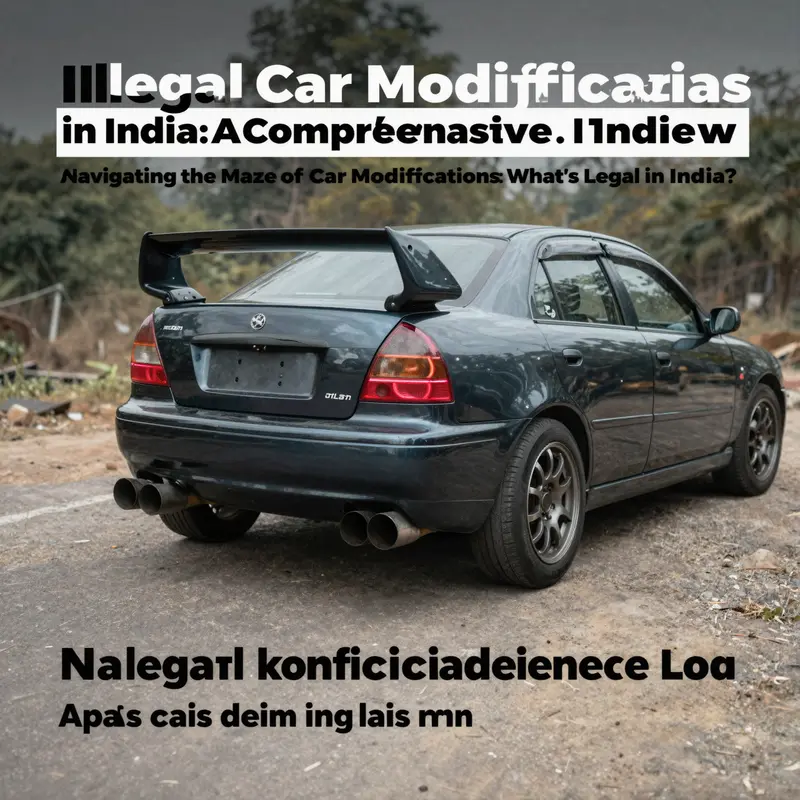
In India, the act of personalizing a vehicle through modifications sits at a delicate intersection of individual expression, safety imperatives, and a sprawling regulatory framework that evolves with technology, road conditions, and environmental concerns. The road to understanding what is permissible begins with the two pillars of regulation most often cited by owners and workshop professionals: the Motor Vehicles Act of 1988 and the Central Motor Vehicle Rules, 1989, as amended over the years. These instruments create a baseline for what counts as a legally compliant alteration and what can trigger scrutiny, penalties, or even the removal of a vehicle from service. The arc of legality is not simply a checklist of allowed bolt-ons or forbidden changes; it is a framework designed to preserve roadworthiness, reduce emissions, and ensure a consistent standard of vehicle design across a vast and varied geography. The responsibility rests not only on the manufacturer who built the vehicle but also on the owner who chooses to modify it and the service ecosystem that implements those changes.
At the core of legitimate modification is a clear-eyed emphasis on safety and emissions. Some alterations are broadly permissible when they stay inside the boundaries of factory specifications and do not compromise essential systems. For instance, changing tires within the permissible size limits, installing aftermarket audio systems that do not obstruct the driver’s view or create unsafe distractions, adding roof racks or luggage carriers that do not disturb the vehicle’s center of gravity or structural integrity, and even making minor aesthetic changes like certain body kit elements or paint schemes—so long as they do not affect emissions or safety—are often within the scope of legal modification. These allowances are not carte blanche; they come with documentation, standards, and an ongoing expectation that the modification will not derail the vehicle’s fundamental performance envelope or its environmental compliance.
The calculus becomes more intricate when one moves from cosmetic or convenience-oriented upgrades to alterations that touch on core performance, safety features, or the vehicle’s fundamental design. The legal boundary in India is drawn with similar precision to those used in many other jurisdictions: any change that departs from the factory’s approved design and safety standards requires scrutiny and, often, certification. This is where the Automotive Research Association of India (ARAI) and the CMVR play pivotal roles. The ARAI, a leading testing and certification body, evaluates modifications that affect emissions and safety to determine whether they meet national norms. The CMVR, together with amendments and clarifications issued by the Ministry of Road Transport and Highways (MoRTH), provides the regulatory grammar for what is permitted, what requires certification, and what remains outright prohibited. When a modification touches on emissions, safety, or vehicle dimensions in ways that could influence handling, stability, braking performance, or environmental impact, it is no longer a simple aftermarket choice but a matter for certification or even denial at the registration or fitness stage.
This regulatory architecture is designed with both uniformity and flexibility in mind. Uniformity ensures that vehicles on Indian roads meet baseline safety and environmental standards, reducing the risk of accidents or uncontrolled emissions spikes due to untested configurations. Flexibility, meanwhile, allows for legitimate personalization and technological advances to be incorporated through formal channels. For a modification to move from a hobbyist’s dream to a legally recognized upgrade, it must pass the test of the CMVR and, where appropriate, obtain documentation from ARAI or BIS certification bodies. The interplay between these bodies and the regulatory regime means that a modification is not simply a matter of what is visible or audible; it is also a matter of what is measurable in terms of emissions, crashworthiness, stability, and long-term reliability.
The practical tests of legality extend beyond what happens inside a workshop or a showroom. Vehicles must pass a fitness test, including a pollution certificate (PUC) and an overall fitness certificate, at authorized centers. These tests ensure that any changes do not push emissions beyond permissible limits and do not degrade the vehicle’s safety profile. If a modification alters the vehicle’s emissions trajectory or interferes with safety features, it is likely to require ARAI certification and, potentially, BIS certification for specific components. Without such certification, a modification can fail to meet the minimum standards for registration renewal or even comprehensive registration. In the eyes of enforcement authorities, a legally modified vehicle is one whose modification is traceable to a compliant process—one that preserves the integrity of the vehicle’s safety systems and its environmental footprint.
A central feature of the regulatory landscape is the emphasis on enforcement and accountability. The National Register of Vehicles (NRV) and the Digital Driving Licence (DDL) system introduced by MoRTH are designed to enable rapid cross-verification of a vehicle’s specifications against registered data. The practical effect is that authorities can detect non-conforming modifications at the point of inspection or during routine checks. This is an important development for road safety because it means that the risk of slipping through the cracks with an undocumented alteration is reduced. In several states, mobile apps have been deployed to empower citizens to report illegal modifications, reflecting a broader societal expectation that the road does not belong to a few enthusiasts but to a shared public space with obligations to maintain safety and order. Such enforcement mechanisms complement the more formal certification path and act as a deterrent against casual, unverified tinkering with critical vehicle systems.
Penalties for illegal or undocumented modifications are not merely symbolic. They range from substantial fines to the mandatory restoration of the vehicle to its original condition, and in some cases, they can include the cancellation of registration. The liability framework signals a crucial message: while customization is not banned outright, it must be undertaken within a verifiable, safety-oriented process. This is why discussions about legality often overlap with insurance considerations. Insurance providers examine how modifications affect risk, claim eligibility, and the moral hazard associated with undocumented changes. Even legitimate modifications can influence insurance premiums or coverage terms if they alter the vehicle’s safety profile or emission characteristics. In some instances, if a modification is not certified or if it interferes with primary safety systems, insurers may contest coverage or adjust premiums accordingly. The interplay between regulatory compliance and insurance economics is an essential dimension of the broader conversation about modifying cars in India.
The path to legal customization is not merely about avoiding penalties. It is also about recognizing that some enhancements can be pursued through official channels, albeit with some effort and cost. The Automotive Research Association of India (ARAI) and the Bureau of Indian Standards (BIS) provide certification pathways for approved modifications. When a modification undergoes rigorous safety and emission testing and passes those tests, it can be permitted legally. Yet this pathway is not always light and affordable; the certification process may involve substantial testing, documentation, and sometimes long lead times. This reality helps explain why a vibrant market for unofficial or unverified modifications persists in some quarters. The allure of a fast, affordable upgrade collides with the discipline of formal certification and the obligation to meet safety and environmental standards. The tension between desire and regulation is a defining feature of the modern automotive landscape in India, and it has meaningful implications for consumer education, industry practices, and law enforcement priorities.
For readers seeking practical navigation through this terrain, there is value in approaching modifications as a structured engagement with legality rather than a series of impulsive upgrades. A key takeaway is that the legitimacy of a modification rests on a chain of documentation and compliance, not merely on the appearance or performance it offers. Owners should consult the latest CMVR guidelines and MoRTH advisories, understand which alterations demand ARAI certification, and recognize that some changes—even those appearing minor—can trigger a formal review if they impact emissions or safety components. The regulatory environment is dynamic; MoRTH periodically updates requirements to reflect advancements in vehicle technology and evolving environmental targets. Therefore, staying informed is not a one-time effort but an ongoing commitment.
From a consumer perspective, it is prudent to examine how a potential modification aligns with long-term implications. Beyond the immediate question of legality, owners should consider how modifications affect resale value, serviceability, and the ability to obtain future registrations or renewals. The market often rewards modifications that can demonstrate traceable compliance and robust documentation, while penalizing those that appear to bypass regulatory checks. The broader point here is not to stifle creativity but to channel it through a framework that supports road safety, environmental responsibility, and predictable ownership experiences. The balance struck by Indian regulators seeks to protect vulnerable road users, ensure fair competition among vehicle owners, and maintain a level playing field where safety is not compromised in pursuit of individual preference.
For readers who want an entry point into the practical world of legal modifications, several resources distill the core principles without getting mired in the technical minutiae. One such resource presents a focused view of what modifications are generally permissible and what requires formal certification, illustrating the distinction with common examples. It is worth noting that such resources should be read alongside official guidelines from MoRTH and ARAI, as well as the latest CMVR amendments. For a practical overview of legality as it pertains to everyday options, this discussion is complemented by accessible summaries that emphasize the relationship between a modification, its safety implications, and its regulatory status. A concise way to anchor this understanding is to consider the modification in terms of three questions: Does it affect emissions? Does it affect safety systems or vehicle dimensions? Is there an approved certification pathway for this change? Answering these questions helps owners distinguish between legitimate personalization and changes that may entangle them in enforcement actions.
In the broader sense, the legal landscape around car modifications in India reflects a public policy stance that favors personal expression only when it can be harmonized with safety, environmental, and regulatory integrity. The state’s approach is not anti-innovation; rather, it seeks to ensure that innovation does not compromise the safety of everyday travelers or the health of urban air quality. This is why the regulatory framework includes explicit prohibitions—such as exhaust systems that exceed noise limits, unauthorized engine tuning that pushes beyond factory specifications, or alterations that modify the vehicle’s dimensions without approval—to preserve a shared standard for what counts as a roadworthy vehicle. It also explains why certain features, like safety equipment and visibility aids, are protected by law and why modifications that hide or disable these features are treated with particular severity.
As you reflect on your own vehicle, you may find it helpful to anchor your decisions in a practical narrative that ties together safety, legality, and ownership economics. The story of car modifications in India is not merely a catalog of do’s and don’ts but a guide to responsible customization. It invites owners to appreciate the engineering that lies in a well-designed, legally certified upgrade—the kind that can withstand the scrutiny of fitness tests, the rigors of daily use, and the expectations of insurers, manufacturers, and the regulatory authorities. It also invites a broader discussion about the role of consumer education in helping people navigate a complex ecosystem. After all, a well-informed owner can achieve meaningful personalization while maintaining compliance, safeguarding warranty considerations, and contributing to safer, cleaner roads for everyone.
The path forward is anchored in official guidance and ongoing dialogue between regulators, industry, and the driving public. For readers who want to explore this topic further, a detailed case with practical implications can be found in resources that discuss the nuances of legality in India and provide a clear articulation of what is permissible, what requires certification, and what should be avoided altogether. This discussion is not merely theoretical; it informs everyday decisions about upgrading a car, choosing a workshop, and planning for future ownership transitions. To explore these ideas through a practical lens, you can consult a resource that frames car modification within the Indian legal context and offers concrete expectations for compliance. car modification legal India. As you navigate the complexities, remember that the most durable and rewarding modifications are those that align with a traceable certification pathway and a transparent commitment to road safety.
In sum, the legality of car modifications in India is a carefully calibrated system that seeks to balance personal expression with public safety and environmental stewardship. It recognizes that drivers want to customize their vehicles, but it insists that such customization occurs within a framework that verifies safety, monitors emissions, and upholds the integrity of the vehicle’s fundamental design. If one keeps this balance in view, the path to satisfying both passion and regulation becomes clearer: pursue modifications through approved channels, stay informed about updates to CMVR and MoRTH guidelines, and approach each potential upgrade with an eye toward safety, compliance, and long-term ownership. The road is long and sometimes winding, but it is a road built to be traveled with care, foresight, and a respect for the shared spaces on which all road users depend.
External resource for authoritative guidance: https://www.morth.gov.in
Armed by Standards: How ARAI Shapes What You Can—and Can’t—Do When Modifying a Car in India

Modifying a car in India sits at the intersection of personal preference, technical possibility, and the larger duty to keep roads safe and emissions in check. The question “are car modifications legal in India?” does not have a single yes-or-no answer. It unfolds as a careful balance of what you want to change, how you change it, and whether the change remains faithful to the standards that govern every part and system that leaves a factory door. At the heart of this balance is a regulatory framework built not by a single agency issuing blanket permissions, but by a lattice of rules and certainties, with the Automotive Research Association of India (ARAI) as a foundational pillar. The role ARAI plays is indirect yet pivotal. It does not routinely police every aftermarket tweak you might dream up, but it certifies the safety, performance, and emission standards that make every vehicle and its components legally sellable, importable, and street-legal in the first place. Those standards shape what is possible, what is advisable, and what would violate the law if altered in certain ways.
To understand why modifications land on a spectrum rather than a binary permit system, one must start with the certified baseline. Every vehicle that enters Indian markets, and every component that accompanies it, is assessed against the Central Motor Vehicle Rules (CMVR), Automotive Industry Standards (AIS), and Indian Standards (IS). ARAI’s core function is certification: it signs off on components such as lighting, tires, braking systems, and even child safety seats, ensuring they meet the rigorous expectations that India’s roads demand. This certification is not just about the parts themselves but about the way those parts interact with the vehicle’s overall design, performance, and compliance with environmental norms. When a part or system carries ARAI certification, it has already navigated a landscape of safety and emission requirements that align with national policy.
In practice, this creates a regulatory reality for modifications that many car enthusiasts encounter. If a modification changes a vehicle’s original certified configuration—whether it’s altering the engine, exhaust, suspension, or bodywork—the change can jeopardize the vehicle’s type approval. In other words, the moment you veer away from what the factory has certified, the risk of non-compliance increases. ARAI’s influence is thus subtle but consequential: it underpins the legitimacy of the components you install and, by extension, the legitimacy of the vehicle’s overall certification. This is why aftermarket parts that have not been certified to the same ARAI standards may render a vehicle non-compliant, even if they seem to offer obvious advantages in performance or aesthetics.
ARAI also participates in broader quality control through factory audits and ongoing compliance checks. These activities ensure that manufacturers maintain consistent adherence to approved designs. If a vehicle that has been modified deviates too far from its original certification, it may fail a fitness test conducted by state transport authorities. The fitness test, which includes inspections of emissions, safety systems, and overall roadworthiness, can result in penalties, denial of registration renewal, or even prohibition from circulating on public roads until the vehicle is brought back into compliance. This is not merely an academic concern; it is the practical consequence of altering a certified configuration without recertification. For anyone contemplating a modification, the prudent approach is to view ARAI certification not as a distant benchmark but as a gatekeeper that defines the boundaries of what is legally permissible.
The regulatory environment surrounding modifications is not static. The Ministry of Road Transport and Highways (MoRTH) updates the CMVR guidelines periodically, and those updates ripple through the standards used by ARAI and AIS. This dynamic aspect means that a modification considered legal at one time might require reassessment later if CMVR guidelines tighten emissions norms, alter noise limits, or redefine safety requirements. The practical upshot is that informed car owners and modification shops must stay current with the latest CMVR amendments and MoRTH advisories to avoid inadvertently crossing into illegality. In this sense, the question of legality is not a one-off decision but an ongoing compliance discipline, particularly for owners who pursue multiple or recurring changes over the lifespan of a vehicle.
When we classify modifications, the boundary between permissible and prohibited changes rests on three pillars: safety, emissions, and alignment with the vehicle’s type approval. Legal modifications are typically those that preserve the vehicle’s safe operation and emission standards. Within this category, changes like upgrading tyres within size limits, installing aftermarket audio systems that do not affect driver visibility or cause excessive noise, adding roof racks or luggage carriers that do not alter the vehicle’s center of gravity or structural integrity, and minor aesthetic updates that do not impair emissions or safety are generally acceptable. Even these are not free-for-alls; they require careful implementation. For instance, a new set of tyres must stay within the permissible size range and have a tire and load index that the vehicle can safely handle. A roof rack must not compromise aerodynamics or stability, and an audio system must be installed in a way that does not distract the driver or violate noise regulations. The overarching principle is to maintain the vehicle’s existing safety margins while ensuring that any added components still conform to the standards that govern the original design.
On the other side of the ledger are illegal modifications, as defined by law and enforced through registration and policing mechanisms. The prohibition list is explicit and pragmatic: exhaust modifications that escalate noise beyond legal limits, unauthorized engine tuning or performance upgrades that surpass factory specifications, alterations to the vehicle’s dimensions without the necessary approvals, and removing or altering safety features such as airbags, seat belts, or ABS. Then there are the sensory and visual mods that can trigger legal scrutiny, including loud or flashing lights—neon underglow, police-style lighting, and other patterns that could mislead other road users or obstruct the visual clarity of a vehicle’s signaling. The sale or registration of modified vehicles for commercial use without ARAI certification is another clear line in the sand. These prohibitions are not arbitrary; they reflect a policy choice to minimize noise, emissions, and safety risks while preserving the integrity of the vehicle’s design and its function on public roads.
An essential, practical implication of this framework is the obligatory fitness and emissions verification. Vehicles must pass a fitness test, which includes pollution checks (commonly via an appropriate emissions certificate) and a general roadworthiness evaluation at authorized centers. If any modification affects emissions or safety, the vehicle may require additional testing or certification to revalidate its market eligibility. This is often the most tangible checkpoint for owners who have modified their cars. The test acts as a regulatory equalizer: even if a modification seems benign or beneficial to performance, it must still clear the same safety and environmental hurdles that governed the vehicle’s original design. For many, this creates a natural constraint on what can be done without triggering a cascade of compliance steps, including possible ARAI certification for the modified components themselves.
The interplay between the certification regime and the practicalities of modification is also connected to the way parts enter the market. ARAI’s certification is a critical precondition for legally manufacturing or importing components. If a part is not certified to meet CMVR AIS standards, using it on a vehicle could be construed as non-compliant. This is where the market for aftermarket parts intersects with regulatory policy. The pressure to offer better performance or aesthetics often collides with the necessity of maintaining a uniform safety baseline across vastly diverse vehicle types and user behaviors. Consequently, many commonly sought-after modifications remain legally uncertain or outright restricted unless the components carry the appropriate ARAI certification and the modifications themselves are conducted in a way that preserves or explicitly validates compliance.
From the owner’s perspective, coming to terms with this framework means adopting a conservative but informed approach to car customization. The first step is to map out what you want to change and assess whether the alteration could affect the vehicle’s certified configuration. If you propose an engine tweak or an exhaust swap, you must anticipate that these changes could impact not just power output but also emissions, noise, and even the vehicle’s type approval status. The prudent path is to consult with authorized service centers or engineering professionals who understand both the CMVR requirements and ARAI’s certification logic. They can help determine whether the modification will remain within legal boundaries or whether it would necessitate a recertification of the affected systems. Documentation becomes more than a formality; it becomes a practical tool to demonstrate compliance during registration renewals and traffic checks.
At the same time, many ordinary, rule-abiding modifications can be pursued with confidence if they are carefully implemented and documented. Upgrading tyres for better grip within the size envelope, installing an audio system with careful cabling and mounting that does not interfere with driver controls, or adding a roof rack with proper load distribution are small, doable steps that align with the safety-first ethos that governs Indian road policy. In this context, the role of the state and central authorities is not simply to police creativity; it is to preserve a universal safety baseline while allowing reasonable personalization within the bounds of that baseline. The tension between personalization and regulation is a constant in the Indian automotive landscape, and the framework established by CMVR, AIS, IS, and ARAI is designed to keep that tension productive rather than punitive.
What does this mean for someone considering a first modification, or someone who has already made changes and wonders about their legality? It means embracing a policy-informed mindset before committing to a modification plan. It means recognizing that the road-legal status of a car is not determined solely by what the owner intends, but by how the modification interacts with the vehicle’s certified design, how it affects emissions, and how it is validated through official testing and certification channels. It also means acknowledging that the MoRTH policy updates can shift the legal landscape, sometimes in ways that affect previously acceptable modifications. In such cases, what was once permissible may require re-certification or, in extreme instances, reversal of certain changes to regain compliance. This practical awareness helps avoid the risk of penalties that accompany non-compliant vehicles during traffic stops or registration renewals.
For readers who want a concise primer on the legality of modifications, there is value in consulting authoritative summaries and official guidance that translate complex regulatory language into everyday implications. A focused resource that considers the Indian context—how modification legality is interpreted, implemented, and enforced—can be a helpful companion as you plan any future tweaks. If you’re exploring this topic through a wider lens, you might find it useful to read about the broader discussion on car modification legality in India, which presents a more accessible entry point while staying grounded in the regulatory framework described above. car modification legality in India. This linked piece provides a practical orientation to the nuances of local regulations and is best read alongside the more formal regulatory references from ARAI and MoRTH.
The conversation around legality is also a reminder that the Indian regulatory ecosystem is designed with road safety and environmental stewardship in mind. The environmental dimension is not just about reducing emissions; it is also about ensuring that modifications do not inadvertently undermine fuel efficiency, pollutant controls, or long-term vehicle durability. ARAI’s certification process, by shaping what parts can enter the market in the first place, creates a shared standard that aligns consumer demand, manufacturer capability, and enforcement realities. In this sense, the relationship between modification potential and regulatory legitimacy is less about restriction and more about channeling innovation within a framework that protects public safety and environmental quality. The practical upshot for car owners, drivers, and enthusiasts is clear: pursue modifications with an awareness of these standards, and seek out certified parts and compliant installation practices to navigate the regulatory landscape smoothly.
In a country as diverse as India, where road conditions, traffic patterns, and urban design vary dramatically from city to city, the need for a coherent, enforceable standard is especially pronounced. ARAI’s certification regime helps create a common reference point that can be applied consistently across the vast and evolving network of vehicles on Indian roads. It supports manufacturers and aftermarket suppliers by clarifying what is required for certification and importation, while it also gives regulators a practical basis to assess compliance during inspections and in the context of registration renewals. For the individual motorist, this translates to a practical, rule-based approach to customization: you can tailor your vehicle to your needs, but you must do so within the boundaries defined by safety, emissions, and certified design.
As you plan any modification, a few guiding questions can keep you aligned with the regulatory framework. Will the change affect the vehicle’s safety systems or its center of gravity? Does the modification impact emissions or noise levels beyond permitted limits? Is the part certified to CMVR AIS standards, and does its installation maintain the integrity of the original type approval? Will I be able to produce documentation or a certificate if asked by traffic authorities or the registration office? These questions are not merely bureaucratic hurdles; they are practical tests that help ensure your vehicle remains roadworthy and legally compliant while still giving you room to express personal taste and performance preferences.
In closing, the story of car modifications in India is not about a simple yes or no. It is a nuanced narrative of standards, safety, and certification that governs what is possible on Indian roads. ARAI sits at the core of this narrative, shaping the baseline for all components and, by extension, influencing what modifications can be considered legitimate. While ARAI does not police every tweak directly, its certification framework makes unapproved changes non-compliant with national law, establishing it as the cornerstone of India’s vehicle safety and environmental regulation regime. For readers who want to engage with the topic beyond this chapter, the official references and MoRTH guidelines provide the formal backbone, while practical guidance and summaries—such as the linked article on car modification legality—offer accessible entry points for enthusiasts navigating the complexities of real-world customization. The result is a coherent system that respects individual innovation while preserving safety, fairness, and environmental responsibility on Indian roads.
External resource for further reading: https://www.araiindia.org
Safety First on Indian Roads: Navigating Law, Safety, and Environmental Impact in Car Modifications

Modifying a car in India is more than a matter of personal taste or performance curiosity. It sits at the intersection of public safety, environmental stewardship, and a dynamic regulatory framework that evolves with technology and urban realities. As the road network expands and cities grapple with congestion and pollution, the state has sharpened rules to ensure that customization does not undermine the very purpose of a vehicle: to move people and goods safely from one point to another. This chapter explores that landscape in a cohesive narrative that emphasizes why safety and environmental considerations shape what is permissible, how compliance is verified, and why responsible choices matter for the long arc of ownership, value, and public welfare. It is not a dry catalogue of prohibitions but a practical map for anyone who wants to personalize a car without compromising the roads we all share.
A foundational layer in this map is the regulatory architecture that governs vehicle modifications. In India, the primary guardrails come from the Central Motor Vehicle Rules (CMVR), first enacted in 1989 and amended over time, and the broader Motor Vehicles Act that gives statutory bite to road safety and enforcement. The Automotive Research Association of India (ARAI) plays a pivotal role in certifying components and ensuring that performance parts meet emission and safety standards before they can be marketed or installed by consumers and workshops. The active enforcement of these rules is carried out through the Ministry of Road Transport and Highways (MoRTH), which periodically updates guidelines to reflect new technologies, evolving emission norms, and shifting urban policies. The net effect is a carefully calibrated balance: owners gain room to tailor aesthetics, comfort, and efficiency; authorities retain the ability to curb modifications that could degrade safety or worsen air quality. A practical takeaway is that the legality of any modification hinges on two pillars: does it preserve safety features and structural integrity, and does it comply with emission norms and testing processes?
Within this framework, some modifications are generally permissible when they pass safety and emission checks. Tyre changes, for example, can be allowed if the new size remains within the manufacturer’s specified limits and does not alter the vehicle’s center of gravity in a destabilizing way. Aftermarket audio systems are another common area of customization, provided they do not obstruct driver visibility, distract the driver, or contribute to excessive noise pollution. Roof racks and luggage carriers can be acceptable when they do not compromise the vehicle’s dynamics, the structural integrity of the roof, or the vehicle’s aerodynamics to a degree that affects handling. Minor aesthetic changes, such as body kits or paint jobs, may be permitted so long as they do not impair safety features, emissions controls, or pedestrian safety in a hypothetical collision. The mix here is practical: the market can respond to consumer demand for personalization as long as the changes do not undermine the fundamental requirements that keep roads safer and air cleaner.
However, a long list of modifications is explicitly prohibited. Exhaust modifications that raise noise levels beyond legal limits are a glaring example. The law is explicit about keeping emissions and noise within thresholds that do not annoy neighbors or frighten pedestrians, and modifications that bypass or remove catalytic converters are particularly frowned upon for their environmental and health costs. Unauthorized engine tuning or performance upgrades that push the factory specifications beyond what the vehicle’s design anticipates also fall into the forbidden category, largely because they can stress engines, transmissions, and braking systems in unforeseen ways. Altering the vehicle’s dimensions—making it wider, taller, or longer—without proper approvals can destabilize the vehicle performance envelope and complicate traffic safety. Removing or altering safety features like airbags, seat belts, or ABS is another line that the regulatory framework draws hard; such changes render a vehicle far riskier in crashes and complicate future inspections. Lights that are too bright or flash in ways associated with emergency or police signaling, including neon underglow, are often restricted because they can confuse other road users or violate visibility standards. Finally, selling or registering modified vehicles for commercial use without ARAI certification undermines the regulatory backbone that ensures uniform safety and environmental baselines across the market. The throughline is clear: any modification that erodes the vehicle’s safety architecture or its compliance with emission norms tends to be off-limits, and penalties can include fines, denial of registration renewal, or more serious enforcement actions.
An equally important layer is the testing and certification regime that accompanies modifications. Vehicles subject to modifications must, in many cases, pass a fitness test and obtain a fitness certificate from authorized centers. Emission-related changes require that components and the overall vehicle continue to meet the Bharat Stage norms that India has adopted to curb pollution; in a world where emissions controls and fuel efficiency increasingly determine a car’s life-cycle costs, the stakes of noncompliance extend beyond a single driving season. The MoRTH guidelines, along with ARAI’s certification processes, provide a structured route for owners to seek approvals before committing to specific changes. This is not merely a bureaucratic ritual; it is a practical mechanism to ensure that modifications do not compromise reliability, braking performance, steering feel, or crash safety. For many enthusiasts, the path to compliance is straightforward: align with manufacturer intent, select parts certified for compatibility, and verify that the modification does not alter the vehicle’s fundamental safety and emission profile.
In day-to-day terms, the law also expects that any modification that affects emissions or safety undergoes certification and that periodic verification be maintained through regional transport office (RTO) inspections and certification processes. This creates a continuity of oversight from the moment a change is installed to the point at which the vehicle returns to the road after renewal of registration or at a scheduled fitness check. It is a reminder that ownership is not a one-off act of procurement but a long-term relationship with a vehicle that must remain within the bounds of safety and environmental responsibility as it ages.
Beyond the regulatory mechanism lies the environmental consideration that shapes which modifications are regarded as responsible. The current Indian and global emphasis on reducing air pollution has made eco-friendly choices not only prudent but increasingly expected by regulators, insurers, and buyers. In practical terms, this translates into a preference for parts and practices that minimize harm to air quality and the broader environment. When discussing exhaust systems, for instance, the focus shifts from raw performance to emissions compatibility. Low-emission exhaust systems certified under BS-VI norms, for instance, align with stringent national standards and help curb the release of pollutants such as NOx and particulate matter. The emphasis is not merely compliance for the sake of compliance; it is an attempt to harmonize vehicle customization with the country’s public health goals and urban air quality targets. The logic is straightforward: a modified car should still respect the air that everyone breathes, especially in densely populated cities where pollution levels are a daily concern.
Another practical environmental consideration is the selection of lighting and interior components. LED lighting, when properly installed, can reduce electrical load and improve energy efficiency compared with older halogen setups. Lightweight materials can contribute to modest gains in fuel economy and handling, and in some cases even offset the additional weight of certain aftermarket parts. More broadly, the environmental footprint of the modification process itself also matters. Using non-toxic, biodegradable cleaning products during installation and avoiding paints rich in volatile organic compounds helps minimize indoor air pollution and reduces the environmental impact of the modification activity. The shift toward sustainable interior upgrades—where feasible—reflects a broader commitment to reducing resource consumption and waste in a sector that traditionally favored rapid, sometimes fleeting, aesthetic shifts.
The process of modification, thus, becomes a climate-aware engineering exercise. It is not enough to claim that a part performs well or looks hot; the modification must be engineered with an eye toward safety margins, structural integrity, and long-term reliability. The suggestion is not to stifle creativity but to channel it through a disciplined approach that centers on certified professionals, authorized workshops, and a clear understanding of which components can be changed without upsetting the vehicle’s safety envelope. When modifications are executed by professionals recognized by the Automotive Component Manufacturers Association of India (ACMA) or other relevant bodies, compliance becomes less of a hurdle and more a baseline of trust between the owner, the workshop, and the regulator. In that sense, the social contract of car modification in India rests on three mutual commitments: safety for the road user, environmental stewardship for the broader public, and consumer confidence through transparency and certification.
For a car owner, this theoretical framework translates into a practical decision-making process. Begin with a clear plan of what you want to achieve—whether it is improved lighting, a more refined audio experience, better storage, or a more personalized aesthetic. Then consult the official MoRTH guidelines to confirm whether the intended change falls within permitted categories and whether it requires ARAI certification or additional documentation. It is wise to engage a certified professional who understands the regulatory expectations and who can advise on compatibility with the vehicle’s existing safety systems. This approach reduces the risk of installing parts that later fail inspections or require expensive retrofits to bring the vehicle back into compliance. It also helps preserve resale value by avoiding a configuration that could be viewed as nonconforming by future buyers or by insurers.
Speaking of insurance, the relationship between modification and insurance is another practical concern that sits at the edge of safety and practicality. Modifications can influence system performance, crash dynamics, and even strain on certain components, all of which insurers take into account when assessing risk and premium levels. While some alterations may be neutral or even beneficial to safety and efficiency, others can trigger changes in coverage terms or pricing. This is why a proactive, transparent approach—declaring modifications to insurers, obtaining required certifications, and maintaining documentation—can prevent disputes at claim time and help preserve the financial value of the car over time. The overarching principle is straightforward: your modifications should not obscure safety or environmental performance, and they should be documented in a way that stands up to regulatory and insurance scrutiny.
From a design perspective, the alignment of modifications with safety features is a recurring theme. The presence of airbags, ABS, seat belts, and other protective systems is not optional equipment; these features are integrated into the vehicle’s crash dynamics. Any modification that jeopardizes these systems, whether through disabling, removing, or bypassing them, is not just illegal in many cases but inherently dangerous. This is why after-market interventions in the realm of safety-critical systems require careful engineering oversight and explicit certification. The temptation to strip a vehicle of its protective hardware for the sake of weight loss or a cleaner look is powerful for some enthusiasts, but the risks—reduced crashworthiness, higher injury severity, and potential liability—are unacceptable by any standard of road safety.
Another layer to consider is the regulatory cadence that MoRTH and related bodies follow. The rules are periodically updated to reflect technology advances, such as newer emission control technologies or safer lighting standards. This evolving landscape means that a modification deemed permissible today may be subject to re-evaluation tomorrow. Owners should therefore stay informed about the latest CMVR amendments and MoRTH advisories, ensuring that their plans remain aligned with current expectations. In practice, this means keeping a finger on the regulatory pulse by consulting official channels and credible summaries that distill complex provisions into actionable guidance. It also means recognizing that the unique conditions of Indian roads—ranging from high-density urban corridors to winding rural lanes—often shape the safety calculus differently from other markets. The regulatory response, in turn, tries to reflect those realities without compromising the universal imperative of road safety and environmental protection.
Ultimately, the core message for anyone contemplating car modifications in India is not a binary verdict of prohibited versus permissible; it is a call to approach customization as an engineering and civic task. If you choose to modify, prioritize safety and environmental responsibility, seek certification when required, and engage with professionals who understand the regulatory landscape. Personalization, after all, can coexist with public welfare when guided by a robust set of standards, tested components, and documented compliance. By anchoring your project in the principles of safety, legality, and environmental prudence, you can enjoy the benefits of a tailored vehicle without introducing unnecessary risk to yourself, others on the road, or the broader community.
For readers seeking a concise roadmap to the legalities that weaves together these themes, a focused overview of the legal landscape and the practical steps to stay compliant is available in our guide on car modification legality in India, which links this broader debate to the everyday decisions that drivers face. car modification legal India.
As you plan any modification, remember that the MoRTH’s official guidelines and the CMVR framework provide the anchor for safe, lawful, and sustainable customization. This is not about constraining creativity but about ensuring that the excitement of personalization does not come at the cost of safety or the health of our cities. It is about recognizing that the road is a shared resource and that the decisions we take about our cars contribute to a safer, cleaner, and more equitable transportation environment for all. In this context, responsible modification practices become a form of civic engagement, merging personal expression with the collective obligation to protect lives, reduce emissions, and sustain a healthier urban future. The road ahead, then, is not simply paved with faster engines or louder exhaust notes; it is paved with informed choices, certified components, and a commitment to the safety and well-being of every user we share the street with.
External resource for authoritative guidance: Official MoRTH guidelines and current CMVR updates can be found at https://morth.gov.in.
Final thoughts
In the ever-evolving landscape of automotive culture in India, understanding the legalities surrounding car modifications is paramount for enthusiasts and professionals alike. Adhering to the regulations set forth by the ARAI and CMVR not only safeguards your investment but also promotes road safety and environmental responsibility. As you embark on your modification journey, keep these legal considerations in mind to ensure that your passion for customization does not cross into the realm of illegality. The thrill of personalizing your vehicle should go hand in hand with compliance, allowing you to enjoy your unique ride without the worry of penalties or safety hazards.