
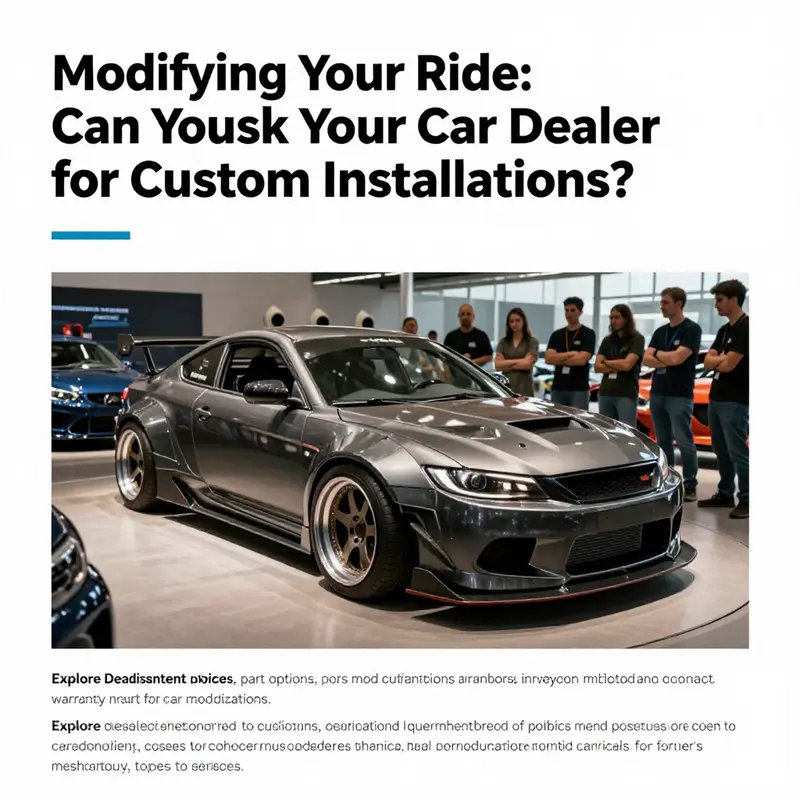
For hobbyist car modifiers, professional tuners, and classic car restoration enthusiasts, the allure of customization extends beyond aesthetics—it’s about personal expression and enhancement. However, when it comes to modifying your vehicle, a common question arises: Can you ask your car dealer to install modifications? This inquiry is not just about the act of asking; it’s layered with dealership policies, the distinction between factory parts and aftermarket options, and the pivotal issue of warranties. The following chapters will delve into each of these aspects, shedding light on the practicality of such requests and guiding you through the complexities of dealership modifications.
Between Factory-Authorized Upgrades and Aftermarket Ambitions: Negotiating Modifications with Your Car Dealer

When a customer starts itching for a little more performance, more function, or a distinct personality for their car, the first instinct often is to ask the dealer for help. The request can feel straightforward: install a product that fits the car, keep the warranty intact, and get back on the road with a little extra edge. But the reality sits at a more nuanced crossroads of policy, safety, and practicality. This chapter explores how to navigate that crossroads with clarity, so you can pursue the modifications you want without compromising the vehicle you rely on every day. The key is to understand not just what you want to add, but how the dealer views modifications in the context of the vehicle’s design, its warranty, and its long-term performance. It is possible to have the dealer assist with modifications, but the path is rarely a simple yes; it’s a choreography of policy, responsibility, and risk management that you must actively negotiate with your dealership, your manufacturer, and sometimes your own insurer.
First, it’s essential to differentiate between factory-approved modifications and aftermarket upgrades. Most dealerships are most comfortable promoting and installing factory-approved accessories and optional packages. These are designed to integrate with the vehicle’s systems in a way that preserves safety, reliability, and emissions compliance. The parts come from the same manufacturing ecosystem as the rest of the car, and the installation is performed by technicians who have been trained and certified to work within the constraints of that system. When a dealer talks about installing a factory option—whether it’s an upgraded audio system, a towing package, a roof rack, or a sportier wheel assembly—they are speaking a language that aligns with the original engineering intent. This alignment matters because it keeps the vehicle within the bounds of the warranty, and it ensures that the modification is tested for compatibility with the car’s electronics, chassis dynamics, and safety systems. Factory options are also typically supported by their own warranties, separate from the base car’s warranty, which can make the total ownership experience smoother.
In practice, the dealer’s capacity to execute these factory-approved modifications depends on the specific model, trim level, and the country or region’s regulations. Availability can vary by year and by the vehicle’s existing configuration. A dealer might offer a suite of factory-installed accessories during the purchase process or through certified pre-owned programs after sale. The installation work for these options is generally performed in-house or by authorized partners, and the process often includes a detailed warranty outline, a clear scope of work, and a projected timeline. In many cases, you’ll receive documentation that confirms the modification is compatible with the vehicle and that it will not void the warranty when installed as designed. In other words, the pathway to “yes” from the dealer begins with a shared understanding of what the modification is, how it integrates with the system, and how it preserves the protections that come with factory design.
When you shift from factory-approved modifications to aftermarket upgrades—think high-performance engine tuning, non-OEM body kits, or non-certified exhaust systems—the conversation becomes more complex. Aftermarket modifications are not always something an authorized dealer will handle, and if a dealer agrees to perform the work, they may distance themselves from any related warranty implications. The concern is not merely a matter of aesthetics or performance. It lies at the heart of how the vehicle safety, emissions compliance, and reliability are preserved under the manufacturer’s umbrella. An aftermarket part, being outside the manufacturer’s typical testing and validation processes, can potentially alter how the car behaves in critical situations. If something goes wrong and it’s linked—however tangentially—to the modification—the manufacturer may refuse to cover the damage under warranty. This is not a universal rule; some manufacturers place narrow allowances for certain modifications, while others take a stricter stance. What is consistent is that the risk profile changes, and the dealer’s willingness to participate under those conditions depends on corporate policy, risk assessment, and the specific vehicle’s architecture.
The warranty implications are not solely about the part’s fit. They extend to the maintenance approach and the burden of proof in the event of a claim. If you opt for an aftermarket component and a failure occurs, the dealer may reasonably contend that the failure was caused or aggravated by the modification, even if the original fault lies elsewhere. In such scenarios, the warranty coverage can be reduced, limited, or completely voided for the affected area. The result can be a frustrating split: the base vehicle remains under warranty for untouched systems, while the modified portion falls outside protective coverage. This division underscores a practical reality: modifications, especially those that alter performance or emissions, demand careful risk management and a clear, documented plan with your dealer and the manufacturer.
Another critical factor is safety and emissions compliance. The car you drive is a finely tuned system of safety features, powertrain control, chassis geometry, and regulatory compliance. When a modification is added, it can ripple through multiple subsystems. For example, changes to exhaust flow can affect emissions and engine management, while altering suspension geometry can influence handling, braking balance, and rollover risk. Dealers who proceed with aftermarket work are often cautious to ensure that the modification won’t trigger safety or emissions warnings or cause the car to fail regulatory inspections. If the modification is not certified or does not pass official testing, the dealership may decline to install it or may offer only limited options that keep the car within a safe and compliant envelope. The instinct here is not to be risk-averse for its own sake, but to protect your investment and keep your daily driver reliable and safe for you, your passengers, and others on the road.
Cost and availability are practical considerations that can determine whether a modification is feasible through a dealership. Factory-installed options typically come with a price tag that reflects genuine OEM parts, integrated warranty coverage, and the labor costs of skilled technicians who understand the vehicle’s architecture. These costs can be higher than independent shops that offer aftermarket parts, largely because OEM parts are priced to reflect their role within the warranty and the long-term support network. The installation timeline also tends to be longer in some cases, as dealership operations must coordinate with parts availability, service bay scheduling, and the need to validate that every modification preserves the integrity of the vehicle’s electrical and mechanical systems. In short, even when a dealer can accommodate a modification, it’s wise to ask for a transparent breakdown of part costs, labor charges, and any incremental warranty implications before you commit. This helps you compare the total ownership cost of pursuing factory-approved options through the dealer versus pursuing similar outcomes through independent specialists whose work you trust for quality and safety.
The negotiation with your dealer often starts long before any paperwork is signed. The first step is to review your warranty documentation with care. Warranty terms can be surprisingly specific about what kinds of changes are permissible and what kinds are not. Some owners assume that a simple accessory installation will be automatically covered, while others discover that certain scenarios are treated as exceptions. The best practice is to bring your questions to the dealer with a precise list of proposed modifications and a clear understanding of the vehicle’s current configuration. If you have concerns about whether a particular modification will affect warranty eligibility, ask the service manager to explain how the modification will be implemented within the standard operating procedures and how they will document the change so that it remains consistent with the warranty framework.
Communication with the dealer should be explicit about expectations and constraints. You want a frank discussion about whether a modification will be considered factory-approved, whether it will be installed by technicians trained to handle the vehicle’s architecture, and whether there will be a separate warranty on the modification itself. It’s important to clarify whether the modification will impact the vehicle’s service intervals, diagnostic capabilities, or the calibration of electronic control units. Some modifications may require recalibration of software, which can be a sensitive area for the dealership. If the modification involves software changes—such as engine management tuning—the dealer may insist on returning the car to its factory software baseline if future service is needed. This is not a trick; it’s a structural safeguard to prevent unintended interactions between the modification and the vehicle’s core control systems. If a dealer is receptive to modifications, insist on a written plan that details the scope of work, the parts used, the expected effects, the warranty implications, and a forecasted timeline that fits your schedule.
Incorporating a practical mindset, consider how you might approach the conversation. Start with a polite, informed inquiry: what factory-approved options are available for my model and trim? What is the process for installation, and how does it affect warranty and resale value? Then, pivot to a more specific request: I’m interested in [how-to-install-modifications-car] theming around the features I want. If you want a concrete path, you can search for guidance that outlines general steps and considerations, and then bring that framework into your meeting with the dealer. The aim is not to pressure the dealership into an outcome that benefits you alone but to foster a collaborative assessment of whether a given modification can be integrated safely, legally, and with a warranty that remains meaningful. The dealer’s role is to guide you toward options that preserve the vehicle’s integrity while meeting your objectives.
If your vehicle is equipped with limited aftermarket support or if the dealer’s policy leans toward conservative options, you still have viable alternatives. A robust strategy is to focus on factory-approved enhancements that preserve the car’s core warranties and safety features. These can include upgraded audio packages, towing packages, improved alphanumeric display clusters, or vehicle-tech integrations that the manufacturer endorses. Even within that scope, there are practical considerations: you should ask about the exact components involved, whether the installation is done in-house or by a certified partner, and whether there’s a specific serial number or VIN-level record that confirms the modification was completed under dealer supervision. You might also request a warranty extension that covers the modification, if available, or a plan that clearly delineates which parts of the vehicle are covered under the standard warranty after modification.
Sometimes, the simplest path is to work with an independent, reputable modification shop that specializes in the kind of upgrade you want. In these cases, the dealer may still be willing to recognize the modification as part of the vehicle’s service history, particularly if the modification uses components that are compatible with the vehicle’s OEM specifications or if the shop can provide a certification showing that the modification meets safety and regulatory standards. The upside of an independent shop is often tailored expertise, faster turnaround, and more extensive customization options. The downside can be a more complicated warranty narrative and potentially higher risk if the modification interacts poorly with the vehicle’s electronics. The best approach is to establish a relationship with a shop that understands how to align their work with the vehicle’s electronics, emissions controls, and safety expectations and to keep a detailed trail of all work performed. If you pursue this route, insist on comprehensive documentation that can be presented to the dealer or the manufacturer if questions arise later about compatibility or warranty.
Throughout your discussions, consider how this decision will affect safety, legality, and resale value. Modifications, particularly those intended to boost performance or alter aesthetics, can influence how your car is perceived by future buyers. A well-documented factory-approved upgrade tends to preserve resale value better because it signals that the modification was planned and implemented within the vehicle’s original design framework. In contrast, unverified aftermarket modifications can raise questions about long-term reliability or the integrity of safety systems. A prudent approach is to maintain full transparency: keep receipts, installation notes, and any calibration or software documentation, and be prepared to disclose modifications to insurers, if necessary. Many insurers require notification of modifications, and failure to disclose can lead to coverage complications in the event of a claim. You may decide to explore the relationship between modifications and insurance early in the process to avoid surprises later on.
A practical route to take is this: begin with a clear list of goals for your vehicle. Are you seeking better sound and comfort, a specific exterior look, enhanced towing performance, or sportier handling characteristics? From there, ask the dealer what factory-approved paths exist to achieve those goals. If a factory path does not satisfy your vision, discuss the feasibility, costs, and risks of aftermarket options with the service department and management. Be ready for a candid answer: the dealer may decline to install certain aftermarket parts, and that is a legitimate outcome. It does not mean you cannot modify the car; it means you may need to work with an aftermarket shop or consider alternative OEM-approved configurations that bring you closer to your goal without triggering warranty or safety concerns.
In closing, the decision to pursue modifications through a car dealer hinges on a balance of alignment with factory engineering, warranty protection, safety, and overall ownership experience. The path to a confident decision begins with understanding the dealer’s policy landscape, the distinction between factory-approved and aftermarket modifications, and the practical costs and timeline involved. It continues with clear, documented conversations that spell out exactly what will be installed, how it will be integrated, and what protections remain in place for the vehicle as a whole. It may lead you to a process that keeps the dealer involved in the most critical respects while still allowing specialized shops to tailor more ambitious projects. And it concludes with a commitment to safety, legality, and honesty about the impact of modifications on insurance, resale value, and everyday drivability. For owners who want a structured path to modification, this blend of collaboration with the dealership, respect for the vehicle’s architecture, and careful planning with third-party specialists provides a pragmatic, repeatable framework. If you want a concise guide that distills practical steps into a usable plan, consider the pathway outlined in the guide linked here: how-to-install-modifications-car. This resource is not a substitute for your dealer’s advice but a companion that helps you frame questions and expectations before you walk into the service lane.
For an external reference that underlines the broader safety and regulatory framework around vehicle modifications, consult the National Highway Traffic Safety Administration’s guidance on vehicle modifications. It provides high-level context about how modifications intersect with safety standards and regulatory expectations, helping you navigate conversations with confidence and clarity: https://www.nhtsa.gov/vehicle-manufacturers-and-dealers/vehicle-modifications
Factory Parts, Aftermarket Ambitions: Navigating Dealer Installations for Vehicle Modifications
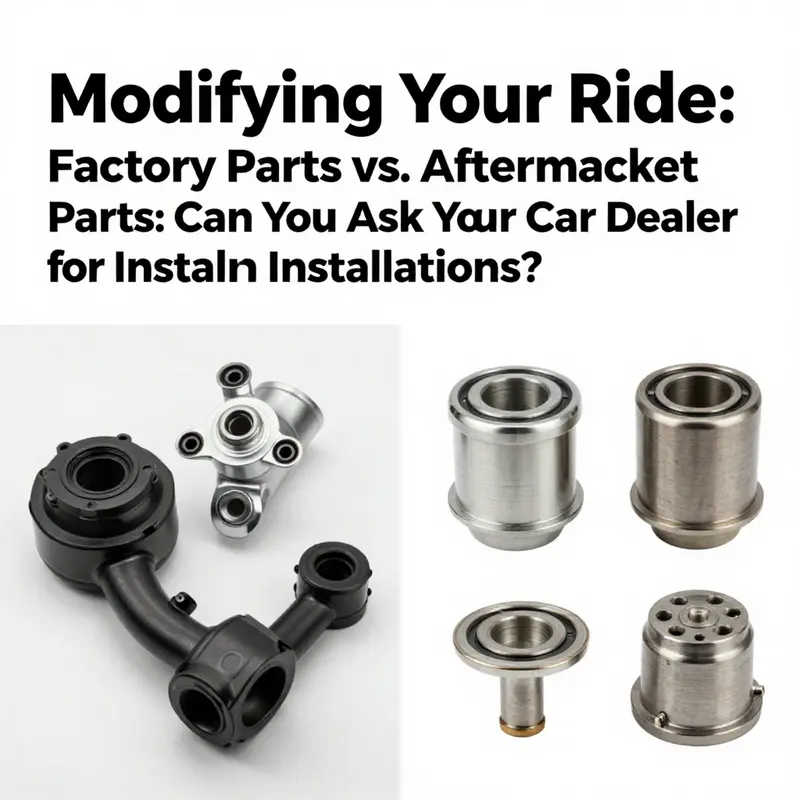
When you start weighing modifications for your vehicle, a central tension emerges: should you pursue factory-approved upgrades installed by your dealer, or should you look to aftermarket parts and independent shops that advertise deeper customization? The short answer is nuanced. Yes, you can ask your car dealer to install modifications, but the scope of what a dealer will install—and how safely and legally it can be done—depends on several interlocking factors. Understanding these factors begins with a clear distinction between factory parts, which are OEM or factory-approved components, and aftermarket parts, which come from third-party manufacturers and may vary widely in quality and compatibility. This distinction matters not only for fit and performance, but also for safety, warranty status, and the potential impact on resale value. The conversation with a dealer is often less about a simple yes or no and more about a tightly defined boundary around what is considered an authorized modification, how it will affect your car’s warranty, and whether the modification aligns with the vehicle’s design and safety standards.
Factory parts sit at the core of what a dealer can install with confidence. These components are engineered to match the exact specifications of your vehicle. They are designed to integrate with the car’s systems in a way that preserves the intended performance envelope and safety margins. When a dealer installs a factory-approved accessory—such as a roof rack that the automaker lists as an approved option, or a specific wheel design that has been certified for your model—there is typically documentation backing the modification. The warranty implications are clearer in these cases because the manufacturer has reviewed and approved the component for use with the vehicle. In many situations, installing factory parts through the dealership can actually reinforce your peace of mind: the parts come with the same engineering standards as the rest of the vehicle, and the dealer can often provide a service plan or diagnostic follow-up aligned with the original design goals. If you rely on the dealer for maintenance and service, this path can also streamline records and future service history, reducing the chance of misalignment between the vehicle’s systems and the modifications.
But the reality is more complicated when you consider aftermarket options. Aftermarket parts are manufactured by third parties and can range from remarkably high quality to questionable. Some aftermarket components are engineered to meet or exceed factory specifications, and some are not. The quality control, testing, and long-term reliability of aftermarket parts can be inconsistent because they fall outside the automaker’s own supply chain and safety certification processes. The financial appeal—often lower upfront costs and a broader palette of styles and performance goals—can be strong. However, the potential downsides deserve careful attention. If an aftermarket part is poorly matched to your vehicle, it can interfere with systems such as braking, steering, suspension, or emissions control. Even when a dealer schedules an installation of aftermarket parts, there is a crucial risk to consider: the extent to which the modification could affect warranty coverage or liability in the event of an accident. Dealers will often weigh the risk and may decline to install aftermarket components that could compromise the vehicle’s integrity or safety, or that could place the warranty at risk. This is not a universal rule, but a common practice across many dealerships, especially those with rigorous risk management and warranty protection policies.
Understanding policy is essential here. Not all dealerships offer modification services, and even when they do, the scope is generally bounded by what the automaker approves or sells directly through the dealer network. Some authorized dealerships maintain in-house customization teams or form partnerships with approved shops to handle limited, OEM-approved enhancements. Others focus on selling vehicles and performing standard maintenance, leaving any non-warranty-supporting modifications to independent specialists. The practical upshot is that a dealer’s willingness to install modifications often depends on two practical questions: is the part factory-approved for your exact model and year, and does the installation preserve the vehicle’s safety, emissions, and performance standards? If the answer is yes to both, a dealer is more likely to proceed. If the answer is no, the dealer may decline or offer a safer, alternative path that keeps the modifications within the bounds of the manufacturer’s warranty and safety expectations.
Cost and availability also shape the dealer’s stance. Factory-installed options that the dealer can source directly from the automaker tend to be more expensive than aftermarket options, largely because genuine OEM parts carry the automaker’s pricing and the labor is calibrated to preserve the warranty and performance specifications. Availability is another practical constraint. Even if a dealer is open to modifying a vehicle, the specific model, year, and configuration may limit what can be installed. Some vehicles simply do not have an OEM-approved accessory compatible with the existing hardware, or the accessory may be restricted to certain markets. In these cases, dealers may be unable to fulfill a modification request, or they may offer a different option that aligns with factory recommendations. When contemplating modifications, it’s prudent to obtain a clear, written estimate that itemizes part costs, labor rates, and any diagnostic or reprogramming fees that may apply. A transparent quote helps you compare dealer-led options with independent shops that can sometimes deliver more customization at a different price point, with their own warranty terms.
If the modification you want sits squarely within the realm of factory-approved accessories, the path is relatively straightforward. The dealer can confirm compatibility by checking the vehicle’s VIN, model year, and body configuration, and then order the exact part from the automaker’s catalog. The installation would typically be performed by certified technicians who understand how the new component interfaces with existing systems. The process may include a limited diagnostic to ensure that adding the component does not trigger fault codes, or it may require a software update to accommodate the new hardware. In such cases, the modification can be documented as part of the vehicle’s original service history, reinforcing a sense of continuity in the ownership record.
For readers who want to pursue modifications beyond what the dealer can responsibly install, the practical path often leads to specialized, reputable independent auto shops that focus on modifications. These shops may offer a broader array of performance or aesthetic enhancements, but their work carries different implications for warranty and resale. A shop that specializes in modifications can be disciplined about part selection, ensuring that aftermarket components meet specific standards for durability, safety, and compatibility with your car’s systems. A critical step here is to verify the shop’s reputation, warranties on parts and labor, and the credentials of the technicians who will perform the work. It is equally important to obtain detailed documentation showing what was installed, the part numbers, the manufacturer’s installation instructions, and any calibration or tuning performed to integrate the new parts with the existing vehicle software. This documentation can be essential when you sell the vehicle or when your insurance company reassesses your coverage as modifications accumulate over time.
One practical way to navigate this landscape is to approach the modification conversation with a clear objective and a well-prepared set of questions. Start by stating what you want to achieve—whether it is improved aerodynamic efficiency, enhanced audio capabilities, better cargo capacity, or a refined interior aesthetic. Then ask pointed questions: Is this part a factory-approved accessory or an OEM-equivalent that the automaker endorses for this model? Will the installation require reprogramming or calibration of the vehicle’s control modules? How will the modification affect warranty coverage, if at all? Will the modification impact emissions compliance or legal operating requirements in your jurisdiction? What is the expected impact on resale value, and does the dealer offer a warranty on the installed part or the installation service? Your questions should be direct and anchored to the dealership’s policies, but they should also demonstrate that you understand the potential ramifications of installing non-OEM parts.
If you’re looking for practical guidance on the nuts and bolts of installing modifications yourself, you can consult targeted resources that walk through the process and common pitfalls. For example, a detailed guide on how to install car modifications can provide procedural insight, part compatibility checks, and a framework for evaluating whether a given modification is appropriate for your vehicle. How to Install Car Modifications offers a structured starting point for assembling a modification plan that prioritizes safety, traceability, and compliance. By using such a guide, you can prepare a well-ordered set of questions for the dealer and a clear scope of work for an independent shop if the dealer cannot accommodate your request.
Another layer to consider is the broader regulatory and consumer-rights context. Vehicle modifications intersect with safety standards, emissions requirements, and consumer protections that vary by jurisdiction. Government safety agencies and regulatory bodies provide guidelines and advisories on how modifications can affect vehicle integrity and on what you should expect from manufacturers and dealers when modifications are contemplated. Your dealership’s response, your warranty terms, and your insurance policy all hinge on how well these considerations are managed. If a modification triggers a safety test or a compliance review, you may need to provide documentation, pass a screening, or obtain certifications demonstrating that the modified vehicle remains within approved safety thresholds. This is another reason why the dealership route, when available for factory-approved options, can be a smoother path for many owners, especially those who place a high premium on documentation and predictable warranty coverage.
The reality, however, is that many owners dream of broader customization that sits outside the narrow band of OEM-approved options. In such cases, a hybrid approach can sometimes work. You might start with a dealer-installed OEM option to gain the benefit of factory support and warranty continuity, and then pursue selective aftermarket refinements through a reputable independent shop. This approach can preserve some degree of warranty protection for existing systems while enabling you to realize your customization goals. The key is to be explicit about the scope of each modification, the parts’ provenance, and which components are covered under warranty and which are not. Documentation should be meticulous, including receipts, part numbers, installation dates, and detailed notes about any software changes. If you choose to go down this hybrid path, you should also ensure that your insurance provider is aware of the modifications and understands how they affect coverage, premiums, and risk assessment.
To close the loop, it helps to approach every modification decision with two guiding principles: prioritize safety and protect your investment. Safety comes first because the vehicle’s essential performance and safety systems—brakes, tires, steering, suspension, stability control, and emissions controls—rely on precise interactions among components. Any modification that tampers with these systems requires careful validation. Investment protection follows, because modifications can influence resale value. Buyers often view factory-installed upgrades as more credible than ad hoc aftermarket changes, particularly if the modifications are not well-documented or fail to meet safety standards. If you can secure a path that aligns with the automaker’s engineering intent, you increase the likelihood that a future owner will view the vehicle as a cohesive, well-maintained whole rather than a patchwork of fittings.
In the end, asking your dealer to install modifications is not simply a yes-or-no proposition. It is a careful negotiation around what counts as an acceptable modification within the framework of factory compatibility, warranty protection, and safety. The best outcome is a modification plan that preserves the vehicle’s integrity while meeting your goals, with transparent costs and documented terms. If the dealer cannot accommodate the request within those terms, the door remains open to skilled independent specialists who can tailor a solution that respects the vehicle’s design philosophy while delivering the performance or appearance you seek. Either way, your decision should be informed by the constraints that come with modern vehicle engineering, the goal of maintaining safety and reliability, and a clear-eyed assessment of how a modification will influence the vehicle’s value over time. For those who want to begin practical planning immediately, a good starting point is to explore a practical guide to installing modifications, which will help you organize your approach and prepare you for constructive conversations with your dealer or a qualified shop. How to Install Car Modifications offers a structured pathway to turn aspiration into a concrete, safe plan.
External resource: For a broader perspective on vehicle safety standards and consumer rights related to automotive modifications, you can consult the National Highway Traffic Safety Administration’s resources at the following external site: NHTSA Website.
Warranty Considerations When Asking Your Car Dealer to Install Modifications
When you start weighing modifications for your vehicle, the question of warranty often rises to the top of the list. The dealership that sold you the car can be a helpful partner in this process, but the reality is nuanced. You can, in many cases, ask your car dealer to install modifications, yet the outcome depends on the dealer’s policies, the parts involved, and how the modifications interact with the vehicle’s original design. The core issue is not simply whether a modification is possible, but how it affects the warranty that came with the car. This is not a single policy line, but a careful balance of manufacturer rules, dealership capability, and your own risk tolerance. A thoughtful conversation with your dealer can illuminate the path ahead, but it also requires you to enter that conversation with a clear understanding of the competing interests at stake: your personal preferences for performance, utility, or style, versus the manufacturer’s guarantees for reliability, safety, and emissions, and the dealership’s willingness to bridge the two without exposing you to avoidable risk.
At the heart of the matter is whether the modification is factory-approved. Dealerships vary widely in their modification offerings. Some authorized dealerships maintain in-house customization departments or have formal partnerships with approved aftermarket shops to fit only factory-approved accessories. In practice, this means they will install components that the automaker itself has sanctioned for that model and year. A genuine OEM roof rack, factory-fitted sport steering wheel, or other official accessories are within the usual scope of dealership-supported work. Other dealerships, focusing primarily on new-vehicle sales and standard maintenance, may not offer any modification services at all or may be strictly limited to the installation of factory options. If you walk into a dealer with a list of aftermarket ambitions—parts not engineered or endorsed by the manufacturer—the odds of a straightforward, in-house installation dim considerably. The dealer may still perform the work if they are comfortable with a manufacturer-approved plan, but they must ensure it aligns with safety, warranty, and compliance standards. This distinction is critical because a successful dealer installation does not automatically guarantee warranty protection for every component involved.
The distinction between factory-approved parts and aftermarket components is more than a semantic one. It defines the boundary of warranty coverage. Factory-approved parts come with the manufacturer’s blessing and, typically, with warranty coverage extending to the point of installation and, in some cases, to the part itself. Aftermarket parts, which are not officially manufactured or specified by the automaker, do not share that warranty shield. Even when a dealer agrees to install aftermarket parts, the warranty policy on the affected components is likely to be limited or voided. In many cases, the dealership will make it clear that while the original vehicle warranty remains intact for factory components, issues arising from non-OEM parts or from modifications may not be covered. In effect, the engine, the transmission, the drivetrain, or the emissions system—areas most tightly regulated for safety and environmental compliance—become risky zones where coverage can evaporate if the modification is deemed the cause of a fault, malfunction, or failure.
To protect yourself, you should seek written confirmation before any modification proceeds. A signed document from the dealer, and ideally from the vehicle manufacturer as well, stating how the modification will affect warranty coverage, is invaluable. The dealer can confirm whether the modification uses OEM parts or approved equivalents and whether the work will be performed by an authorized technician. The manufacturer may issue a warranty decision letter that clarifies coverage boundaries and any carve-outs for the modified components. Without that written clarity, you are left with a best-guess scenario that could lead to disputes later, especially if a problem arises elsewhere in the vehicle that you reasonably attribute to the modification. The written record then becomes your primary tool should a claim be questioned, delayed, or denied. This is not merely a bureaucratic step; it is a practical shield against misinterpretation when warranty service is needed years after the work was completed.
There is also the matter of add-on warranties. Some dealers offer their own warranties or service contracts for modifications, promising continued coverage for the modification itself or for related failures. In practice, these add-on warranties typically do not extend to the original factory components in the same way as the factory warranty. They may cover installation labor for the modification or defects in the aftermarket parts, but they rarely provide comprehensive coverage for the underlying factory systems. If you rely on an add-on warranty, read the fine print carefully. Confirm what is covered, what is excluded, how long the coverage lasts, and whether it can be transferred if you sell the car. The more explicit the terms, the more confident you can be that you are making an informed choice rather than trading a single decision for a string of later checks and doubts.
Documentation emerges as another pillar of sound decision-making. Keeping meticulous records of every modification—part numbers, installation dates, installer credentials, and service logs—helps you demonstrate that the work was performed professionally and with attention to safety. If a warranty claim ever arises, you can present a transparent trail showing that the modification had a legitimate basis, that OEM parts were used where required, and that the installation was completed by qualified personnel. This record-keeping becomes particularly important if questions surface about environmental compliance, safety systems, or emissions-related components. Good documentation can meaningfully influence the manufacturer’s interpretation of responsibility in the event that a fault appears after a modification.
Even with these precautions, the decision to have a dealer install modifications invites certain realities about cost and feasibility. Dealer-installed modifications, especially when they involve factory-approved components, tend to be more expensive than independent options. Labor rates at dealerships can be higher, and the price of genuine OEM parts often exceeds that of third-party alternatives. Availability can also constrain your choices; not all models and years have a wide menu of factory-approved accessories, and some items may require special ordering or extended lead times. If the modification is purely cosmetic or falls within a narrow, explicitly approved range, the dealer may be able to complete the work promptly. If it is a performance-oriented change—such as engine tuning, a new exhaust system, or a body kit—your chances for in-house dealer installation become more complex. In those cases, a specialized, reputable independent shop with a focus on modifications may be a better route, particularly if you value broader customization options or a more aggressive performance objective. The key is to align expectations: the dealer can be a facilitator and validator of OEM-compliant work, but non-OEM ambition often shifts the risk to your warranty and to broader regulatory compliance.
To further illustrate practical next steps, begin with a candid, written inquiry to your service or parts manager. Ask whether the dealer supports installation of modifications for your specific vehicle and whether those modifications will be performed with factory-approved parts. If the answer is yes, request a detailed quote that enumerates the exact parts, the installation procedure, the technician responsible, and the warranty implications for both the modified parts and the factory components. If the answer is no or unclear, ask for a clear description of what is permissible and what would void the warranty. Do not proceed until you have explicit, written confirmation from the dealership about warranty implications. It is not enough to rely on a verbal assurance; a document is your strongest safeguard.
At this point, it is helpful to consider the longer arc of your ownership and your goals for the vehicle. You may be drawn to a particular performance improvement, storage solution, or aesthetic change. Each modification carries its own risk profile, and the way it is integrated matters as much as the modification itself. A modification that is straightforward and factory-approved often fits cleanly within the warranty framework, while a more aggressive alteration can trigger a cascade of warranty and regulatory questions that may not be worth the potential benefit. If you determine that a dealer-installed modification is essential to your plan, prioritize options that preserve the vehicle’s integrity and safety. Ensure that any change does not compromise critical systems—steering, brakes, airbags, sensors, emissions controls, or drivetrain components. A modification that weakens a safety feature or increases emissions in a manner not sanctioned by the manufacturer can create both legal and insurance complexities, separate from warranty concerns.
One helpful path to keep in mind is the distinction between dealer-friendly, factory-aligned changes and broader customization. The former can preserve the vehicle’s reliability and resale value by ensuring compatibility and support from the manufacturer. The latter may offer broader freedom and potentially greater performance gains, but it comes with a heightened risk of safety issues, regulatory noncompliance, insurance adjustments, and warranty limitations. When the goal is to retain as much warranty protection as possible, steer toward modifications that the manufacturer officially endorses for your model. This approach minimizes ambiguity and keeps your vehicle within a warranty framework that the dealership and the manufacturer understand and can defend together. To explore a broader landscape of how car modifications are approached in practice, see the car modifications guide, which outlines common routes, considerations, and the kinds of parts typically associated with different goals: car modifications guide.
Even with all these steps, it is wise to consider the alternative route of working with a highly qualified independent shop. If your ambitions exceed what the dealer can support under warranty, a reputable shop specializing in modifications can offer a broader spectrum of OEM-aligned options and aftermarket choices. The shop can help you evaluate how a modification will affect the warranty, what parts will be used, and how the work will be documented. Importantly, a careful independent shop will often provide tailored guidance on maintaining safety and compliance, including how to preserve resale value and manage insurance implications. In many cases, you can structure the project so that the core factory warranty remains intact for the unmodified portions of the vehicle, while the modification is treated separately with its own warranty coverage structure, if available. The critical task remains the same: verify, document, and choose a path that aligns with your priorities without compromising fundamental protections.
If you proceed, maintain a keen eye on safety and legality. Modifications that affect the vehicle’s engine, exhaust, or emissions systems must comply with environmental regulations and safety standards in your jurisdiction. Even when the dealer is involved, the modification must pass any inspection or registration requirements and should not create a scenario where the vehicle becomes noncompliant with local laws. Your ownership experience should reflect a thoughtful balance between personalization and the enduring protections you expect from a modern automobile. The dealer can be a guide in this journey, but you drive the decision, and you carry the record of that decision through every future service, claim, and resale discussion. For the curious reader, a broader context on how modifications intersect with liability, insurance, and vehicle value is explored in resources that address the practical implications of modifying financed or leased cars, the resale impact of modifications, and how to navigate insurance considerations as ownership evolves.
Ultimately, you do not have to avoid modifications to your car entirely. You simply need to approach modifications with a clear plan, a written understanding of warranty boundaries, and a preference for options that preserve safety, reliability, and regulatory compliance. If a dealer can offer a factory-approved modification that satisfies your objectives, that path often provides the most straightforward route to a confident ownership experience. If your goals require more extensive customization, know that reputable independent shops can be a strong ally, provided you maintain robust documentation and a clear understanding of how warranty coverage may be affected. Throughout this process, your best tools are clarity, documentation, and a measured assessment of risk versus reward. These elements help ensure that you arrive at a modification plan that reflects your preferences while preserving the protections that justified your vehicle purchase in the first place. For those who want to deepen their understanding of these dynamics, the official guidance from the U.S. Department of Transportation on vehicle warranties and modifications offers a broader regulatory perspective that can help frame your decision within a recognized framework: Official guidance on vehicle warranties and modifications.
Final thoughts
Navigating the landscape of vehicle modifications can be daunting, particularly when factoring in the policies of dealerships, the distinction between factory and aftermarket parts, and the resultant warranty implications. It is essential for hobbyist car modifiers and professional tuners to approach their local dealers informed and prepared, armed with knowledge about what is feasible and what might jeopardize their vehicle’s warranty. Ultimately, whether you pursue customization through a dealership or choose an independent shop for your modifications, prioritizing safety and quality should always be the guiding principles.